
TL;DR:
- Many small businesses overlook the need for consistent management and optimization of their local listings to succeed in local search results. An accurate, complete, and regularly updated profile across essential platforms like Google, Yelp, and industry-specific sites significantly increases visibility and local customer engagement. Ongoing maintenance and strategic platform selection transform listings from mere checkboxes into powerful channels for local lead generation.
Most small business owners set up a Google profile or Yelp page, call it done, and then wonder why competitors keep showing up first in local search results. The hard truth is that simply existing on a listing platform is not a strategy. Using local listings effectively requires consistency, smart choices, and regular attention. This guide breaks down exactly what local business listings are, which elements make them powerful, how to pick the right platforms, and what ongoing habits turn a basic profile into a genuine lead-generation machine.
Table of Contents
- What are local business listings and why do they matter?
- Key components of effective local business listings
- Choosing the right listing platforms for your business
- Maintaining your listings for maximum impact
- How listings support your wider digital marketing strategy
- The overlooked truth about local business listings
- Level up your local presence with expert support
- Frequently asked questions
Key Takeaways
| Point | Details |
|---|---|
| Complete accurate listings | Provide consistent details on every platform for better visibility and trust. |
| Select the right platforms | Focus efforts on platforms your customers use to gain the most impact. |
| Maintain and respond | Regular updates and review management keep your listings working for you. |
| Integrate with marketing | Tie listings into your SEO and social campaigns for best results. |
What are local business listings and why do they matter?
A local business listing is an online profile that displays your business information across directories, search engines, and review platforms. Think of it as your digital storefront sign. When someone searches “coffee shop near me” or “emergency plumber in Austin,” those results pulling up names, addresses, phone numbers, and star ratings? Those are local business listings doing their job.
Platforms like Google Business Profile, Yelp, Bing Places, Apple Maps, and Facebook all host these profiles. Each one serves as a data point that search engines use to decide whether your business is relevant and trustworthy enough to recommend to searchers nearby. When your information is complete and correct, search engines feel confident showing your business to potential customers.
Here is what a well-built listing typically includes:
- Business name (exactly as it appears on your signage)
- Address and service area
- Phone number and website URL
- Operating hours, including holiday hours
- Business categories and subcategories
- Photos and videos
- Customer reviews and your responses
- A compelling business description with local keywords
A complete business listing increases your chances of being found online by customers actively looking for what you offer. This is not a small advantage. People searching locally are often ready to buy, book, or visit within hours.
“Being discoverable at the moment a local customer needs you is more valuable than a billboard on the busiest road in town. Listings put you in front of buyers when intent is at its highest.”
Your listing also feeds Google Maps, Apple Maps, and voice search results. When someone asks Siri or Google Assistant to find the nearest dentist, your listing data is what powers that answer. Accuracy and Google Business Profile tips for optimization are not optional extras; they are the foundation of local visibility.
Key components of effective local business listings
Understanding what a local business listing is sets the stage for knowing how to make yours effective and complete. The difference between a listing that drives calls and one that gets ignored usually comes down to a handful of critical details.
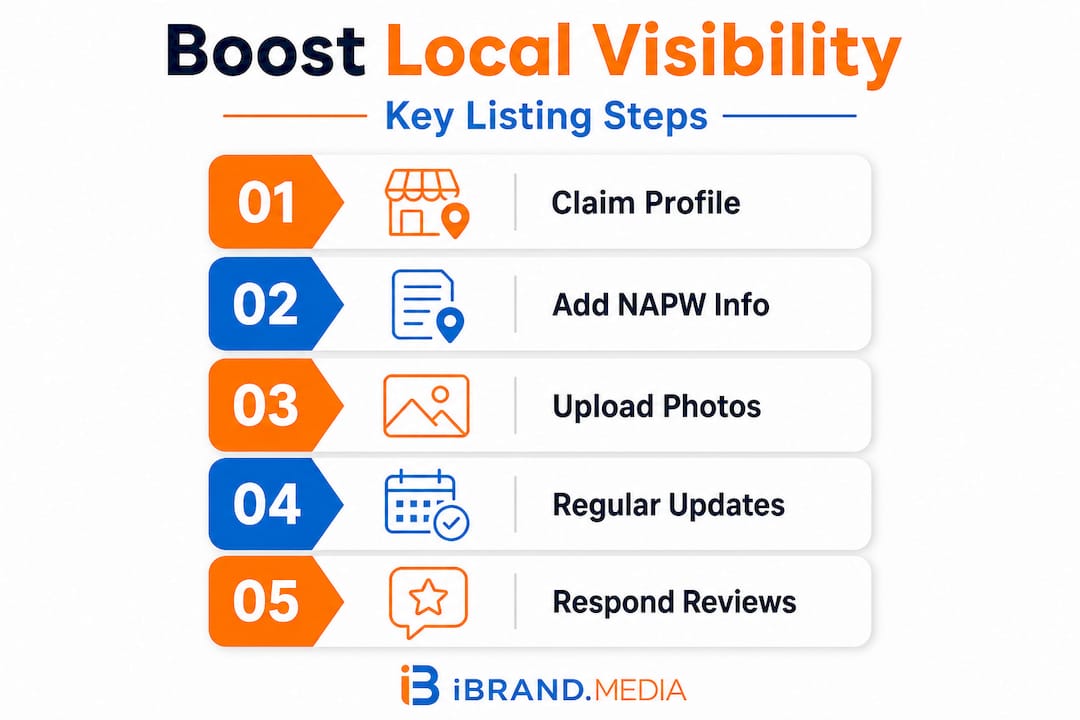
The most important concept here is NAPW consistency: your Name, Address, Phone number, and Website must be identical across every platform where you appear. Even small variations like “St.” versus “Street” or a missing suite number can confuse search engine algorithms and reduce your ranking.
| Listing element | Why it matters | Common mistake to avoid |
|---|---|---|
| Business name | Identifies you in search results | Adding keywords to your actual name |
| Address | Powers map results and directions | Using a PO box instead of physical address |
| Phone number | Drives direct calls from listings | Using a tracking number inconsistently |
| Website URL | Connects listings to your site | Linking to a social page instead |
| Photos | Increases click-through rate significantly | Using stock photos instead of real images |
| Business hours | Prevents frustrated customers | Failing to update for holidays or closures |
| Business categories | Matches you to relevant searches | Choosing too few or irrelevant categories |
| Description | Communicates value with keywords | Generic text with no local relevance |
Beyond NAPW, high-quality photos matter more than most business owners realize. Listings with photos receive significantly more clicks and direction requests than those without. Actual photos of your team, space, and products build trust in a way that words alone cannot.
Your business description is another underused tool. You have limited space, so use it to mention your location, your specialty, and what makes you different. Naturally weaving in phrases like “family-owned bakery in Portland” or “24-hour locksmith serving downtown Chicago” helps you appear in the right searches.
Pro Tip: Use a listing management tool like Moz Local, BrightLocal, or Yext to push updates to dozens of directories at once. Manually updating every platform is time-consuming and easy to neglect.
Keeping information accurate is not just about SEO. An outdated phone number or wrong address costs you real customers. Up-to-date and consistent information across listings directly boosts your credibility and local ranking. That means reviewing your listings whenever anything at your business changes and staying ahead of errors rather than reacting to them later.

If you want to understand the deeper side of getting found online as a local business, consistency across your listings and your own website is where that journey starts.
Choosing the right listing platforms for your business
Now that you know what makes a great listing, let’s find out which platforms offer the most value for your business type. Not all directories are created equal, and spreading yourself too thin means none of your listings get the attention they deserve.
Here is a comparison of the most impactful platforms for small businesses:
| Platform | Best for | Primary benefit |
|---|---|---|
| Google Business Profile | All local businesses | Dominates local search and Maps results |
| Yelp | Restaurants, services, retail | Strong review culture and buyer intent |
| Bing Places | All businesses, older demographics | Syncs with Cortana and Windows search |
| Apple Maps | All mobile users | Essential for iPhone users and Siri searches |
| Community-focused businesses | Social proof, messaging, and local ads | |
| TripAdvisor | Hotels, restaurants, attractions | Trusted travel and dining discovery site |
| ZocDoc | Healthcare providers | Specialized booking for medical appointments |
| Houzz | Home improvement and design | Niche audience with high purchase intent |
As the data shows, your starting point is always Google Business Profile. It powers the local pack (those three business results shown at the top of a Google search) and Maps, which are used by the majority of people looking for local businesses. After that, your next priorities depend on your industry and where your customers actually look.
Not every platform is right for every business. A restaurant should prioritize TripAdvisor and OpenTable. A law firm might benefit more from Avvo and Justia. A hair salon gets real value from StyleSeat. Tailoring your approach amplifies your results in a way that listing yourself on every possible directory never will.
Here is a practical step-by-step process for choosing and claiming your platforms:
- Google your own business name to see which directories already list you, often with incomplete or wrong information.
- Ask your best customers where they found you or where they look for businesses like yours.
- Research your top two competitors and note which platforms they are active on.
- Claim and fully optimize your top three platforms before worrying about the rest.
- Set up alerts or use a monitoring tool to catch new listings or inaccurate data that appears about your business.
Following this process means you invest your time where it actually moves the needle. Improving local search rankings is about strategic depth, not just breadth of coverage. Once your top platforms are optimized, you can layer in secondary directories as part of a broader local SEO strategy for your business.
Maintaining your listings for maximum impact
Choosing the right platforms is only the start. Ongoing maintenance ensures your listings keep working for you long after the initial setup.
Incomplete or outdated listings frustrate customers and hurt conversions. Imagine someone drives to your location based on outdated hours listed online and finds the door locked. That experience does not just cost you a sale. It often costs you a review, and not a positive one.
Here is a simple monthly maintenance routine that takes less time than you think:
- Log into each of your top three platforms and verify that all information is current.
- Check for and respond to new reviews, both positive and negative, within 48 hours.
- Update photos or posts if you have a promotion, new menu item, or seasonal service.
- Look for duplicate listings that may have been auto-generated by the platform.
- Check your listing insights (views, clicks, direction requests) to spot any drops that may signal a problem.
Responding to reviews is one of the highest-return activities for any small business owner. A thoughtful response to a negative review often impresses potential customers more than five-star reviews with no engagement at all. It signals that you are present, professional, and genuinely care about customer experience.
Pro Tip: Assign one person on your team to own listing management, or partner with a digital marketing agency that handles it as part of a broader strategy. Relying on memory alone means listings go stale without anyone noticing.
Strong Google Business management habits, like posting weekly updates or responding to Q&A sections promptly, also signal to Google that your profile is active and accurate. Active profiles tend to rank higher. Understanding why reviews matter for your local visibility gives you extra motivation to stay on top of this habit.
How listings support your wider digital marketing strategy
The power of listings multiplies when they are woven into a full digital marketing plan. A listing does not exist in isolation. It feeds into and draws strength from every other digital effort you make.
Here is how listings connect to the bigger picture:
- Local SEO: Your listing data tells search engines where you are, what you do, and how credible you are. Consistent NAPW details across dozens of sites send strong ranking signals.
- Content marketing: Blog posts or web pages that reference your location and services give listings more context and strengthen your local authority online.
- Social media: Sharing your Google reviews on Facebook or Instagram and linking back to your listing creates a feedback loop of credibility.
- Paid advertising: Google Local Services Ads and Google Ads pull directly from your Business Profile data, meaning a stronger listing improves your ad performance too.
- Mobile search: Most local searches happen on phones. A complete listing with click-to-call buttons, directions, and photos converts mobile searchers into customers immediately.
“Your business listing is often the very first interaction a potential customer has with your brand. That first impression should be accurate, complete, and compelling.”
Coordinated digital marketing, including listings as a core component, drives consistent and measurable growth. The benefits of local marketing compound over time when each piece of your strategy reinforces the others. Tracking your listing performance alongside your website traffic and social engagement gives you a clear view of what is working and where to invest more energy.
If you are serious about building a full system for getting found locally, your listings are not just a starting point. They are the connective tissue that ties your entire online presence together.
The overlooked truth about local business listings
Here is what most guides will not tell you: businesses treat their listings like a checkbox, not a channel. They get claimed, get filled in once, and then get forgotten while money gets poured into paid ads, fancy websites, and social media campaigns.
We have seen businesses spending hundreds of dollars a month on Google Ads while their Business Profile has wrong hours, zero photos, and unanswered reviews dating back two years. The ads drive clicks. The listing drives those clicks away.
The deeper truth is that your business listings strategy is a living, breathing asset. Search engines reassess your listings constantly. Competitors update theirs. Customer behavior shifts. A listing that was ranking well six months ago may have slipped simply because it went static while others became more active and accurate.
Ten minutes per week, focused on your top three platforms, often moves more leads than an hour spent tweaking ad copy. That means checking reviews, updating a photo, confirming your hours are correct for the upcoming holiday, and responding to any questions left by potential customers. It sounds almost too simple. That is exactly why most businesses skip it.
The businesses that win in hyperlocal search are not necessarily the ones with the biggest budgets. They are the ones who treat their listings with the same seriousness they give their physical storefront. Would you let your window display go two years without changing it? Your listings are that window for the digital world.
Level up your local presence with expert support
Your listings are the foundation, but a truly competitive local presence requires a full strategy behind them. Understanding the mechanics is a great start, and putting them into action consistently is where the real growth happens.
At ibrand.media, we help small businesses build and maintain optimized local listings as part of a complete digital marketing approach. From SEO for small businesses to custom campaigns that drive real local leads, our team takes the guesswork out of online visibility. We also help you optimize your website so that when your listing brings someone to your site, they convert. Whether you need a quick listing audit or a full local marketing plan, we make it easy to take the next step without wasting time or budget.
Frequently asked questions
What is a local business listing?
A local business listing is an online profile that includes your business name, location, contact information, and details, helping you appear in search and map results. A complete business listing significantly increases your chances of being found by nearby customers who are ready to buy.
How often should I update my business listings?
Update your listings at least once a month, or immediately whenever your hours, contact information, or services change. Consistent, up-to-date information directly boosts your credibility with both customers and local search rankings.
Does managing reviews on listings really matter?
Yes. Responding to reviews signals to potential buyers that you are active and trustworthy, and it directly influences purchase decisions. Coordinated digital efforts including review management drive measurable business growth.
Which local listing platform should I start with?
Start with Google Business Profile since it powers the majority of local search and Maps results, then expand to Yelp, Bing, and industry-specific sites. Tailoring your platform choices to where your specific customers search amplifies your results far more than spreading thin across every directory.
Recommended
- How to Use Local Listings to Boost Business Visibility | Ibrandmedia
- How to Get Found Online: Boost Your Local Business Fast | Ibrandmedia
- Essentials of Local Search: Boosting Your Service Business | Ibrandmedia
- Improving Local Search Rankings for Small Businesses Easily | Ibrandmedia
- Effective Business Logo Signs That Increase Sales – The Logo Light Store
Recent Comments