
TL;DR:
- Local digital outreach involves multi-channel efforts focused on proximity and community engagement.
- Success requires ongoing, strategic actions using SEO, social media, reviews, and targeted ads.
- Measuring results through website traffic, engagement, and reviews helps optimize local outreach efforts.
Most small business owners assume digital outreach means running a Facebook ad or posting a photo on Instagram. That assumption is costing them real customers. Local digital outreach is a deliberate, multi-channel system designed to put your business in front of the right people at the right moment, specifically those who live, work, or shop near you. This guide breaks down what local digital outreach actually involves, which strategies produce the best results, and how to measure whether your efforts are working so you can grow with confidence.
Table of Contents
- Defining local digital outreach for small businesses
- Core strategies and channels for local digital outreach
- Comparing business and non-business digital outreach
- Measuring and improving your local outreach results
- Why most businesses underutilize local digital outreach — and how to do better
- Take your local digital outreach to the next level
- Frequently asked questions
Key Takeaways
| Point | Details |
|---|---|
| Local outreach defined | Local digital outreach is intentional online communication targeting your immediate area for business growth. |
| Multiple channels matter | Combining SEO, social media, ads, and reviews creates the strongest local impact. |
| Measure what matters | Tracking engagement and conversion shows what’s working and where to improve. |
| Business vs. nonprofit goals | Businesses seek sales while nonprofits aim for participation and feedback. |
| Integrate, don’t automate | The most successful outreach blends digital efficiency with real community engagement. |
Defining local digital outreach for small businesses
Local digital outreach involves intentional online strategies designed to reach people in your geographic area. It is not one tactic. It is a collection of connected efforts that work together to build awareness, trust, and community around your business.
The three core pillars of local digital outreach are:
- Search visibility: Making sure your business appears when nearby people search for your products or services on Google, Bing, or Apple Maps.
- Social engagement: Building genuine relationships with local audiences through platforms like Facebook, Instagram, and Nextdoor.
- Reputation management: Actively collecting, responding to, and leveraging online reviews to shape how people perceive your brand.
What separates local digital outreach from general digital marketing is the emphasis on proximity and community. When targeting your local audience, your messaging, your keywords, and your content all need to reflect the specific neighborhood, city, or region you serve. A national campaign selling generic benefits will not connect the way a post that mentions a local event or a neighborhood landmark will.
“Digital outreach can also refer to non-business contexts, such as government engagement, political advocacy, or nonprofit online engagement. In those cases, the objective is two-way communication and inclusive participation rather than revenue conversion.”
This distinction matters because it shapes what success looks like for a small business. Your outreach goal is not just awareness. It is action. You want someone searching for “best breakfast near me” on a Saturday morning to walk through your front door. That requires a different strategy than a city government trying to collect public feedback on a zoning change. When thinking about marketing to local customers, the intent behind every digital touchpoint should be to move someone from curious to committed.
Many business owners also confuse local digital outreach with their website. Your website is the destination. Outreach is everything that points people toward it, from a Google Business Profile that appears in local searches to a positive Yelp review that convinces someone to book an appointment. Think of your website as your storefront and your outreach as the signage, word of mouth, and community presence that gets people through the door.
Core strategies and channels for local digital outreach
With a clear definition in place, let’s look at the most effective strategies and channels businesses use for local outreach. Local digital outreach strategies commonly combine SEO, social media engagement, online reviews, and targeted digital ads. Each one plays a different role, and the combination is what makes your presence hard to ignore.
The main channels compared
| Channel | Primary goal | Best for | Typical timeline |
|---|---|---|---|
| Local SEO | Search visibility | Ongoing organic traffic | 3 to 6 months |
| Social media | Community engagement | Building brand personality | Immediate to 3 months |
| Online reviews | Trust and reputation | Converting interest to sales | Ongoing |
| Digital advertising | Targeted reach | Fast visibility boosts | Immediate |
| Email marketing | Retention and loyalty | Repeat customers | Ongoing |
Local SEO is the backbone of any outreach plan. It means optimizing your Google Business Profile, using location-specific keywords on your website, and earning backlinks from local directories and community organizations. When someone types “plumber in Austin” or “coffee shop open Sunday in Denver,” SEO is what determines whether you appear at the top or get buried on page three.
Social media platforms give you a direct line to your neighborhood. Facebook groups for local communities, Instagram posts tagged to your city, and platforms like Nextdoor (which is specifically built for neighborhood communication) are all places where social media for small businesses can create genuine connection, not just vanity metrics. When a local mom’s group on Facebook recommends your bakery, that is more valuable than any paid ad.
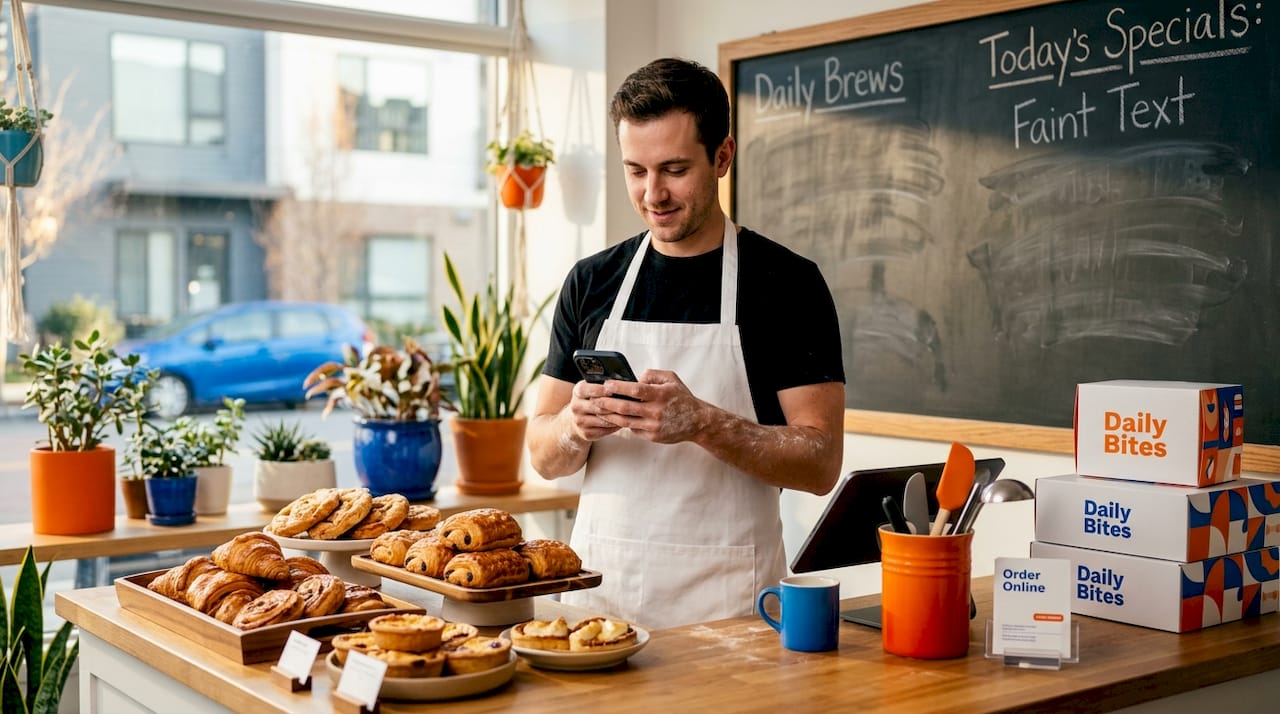
Online reviews are the digital version of word of mouth. A business with 50 recent reviews averaging 4.7 stars will consistently outperform a competitor with a better product but no online presence. The key is to make asking for reviews a routine part of your customer experience, not an afterthought.
Digital advertising through Google Ads or Meta Ads allows you to serve targeted messages to people within a specific zip code, radius, or even neighborhood. The online advertising tips that work best for local businesses focus on hyper-specific targeting, strong calls to action, and ad copy that speaks to local context, like referencing a nearby landmark or a community event.
Here is what a well-rounded local outreach plan looks like in practice:
- Claim and fully optimize your Google Business Profile with photos, hours, and service descriptions.
- Post consistently on one or two social platforms where your customers actually spend time.
- Send a follow-up email or text after every purchase asking for a review.
- Run a small geo-targeted ad campaign during busy seasons or around local events.
- Engage with community engagement strategies like sponsoring a local event or joining neighborhood online groups.
Pro Tip: Do not spread yourself across every platform at once. Pick two or three channels where your customers are most active and do those exceptionally well before expanding. Consistency beats volume every single time.
Comparing business and non-business digital outreach
Understanding the channels, it’s important to see how business outreach differs from outreach in other fields. The same platforms can serve radically different goals depending on who is using them and why.
Outreach objectives differ significantly by context: business outreach prioritizes conversion and visibility, while government and nonprofit outreach prioritize engagement and inclusivity. Here is how those differences play out in practice:
- Goal definition: A business measures success by leads, sales, and booked appointments. A city government running digital outreach measures success by survey responses, public participation rates, and community representation.
- Messaging tone: Business outreach can be promotional, benefit-focused, and persuasive. Nonprofit or government outreach typically needs to remain neutral, inviting, and accessible to diverse audiences.
- Platform selection: Both types of outreach use social media and email. However, a business might prioritize Instagram and Google, while a government agency might focus more on email newsletters and community forums.
- Metrics for success: A business tracks click-through rates, cost per acquisition, and return on ad spend. A public agency might track engagement diversity, response rates, and whether underrepresented groups are participating.
- Follow-up actions: Business outreach funnels people toward a sale or inquiry. Non-business outreach channels feedback into policy decisions or program design.
| Factor | Business digital outreach | Non-business digital outreach |
|---|---|---|
| Primary goal | Sales and visibility | Participation and inclusivity |
| Success metric | Conversion rate, revenue | Engagement rate, diversity |
| Audience targeting | Potential customers | All community members |
| Tone | Persuasive, brand-forward | Neutral, welcoming |
| Core platform use | Google, Instagram, Ads | Email, civic forums, social |
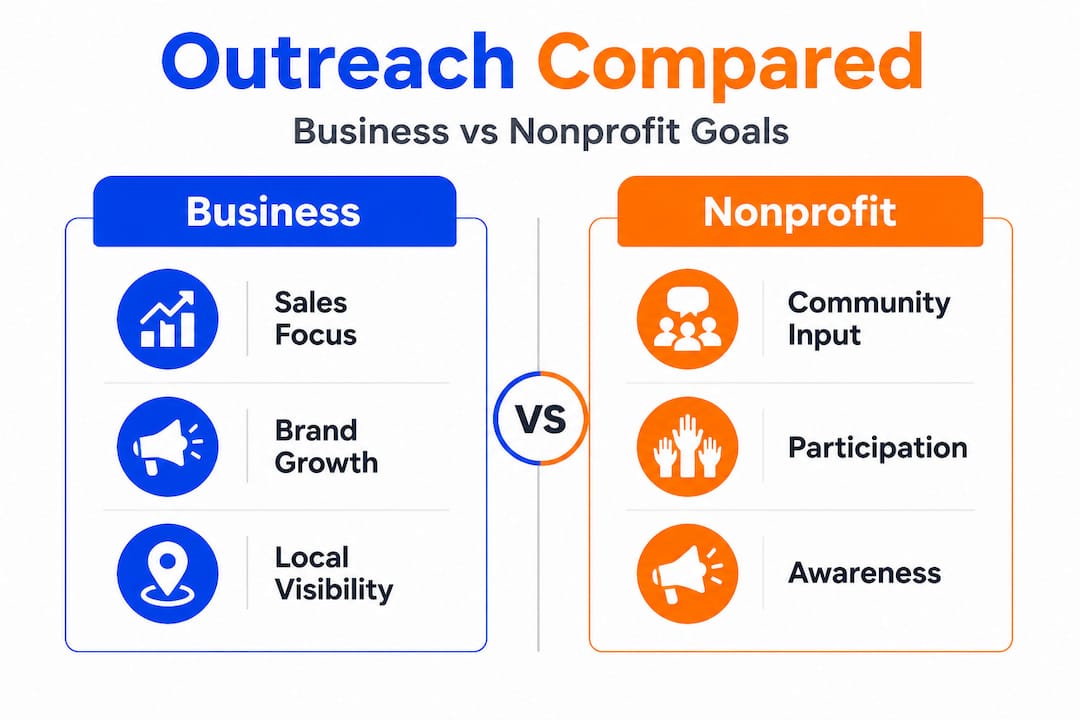
Understanding this distinction helps you sharpen your own strategy. As a business owner, you should not be running your digital outreach like a nonprofit campaign. Your outreach needs a clear commercial purpose, a defined audience, and measurable results. Knowing who else uses these tools and why they use them differently helps you stay focused on what actually moves the needle for your business.
Measuring and improving your local outreach results
Having explored the nuances, the next step is to understand how to measure and continually improve your outreach. Measuring outreach impact involves tracking website traffic, social engagement, and conversion metrics. Without these numbers, you are guessing, and guessing is expensive.
Here are the key metrics every small business should monitor:
- Website visits from local searches: Use Google Analytics or Google Search Console to see how many visitors are finding you through local search terms. Look for trends over time, not just one-time spikes.
- Google Business Profile views and clicks: This dashboard shows how many people found your profile, clicked your website, or asked for directions. These are warm signals from people actively looking for what you offer.
- Social media engagement: Likes and followers are surface-level. Pay more attention to comments, shares, and direct messages, because those indicate genuine interest from real people in your area.
- Review volume and rating trends: Track how many new reviews you receive each month and whether your average rating is rising or falling. Both volume and quality matter for how Google ranks your local listing.
- Conversion rate from outreach channels: Use tracking ROI for digital marketing tools and UTM parameters (short tracking codes added to URLs) to identify which outreach channels are actually sending paying customers your way, not just traffic.
- Email open and click rates: If you use email newsletters, open rates above 25% and click-through rates above 3% are solid benchmarks for local businesses.
Once you have baseline numbers, the real work begins. Look for your highest-performing channel and invest more there. If your Google Business Profile is generating three times more inquiries than your Instagram account, that tells you where to focus your energy this quarter.
Use feedback and online reviews as qualitative data. When multiple reviews mention your quick response time or your friendly staff, lean into those in your marketing. When reviews flag a recurring complaint, address it operationally, then address it publicly in your review responses to show future customers that you listen.
Pro Tip: Set a fixed time each month to review your outreach metrics, at least 30 minutes. Every quarter, do a deeper audit and adjust your strategy based on what the data tells you. Businesses that review performance regularly grow faster than those that set campaigns and forget them.
Why most businesses underutilize local digital outreach — and how to do better
Here is an uncomfortable truth from working with small businesses on their digital presence: most business owners treat local digital outreach as a checklist they complete once and move on from. They set up a Google Business Profile in 2021, post on Facebook occasionally when they remember, and wonder why their competitor across the street is fully booked every weekend.
The problem is not a lack of effort. It is a lack of system. Effective local digital outreach is not a task. It is an ongoing operation, as essential to your business as managing inventory or handling customer service. The businesses that win locally treat outreach as a living part of how they operate, not something they do between the “real” work.
The second underutilized element is the human touch. Digital tools are efficient, but they cannot replace the warmth of a business that feels genuinely connected to its community. Sponsoring a local charity run, sharing a post celebrating a neighboring business’s anniversary, or responding to every Google review (positive and negative) with a personal note, these actions build the kind of loyalty that no ad budget can manufacture.
The most effective local outreach we have seen blends deep community engagement with smart digital systems. It is not about being everywhere. It is about being present, consistent, and genuinely useful to the people in your community. When you stop thinking of outreach as marketing and start thinking of it as relationship building at scale, your results will shift dramatically.
Take your local digital outreach to the next level
Knowing the strategy is one thing. Executing it consistently while running a business is another challenge entirely.
If you are ready to move from knowing to doing, ibrand.media offers practical resources and hands-on support built specifically for small and medium-sized businesses. Start with our small business SEO tips to strengthen your local search presence, or explore our detailed local customer marketing guide to build a channel strategy that fits your business and your budget. Our team creates personalized digital marketing plans focused on real, measurable growth so you can stop guessing and start seeing results.
Frequently asked questions
What is the main goal of local digital outreach for businesses?
The main goal is to connect with people in your geographic area and convert their interest into sales, bookings, or community support. Local digital outreach focuses on local visibility and conversion rather than broad awareness.
How do I choose the right platforms for local outreach?
Select platforms popular with your local community, such as Facebook, Google Business Profile, and Instagram, and monitor which channels yield the best engagement and actual inquiries over time.
How can I measure if my digital outreach is working?
Track website visits, social media interactions, and conversion metrics to assess your outreach success. Measuring outreach impact through traffic, engagement, and conversion data gives you a clear picture of what is working.
What’s the difference between outreach for nonprofits and for businesses?
Nonprofit outreach prioritizes community participation and inclusive feedback, while businesses focus on visibility and sales. Outreach objectives differ significantly based on whether the goal is revenue or community representation.
Is local digital outreach only about advertising?
No. Local digital outreach covers social engagement, reputation management through reviews, SEO, and community-building efforts alongside paid advertising, and often the non-paid elements deliver the highest long-term value.
Recommended
- Boosting Online Sales Locally: Step-by-Step Guide for SMBs | Ibrandmedia
- Marketing to Local Customers Online: A Step-by-Step Guide | Ibrandmedia
- How to Attract Local Customers in 2025: Smart Strategies for Small Businesses | Ibrandmedia
- Creating Engaging Social Content: A Guide for Small Businesses 2025 | Ibrandmedia
- Localized Marketing Strategies for Small Business – 16W Media Group
- Local coupon marketing guide: attract customers and save big
Recent Comments