
TL;DR:
- Small businesses see a high ROI from marketing automation, with benefits including lead capture and better segmentation.
- Effective automation requires strategic planning, regular audits, and balancing technology with human oversight.
- Over-automation and neglecting data hygiene can damage customer trust and brand reputation.
Marketing automation isn’t reserved for Fortune 500 companies with massive tech budgets. The average ROI is $5.44 for every dollar spent on marketing automation, meaning a $500 monthly investment could realistically return over $2,700. For small and medium-sized business owners who feel stretched thin between managing operations, serving customers, and trying to grow their online presence, that kind of efficiency isn’t a luxury. It’s a lifeline. This guide breaks down exactly how automation works in real digital marketing scenarios, what tools make sense for your budget, and how to avoid the mistakes that waste money and frustrate customers.
Table of Contents
- Why automation matters for SMB marketing
- Key roles automation plays in digital marketing
- How to implement automation for immediate impact
- Pitfalls to avoid with marketing automation
- The missing ingredient: Human touch in a digital age
- Unlock next-level marketing with the right automation strategy
- Frequently asked questions
Key Takeaways
| Point | Details |
|---|---|
| Proven ROI | Automation in SMB marketing delivers 544% ROI and fast payback with the right approach. |
| Start simple | Piloting one workflow such as email follow-ups helps SMBs see measurable wins quickly. |
| Balance automation | Blend automation with a human touch to avoid impersonal or spammy marketing. |
| Avoid pitfalls | Maintain clean data, schedule regular audits, and don’t over-automate to minimize risks. |
| Choose affordable tools | Select user-friendly, budget-conscious automation tools tailored for small businesses. |
Why automation matters for SMB marketing
Most small business owners wear too many hats. You’re the salesperson, the customer service rep, the social media manager, and the strategist all rolled into one. That’s where automation changes the equation entirely. It doesn’t replace you. It handles the repetitive, time-consuming tasks so you can focus on decisions that actually require your judgment.
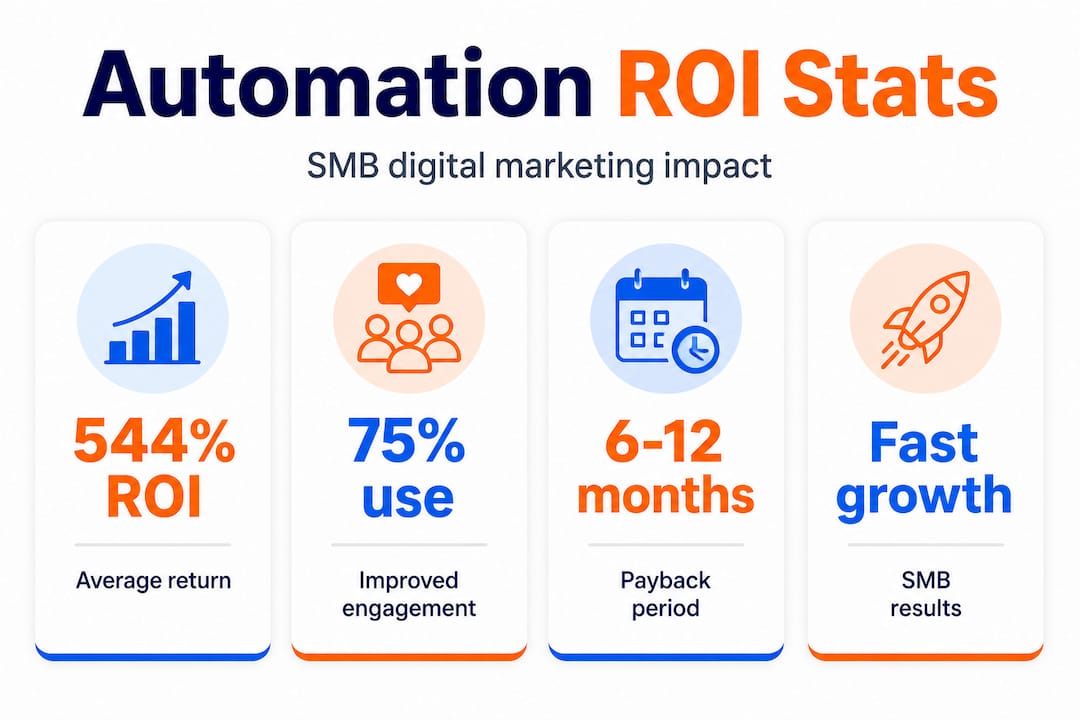
The numbers back this up. Beyond the 544% average ROI reported across SMBs, 75% of businesses using automation see improved lead conversions, and 63% outperform competitors who rely on manual marketing processes. The payback period typically falls within 6 to 12 months, which is a relatively short window for a strategy that continues compounding results over time.
Think of automation as the bridge between your current capacity and the results you want. Without it, a small team can only send so many emails, follow up with so many leads, and post so much content. With it, a team of two can execute what used to require a department of ten. That’s not an exaggeration. That’s the operational reality thousands of SMBs are already experiencing.
Here’s what well-implemented automation consistently delivers for smaller marketing teams:
- More leads captured through consistent follow-up sequences that don’t slip through the cracks
- Better audience segmentation so the right message reaches the right person at the right time
- Faster response times to new inquiries, form fills, and purchase triggers
- Consistent brand messaging across every channel, every day, without manual effort
Exploring affordable digital marketing tactics alongside automation is one of the smartest moves an SMB can make. Automation amplifies whatever strategies you’re already running, including email marketing best practices that convert subscribers into buyers over time.
Pro Tip: Before investing in any tool, map out one specific marketing bottleneck your team faces weekly. That’s where automation should start.
Key roles automation plays in digital marketing
Understanding what automation can do is one thing. Understanding where it specifically fits in your marketing workflow is what turns theory into results. Automation isn’t a single button you press. It’s a set of connected processes that replace manual triggers with smart, pre-configured actions.
Here’s a clear breakdown of how automation tools map to real marketing functions:
| Automation tool or process | What it does for your marketing |
|---|---|
| Email autoresponders | Sends personalized follow-ups instantly after a lead signs up or makes a purchase |
| Social media schedulers | Posts consistently to all platforms without daily manual input |
| Lead scoring systems | Ranks prospects by engagement level so your team focuses on the hottest leads |
| CRM workflow triggers | Moves contacts through your funnel based on behavior, not just time |
| Retargeting ad automation | Re-engages visitors who didn’t convert on the first visit |
| Chatbots and live chat routing | Answers common questions 24/7 and routes complex issues to a human |
According to expert guidance from BizTech Magazine, the smartest approach for SMBs is to start simple. Email follow-up sequences are typically the best entry point because they’re low risk, easy to monitor, and produce measurable results fast. The same expert guidance stresses ensuring human review for AI-generated content, maintaining brand voice across every touchpoint, and integrating your CRM properly from the start.
What many business owners overlook is that automation requires strategic thinking upfront to produce results that feel natural. As noted in marketing automation research, the transformation from manual to scalable marketing only works when you use clean data, behavioral triggers, and regular optimization to avoid common pitfalls like spam perception and impersonal messaging.
Connecting automation to your broader goals matters just as much as the tools themselves. If your goal is engagement, social media scheduling and triggered email campaigns are your priorities. If your goal is retention, post-purchase sequences and loyalty triggers move the needle. Understanding this relationship is core to digital marketing for small businesses that actually produces revenue, not just activity.
Pro Tip: Start with one automated workflow and run it for at least 30 days before adding a second. This gives you clean data to evaluate what’s working before you scale.
How to implement automation for immediate impact
Implementation is where most SMBs either win big or stall out entirely. The most common mistake is trying to automate everything at once. The better path is a focused pilot that produces a visible, measurable result within 60 days, then builds from there.
Here’s a practical step-by-step framework that works for most small businesses:
-
Define one specific workflow to automate. The classic starting point is a welcome email sequence for new subscribers. Map it out on paper first: what triggers it, what the first email says, when the second one sends, and what action you want the reader to take.
-
Choose an affordable, beginner-friendly tool. For most SMBs, HubSpot’s free tier or ActiveCampaign’s entry-level plan are the top recommendations. Both offer email automation, CRM integration, and analytics without requiring a developer.
-
Integrate your existing data carefully. Before importing your contacts, clean your list. Remove duplicates, update outdated information, and segment your audience by at least one meaningful variable like purchase history or geographic location.
-
Set clear KPIs before you launch. Decide in advance what success looks like: open rate above 30%, click-through rate above 4%, or 10 new demo bookings per month. You can’t optimize what you don’t measure.
-
Run the workflow for a defined test period. Four to six weeks is enough to collect meaningful data for a simple email sequence. Resist changing variables mid-test.
-
Analyze results and expand gradually. Once your first workflow is stable and producing results, add a second. Maybe that’s an abandoned cart email for your e-commerce customers, or a re-engagement sequence for leads that went cold after 90 days.
“Automation is about scalability with smart oversight, not removing the human touch. The businesses that get the most from automation are the ones that treat it as a co-pilot, not an autopilot.”
This is a mindset shift that separates SMBs that see consistent ROI from those that set up automation and forget it. Reviewing time-saving marketing strategies alongside your automation rollout helps you identify where human effort is still most valuable versus where a trigger-based workflow handles it better.
Affordable tools worth exploring beyond HubSpot and ActiveCampaign include Mailchimp for email, Buffer or Later for social scheduling, and Zapier for connecting apps that don’t natively integrate. Each of these has a free or low-cost entry tier that lets you test before you commit.
Pro Tip: Prioritize data integration and segmentation before you write a single email. The best-written automation sequence still fails if it’s reaching the wrong people.
Pitfalls to avoid with marketing automation
Automation done right is a growth engine. Automation done poorly is a reputation problem. The gap between the two often comes down to a handful of avoidable mistakes that show up repeatedly across businesses of every size.

Here’s a comparison of what smart automation looks like versus where over-automation creates problems:
| Smart automation | Over-automation problems |
|---|---|
| Behavioral triggers based on real actions | Time-only triggers that ignore customer context |
| Regular audits every quarter | Set-it-and-forget-it workflows that decay over months |
| Clean, segmented data | Duplicate records and outdated contact info |
| Human review of AI-generated content | Unreviewed AI emails that sound robotic or off-brand |
| Branching logic for different responses | Single-path sequences that ignore how a lead actually behaves |
According to Zapier’s research on automation mistakes, some of the most damaging pitfalls are the less obvious ones. Overwriting UTM tags (the tracking codes attached to your links) is a technical mistake that quietly corrupts your analytics. Poor data hygiene leads to duplicate contacts receiving the same message twice, which is both embarrassing and annoying. Lack of branching in workflows means a customer who already bought your product might still receive a promotion pushing them to buy it.
The classic mistake every guide warns about is spammy messaging. But the more nuanced issue is automation that was designed thoughtfully but was never audited after launch. An email that worked perfectly six months ago might now reference a promotion that’s expired, a product that’s out of stock, or a landing page that’s been redesigned. No one noticed because the workflow just kept running.
Watch out for these specific pitfalls in your own setup:
- Skipping quarterly audits of every active workflow
- Using the same message for cold leads and warm buyers because segmentation wasn’t set up properly
- Automating customer service responses without a clear escalation path to a real person
- Ignoring unsubscribes and complaints as a feedback signal that something in the workflow isn’t working
- Over-automating social media to the point where you stop responding to real comments and conversations
Reviewing common digital marketing mistakes helps you catch problems that often overlap with automation failures, especially around messaging consistency and audience targeting.
Pro Tip: Put a recurring quarterly reminder in your calendar labeled “Automation audit.” Review every active workflow, update any outdated content, and check your data quality. This single habit prevents most automation-related reputational damage.
The missing ingredient: Human touch in a digital age
Here’s something most automation guides won’t tell you: the businesses seeing the highest long-term returns from marketing automation aren’t the ones who automate the most. They’re the ones who know exactly where to stop.
Automation is extraordinarily good at consistency, speed, and scale. It is not good at empathy, nuance, or the kind of response that makes a frustrated customer feel genuinely heard. When a business fully hands its communication to automated sequences without any human checkpoint, customers feel it. The messages sound templated. The timing feels off. The brand voice drifts over time as workflows are copied, tweaked slightly, and reused without fresh oversight.
Our view is that the businesses winning with automation in 2026 treat it as an amplifier, not a replacement. They use automation to handle the routine so their team has capacity for the moments that matter: the negative review that needs a thoughtful response, the VIP customer who deserves a personal note, the inquiry from a prospect who asks a question the workflow never anticipated.
The expert consensus aligns with this approach. Human review of AI-generated content, maintaining a clear brand voice, and quarterly audits aren’t optional extras. They’re the infrastructure that keeps automation from becoming a liability.
What most playbooks miss entirely is that customer trust is your most valuable asset, and automation either builds or erodes it depending on how thoughtfully it’s deployed. The goal isn’t to remove humans from marketing. The goal is to free your humans to do what only humans can do, including refining your email marketing best practices to stay genuinely relevant and personal even while running at scale.
Automation amplifies your marketing. But your brand voice, your judgment, and your willingness to show up as a real business behind the tools are what build lasting relationships. Those don’t get automated.
Unlock next-level marketing with the right automation strategy
Knowing the principles of marketing automation is a strong start. Executing them effectively while running a business is a different challenge entirely.
At ibrand.media, we help SMBs move from knowing to doing. Whether you’re working on optimizing your website for search, choosing the right social media management tools, or building a local customer marketing strategy, our team builds plans around your specific goals, budget, and audience. You don’t need to figure out automation alone or guess which tools are worth the investment. We match SMBs with strategies that produce measurable results quickly, without the enterprise-level price tag.
Frequently asked questions
What is the most cost-effective automation tool for SMBs?
Affordable platforms like HubSpot and ActiveCampaign are consistently recommended for SMBs starting with automation because they combine ease of use with strong email, CRM, and analytics features at a low entry cost.
How fast can I expect a return on investment with marketing automation?
Most SMBs experience a payback period of 6 to 12 months when adopting marketing automation, with the average return running at $5.44 for every dollar invested.
How do I prevent my automation from feeling spammy to customers?
Use behavioral triggers and clean segmentation rather than blanket time-based sends, and regularly review your sequences to make sure they still reflect your current offers and tone.
What common mistakes should I avoid in marketing automation?
The most damaging issues include poor data hygiene and skipped audits, which cause duplicate messages, outdated content, and workflows that slowly erode the personal connection your customers expect.
Recommended
- Why choose digital ads in 2026: A smart guide for SMBs | Ibrandmedia
- Digital branding drives 23% sales growth for SMBs in 2026 | Ibrandmedia
- Master digital branding fundamentals: 23% revenue boost for SMBs | Ibrandmedia
- Why automate SEO: Unlock local growth and AI visibility
- What is digital marketing? A guide for small business success
Recent Comments