
Over 72% of U.S. small and medium business leaders already use digital advertising, yet countless SMBs still hesitate or underutilize these powerful tools. If you think digital ads are only for big brands with massive budgets, you’re missing a huge opportunity. Digital advertising in 2026 is more affordable, targeted, and effective than ever, thanks to AI automation and smarter platforms. This guide will show you why digital ads are essential for growth, how to navigate common challenges, and practical steps to launch campaigns confidently without wasting money.
Table of Contents
- Why Digital Ads Are Essential For SMB Growth In 2026
- How AI And Automation Make Digital Ads Affordable And Effective
- Challenges And Best Practices For SMB Digital Ad Success
- Practical Steps To Start Digital Advertising Confidently In 2026
- Enhance Your Digital Advertising With Expert Help
Key takeaways
| Point | Details |
|---|---|
| High SMB adoption drives growth | Most U.S. SMB leaders use digital ads to reach new customers and compete effectively with larger competitors. |
| AI makes ads affordable | Automation tools reduce costs and complexity, enabling SMBs to start with budgets as low as $300 monthly. |
| Social ads gain traction | Paid social advertising shows improved effectiveness in 2026, making it a strong revenue driver for small businesses. |
| Watch for common pitfalls | Wasted spend, creative fatigue, and rising acquisition costs require strategic planning and regular optimization. |
| Start smart and diversify | Begin with small budgets, prioritize first-party data, and spread campaigns across multiple channels for best results. |
Why digital ads are essential for SMB growth in 2026
Digital advertising has become the backbone of small business marketing strategies. The numbers tell a compelling story: 72% of U.S. SMB leaders actively use digital ads, with 78% reporting they successfully reach new customers and 75% saying these tools help them compete against larger rivals. This isn’t just about keeping up with trends. It’s about survival and growth in a marketplace where your competitors are already leveraging these channels.
Digital advertising levels the playing field in ways traditional marketing never could. You can target specific demographics, interests, and behaviors without needing a Fortune 500 budget. A local bakery can reach nearby customers searching for birthday cakes. A consulting firm can connect with decision makers in specific industries. This precision was impossible with billboards or newspaper ads.
The business impact speaks for itself. Companies investing in digital branding see 23% sales growth on average, proving that strategic online presence directly translates to revenue. Paid digital ads accelerate this growth by putting your message in front of ready-to-buy customers at exactly the right moment.
“Digital ads have fundamentally changed how small businesses compete. They’re no longer at a disadvantage against big brands with deep pockets. Smart targeting and automation mean a $1,000 monthly budget can deliver results that would have required $10,000 just five years ago.”
The shift toward digital isn’t slowing down. Understanding why to invest in online advertising helps you make informed decisions about where to allocate marketing dollars for maximum impact.
Key benefits driving SMB adoption include:
- Measurable results that show exactly which ads drive sales, leads, or website visits
- Flexible budgets that let you start small and scale based on performance
- Real-time adjustments to pause underperforming campaigns and double down on winners
- Geographic targeting to focus on local markets or expand nationally as you grow
How AI and automation make digital ads affordable and effective
Artificial intelligence has revolutionized digital advertising for small businesses. SMB digital ad spend grew 22% in 2025, now accounting for roughly 27% of the total U.S. digital ad market at approximately $98 billion. This explosive growth happened because AI automation lowered the technical barriers that once kept smaller players on the sidelines.
You no longer need a marketing degree or agency retainer to run effective campaigns. AI tools handle the heavy lifting: analyzing audience data, optimizing bid strategies, and even generating ad copy and creative variations. What used to take hours of manual work now happens automatically, freeing you to focus on strategy and business growth.

Cost effectiveness has improved dramatically. Many SMBs successfully run campaigns with affordable budgets between $300 and $1,500 monthly, seeing meaningful returns that justify continued investment. The key is starting strategically and letting AI optimization improve performance over time.
Here’s how to integrate AI tools for maximum campaign effectiveness:
- Choose platforms with built-in AI optimization like Google Ads Smart Bidding or Meta Advantage+
- Feed the algorithms quality data by installing conversion tracking pixels on your website
- Let AI test multiple ad variations automatically to identify top performers
- Review performance weekly and provide feedback by pausing poor performers and increasing budgets on winners
- Expand gradually by adding new audience segments or platforms once you’ve proven success
| Metric | Pre-AI Average | AI-Optimized Average | Improvement |
|---|---|---|---|
| Cost per click | $2.50 | $1.80 | 28% reduction |
| Conversion rate | 2.1% | 3.4% | 62% increase |
| Setup time (hours) | 8-12 | 2-4 | 70% faster |
| Campaign management (hours/week) | 6-8 | 1-2 | 80% less time |
Pro Tip: Use AI-powered creative testing to run 3-5 ad variations simultaneously. The algorithms will automatically show top performers more often, maximizing your return on ad spend without manual intervention. This approach delivers more effective advertising results than static campaigns ever could.
The democratization of sophisticated marketing tools means you can compete effectively regardless of company size. AI doesn’t care if you’re a solo entrepreneur or a 50-person firm. It optimizes based on data and performance, giving everyone access to enterprise-level capabilities.
Challenges and best practices for SMB digital ad success
Digital advertising isn’t without risks. Understanding common pitfalls helps you avoid expensive mistakes and build campaigns that deliver sustainable results. Average wasted impressions reach 27% when ads show to irrelevant audiences, directly hurting your return on investment. That’s more than a quarter of your budget going to people who will never become customers.
Creative fatigue presents another significant challenge. Your target audience sees the same ads repeatedly, leading to declining engagement and rising costs. Research shows you need to refresh ad creatives every 6-8 weeks to maintain effectiveness. This constant need for fresh content can strain small teams without dedicated marketing staff.
Rising customer acquisition costs on popular platforms compound these issues. Meta’s average cost per acquisition climbed from $22 to $38 over recent periods, forcing advertisers to either accept lower margins or find more efficient targeting strategies. Google Search ads face similar pressures as competition intensifies for valuable keywords.
| Common Risk | Impact | Best Practice Solution |
|---|---|---|
| Irrelevant traffic | 27% wasted spend | Use negative keywords and precise audience targeting |
| Creative fatigue | Declining engagement after 6-8 weeks | Rotate ad variations and test new messaging regularly |
| Rising CAC | Squeezed profit margins | Diversify channels and optimize for conversion value, not just volume |
| Poor tracking | Can’t identify what works | Implement conversion pixels and attribute sales to specific campaigns |
Smart SMBs overcome these challenges through disciplined execution and continuous optimization. Start by implementing these proven best practices:
- Build negative keyword lists to exclude searchers who aren’t potential customers
- Track conversions, not just clicks, to measure actual business impact
- Diversify across multiple channels rather than relying on a single platform
- Set up proper attribution to understand the customer journey from first click to purchase
- Test incrementally by changing one variable at a time to isolate what drives improvement
Pro Tip: Begin with modest budgets of $300-500 monthly while you learn what works for your business. Prioritize collecting first-party data through email signups and website tracking, then use this information for precise targeting that reduces wasted spend. This foundation supports improved sales lift as you scale.
The difference between successful and failed campaigns often comes down to patience and strategic thinking. B2B businesses especially need longer runway periods, as decision cycles extend beyond immediate purchases. Social media marketing requires consistent effort over months, not days, to build audience relationships that convert.
Avoid the temptation to chase every new platform or tactic. Focus on mastering one or two channels thoroughly before expanding. Deep expertise in Facebook ads or Google Search will outperform superficial efforts across six different platforms.
Practical steps to start digital advertising confidently in 2026
Launching your first digital ad campaign doesn’t require a marketing degree or massive budget. Follow this systematic approach to build campaigns that deliver measurable results while minimizing risk and wasted spend.
Start by setting a realistic monthly budget you can sustain for at least three months. Digital advertising requires time to optimize, so plan for $300-1,500 monthly depending on your industry and goals. This runway lets algorithms gather performance data and identify your best customers.
Here’s your step-by-step launch guide:
- Define one specific goal: website visits, lead form submissions, online sales, or phone calls
- Choose your primary platform based on where your customers spend time (Meta for B2C, Google Search for high-intent buyers, LinkedIn for B2B)
- Install conversion tracking pixels on your website before spending a dollar
- Create 3-5 ad variations with different headlines, images, or calls to action
- Set up audience targeting using demographics, interests, and geographic parameters
- Launch with conservative daily budgets and monitor performance for the first week
- Analyze which ads and audiences perform best, then reallocate budget accordingly
- Refresh creative assets every 6-8 weeks to combat fatigue
Channel diversification protects against platform changes and algorithm updates. 60.6% of SMBs using paid social report improved effectiveness in 2026 compared to prior years, making it a strong foundation. Complement social ads with Google Search campaigns to capture high-intent customers actively looking for your products or services.
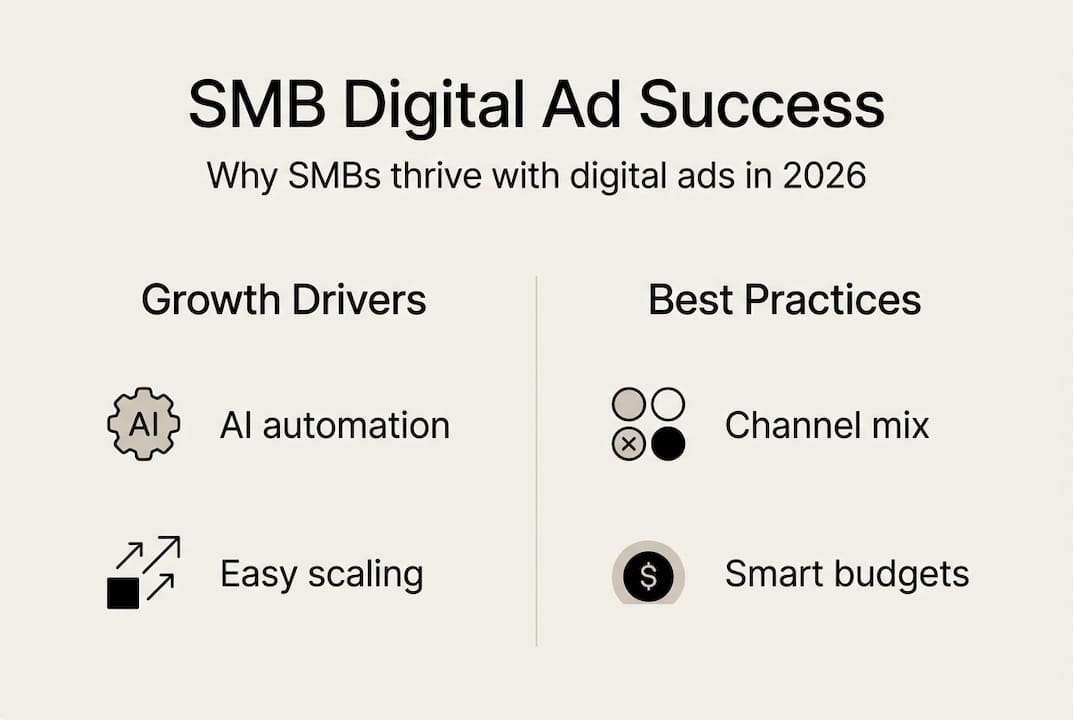
Emerging channels like connected TV (CTV) offer new opportunities as streaming replaces traditional television. These platforms provide targeting precision similar to social media but with the brand-building impact of video advertising.
Critical success factors for omni-channel marketing:
- Maintain consistent messaging across all platforms to reinforce brand recognition
- Track customer journeys to understand how different channels work together
- Allocate budgets proportionally based on each channel’s contribution to conversions
- Test new platforms with small budgets before committing significant resources
Understanding how to run social ads effectively for local businesses requires balancing broad awareness campaigns with conversion-focused ads. Start with awareness to build your audience, then retarget engaged users with specific offers.
B2B and B2C strategies differ significantly. B2C campaigns often see results within days or weeks as customers make quick purchase decisions. B2B requires nurturing prospects over months through educational content and repeated touchpoints before they’re ready to buy.
Pro Tip: Create a simple spreadsheet tracking daily spend, clicks, conversions, and cost per conversion for each campaign. Review this data weekly to spot trends and make informed optimization decisions. This discipline separates profitable campaigns from money pits.
Patience pays dividends in digital advertising. Your first campaigns rarely perform optimally out of the gate. Algorithms need data to learn, and you need time to understand what messages resonate with your audience. Commit to at least 90 days of consistent effort before judging overall effectiveness.
The benefits of online advertising compound over time as you build audience lists, refine targeting, and develop creative assets that convert. Each campaign teaches lessons that improve the next one, creating a virtuous cycle of improving performance and declining costs.
Enhance your digital advertising with expert help
Navigating the complexities of digital advertising while running your business can feel overwhelming. Expert guidance saves time and accelerates results by helping you avoid common mistakes and implement proven strategies from day one. Professional support means you benefit from experience across hundreds of campaigns without the trial-and-error learning curve.
Tailored strategies account for your specific industry, budget, and goals rather than generic one-size-fits-all approaches. Whether you’re investing $500 or $5,000 monthly, the right expertise maximizes every dollar through precise targeting and continuous optimization.
Explore comprehensive resources on why to invest in online advertising and effective advertising tips to deepen your knowledge. For ongoing campaign management, social media management services handle the daily optimization work while you focus on serving customers and growing your business.
Frequently asked questions
What is digital advertising and why is it important for SMBs?
Digital advertising uses online platforms like Google, Facebook, and Instagram to promote products or services to targeted audiences based on demographics, interests, and behaviors. It helps small and medium businesses reach customers efficiently and compete with larger companies by providing measurable results and flexible budgets that traditional advertising can’t match.
How can small businesses start digital advertising with a limited budget?
Begin with monthly campaigns between $300 and $1,500 focusing on precise audience targeting to maximize every dollar. Use AI-powered tools available on platforms like Google Ads and Meta to automate campaign creation, optimization, and bid management, reducing the time and expertise traditionally required for effective advertising.
What are common mistakes to avoid in digital advertising?
Avoid targeting broad audiences that waste 27% of impressions on irrelevant viewers who will never convert. Refresh your ad creative assets every 6-8 weeks to prevent fatigue that causes declining engagement and rising costs, and always track conversions rather than just clicks to measure actual business impact.
How long does it take to see results from digital advertising?
B2C campaigns often show initial results within days or weeks as customers make quick purchase decisions, while B2B advertising requires 2-3 months of consistent effort due to longer sales cycles. Commit to at least 90 days of testing and optimization before judging overall campaign effectiveness, as algorithms need time to learn and improve performance.
Which digital advertising platforms work best for small businesses in 2026?
Meta platforms (Facebook and Instagram) excel for B2C businesses targeting specific demographics and interests, while Google Search captures high-intent customers actively looking for solutions. LinkedIn serves B2B companies well, and emerging connected TV platforms offer brand-building opportunities with precise targeting as streaming replaces traditional television viewing.
Recommended
- Why invest in online advertising in 2026: A small business guide | Ibrandmedia
- Understanding Online Advertising: A 2025 Guide for Small Business | Ibrandmedia
- Digital branding drives 23% sales growth for SMBs in 2026 | Ibrandmedia
- Why Choose Digital Advertising: Smarter Reach, Measurable Growth
Recent Comments