
TL;DR:
- Brand positioning is the mental space a brand occupies relative to competitors and influences customer choice. It requires a clear internal framework based on five components: alternatives, attributes, customer value, target segment, and market category. Leaders must own the positioning to ensure consistent messaging, product decisions, and emotional connection that build long-term customer loyalty.
Brand positioning is defined as the distinct place a brand occupies in a customer’s mind relative to every competitor in its category. It is not a tagline or a logo. It is the answer to the question customers ask without realizing it: “Why this brand and not the other one?” For small business owners, understanding what is brand positioning means understanding the single most powerful tool for winning customers before a sales conversation even starts. Get it right, and your business becomes the obvious choice. Get it wrong, and you compete on price forever.
What is brand positioning and why does it matter?
Brand positioning is the strategic process of owning a mental space in the customer’s mind, not just broadcasting a public-facing slogan. It drives how customers actually perceive and choose between brands. That distinction matters enormously for small businesses, because perception shapes purchase decisions long before a customer reads your pricing page.

The importance of brand positioning shows up in a concrete way: when your positioning is clear, customers stop comparing you to alternatives and start demanding you specifically. Effective positioning directly influences brand insistence, the point where customers refuse substitutes, through relevance, differentiation, value, accessibility, and emotional connection. That is the difference between a business that grows through referrals and one that grinds through discounts.
Brand positioning vs branding is a distinction worth making early. Branding covers the visible expressions of your business: colors, fonts, tone of voice, and logo. Positioning is the underlying logic that tells you what those expressions should communicate. Branding without positioning is decoration. Positioning without branding is a strategy that never reaches the customer.
Pro Tip: Write your positioning in one sentence before you design anything. If you cannot state clearly who you serve, what you offer, and why you are different, no amount of visual branding will fix the confusion.
What are the five core components of a brand positioning framework?
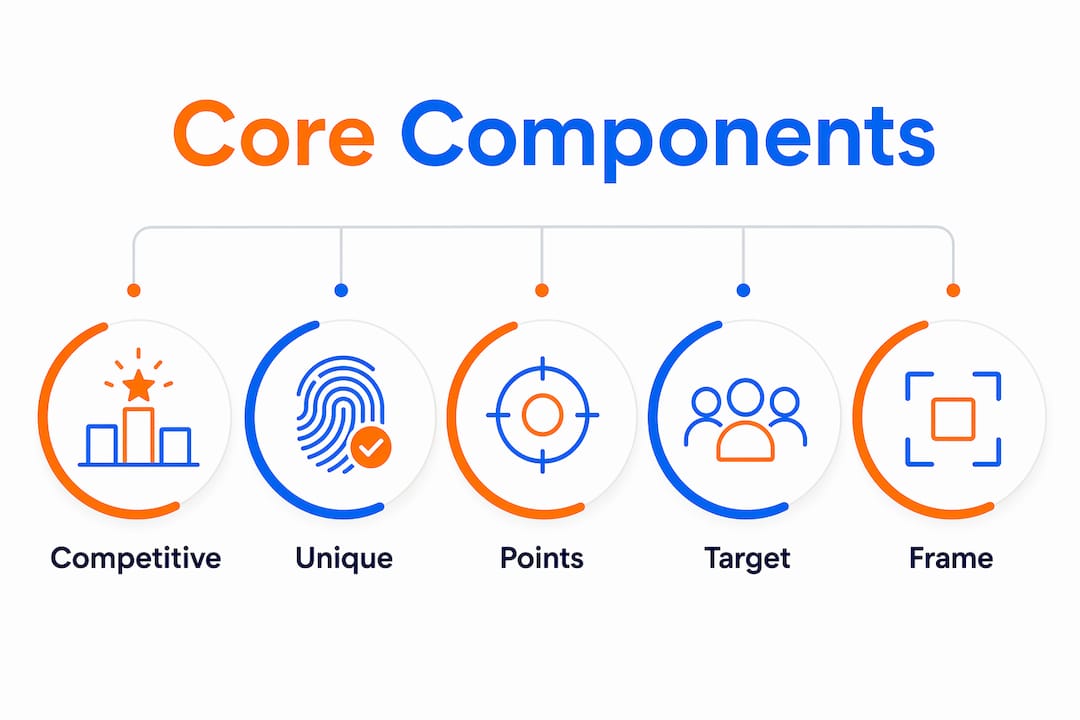
A strong brand positioning framework consists of five components that work together. Miss one, and the whole structure weakens.
- Competitive alternatives: Who would your customer choose if your brand did not exist? This is your real competitive set, not just the businesses you think of as rivals.
- Unique attributes: What does your brand deliver that competitors do not? These must be real, verifiable, and specific.
- Customer value: What does the customer gain from those unique attributes? Translate features into outcomes the customer actually cares about.
- Target market segment: Who, specifically, is this positioning for? A position that tries to speak to everyone speaks to no one.
- Market category: What category does your brand compete in? Positioning operates on both category and competitive levels, requiring clarity on both.
Most brands confuse features with points of difference. True differentiation is what a brand uniquely delivers and competitors cannot replicate. A local bakery that uses heritage grain from a single farm has a genuine point of difference. One that says “we bake with love” does not.
| Component | What to define |
|---|---|
| Competitive alternatives | Who customers choose instead of you |
| Unique attributes | What only you deliver |
| Customer value | The outcome the customer gains |
| Target segment | The specific group you serve best |
| Market category | The space you compete in |
An internal positioning statement ties all five components together. It is a single internal document, not a tagline, that aligns your team on who the brand is for, what it stands for, and why customers choose it. Every pricing decision, product launch, and marketing message should trace back to that statement.
Pro Tip: Test your positioning statement by showing it to a team member who was not involved in writing it. If they cannot explain your brand’s difference in their own words after reading it once, rewrite it.
Why is brand positioning a leadership decision?
Brand positioning is a leadership agenda item, not a task to delegate to a marketing coordinator. It creates alignment across strategy, culture, and execution. When leadership does not own positioning, different departments pull in different directions, and the brand sends mixed signals to the market.
“Positioning requires leaders to make deliberate trade-offs: choosing who to serve and, just as importantly, who not to serve. Without that clarity from the top, strategy fragments and culture drifts. The brand becomes a collection of disconnected messages rather than a coherent market presence.”
Leadership involvement in positioning shapes more than marketing copy. It guides product development priorities, hiring decisions, customer service standards, and pricing philosophy. Brand positioning requires top leadership involvement because it touches every part of the business, not just the communications team.
The practical signs of leadership-driven positioning are visible. Teams agree on which customers to pursue and which to turn away. Product decisions get made faster because the positioning filters out options that do not fit. Marketing campaigns feel consistent because every piece of content comes from the same strategic foundation.
- Leadership defines the competitive intent: what the brand will win at and what it will not try to win at.
- Leadership sets the emotional tone: whether the brand leads with confidence, warmth, expertise, or community.
- Leadership protects the positioning from short-term pressure to chase trends or copy competitors.
Pro Tip: Schedule a quarterly positioning review with your leadership team. Markets shift, and a positioning that was sharp two years ago can quietly become generic without anyone noticing.
How does emotional brand positioning strengthen customer loyalty?
Emotional brand positioning builds mental availability and customer loyalty by linking brand values to emotional needs. Mental availability means your brand comes to mind first when a customer faces a relevant buying situation. That recall advantage is worth more than any single advertising campaign.
Kantar research highlights the importance of emotional connection in creating lasting distinction. Customers do not just buy products. They buy the feeling of making a good decision, belonging to a community, or solving a problem that has frustrated them for years. A brand that connects to those feelings earns loyalty that price cuts from competitors cannot easily break.
Small businesses build emotional positioning through consistency and specificity, not through large budgets. Here is how that works in practice:
- Identify the one emotional need your best customers share. Is it confidence, relief, belonging, or pride?
- Align your brand language, visuals, and customer experience to reinforce that feeling at every contact point.
- Use brand storytelling to make the emotional connection concrete. Stories are more memorable than feature lists.
- Measure emotional resonance through customer feedback, not just sales data. Ask customers how your brand makes them feel.
The brands that small business owners most admire, whether a local coffee shop with a cult following or a regional service firm that clients recommend without prompting, all share one trait. They made customers feel something specific and repeated that feeling consistently.
- Emotional positioning creates a reason to choose you that competitors cannot copy by lowering their price.
- It reduces customer churn because loyalty built on feeling is stickier than loyalty built on convenience.
- It generates word-of-mouth referrals, because people share experiences that made them feel something, not experiences that were merely adequate.
What practical steps build and maintain effective brand positioning?
Developing a market position is not a one-time project. It is an ongoing discipline. These steps give small business owners a repeatable process for building and protecting their position.
-
Research your competitive landscape. Map who your customers currently choose and why. Talk to your best customers directly. Ask what they would do if your business closed tomorrow. Their answers reveal your real competitive alternatives and your genuine points of difference. Use audience segmentation to identify which customer groups value your difference most.
-
Define your target segment with precision. “Small business owners” is not a segment. “Independent restaurant owners in mid-sized cities who are losing lunch traffic to fast-casual chains” is a segment. The more specific your segment, the more powerful your positioning becomes.
-
Write an internal positioning statement. Use this structure: For target segment], [brand name] is the [market category] that [unique benefit] because [reason to believe]. Keep it to two sentences. Share it with your team. [A positioning framework speeds downstream decisions and unifies messaging by defining who the brand is for and why it is chosen over alternatives.
-
Align every customer touchpoint with the positioning. Your website copy, pricing structure, social media tone, and in-person experience should all reflect the same core promise. Inconsistency is the fastest way to erode a position you worked hard to build.
-
Guard against messaging drift. Consistency across all touchpoints builds durable brand equity over time. Messaging drift happens when teams add new campaigns, promotions, or product lines without checking them against the positioning statement. Assign one person the responsibility of reviewing all external communications against the positioning before they go live.
-
Revisit and sharpen your positioning annually. Markets shift. New competitors enter. Customer needs evolve. A positioning review does not mean starting over. It means checking whether your current position still reflects a real and defensible difference, and adjusting the language if the market has moved.
Pro Tip: The most common positioning mistake small businesses make is trying to be the best at everything. Pick one thing your brand wins at and make that the center of your positioning. Customers remember one clear idea, not a list of strengths.
Key Takeaways
Strong brand positioning is the foundation of every marketing decision a small business makes, from pricing to product development to the words on your homepage.
| Point | Details |
|---|---|
| Positioning is a mental space | It defines how customers perceive and choose your brand relative to competitors. |
| Five components are required | Competitive alternatives, unique attributes, customer value, target segment, and market category must all be defined. |
| Leadership must own it | Positioning guides culture, product, and pricing, not just marketing messages. |
| Emotional connection drives loyalty | Linking brand values to customer feelings creates recall and reduces churn. |
| Consistency protects equity | Messaging drift erodes positioning. Review all touchpoints against your positioning statement regularly. |
Why small businesses underestimate their most durable asset
Most small business owners I work with treat positioning as something they will figure out once the business is more established. That is exactly backwards. Positioning is most powerful when it is set early, because every decision made without it pulls the brand in a slightly different direction. After two or three years of that, the brand has no clear identity, and fixing it costs far more than getting it right from the start.
The other mistake I see constantly is confusing positioning with messaging. Owners rewrite their tagline or refresh their website and call it repositioning. Real positioning work happens internally first. It is a leadership conversation about trade-offs, not a copywriting exercise. When I see a small business that has genuine word-of-mouth momentum and loyal customers who pay full price without complaint, there is almost always a clear, consistent position underneath it, even if the owner has never written it down formally.
The businesses that build a strong online brand presence and sustain it over years are the ones that treat positioning as a living asset. They protect it, sharpen it, and make sure every new hire and every new campaign reflects it. That discipline compounds. A brand that is consistently positioned for five years is worth more than one that has been redesigned three times chasing trends.
— TONY
How Ibrand helps small businesses build their market position
Ibrand works with small business owners who know their product is good but struggle to communicate why it is the right choice. The team at Ibrand builds brand visibility through SEO and digital marketing strategies that are grounded in clear positioning. That means your website, your content, and your local search presence all reinforce the same core message rather than sending mixed signals to potential customers. If you want your brand to own a clear space in your market and attract the customers who are already looking for exactly what you offer, Ibrand has the tools and the experience to make that happen.
FAQ
What is brand positioning in simple terms?
Brand positioning is the specific place your brand holds in a customer’s mind compared to competitors. It defines why a customer chooses you over every other option available.
What is the difference between brand positioning and branding?
Branding covers the visible elements of your business, such as your logo, colors, and tone. Positioning is the underlying strategy that determines what those elements should communicate and to whom.
How do you write a brand positioning statement?
A positioning statement follows this structure: For [target segment], [brand name] is the [category] that delivers [unique benefit] because [reason to believe]. It is an internal document, not a public tagline.
Why does emotional positioning matter for small businesses?
Emotional brand positioning builds mental availability, making your brand the first one customers recall in a buying situation. That recall advantage reduces price sensitivity and increases referrals.
How often should a small business review its brand positioning?
A positioning review should happen at least once a year, or whenever a significant market shift occurs, such as a new competitor entering your category or a change in customer behavior.
Recent Comments