
TL;DR:
- Analytics helps med spas make evidence-based marketing decisions using client data and operational reports. Building tracking systems and analyzing metrics like lifetime value and attribution models improves profitability and operational efficiency. Most practices focus on volume metrics instead of value metrics, limiting growth and ROI.
Analytics in med spa marketing is defined as the systematic use of client data, campaign metrics, and operational reporting to make marketing decisions based on evidence rather than intuition. The role of analytics in med spa marketing has grown more critical as healthcare marketing budgets shrank from 9.6% of revenue in 2023 to 7.2% in 2024, forcing med spa owners to prove ROI on every dollar spent. The industry term for this practice is “marketing performance management,” and it covers everything from patient acquisition cost to treatment-level profitability. Med spas that build their marketing around data consistently outperform those that rely on gut feel, and the gap is widening.
How analytics identifies high-value med spa client segments
Client segmentation is the foundation of data-driven marketing for med spas. It means grouping clients by shared characteristics so you can target the right people with the right message at the right time. Without segmentation, you spend equally on clients who book once and clients who return every six weeks.

Analytics pulls segmentation data from three main sources: your CRM, your booking system, and your digital channels. Each source reveals a different layer of client behavior. Together, they build a complete picture of who your most valuable clients actually are.
High-LTV (lifetime value) clients share predictable attributes. Tracking these attributes lets you find more clients who match the same profile. The most useful segment variables for med spas include:
- Treatment preferences: Clients who book injectables quarterly spend more annually than those who book single facial treatments.
- Acquisition channel: Clients who found you through organic search tend to have higher retention rates than those from discount platforms.
- Demographics and geography: Age range and zip code predict which services resonate and which promotions convert.
- Visit frequency and recency: A client who visited three times in the last six months is far more valuable than one who visited once two years ago.
- Referral behavior: Clients who refer others multiply your acquisition value without adding cost.
Predictive analytics takes segmentation further. By analyzing historical booking patterns, you can forecast which clients are likely to lapse and trigger a retention campaign before they leave. Only 35% of med spa practices use dedicated CRM software, which means the majority cannot accurately track these segments at all. A CRM is not optional if you want to allocate budget toward your best clients and stop wasting spend on low-value ones.
Pro Tip: Rank your client list by total revenue generated over 12 months. The top 20% almost always account for the majority of your revenue. Build a separate campaign targeting clients who match that profile but have not yet reached that spend level.
What metrics and tools do med spas use to track marketing performance?
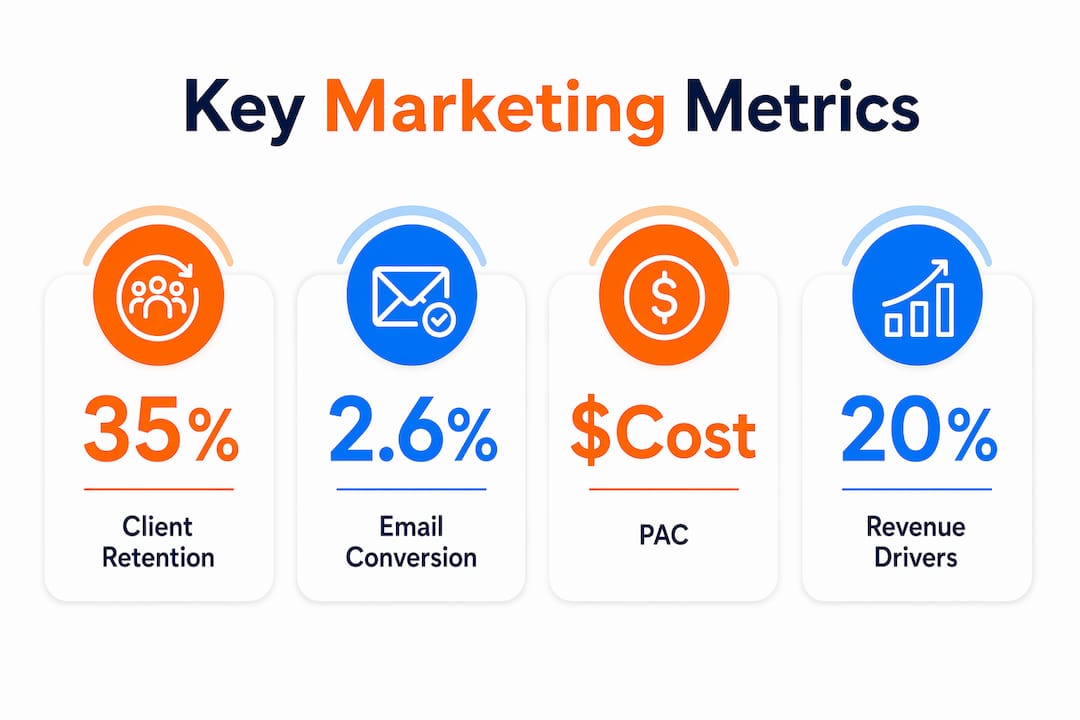
The core performance metrics in spa marketing fall into four categories: acquisition, conversion, retention, and channel attribution. Each category answers a different question about where your marketing is working and where it is not.
Acquisition and conversion metrics
Patient acquisition cost (PAC) measures how much you spend to bring in one new client. Conversion rate measures how many leads become paying clients. Lead response time under 5 minutes increases conversion rates 10x compared to waiting 30 minutes. That single metric, response speed, is one of the highest-leverage variables in your entire funnel.
Healthcare email marketing achieves open rates between 22% and 36% with an average conversion rate of 2.6%. Email remains one of the most measurable channels available to med spas, and those numbers give you a clear benchmark to test against.
Attribution models: moving past last-click
Most med spa owners default to last-click attribution, which credits the final touchpoint before a booking. That model systematically undervalues the blog post, the Instagram ad, and the email that built trust over weeks. Extended healthcare decision cycles require multi-touch attribution models like time-decay or position-based to fairly credit every channel that contributed to a conversion.
The table below compares the two most practical attribution models for med spa marketing:
| Attribution model | How it works | Best use case |
|---|---|---|
| Time-decay | Credits touchpoints closer to conversion more heavily | Short sales cycles, promotional campaigns |
| Position-based | Splits credit between first touch (40%), last touch (40%), and middle touches (20%) | New client acquisition with multi-step nurturing |
Pro Tip: Set up Google Analytics 4 with a CRM integration before you run your next paid campaign. Without that connection, you cannot see which ad drove a booking. You will only see which ad drove a click.
Tools that support med spa digital marketing analytics
Google Analytics 4 tracks website behavior, traffic sources, and goal completions. A CRM with booking integration connects that web data to actual revenue. Platforms that track treatment-level ROI, patient lifetime value, and marketing channel ROI give med spa owners the clearest picture of which services and which campaigns actually generate profit. Integrating marketing automation with CRM and analytics dashboards enables systematic tracking of KPIs like lifetime value, patient acquisition cost, and retention rates. That integration is what separates a med spa running on data from one running on assumptions.
How does analytics improve med spa operational efficiency?
Analytics in wellness clinics extends well beyond marketing campaigns. Operational data reveals where revenue leaks before it ever reaches your marketing funnel. A fully booked schedule that still underperforms financially almost always has an operational problem, not a marketing problem.
Unsynchronized scheduling and poor room velocity cause revenue leakage that analytics can detect and fix. Room utilization rate measures how much of your available treatment time is actually generating revenue. A room sitting idle during peak hours is a direct cost, and no amount of ad spend fixes a scheduling gap.
The table below shows the key operational metrics med spa managers should review weekly:
| Metric | What it measures | Why it matters |
|---|---|---|
| Room utilization rate | Percentage of available treatment hours booked | Identifies scheduling gaps that reduce revenue |
| Staff hours per treatment | Labor cost relative to service revenue | Reveals overstaffing or underperforming service lines |
| Front desk conversion rate | Calls and inquiries that result in bookings | Exposes training gaps and lost revenue at intake |
| No-show and cancellation rate | Appointments lost without rebooking | Quantifies revenue leakage from poor confirmation systems |
Weekly tracking of room utilization and staff hours combined with revenue cycle data identifies revenue leaks more accurately than simply adding marketing budget. That is a counterintuitive finding for most med spa owners, who assume more ad spend solves a revenue problem. Often, the fix is operational, and analytics is the only way to see it clearly.
Operational data also feeds back into marketing. A high no-show rate in a specific client segment tells you that segment needs a different confirmation sequence. A service with low room utilization might need a targeted promotion rather than a price cut.
Practical steps to build an analytics-driven marketing system
Building a data-driven marketing system for your med spa does not require a data science team. It requires a clear process and the discipline to follow it.
-
Audit your current tracking. Confirm that Google Analytics 4 is installed, goals are configured, and your booking system passes conversion data back to your analytics platform. If these three things are not in place, every metric you see is incomplete.
-
Set baseline metrics. Before running any new campaign, record your current patient acquisition cost, lead-to-booking conversion rate, and average client lifetime value. These baselines are the only way to measure whether a campaign actually improved performance.
-
Map your marketing funnel. Identify every touchpoint from first awareness to first booking. Assign a tracking mechanism to each one. A client who finds you on Instagram, reads your blog, and then books via email represents three touchpoints. All three need to be visible in your attribution model.
-
Run structured tests. Change one variable at a time. Test one subject line, one ad creative, or one landing page headline. Changing multiple variables simultaneously makes it impossible to know what drove a result.
-
Reallocate budget based on data, not habit. Multi-channel campaigns combining PPC and SEO improve patient volume by about 47% compared to using either channel alone. If your data shows that organic search drives higher-LTV clients than paid social, shift budget accordingly.
-
Respond to leads within 5 minutes. Build a system, whether automated or staffed, that contacts every new inquiry within that window. The conversion impact is not marginal. It is a 10x difference.
-
Review and act weekly. Set a fixed weekly time to review your core metrics. Analytics without a review cycle is just data collection. The value comes from the decisions the data informs.
Pro Tip: Use UTM parameters on every link in every campaign. Without UTMs, Google Analytics cannot distinguish traffic from a Facebook ad from traffic from an email. UTMs take two minutes to set up and make attribution dramatically more accurate.
Key Takeaways
Analytics converts med spa marketing from a cost center into a measurable growth engine by connecting client behavior, campaign performance, and operational data into one decision-making system.
| Point | Details |
|---|---|
| Segment clients by lifetime value | Use CRM and booking data to identify high-LTV clients and target similar prospects. |
| Use multi-touch attribution | Time-decay and position-based models credit the full client journey, not just the last click. |
| Track operational metrics weekly | Room utilization and staff hours reveal revenue leaks that more ad spend cannot fix. |
| Respond to leads within 5 minutes | Faster response time produces dramatically higher conversion rates from the same lead volume. |
| Integrate tools before spending | Connect Google Analytics 4, your CRM, and booking system before launching paid campaigns. |
Why most med spas are measuring the wrong things
Med spa owners almost universally focus on the wrong metric first: total bookings. Bookings feel like success. But I have worked with practices that were fully booked and still losing money because they had no visibility into which services, which clients, and which channels were actually profitable.
The shift that changes everything is moving from volume metrics to value metrics. Total bookings is a volume metric. Patient lifetime value, treatment-level ROI, and acquisition cost by channel are value metrics. They tell you not just how much activity you generated, but whether that activity was worth the spend.
The other mistake I see constantly is the last-click attribution trap. A med spa owner runs Instagram ads for three months, sees no direct bookings attributed to Instagram, and cuts the budget. What the data does not show is that Instagram was the first touchpoint for 40% of clients who eventually booked through Google search. Cutting Instagram tanks organic conversions two months later, and the owner never connects the two events.
Operational analytics is the most underused tool in the category. Most med spa owners think of analytics as a marketing function. The practices I have seen grow fastest treat it as a business intelligence function. They track room velocity, front desk conversion, and no-show rates with the same rigor they apply to ad performance. That combination is what separates a practice growing at 15% annually from one that is flat.
The mindset shift is simple but not easy: stop making decisions based on what feels like it is working and start making them based on what the data shows is working. The role of analytics in marketing is to remove that gap between perception and reality.
— TONY
How Ibrand helps med spas build measurable marketing systems
Med spa marketing produces results when every campaign is tracked, every channel is measured, and every budget decision is backed by data. Ibrand builds digital marketing systems for small and medium-sized businesses, including med spas, that connect SEO, paid advertising, and social media to real performance data.
Ibrand’s approach starts with search visibility and builds outward through campaign tracking and real-time reporting. Every client gets a personalized plan built around their specific growth goals, not a generic package. If your med spa is ready to replace guesswork with a system that shows exactly what is working, contact Ibrand to request a custom strategy session.
FAQ
What is the role of analytics in med spa marketing?
Analytics in med spa marketing means using client data, campaign metrics, and operational reports to make marketing decisions based on evidence. It covers patient acquisition cost, lifetime value, channel attribution, and retention rates.
How does analytics improve the client experience at a med spa?
Analytics identifies which client segments have the highest satisfaction and retention rates, allowing you to tailor communications, offers, and follow-up sequences to match their preferences. Operational data also reduces scheduling friction, which directly improves the client experience.
What is the best attribution model for med spa marketing?
Position-based or time-decay attribution models work better than last-click for med spas because clients typically interact with multiple channels before booking. Last-click attribution undervalues early-stage touchpoints like social media and blog content.
Why do most med spas struggle with marketing ROI?
Only 35% of med spa practices use dedicated CRM software, which makes accurate attribution nearly impossible. Without connecting booking data to marketing spend, ROI calculations are incomplete.
How quickly should a med spa respond to new leads?
Responding within 5 minutes produces conversion rates 10x higher than waiting 30 minutes. Automated follow-up systems or dedicated intake staff are the most reliable ways to hit that window consistently.
Recent Comments