
TL;DR:
- Lead generation is a continuous system of attracting, qualifying, and nurturing prospects who are likely to buy. Small businesses improve results by defining their ideal customer profile, using targeted strategies, and measuring conversion rates by channel. Patience, consistency, and focus on quality leads deliver better long-term sales than chasing high volume with poor fit.
Lead generation is the process of attracting potential customers and converting them into contacts with genuine buying interest. For small business owners, understanding lead generation is the difference between chasing random prospects and building a predictable pipeline of people who actually want what you sell. The industry term is “demand generation” at the broader level, but lead generation specifically refers to the capture and qualification stage. Done right, it replaces guesswork with a system that feeds your sales process consistently. This guide breaks down every stage, from attraction to conversion, so you can build that system without wasting budget or time.
What is explaining lead generation and why does it matter?
Lead generation is defined as the structured process of identifying, attracting, and capturing potential buyers at the moment they show interest. It matters because 79% of all leads never convert, mostly due to poor targeting, bad timing, or no follow-up. That statistic means the majority of marketing spend goes to waste when there is no system behind it.

The core goal is not volume. It is quality. A lead’s value depends entirely on how well that person matches your Ideal Customer Profile (ICP) and whether they show active buying intent signals. Chasing raw numbers without filtering by fit and intent wastes your sales team’s time and your marketing budget.
For small business owners, this distinction is especially important. You do not have the resources to pursue every possible contact. A focused lead generation system lets you spend time on the people most likely to buy, which makes your entire operation more efficient.
What are the essential components and stages of lead generation?
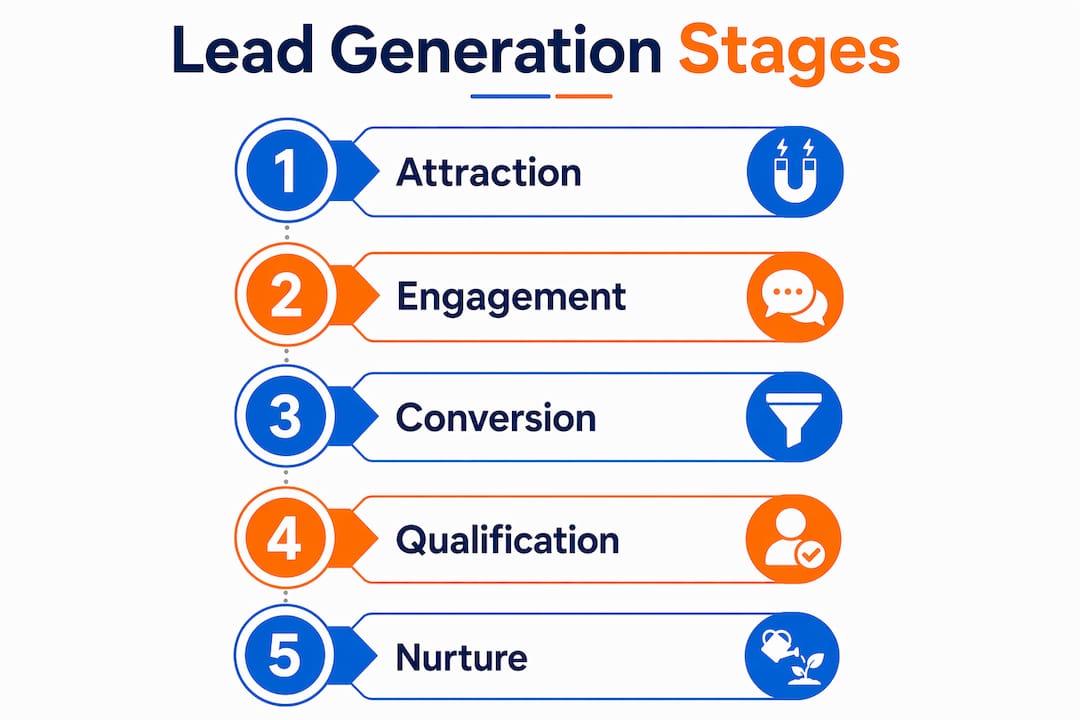
Lead generation works as a five-stage process. Each stage connects to the next, and a breakdown at any point weakens the entire system.
| Stage | What happens | Why it matters |
|---|---|---|
| Attraction | Content, ads, or outreach bring prospects to your brand | No traffic means no leads |
| Capture | A form, call, or landing page collects contact details | Converts visitors into identifiable contacts |
| Qualification | You filter leads by fit and intent | Removes low-probability prospects early |
| Nurturing | Emails, content, and follow-ups build trust over time | Keeps warm leads engaged until they are ready to buy |
| Conversion | A qualified lead becomes a paying customer | The payoff for every earlier stage |
The Ideal Customer Profile defines who you are trying to attract. It includes job role, company size, location, pain points, and budget range. Without a clear ICP, your attraction efforts pull in the wrong people, and your qualification stage becomes overwhelmed with poor-fit contacts.
Buyer intent refers to the signals a prospect sends that indicate they are actively considering a purchase. These signals include visiting your pricing page, downloading a product guide, or replying to an outreach email. Lead generation works best as a connected, continuous system where attraction, qualification, and nurturing run in sync. Isolated campaigns that skip nurturing or ignore intent signals consistently underperform.
What lead generation strategies are most effective for small businesses?
The most effective strategies for small businesses depend on your timeline and your ICP. The two main approaches are inbound and outbound, and each serves a different need.
Inbound lead generation pulls prospects toward you through content, SEO, and social media. It takes 9–12 months to build momentum, but it produces leads who already trust your brand before they contact you. Outbound lead generation pushes your message directly to prospects through cold email, calls, or paid ads. It generates results in under three months, but requires more active effort and budget. A hybrid strategy runs both in parallel, which gives you short-term pipeline while building long-term authority.
| Tactic | Best for | Key advantage | Watch out for |
|---|---|---|---|
| Content marketing | Inbound, long-term | Builds trust and organic traffic | Slow to produce results |
| Cold email outreach | Outbound, short-term | Direct and measurable | Requires strong personalization |
| Referral programs | Both timelines | High trust, low cost | Needs existing happy customers |
| Paid search ads | Outbound, fast | Immediate visibility | Costs rise without tight targeting |
| Local SEO | Inbound, long-term | Captures nearby buyers | Requires consistent optimization |
Cold email works best when it is personalized and triggered by a relevant event. Trigger-based outbound strategies yield 3–5 times higher reply rates than generic outreach because the message arrives at a moment of relevance. For example, emailing a prospect the week they announce a new hire or a funding round is far more effective than a cold pitch with no context.
Account-based marketing (ABM) takes personalization further by targeting specific companies and mapping every stakeholder in the buying group. Well-run ABM programs achieve 15–25% meeting rates at target accounts, compared to 1–3% for generic outbound. That gap is significant for a small business where every sales conversation counts.
Focusing on 3–5 aligned strategies produces better results than spreading effort across every available channel. Pick the tactics that match your ICP, your timeline, and your budget, then execute them well before adding more.
Pro Tip: Before choosing a channel, ask where your ICP already spends time online. If your best customers use LinkedIn, start there. If they search Google for local services, prioritize local SEO. Channel selection should follow your customer, not industry trends.
For practical channel selection guidance, Ibrand’s resource on choosing marketing channels walks through the decision process for businesses with limited budgets.
How do you qualify and nurture leads to boost conversion rates?
Lead qualification is the process of deciding which contacts are worth pursuing and which are not. The two criteria that matter most are fit and intent. Fit measures how closely a prospect matches your ICP. Intent measures how actively they are considering a purchase. A prospect with high fit and low intent needs nurturing. A prospect with high intent but poor fit is a distraction.
Lead scoring assigns point values to prospect behaviors and profile attributes. A prospect who visits your pricing page three times in a week scores higher than one who opened a single email six months ago. Scoring helps you route leads to the right next step: a sales call for high scorers, a nurture sequence for mid-range contacts, and removal from the list for poor fits.
Key nurturing activities that keep leads engaged include:
- Sending educational content that addresses the prospect’s specific pain point
- Sharing case studies or testimonials that match the prospect’s industry or situation
- Following up after a prospect takes a specific action, such as downloading a guide
- Checking in at regular intervals without pitching on every contact
- Inviting prospects to webinars, events, or free consultations that demonstrate your expertise
High-performing nurture sequences follow the 70/20/10 rule: 70% educational content, 20% social proof, and 10% direct sales offers. This ratio prevents lead fatigue, which happens when prospects feel they are being sold to on every interaction. Lead fatigue causes unsubscribes and kills relationships that could have converted later.
B2B buying decisions often involve multiple stakeholders, including technical evaluators, end users, and budget holders. Sending the same message to all three roles is a common mistake. Tailor your nurture content to each role’s specific concerns to reduce deal risk and keep the entire buying group engaged.
Pro Tip: Set a “breakup email” at the end of a nurture sequence for leads who never respond. A short, direct message asking if they are still interested often reactivates 10–15% of dormant contacts. It also keeps your list clean.
For a step-by-step approach to building your lead pipeline, Ibrand’s guide on how to get more leads covers practical implementation from capture to conversion.
What common mistakes should small businesses avoid in lead generation?
The most damaging mistake in lead generation is treating it as a series of one-off campaigns rather than a continuous system. A campaign that runs for six weeks and then stops leaves your pipeline empty the moment it ends. Lead generation requires ongoing attraction, qualification, and nurturing running together at all times.
Targeting too broadly is the second most common error. When your ICP is vague, your ads and content attract people who will never buy. This inflates your lead count while reducing your conversion rate, which makes your results look worse over time, not better.
Poor data hygiene compounds both problems. Outdated contact information, duplicate records, and unqualified contacts left in your database slow down your sales process and skew your reporting. Clean your list quarterly at minimum.
Ignoring intent signals is equally costly. Filtering prospects by buying readiness is the critical differentiator between businesses that convert efficiently and those that burn through leads without results. A prospect who visited your website twice last week is far more valuable than one who signed up for your newsletter eight months ago and never engaged again.
Pro Tip: Track your lead-to-customer conversion rate by channel, not just total lead volume. If one channel produces twice the leads but half the conversions, it is costing you more than it returns. Measure what matters.
For a deeper look at the obstacles small businesses face, Ibrand’s article on lead generation challenges identifies the most common pitfalls and how to avoid them.
Key Takeaways
Effective lead generation is a continuous system that combines clear targeting, consistent nurturing, and intent-based qualification to convert the right prospects into paying customers.
| Point | Details |
|---|---|
| Define your ICP first | Every tactic works better when you know exactly who you are trying to attract. |
| Choose inbound or outbound by timeline | Use outbound for results under 3 months; build inbound for long-term pipeline. |
| Qualify by fit and intent | High volume means nothing without filtering for prospects who are ready to buy. |
| Follow the 70/20/10 nurture rule | Send 70% educational content, 20% social proof, and 10% direct offers to avoid lead fatigue. |
| Treat lead generation as a system | Isolated campaigns fail; attraction, qualification, and nurturing must run continuously. |
What I have learned from watching small businesses get lead generation wrong
Most small business owners I have worked with start lead generation the same way: they pick a channel, run a campaign, and wait for results. When the results disappoint, they switch channels and repeat the cycle. The problem is never the channel. The problem is the absence of a system.
The businesses that generate leads consistently are not the ones with the biggest budgets. They are the ones who defined their ICP clearly, built a nurture sequence before they needed it, and measured conversion rates by channel from day one. They also accepted that inbound takes time. Patience is not a soft skill in lead generation. It is a competitive advantage, because most competitors quit before the compounding effect kicks in.
Quality beats quantity every time. I have seen businesses with 50 well-qualified leads outperform competitors with 500 poorly targeted ones. The math is simple: a smaller list of the right people converts at a higher rate and costs less to manage. Focus your effort, measure what converts, and iterate. That is the entire playbook.
— TONY
How Ibrand helps small businesses build stronger lead pipelines
Small businesses that want to generate leads online need two things working together: a website that captures interest and a search presence that attracts the right visitors. Ibrand specializes in both, with SEO and digital marketing services built specifically for small and local businesses.
Ibrand’s guide to SEO for small businesses covers how to build search visibility that brings qualified traffic to your site consistently. For businesses ready to turn that traffic into leads, Ibrand’s resource on optimizing websites for search walks through the technical and content changes that improve lead capture rates. Both resources are free and built for owners who want practical steps, not theory.
FAQ
What is lead generation in simple terms?
Lead generation is the process of attracting potential customers and collecting their contact information so you can follow up and convert them into buyers. It is the first step in any sales process.
How long does lead generation take to show results?
Outbound strategies like cold email can produce leads in under three months. Inbound strategies like SEO and content marketing typically take 9–12 months to build consistent pipeline.
What is the difference between a lead and a qualified lead?
A lead is any contact who has shown some interest in your business. A qualified lead matches your Ideal Customer Profile and shows active buying intent, making them far more likely to convert.
Why do most leads fail to convert?
79% of leads never convert due to poor targeting, bad timing, or a failure to follow up with a nurture sequence. Fixing these three issues dramatically improves conversion rates.
How many lead generation channels should a small business use?
Start with 3–5 channels that align with your ICP and budget. Spreading effort across too many channels at once reduces the quality of execution on each one and lowers overall results.
Recent Comments