
Every plumber and HVAC technician knows what it feels like when a slow week turns quiet phone lines into missed paydays. Getting noticed online is no longer just for major franchises—smart use of SEO means your small business in any American or Canadian city can compete and win customers cost-effectively. With strategies that bring qualified leads around the clock, you can turn your website into an always-on sales team that connects you with homeowners searching for your services right now.
Table of Contents
- SEO For Small Businesses Explained
- Types Of SEO: Local, On-Page, And AI Trends
- Affordable Strategies That Drive Local Traffic
- Mistakes Small Businesses Must Avoid
- Measuring Results And ROI In 2026
Key Takeaways
| Point | Details |
|---|---|
| Understanding SEO Importance | SEO optimizes your online presence, making it easy for potential customers to find you on Google, generating business around the clock without ongoing costs. |
| Local SEO Focus | Prioritize local SEO strategies to enhance visibility in geographic searches, crucial for service providers. |
| Regular Performance Measurement | Use tools like Google Analytics to track essential metrics, focusing on conversion rates and organic traffic to measure SEO effectiveness. |
| Avoid Common Mistakes | Ensure your website is mobile-friendly and contains unique, relevant content to improve your rankings and avoid penalties. |
SEO for Small Businesses Explained
Small business SEO is straightforward: it’s the process of optimizing your online presence so potential customers find you when searching on Google. For service providers like plumbers and HVAC technicians, this means showing up when someone searches “plumber near me” or “emergency AC repair in [your city].” Unlike paid advertising, SEO works around the clock without draining your budget.
What SEO actually does for your business:
- Brings qualified customers to your website 24 hours a day, even while you’re on a job
- Costs significantly less than paying for ads each month
- Builds trust because customers see you ranked among top results
- Generates steady work for months and years, not just days
How SEO differs from paid advertising:
Paid ads stop working the moment you stop paying. SEO is different. Once you rank well for “water heater installation” or “furnace repair,” you keep getting clicks and calls. This cost-effective, generates continuous customer access strategy allows plumbers and HVAC companies to compete with larger franchises without massive marketing budgets.
Small business SEO involves three core components working together. First comes keyword research, finding what your customers actually search for. Second is content optimization, making sure your website answers their questions. Third is balancing local search (customers in your service area) with broader strategies (expanding into new territories).
For a plumber in Toronto, this might mean targeting “emergency plumbing Toronto” and “pipe replacement near me.” For an HVAC technician in Phoenix, it’s “AC repair Phoenix” and “furnace maintenance.” These specific searches convert browsers into paying customers.
When done right, SEO becomes your always-on sales team, working while you sleep and bringing customers directly to your phone.
Many service business owners skip SEO thinking it’s too complicated. The truth is simpler: Google wants to send customers to businesses that answer their questions clearly. Your job is to make it easy for Google to understand what you do and where you do it.
Understanding how SEO works for small businesses helps you see why certain tasks matter more than others. Local search optimization becomes especially critical for service providers with geographic limitations.
Pro tip: Start by listing 10 specific customer problems your business solves (“My toilet runs constantly,” “My AC isn’t cooling my upstairs”), then build website content answering each one with simple, direct language.
Types of SEO: Local, On-Page, and AI Trends
SEO isn’t one-size-fits-all. Different strategies target different goals, and as a service provider, you need to understand which ones matter most for your business. The main types of SEO strategies each serve a specific purpose in getting customers to find you.
Local SEO: The lifeline for service providers.
This is your priority. Local SEO targets customers searching in your specific geographic area. When someone searches “plumber near me” or “HVAC repair in my neighborhood,” local SEO puts your business in front of them.
Key elements of local SEO include:
- Claiming and optimizing your Google Business Profile
- Getting your address, phone number, and hours correct everywhere online
- Building local citations (mentions of your business on directories)
- Collecting customer reviews on Google and trusted platforms
- Creating location-specific content for service areas you cover
Local SEO strategies work best when combined with honest, consistent business information across all online platforms.
On-Page SEO: Making your website speak Google’s language.
On-page optimization means improving individual pages so Google understands what you offer. This includes writing clear page titles, using relevant keywords naturally, and organizing content with headings that answer customer questions.
Your plumbing website should have pages titled “Pipe Burst Repair Toronto” not just “Services.” Your HVAC site needs “Emergency AC Repair Phoenix” not “About Us.” Specific titles and clear structure help both Google and customers understand exactly what you do.
Off-Page and Technical SEO: Building authority.
Off-page SEO means getting other websites to link to yours, signaling to Google that you’re trustworthy. Technical SEO ensures Google can actually crawl and index your website properly. Both matter, but they take longer to show results.
AI trends reshaping SEO right now.
AI is changing how people search. Voice search (“Hey Google, find a plumber near me”) now accounts for growing search traffic. Generative AI tools like ChatGPT are changing how content ranks. Smart business owners adapt by creating content that answers actual customer questions conversationally, not just keyword-stuffed pages.
Local SEO drives immediate revenue for service businesses; national SEO trends matter more for established brands with multiple locations.
For your plumbing or HVAC business, focus 80 percent of effort on local SEO and on-page optimization. These two deliver the fastest customer leads and sales.
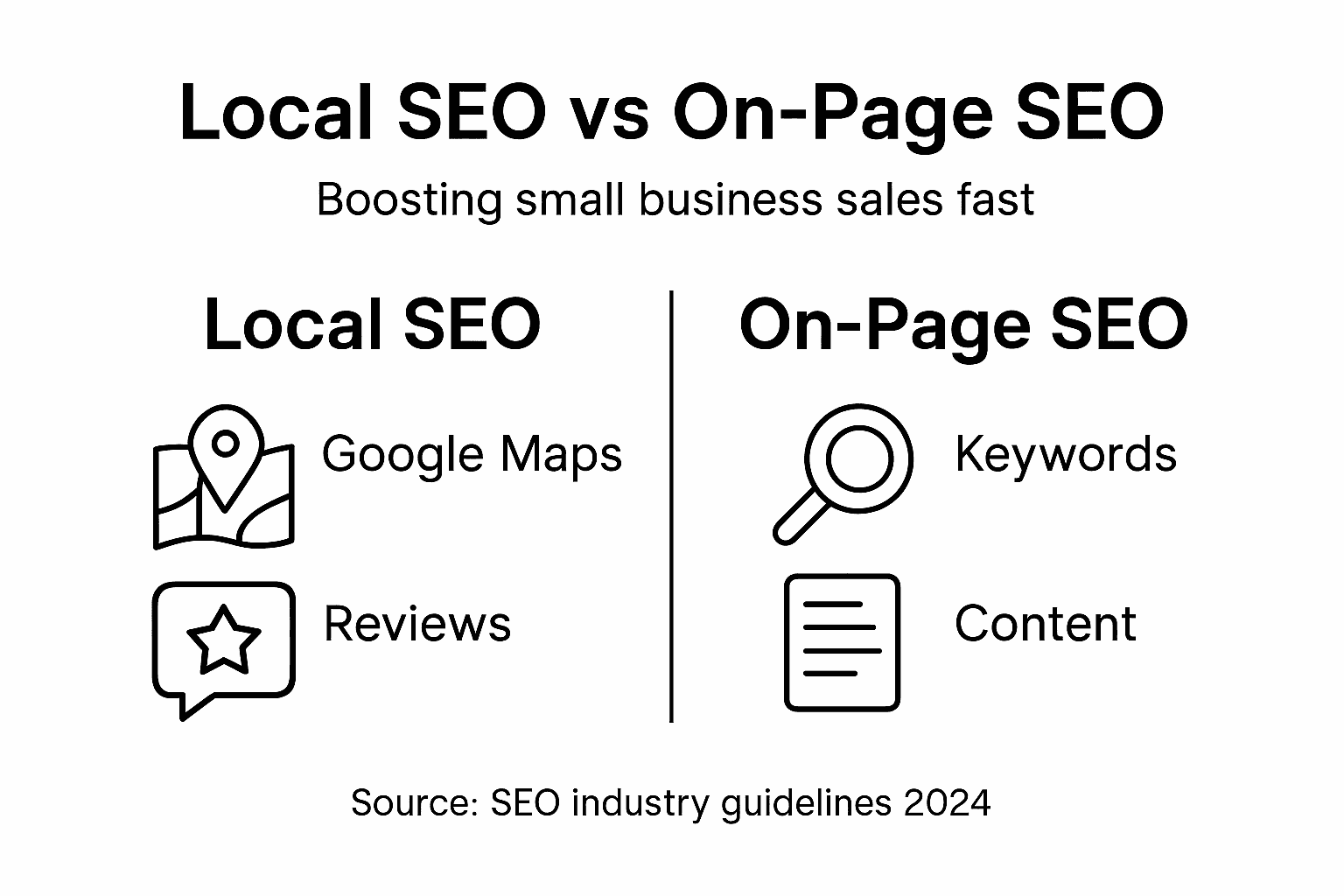
Here’s a comparison of core SEO strategies for service businesses:
| SEO Type | Main Focus | Best For | Typical Impact |
|---|---|---|---|
| Local SEO | Geographic search results | Plumbers, HVAC, local firms | Higher local visibility |
| On-Page SEO | Content and keywords | All small businesses | Clearer site messaging |
| Off-Page SEO | Building external links | Companies seeking authority | Boosts search credibility |
| Technical SEO | Site structure and indexing | Tech-savvy businesses | Better Google crawling |
| AI-Driven Trends | Voice & conversational search | Forward-thinking companies | Adapting to new search modes |
Pro tip: Audit your Google Business Profile today—fix any incorrect information, add high-quality photos of your work, and respond to every review within 24 hours to signal active engagement to both Google and potential customers.
Affordable Strategies That Drive Local Traffic
You don’t need a massive budget to dominate local search. Smart tactics cost far less than traditional advertising while delivering customers who are actively looking for your services right now. The key is focusing on strategies that give you the biggest return on your time and money.
Google Business Profile optimization: Your free marketing powerhouse.

This single tool reaches more potential customers than anything else you’ll do. Your Google Business Profile appears when someone searches your service plus location. It’s completely free and directly influences whether customers call you or a competitor.
Optimize it by:
- Adding clear, professional photos of your work (not generic stock images)
- Writing detailed service descriptions using language customers actually use
- Posting regular updates about seasonal services or special offers
- Responding to every review within 24 hours, positive or negative
- Keeping your phone number, address, and hours perfectly accurate
Local keyword targeting without breaking the bank.
You don’t need expensive keyword research tools. Start by asking yourself: “What specific problems do my customers search for?” A plumber might target “emergency plumbing near me,” “running toilet fix,” or “water heater replacement [city].” An HVAC technician targets “AC repair [neighborhood],” “furnace won’t start,” or “seasonal maintenance.”
Then write blog posts and service pages answering these exact questions. Google rewards relevant, helpful content that matches what people actually search for.
Building citations across local directories: The compounding effect.
When your business appears on multiple directories with consistent information, Google trusts you more. Strategies for attracting local customers include getting listed on Google Maps, Yelp, local plumber directories, Better Business Bureau, and industry-specific sites.
This takes a few hours initially but continues driving traffic for months. Each citation acts like a vote of confidence.
Asking for reviews: Your most valuable marketing tactic.
Positive reviews cost nothing but dramatically increase your conversion rate. After completing a job, text customers a link to leave a Google review. Most will take 30 seconds if you make it easy.
More reviews mean higher ranking in local search. They also reassure new customers that you deliver quality work.
Free and low-cost tactics like reviews, citations, and optimized Google profiles often outperform expensive paid advertising for local service businesses.
Quick wins that don’t require ongoing costs:
- Optimize your website for mobile (most customers search on phones)
- Create location-specific landing pages for each service area
- List your business on local Facebook business pages
- Build internal linking between related service pages
Pro tip: Create a simple follow-up system: after every job, text or email customers within 48 hours with a Google review link and a personal message—you’ll build a steady stream of fresh reviews that automatically boost your local rankings.
Mistakes Small Businesses Must Avoid
Many small business owners invest in SEO but see disappointing results because they’re making preventable mistakes. Learning what kills your rankings before you waste time and money can save you months of wasted effort. Here are the critical errors that derail local SEO success.
Ignoring mobile optimization: Your biggest ranking killer.
Most customers search on phones. If your website isn’t mobile-friendly, Google ranks you lower and customers leave immediately. Slow loading times and broken buttons on mobile destroy your chances of converting clicks into calls.
Check your site right now on a phone. Can you click buttons easily? Does it load in under three seconds? If not, fix this first before doing anything else.
Blocking Google from crawling your pages.
Some business owners accidentally block Google from seeing important pages through robots.txt files or noindex tags. This completely prevents your pages from ranking, no matter how good they are.
Verify that your service pages aren’t accidentally hidden from search engines. Ask your web developer to check your robots.txt file and meta tags.
Neglecting keyword research and matching search intent.
You might write excellent content about “plumbing services” but customers search “my toilet runs constantly” or “how much does a new water heater cost.” Key SEO mistakes to avoid include targeting wrong keywords and creating content that doesn’t answer what people actually search for.
Write content addressing specific customer problems, not generic service descriptions.
Keyword stuffing: The outdated tactic that backfires.
Using your target keyword repeatedly unnaturally (“plumber plumber plumber in your city”) signals low quality to Google. Modern SEO rewards natural, readable writing that actually helps readers.
Write for humans first. Use keywords naturally as they fit the conversation.
Creating duplicate content across service pages.
If every service page says the same thing with different keywords, Google can’t tell which page ranks for which service. Each page needs unique, specific information.
Neglecting technical SEO fundamentals.
Missing sitemaps, broken internal links, poor site structure, and missing schema markup all slow your progress. These behind-the-scenes fixes take hours but compound into significant ranking improvements.
The costliest mistake isn’t a single bad decision—it’s ignoring technical SEO basics while spending months creating content that Google can’t properly index or understand.
Critical mistakes checklist:
- Website not mobile-friendly
- Slow page load speeds (over three seconds)
- Google accidentally blocked from indexing
- Generic content that doesn’t match customer searches
- Keyword stuffing instead of natural writing
- Duplicate content across multiple pages
- Missing or incomplete Google Business Profile
- No internal linking between related service pages
Pro tip: Run your website through Google’s Page Speed Insights tool and fix any mobile usability issues it identifies—most small businesses overlook these technical basics, giving you a quick competitive advantage.
Measuring Results and ROI in 2026
You can’t improve what you don’t measure. Many small business owners implement SEO but have no idea if it’s actually working. Without tracking the right metrics, you’re flying blind and wasting time on tactics that don’t deliver results.
Start with the metrics that matter to your business.
Not all metrics are created equal. Vanity metrics like total impressions sound good but don’t pay your bills. Real metrics tell you whether SEO is actually bringing customers who call and pay.
The metrics that matter:
- Organic traffic: Actual visits from Google search
- Keyword rankings: Where you rank for customer-search terms
- Conversion rate: Percentage of visitors who call or submit a form
- Phone calls and form submissions: Direct customer inquiries
- Cost per lead: How much SEO costs compared to leads generated
Set up Google Analytics and Google Search Console immediately.
These free tools show you exactly how many people find you through Google, what they search for, and whether they take action. Without them, you’re guessing. With them, you have data.
Google Search Console reveals which keywords drive traffic. Google Analytics shows you what visitors do after arriving. Together, they tell the complete story.
Measure conversion, not just traffic.
Getting 1,000 visitors means nothing if zero of them call you. SEO performance measurement should focus on tracking concrete results like actual phone calls, appointment bookings, and form submissions—not broad trends like keyword growth alone.
Configure conversion tracking so you know exactly which search terms bring customers who actually hire you.
Track month-over-month progress, not daily fluctuations.
SEO changes slowly. One bad day doesn’t mean your strategy failed. Compare this month to last month, and this quarter to last quarter. Look for trends upward over months, not days.
Expect two to four months before seeing meaningful traffic increases. Rankings improve gradually as your authority grows.
Calculate your actual ROI.
This summary table shows how to assess SEO results vs. paid advertising:
| Metric | SEO | Paid Advertising | Business Value |
|---|---|---|---|
| Ongoing Cost | Low (after setup) | High (monthly) | SEO saves budget over time |
| Visibility | Long-term, steady | Immediate, short-term | SEO sustains lead flow |
| Trust Level | Higher (organic rankings) | Lower (ads can be ignored) | SEO builds business reputation |
| Customer Acquisition | Grows with authority | Stops when budget ends | SEO delivers lasting access |
If SEO costs you $500 monthly and brings five customers worth $2,000 each, your ROI is 1,900 percent. Compare this to paid advertising, traditional marketing, or other channels. This shows whether SEO deserves your continued investment.
Measuring what matters transforms SEO from a mysterious expense into a trackable business investment with clear return calculations.
Key metrics to monitor monthly:
- Organic traffic from Google
- Top 10 rankings for target keywords
- Phone calls from organic search
- Contact form submissions from search
- Cost per customer acquired through SEO
- Customer lifetime value from SEO leads
Dashboard essentials for 2026:
Create a simple monthly report tracking your five most important metrics. Spreadsheets work fine; fancy tools aren’t necessary. Share this with anyone managing your SEO so everyone sees the same data.
Pro tip: Set up a phone number tracking extension that attributes calls to specific keywords and landing pages—this single change transforms SEO from unmeasurable to crystal clear, showing exactly which search terms bring paying customers.
Accelerate Your Small Business Growth with Proven Local SEO Solutions
Struggling to turn local searches into paying customers? This article highlights how targeted local SEO and on-page optimization are crucial for small businesses like yours to stand out in your community. Avoid common pitfalls like poor mobile usability and irregular Google Business Profiles that can silently sabotage your online potential. With the right strategy, you can transform your website into a trusted, always-on sales team working even while you sleep.
Take control of your local search visibility today with Ibrandmedia Our expert team specializes in affordable, custom digital marketing plans that focus on what matters most: boosting your local sales fast. From optimizing your Google Business Profile to crafting location-specific web content and monitoring real-time results, we deliver measurable growth without breaking your budget. Ready to turn searches into steady customers now? Visit our Uncategorized | Ibrandmedia page to learn how we can tailor a strategy that fits your business goals. Start transforming your online presence the smart way with Ibrandmedia today.
Frequently Asked Questions
What is SEO for small businesses?
SEO for small businesses is the process of optimizing your online presence so that potential customers can easily find your services when they search for related queries on search engines like Google.
How does local SEO help service providers?
Local SEO helps service providers by targeting customers in their specific geographic area, ensuring that when someone searches for their services, such as “plumber near me,” their business appears in the search results.
What are some effective strategies for improving my Google Business Profile?
To improve your Google Business Profile, optimize it by adding professional photos, writing detailed service descriptions, posting updates regularly, and ensuring that all information such as your address and hours are accurate.
How can I measure the success of my SEO efforts?
You can measure the success of your SEO efforts by tracking key metrics such as organic traffic, keyword rankings, conversion rates, and the number of phone calls or form submissions generated from organic search.
Recommended
- Improving Local Search Rankings for Small Businesses Easily | Ibrandmedia
- Boosting Online Sales Locally: Step-by-Step Guide for SMBs | Ibrandmedia
- Optimizing Websites for Search: A Guide for Small Businesses 2025 | Ibrandmedia
- How to Get Found Online: Boost Your Local Business Fast | Ibrandmedia
- SEO packages for small business | Brainiac Media
Recent Comments