
Local business owners across the United States face stiff competition for attention in search results every day. Standing out to nearby customers depends on using the right strategies to appear where it matters most. With practical steps like strategic keyword selection and focusing on your Google Business Profile, this guide breaks down affordable ways to boost your visibility and bring more local clients through your doors.
Table of Contents
- Step 1: Identify And Target Relevant Local Keywords
- Step 2: Optimize Your Google Business Profile Effectively
- Step 3: Enhance On-Page Seo For Local Relevance
- Step 4: Build Quality Local Citations And Listings
- Step 5: Encourage And Manage Customer Reviews
- Step 6: Monitor Progress And Adjust Your Local Strategy
Quick Summary
| Key Point | Explanation |
|---|---|
| 1. Identify Local Keywords | Think from your customers’ perspective to find relevant keywords for your business. Use tools and competitor analysis to refine your strategy. |
| 2. Optimize Your Google Profile | Ensure your Google Business Profile is complete and accurate to enhance visibility. Include business hours, photos, and relevant categories. |
| 3. Implement On-Page SEO | Use location-specific keywords in your website content to improve relevance. Create helpful content that resonates with local customers. |
| 4. Build Consistent Citations | Maintain accurate listings across various directories to improve search rankings. Ensure NAP consistency everywhere your business appears. |
| 5. Manage Customer Reviews | Encourage satisfied customers to leave reviews. Respond professionally to feedback to enhance your business’s reputation and trust. |
Step 1: Identify and Target Relevant Local Keywords
Understanding which local keywords can boost your business’s online visibility is crucial for small businesses seeking to dominate local search results. Strategic keyword selection helps align your digital content with potential customers’ specific search queries.
To effectively identify local keywords, start by thinking like your target customer. Consider the specific phrases people might use when searching for your services in your geographic area. For example, a plumber in Austin, Texas, might target keywords like “emergency plumber in Austin” or “Austin water heater repair.”
Here are some practical strategies for finding relevant local keywords:
- Use Google’s autocomplete feature to discover common local search phrases
- Analyze competitor websites for localized keyword inspiration
- Leverage tools like Google Keyword Planner to find search volume for local terms
- Include neighborhood names, city districts, and local landmarks in your keyword strategy
- Combine service descriptions with geographic identifiers
Local keywords are not just words – they’re strategic bridges connecting your business to nearby customers.
Pro tip: Check your Google My Business insights to see exactly what search terms are already bringing people to your listing and refine your keyword strategy accordingly.
Step 2: Optimize Your Google Business Profile Effectively
Optimizing your Google Business Profile is a critical strategy for improving local search visibility and attracting nearby customers. Comprehensive business profile management can significantly boost your online presence and help potential customers find your business more easily.
To maximize your profile’s effectiveness, focus on providing complete and accurate information. This means including your exact business name, address, phone number, website, business hours, and high-quality photos that showcase your services or products. Pay special attention to selecting the most relevant business categories, as these help Google understand and display your business in appropriate local searches.
Here are key strategies for optimizing your Google Business Profile:
- Verify your business listing to unlock full profile capabilities
- Upload professional, recent photos of your business interior and exterior
- Write a compelling business description that includes local keywords
- Encourage satisfied customers to leave detailed, positive reviews
- Update your profile regularly with new photos, posts, and current information
- Respond promptly and professionally to all customer reviews
A well-maintained Google Business Profile is your digital storefront – make it count.
Pro tip: Use Google Business Profile’s insights feature to track how customers find and interact with your listing, and continuously refine your strategy based on those analytics.
Step 3: Enhance On-Page SEO for Local Relevance
Improving your website’s local search performance requires strategic on-page optimization that speaks directly to your local audience. Targeted on-page SEO techniques can significantly boost your visibility in local search results and help potential customers find your business more easily.

To effectively optimize your website for local searches, you need to weave location-specific keywords and context throughout your content. This means going beyond simply stuffing keywords and creating genuine, helpful content that resonates with local customers. Focus on incorporating neighborhood names, local landmarks, regional references, and community-specific information that demonstrates your genuine connection to the area.
Here are critical on-page SEO strategies for local relevance:
- Include your city and region in page title tags
- Create location-specific meta descriptions
- Use heading tags that incorporate local keywords
- Add your business’s complete address on multiple pages
- Include local schema markup to help search engines understand your location
- Create content about local events, news, or community activities
- Optimize image alt text with local keywords
Local SEO is about proving your authentic connection to the community, not just manipulating search results.
Pro tip: Conduct a local keyword audit every six months to ensure your content remains current and aligned with how local customers are searching for businesses like yours.
Step 4: Build Quality Local Citations and Listings
Building accurate and consistent local citations is crucial for establishing your business’s online credibility and improving local search rankings. Local business listing management requires strategic placement across multiple reputable online directories to maximize your digital visibility.
Consistent business information is the foundation of effective local citations. This means using the exact same name, address, and phone number (often called NAP) across every online platform. Even minor variations can confuse search engines and potentially harm your local search rankings. Focus on creating profiles in industry-specific directories, general business listings, and location-based platforms that are most relevant to your specific business type and local market.
Here are key strategies for building quality local citations:
- Verify and claim your Google Business Profile first
- Target high-authority local and industry-specific directories
- Ensure 100% consistent business information across all platforms
- Include detailed business descriptions with local keywords
- Add high-quality photos and accurate business categories
- Update listings regularly to maintain accuracy
- Monitor and respond to directory reviews
Quality local citations are like digital references that validate your business’s legitimacy and local presence.
Pro tip: Use citation tracking tools to audit your existing online listings and quickly identify any inconsistencies that could negatively impact your local search performance.
Step 5: Encourage and Manage Customer Reviews
Customer reviews are a powerful tool for building trust and improving your local search rankings. Strategic review management can transform online feedback into a significant competitive advantage for your small business.
Encouraging genuine customer reviews requires a proactive and authentic approach. Instead of passive waiting, you need to create multiple touchpoints that make leaving a review easy and appealing for your customers. This means implementing systematic processes that guide satisfied customers toward sharing their positive experiences while demonstrating your commitment to addressing any potential concerns.
Here are effective strategies for generating and managing customer reviews:
- Train staff to politely request reviews after positive interactions
- Create simple, direct links to review platforms
- Follow up with customers via email or text with review instructions
- Offer convenient review methods across multiple platforms
- Respond professionally to all reviews, positive and negative
- Set up automated review request systems
- Monitor review platforms regularly
- Thank customers who take time to provide feedback
Reviews are conversations, not just ratings – engage genuinely and respectfully.
Pro tip: Create a standardized response template for different review scenarios that sounds personal and authentic, helping you respond quickly without sounding robotic.
Step 6: Monitor Progress and Adjust Your Local Strategy
Tracking and analyzing your local search performance is crucial for continuous improvement and staying competitive in your market. Comprehensive SEO performance tracking enables you to make data-driven decisions that can significantly enhance your local search rankings.
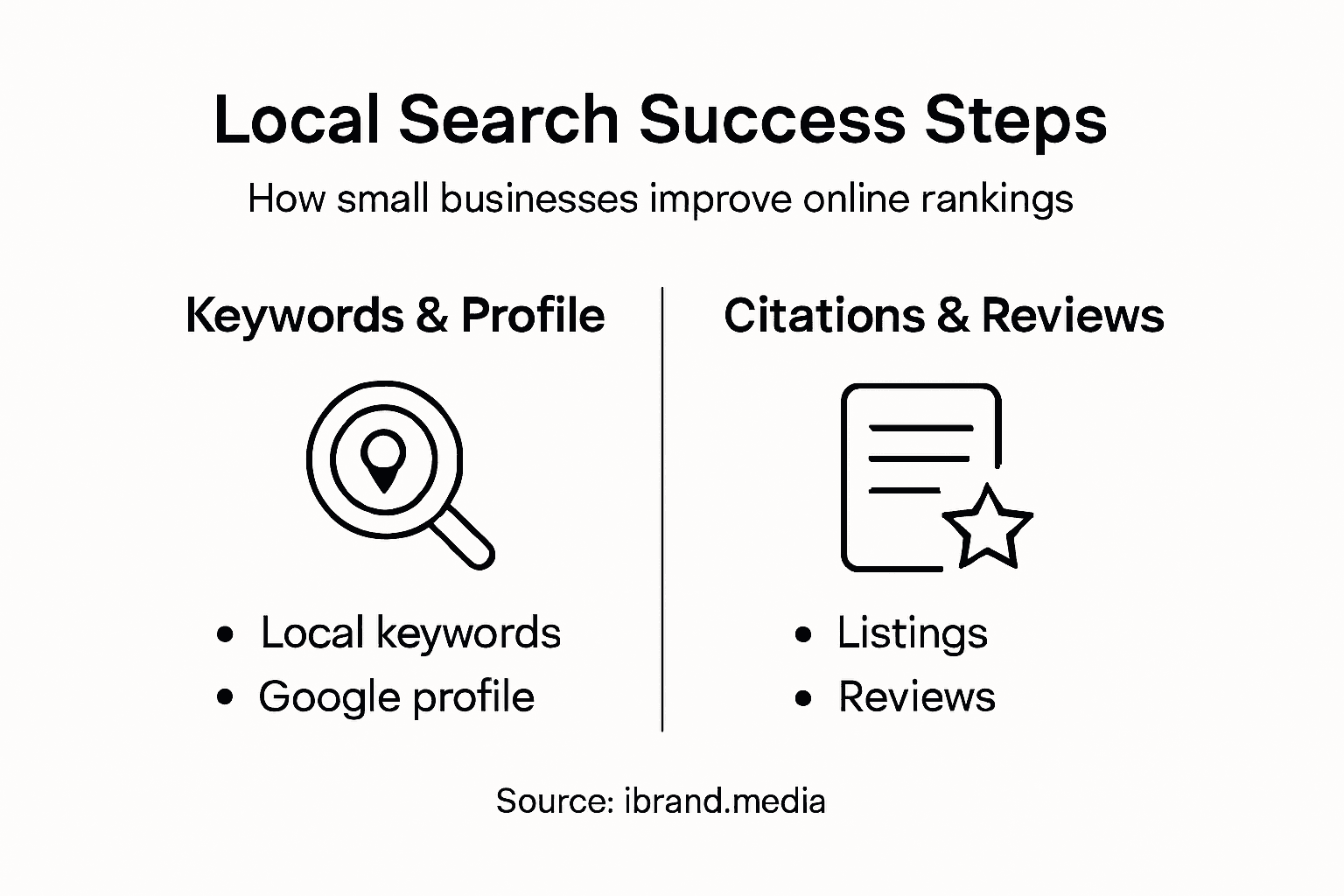
Effective monitoring involves using multiple tools and metrics to get a holistic view of your local search performance. This means regularly checking your Google Analytics, Google Search Console, and other local SEO tracking platforms to understand how potential customers are finding and interacting with your business online. Pay close attention to key performance indicators like local pack rankings, website traffic from local searches, click-through rates, and the quality and quantity of your online reviews.
Here are strategic methods for monitoring and adjusting your local SEO strategy:
- Set up Google Analytics and Google Search Console
- Track local keyword rankings monthly
- Monitor website traffic from local searches
- Analyze user behavior and engagement metrics
- Review and update your local business listings
- Compare your performance against local competitors
- Conduct quarterly SEO audits
- Adjust strategy based on performance data
Successful local SEO is a dynamic process of continuous learning and adaptation.
Pro tip: Create a monthly dashboard that consolidates your key local SEO metrics, making it easy to quickly assess your progress and identify areas for improvement.
Use this table to understand the relationship between common local SEO tools and their core tracking functions:
| Tool | Key Function | Typical Use Case |
|---|---|---|
| Google Analytics | Track website visits | Monitor local traffic sources |
| Google Search Console | Monitor search performance | Identify keyword opportunities |
| Citation Tracking Tools | Audit business listings | Fix NAP inconsistencies |
| Review Management Tools | Aggregate customer reviews | Respond to and analyze feedback |
Here is a quick comparison of key local SEO elements and their primary benefits:
| Local SEO Element | Main Goal | Business Impact |
|---|---|---|
| Local Keywords | Attract local customers | Higher local search traffic |
| Google Business Profile | Enhance map and listing visibility | More walk-in and call inquiries |
| On-Page Local SEO | Improve website local relevancy | Greater conversion rates |
| Local Citations | Establish trust and authority | Better search ranking positions |
| Customer Reviews | Build reputation and trust | Increased customer conversions |
| SEO Performance Monitoring | Identify areas to improve | Sustained competitive advantage |
Boost Your Local Search Rankings with Expert Help
Struggling to improve your local search rankings despite following basic SEO steps Like optimizing your Google Business Profile and building local citations it can feel overwhelming to keep up with the ongoing adjustments needed for success Our article on Improving Local Search Rankings for Small Businesses Easily highlights the challenges of consistent SEO performance, local keyword targeting, and review management that many small businesses face every day
Take control of your local online presence today with ibrand.media We specialize in tailored digital marketing strategies designed for small to medium-sized businesses seeking affordable and effective SEO optimization, local marketing, and real-time performance tracking. Don’t let your competition outpace you Act now to get your personalized plan, increase targeted traffic, and boost your customer engagement. Explore our specially curated insights on Uncategorized | Ibrandmedia and start transforming your local search results immediately
Frequently Asked Questions
How can I identify relevant local keywords for my small business?
To identify relevant local keywords, think about the specific phrases potential customers might use when searching for your services. Start by using tools like Google’s autocomplete feature and analyze competitor websites to gather keyword ideas.
What should I include in my Google Business Profile to improve local search visibility?
To improve local search visibility, ensure your Google Business Profile includes complete information such as your business name, address, phone number, website, business hours, and high-quality photos. Regularly update your profile with new content and encourage satisfied customers to leave positive reviews.
What on-page SEO strategies can enhance my website’s local relevance?
Incorporating local keywords into your website’s page title tags, meta descriptions, and heading tags can enhance local relevance. Also, consider creating content about local events or community activities to demonstrate your connection with the area.
How can I ensure my citations are helping my local search rankings?
Make sure your business’s name, address, and phone number (NAP) are consistent across all online directories. Regularly audit your citations to identify and correct any discrepancies, as consistent information can significantly improve your local search rankings.
What steps should I take to encourage more customer reviews?
To encourage more customer reviews, proactively ask satisfied customers to leave feedback after a positive experience. Implement follow-up emails or messages that provide simple instructions and direct links to your review platforms for ease of access.
How can I monitor my progress and adjust my local SEO strategy?
To monitor your progress, regularly check key performance indicators such as local rankings and website traffic from local searches. Use this data to identify areas that need improvement and adjust your strategies accordingly, aiming for quarterly reviews and updates.
Recommended
- Understanding the Benefits of Local SEO for Small Businesses | Ibrandmedia
- Top SEO Techniques for Small Business Owners in 2025 | Ibrandmedia
- Understanding Local SEO Ranking Factors for Businesses | Ibrandmedia
- Local SEO: Everything You Need to Know | Ibrandmedia
- Unlocking the Secrets of SEO for Small Businesses
Recent Comments