
Many HVAC and plumbing business owners in North America think local search only means showing up on Google Maps or in basic directories. In reality, local search is a heuristic method designed to find good, practical solutions efficiently, helping you connect with nearby customers faster than traditional SEO ever could. Understanding how local search explores neighboring solutions and delivers results quickly gives you an edge over competitors. This article breaks down proven strategies to help your service business rank where your local customers are actually searching.
Table of Contents
- Local Search Basics And Key Misconceptions
- Types Of Local Search Results Explained
- Optimizing Google Business Profile Effectively
- Building Authority Through Listings And Reviews
- Mobile-First Site Practices For Local Visibility
- Avoiding Costly Local Search Mistakes
Key Takeaways
| Point | Details |
|---|---|
| Local Search is Not Static | It evolves rapidly based on competitor actions and customer behavior; consistent visibility is key, rather than just aiming for the top ranking. |
| Optimize Google Business Profile | Fully claim and update your profile regularly to increase visibility and engagement; accuracy and responsiveness are crucial. |
| Leverage Customer Reviews | Actively request and respond to reviews to enhance credibility and authority; consistent engagement signals reliability to potential customers. |
| Mobile Optimization is Essential | Ensure your website is mobile-friendly, as most local searches occur on mobile devices; fast loading times and accessible contact options are critical. |
Local Search Basics and Key Misconceptions
Local search is fundamentally different from what most service business owners think it is. When you hear “local search,” your mind probably jumps to Google Maps or simple business directory listings. But there is much more happening behind the scenes. Local search operates as a heuristic method designed to find good, practical solutions efficiently rather than perfect ones. Think of it like this: you do not need the absolute optimal solution to your customer acquisition problem. You need a solution that works well enough and delivers results faster than competitors who are still figuring out their strategy.
The core concept involves exploring neighboring solutions and progressively improving your position. When you optimize your HVAC or plumbing business for local search, you are essentially moving your business profile closer to customers who are actively searching for your services right now. This is nothing like traditional SEO, which takes months to show results. Local search results can shift within weeks because the algorithm explores neighboring candidate solutions to determine which businesses deserve prominent placement. Your Google Business Profile updates, customer reviews, and location accuracy create a constant flow of signals that influence where your business appears.
Here are the biggest misconceptions holding service businesses back:
-
“Local search guarantees top rankings” is false. Like any heuristic method, local search finds strong solutions but cannot guarantee you will always rank first. Variables shift daily as competitors optimize and customer search behavior changes. What matters is consistent visibility in your top 3 positions, not a mythical number one spot forever.
-
“It only works in big cities” is outdated. Small towns and suburban areas actually perform better for service businesses because competition is lower and customers know they need local expertise. An HVAC company in a town of 50,000 people often dominates faster than one in a major metropolitan area.
-
“You need complex technology to win” misses the point. Local search requires little memory and performs faster when you focus on the fundamentals: accurate business information, customer reviews, and proximity signals. You do not need expensive software. You need consistency.
The truth is that local SEO ranking factors respond predictably to basic optimization. Your customers are searching for “emergency plumber near me” or “HVAC repair today” right now. Local search exists specifically to connect those searches with your business when you show up with the right signals.
Pro tip: Start by claiming and completely filling out your Google Business Profile with all business details, hours, photos, and services before spending money on anything else. This single step delivers more local search visibility than most service businesses achieve in their first year.
Types of Local Search Results Explained
When a customer searches for “emergency plumber” or “HVAC repair near me,” they see multiple types of results on their screen. Understanding what each type is and how it works changes how you approach your local search strategy. The results they see include local pack results with map listings, organic local results below those, and paid local advertisements. Each type operates differently and reaches customers at different points in their decision-making journey. Your goal is not to dominate every single result type, but to show up consistently in the ones that matter most for your service business.
The local pack is what most people notice first. When someone searches for your service, Google displays a map with three to five businesses highlighted on it. This is the prime real estate on the search results page. If you are not in the local pack, you are invisible to most customers because they will not scroll down. Getting into the local pack requires a combination of factors: accurate business information, customer reviews, proximity to the searcher, and website relevance. For an HVAC company, this is where the magic happens. Customers see your business name, location, phone number, and star rating all at once. They can click directly to call you or get directions. Your position in the local pack often determines whether you get the call or your competitor does.
Below the map, you see the organic local results. These are standard search results that include a business name with a small location label. These results reach people who are slightly further along in their search process. They might be comparing multiple options or looking for more detailed information about your services. This is where your website optimization matters. These listings pull from your website content, so if your site clearly explains the services you offer and mentions your service area, you rank better here. Do not neglect this section just because the local pack is flashier.
The third type is paid local advertising. These are sponsored listings that appear at the very top of the search results page before everything else. A plumber or HVAC company can run paid campaigns targeting specific keywords and geographic areas. While this gets immediate visibility, it costs money for each click. Many service businesses find that mastering the local pack and organic results delivers better long-term value because they do not require ongoing ad spend.
The secret that most service businesses miss is that all three result types feed off the same core information. Your Google Business Profile, customer reviews, website content, and local citations create the signals that determine your placement across all three types. When you optimize one area properly, you improve visibility across all of them simultaneously.
Here’s how the main types of local search results differ for service businesses:
| Result Type | Placement on Search Page | When Customers Interact | Business Impact |
|---|---|---|---|
| Local Pack | At top, inside Google Map | Quick, urgent searches | Highest call conversion rate |
| Organic Local Result | Below map, standard listing | Comparing, researching | Boosts trust and awareness |
| Paid Local Ads | Above map and organic listings | Immediate needs, low loyalty | Costly but instant visibility |
Pro tip: Focus first on dominating your local pack results since that is where 70 percent of clicks happen, then expand attention to organic results and paid ads once you consistently show in the top three positions.
Optimizing Google Business Profile Effectively
Your Google Business Profile is the control center for how customers find and perceive your service business online. This is not just another place to list your information. It is the bridge between someone searching for your services and actually calling you. When you optimize it properly, you get more visibility, more calls, and more credibility. The stakes are high because this profile appears directly in search results, on Google Maps, and across Google’s network. A complete and accurate profile means customers see your phone number, hours, location, and customer reviews without ever leaving Google. An incomplete profile means losing potential work to competitors who took the time to fill it out.

Start by claiming and verifying your profile if you have not already done so. This takes minutes but gives you control over your business information. Once verified, the real work begins. Fill out every single field that applies to your business. Your business name, address, phone number, and service categories must be exact and consistent everywhere online. For a plumbing company, do not use “Smith’s Plumbing” in one place and “Smith Plumbing” in another. These inconsistencies confuse Google’s algorithm and hurt your rankings. Next, add high-quality photos. Do not use generic stock images. Show real work: your team installing an HVAC system, a finished plumbing project, your service van, your office. Customers want to see what they are hiring. Managing accurate business information and photos directly improves visibility in local searches and increases customer engagement because Google can better understand what your business actually does.
Regularly update your profile to show that your business is active and current. Add new photos monthly. Update your service areas if you expand. Respond to every customer review, positive or negative. When someone leaves a five-star review thanking you for fixing their heating in the middle of winter, respond with something like “We are glad we could help keep your family warm.” This shows future customers that you actually engage with clients. When you get a one-star review from someone upset about pricing, respond professionally without being defensive. Acknowledge their concern and offer to discuss it directly. Google rewards businesses that actively maintain their profiles with better visibility.
One mistake many service businesses make is setting inconsistent hours. Your Google Business Profile hours must match your actual availability. If you are closed on Sundays, mark it. If you offer emergency service after 6 PM, update that. When customers call at 8 PM on a Sunday and your profile says you are open, they lose trust immediately. Your profile is not marketing material. It is a communication tool. Treat it like how you would answer the phone: accurately and professionally.
Pro tip: Set a calendar reminder to update your Google Business Profile monthly with new photos or service area changes, and respond to all reviews within 24 hours to signal to Google that your business is actively engaged and boost your ranking visibility.
Building Authority Through Listings and Reviews
Authority in local search is not something you claim. It is something you earn through consistent presence and positive customer feedback. When a potential customer searches for a plumber or HVAC technician, they do not just want the first result. They want proof that you are reliable, professional, and worth hiring. This proof comes from two sources: your business listings across multiple directories and the reviews customers leave about their experience with you. Together, these elements build trust and signal to Google that you are a legitimate, established business.
Business listings act as citations that verify your existence and legitimacy. When your business appears on Yelp, Facebook, the Better Business Bureau, Angie’s List, and industry-specific directories, Google sees consistent information about you across the web. This consistency tells Google you are not a one-off scam site. You are a real business that multiple authoritative platforms recognize. The key is making sure your information is identical everywhere. Your business name, phone number, address, and service descriptions must match across every platform. If your address differs on Yelp versus Google, it confuses the algorithm and hurts your rankings. One inconsistency might be a typo. Three inconsistencies look like you do not manage your business carefully. Professional conduct and adherence to standards reflect the reliability that customers seek when choosing service providers, and this same principle applies to how consistently you maintain your online presence across directories.
Reviews are the social proof that converts casual searchers into actual customers. A potential customer calls three plumbers to get quotes. One has 23 reviews averaging 4.8 stars. Another has 4 reviews at 5 stars. The third has no reviews. The first one gets the call because reviews signal that real customers have had good experiences. Negative reviews matter too. A business with some negative reviews but many positive ones looks honest. A business with only five-star reviews looks fake. You want at least 50 reviews before your business appears fully authoritative. Getting there requires actively asking satisfied customers to leave feedback. After finishing a job, send a text or email: “We loved working with you. If you have five minutes, a review on Google helps us grow.” Make it easy by including a direct link. Do not ask for five-star reviews. Ask for honest ones. A customer who had a mediocre experience but leaves three stars is more valuable than someone who never leaves a review because they do not know how.
Responding to reviews builds authority even more than the reviews themselves. When you respond to a negative review with grace and a solution, potential customers see that you care about fixing problems. When you thank customers for positive reviews, you show gratitude and engagement. Google ranks profiles higher when businesses actively respond to reviews because it signals active management. A business that ignores reviews for months looks abandoned. A business that responds to every review within 24 hours looks professional and engaged.
Quick reference: Key signals that improve your local search authority and visibility:
| Signal Type | Description | How It Impacts Local SEO |
|---|---|---|
| Directory Listings | Consistent info across sites | Confirms legitimacy, boosts rank |
| Customer Reviews | Honest, recent feedback | Converts leads, signals activity |
| Google Profile | Complete, regularly updated | Primary ranking factor |
| Website Content | Service area and offerings | Supports organic search results |
Pro tip: Create a simple system where you ask for reviews after every completed job and set a weekly reminder to respond to all new reviews, targeting 50 total reviews within your first year to establish strong local authority.
Mobile-First Site Practices for Local Visibility
Google changed how it ranks websites years ago. Now, your mobile site is not an afterthought. It is the primary version Google uses to index and rank your business. This shift happened because most people search on phones, especially when looking for local services. When someone has a burst pipe at 2 AM, they search “emergency plumber near me” on their phone while standing in water. They are not sitting at a desktop computer. If your website does not work well on mobile, you are invisible to the people actively looking for your services right now.
Responsive design that adapts seamlessly to devices is the foundation of mobile optimization. This means your website automatically adjusts its layout, font sizes, and buttons based on the screen size. A visitor on an iPhone 12 should see the same content and functionality as someone on a Samsung tablet or desktop. Do not create a separate mobile site. Do not hide content on mobile versions. Google sees when you do this and penalizes you. Everything on your desktop site must appear on your mobile site in an accessible, readable format. For a plumbing company, this means your service descriptions, photos of past work, pricing, phone number for emergency calls, and booking form all function perfectly on a phone screen.
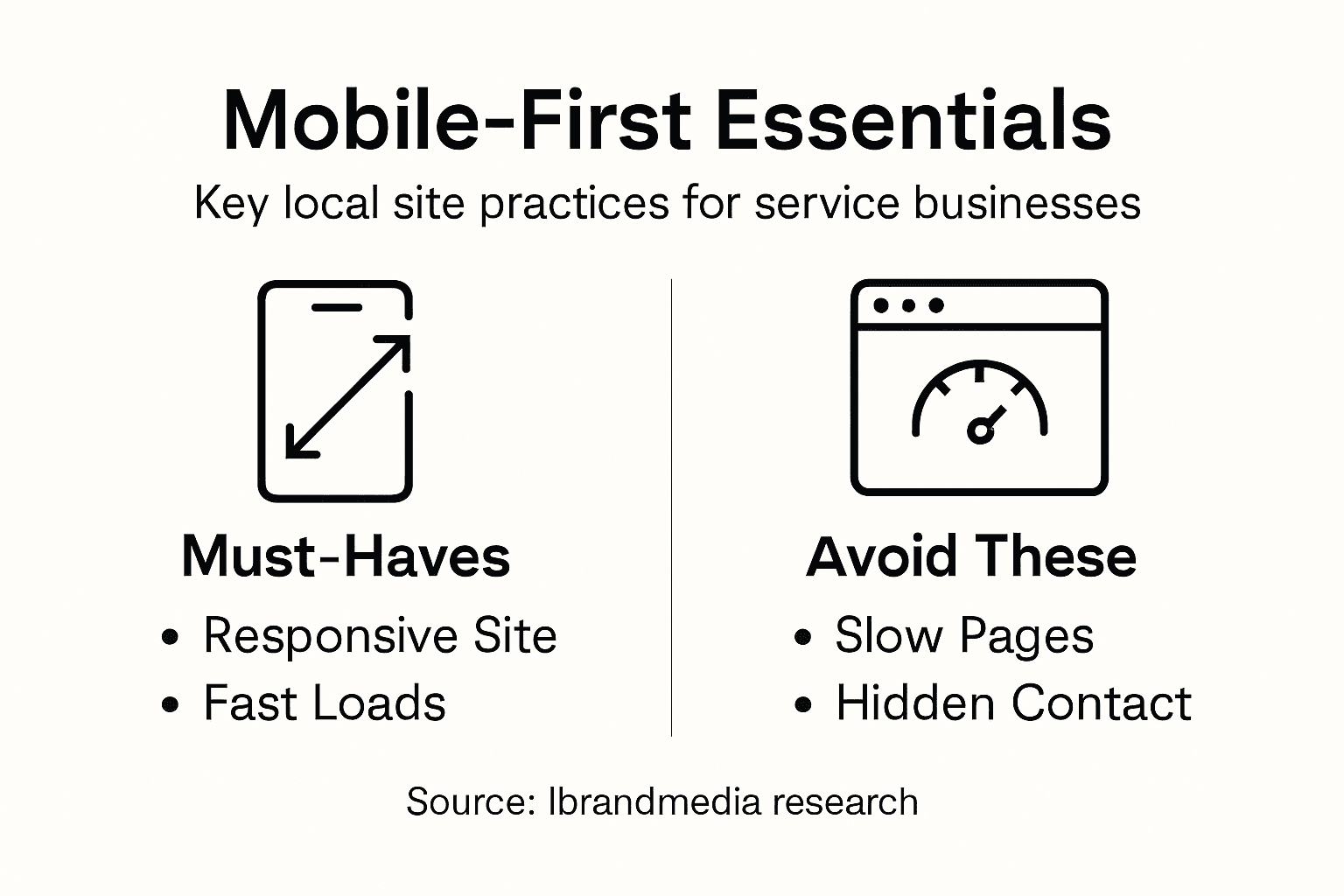
Loading speed matters enormously on mobile because people have patience measured in seconds. A desktop visitor might wait three seconds for your site to load. A mobile visitor closes the tab and calls a competitor in two seconds. Compress your images so they load faster. Remove unnecessary plugins that slow down your site. Test your loading speed using Google’s PageSpeed Insights tool. Aim for pages that load in under two seconds. Every extra second of load time costs you customers. Additionally, make sure your phone number is clickable so customers can call with one tap. Do not force them to read your number and type it manually. Include a “Call Now” button prominently at the top of your site. Make your contact form simple. Three fields instead of twenty. Mobile visitors want to contact you quickly, not fill out a novel.
One critical mistake service businesses make is creating a mobile site that looks nice but does not actually solve the customer’s problem. A potential customer lands on your mobile site at 11 PM looking to book an emergency HVAC repair. Can they actually book through the site, or do they have to email you and wait until morning? Can they see your response time? Can they see your service area clearly? Can they read reviews? Every element that convinced someone to hire you on desktop must work just as well on mobile. The mobile version is not a simplified version. It is a focused version that removes distractions and makes action easy.
Pro tip: Test your website right now on your own phone by searching for your business, then tap through every major page and try to complete a call or booking to identify exactly where mobile users get stuck.
Avoiding Costly Local Search Mistakes
One wrong decision in local search can cost you months of lost revenue and hundreds of potential customers. The problem is that most service business owners do not realize they are making mistakes until it is too late. They notice rankings dropped or calls stopped coming in. By then, the damage is done. The good news is that these mistakes are preventable if you understand what causes them. Many of these errors stem from trying to cut corners or following outdated advice that circulated before Google changed its algorithms.
The most expensive mistake is claiming your Google Business Profile incorrectly or not claiming it at all. If someone else claims your business on Google, you lose control. Your hours might be listed wrong. Your phone number might direct to a competitor. Your address might be in the wrong location. You cannot fix it without reclaiming the profile, which takes time and can damage your rankings temporarily. Claim your profile today if you have not already. Verify it completely. The second costly mistake is inconsistent business information across the web. Your business name is “Smith HVAC” on Google, “Smith’s HVAC Services” on Facebook, and “HVAC by Smith” on Yelp. This confusion tells Google you are not a professional operation. It also makes you harder to find because Google cannot connect all these listings as the same business. Spend one afternoon getting every single listing updated to match exactly.
Another critical error is ignoring negative reviews or responding defensively. A customer had a bad experience and left one star. Your natural reaction is to defend yourself or dismiss their complaint. Do not. Potential customers see your response. When you respond professionally and offer to fix the problem, you look good even with the negative review. When you respond with attitude, you lose all credibility. The worst approach is not responding at all. That signals you do not care about customer satisfaction. Respond to every review within 24 hours, period.
Many service businesses also make the mistake of optimizing for keywords that do not match customer intent. You optimize your website for “plumbing services” when customers search “emergency plumber” or “plumber open now.” You are visible for the wrong searches. Use local online marketing strategies that target the actual terms your customers use when they need help immediately, not generic industry terms. Finally, avoid hiring cheap SEO companies that promise guaranteed rankings or use sketchy tactics like link farms and keyword stuffing. Google penalizes these practices. You end up spending money to make your rankings worse. Invest in legitimate optimization or do it yourself carefully.
Pro tip: Audit your business listings, Google Business Profile, and website right now for these five mistakes: wrong information, inconsistent details across platforms, ignored reviews, wrong keywords, and questionable SEO tactics. Fix each one immediately.
Unlock Your Service Business Potential with Expert Local Search Solutions
Navigating the complex world of local search can feel overwhelming, especially when your business depends on appearing in the crucial local pack and converting searches into calls. You might be struggling with inconsistent business information, unanswered reviews, or a mobile site that does not truly deliver the convenience your customers expect. These challenges directly impact your visibility and prevent you from reaching urgent service inquiries like “emergency plumber near me” or “HVAC repair today.” Understanding these pain points is the first step toward real growth.
At Ibrandmedia, we specialize in tailored digital marketing strategies designed to fix exactly these issues. Our services cover accurate Google Business Profile optimization, consistent local directory management, review engagement tactics, and mobile-first web design that converts visitors into customers fast. If you want to dominate the local pack, build strong authority through genuine customer reviews, and avoid costly mistakes that drain your budget, start exploring our expert insights in Uncategorized | Ibrandmedia. Don’t wait for your competitors to outshine you. Visit ibrand.media now and take control of your local search success with a personalized plan crafted just for your service business.
Frequently Asked Questions
What is local search, and how does it differ from traditional SEO?
Local search is a method focused on connecting service businesses with customers actively searching for services nearby. Unlike traditional SEO, which often takes months to show results, local search can impact visibility within weeks, emphasizing practical and fast solutions over perfect rankings.
How can I optimize my Google Business Profile effectively?
To optimize your Google Business Profile, claim and verify it, fill out all applicable fields consistently with your business name, address, and phone number, and add high-quality photos that depict your work. Regular updates and responding to customer reviews also help increase your visibility and credibility.
What are the main types of local search results that influence customer decisions?
The three main types of local search results are: 1) Local Pack results (map listings) that appear at the top of search pages, 2) Organic Local results, which are standard listings below the map, and 3) Paid Local ads that appear at the very top. Each type reaches customers at different stages in their decision-making process.
Why are customer reviews important for my service business’s local search success?
Customer reviews are essential for building trust and converting leads into customers. Positive reviews signal reliability and quality service, while actively responding to reviews enhances your credibility. Google also rewards businesses that engage with reviews by improving their visibility in local search results.
Recommended
- How to Get Found Online: Boost Your Local Business Fast | Ibrandmedia
- Understanding the Benefits of Local SEO for Small Businesses | Ibrandmedia
- 7 Powerful Tips for Local Service Area Marketing Success | Ibrandmedia
- Local SEO: Everything You Need to Know | Ibrandmedia
- Effective Strategy: How to Increase Customer Flow and Sales by X
- The Essential Guide to Website Role in Business Growth – Lind Creative
Recent Comments