
TL;DR:
- Dental clinics often lack a strategic content marketing approach, limiting their online visibility and patient bookings. Creating accessible, targeted content across blogs, videos, and infographics, combined with proper planning and measurement, can significantly boost local search rankings and engagement. Prioritizing accessibility not only improves user experience but also directly increases appointment conversions and long-term practice growth.
Most dental clinics have a website, a Facebook page, and maybe a few Google reviews. But when a potential patient searches “dentist near me who accepts new patients,” those clinics are nowhere to be found. The problem is not the quality of care. It is the absence of a deliberate content marketing strategy. Dental clinics that publish the right content, in the right format, with the right structure, consistently outrank and out-book their competitors. This guide walks you through exactly how to build, execute, and measure a content marketing strategy that fills your appointment calendar.
Table of Contents
- Understanding the basics: What content marketing means for dental clinics
- Preparation and planning: Setting up your content marketing foundation
- Step-by-step execution: Creating and publishing content that attracts patients
- Measurement and refinement: Tracking results and optimizing for growth
- Our expert perspective: Why accessibility is the hidden engine of dental content marketing
- Take your dental clinic’s marketing to the next level
- Frequently asked questions
Key Takeaways
| Point | Details |
|---|---|
| Accessibility drives results | Accessible content directly boosts engagement, patient requests, and SEO outcomes. |
| Plan with clear goals | Setting strategic objectives is critical before launching any content marketing effort. |
| Stepwise execution matters | Structured creation, optimization, and publishing are vital to attracting new patients. |
| Measure and refine | Regular tracking and improving content delivers sustained growth for dental clinics. |
| Compliance is foundational | Treat compliance not as a checkbox but as the base of effective content marketing. |
Understanding the basics: What content marketing means for dental clinics
Content marketing is the practice of creating and distributing valuable, relevant information to attract a specific audience. For dental clinics, that audience is local patients searching for answers about oral health, procedures, costs, and providers they can trust. Unlike paid ads that stop working the moment you pause spending, content compounds. A blog post published today can drive appointment requests two years from now.
The three most effective content types for dental clinics are blog posts, videos, and infographics. Each serves a different role. Blog posts capture search traffic and establish authority. Videos build trust and explain complex procedures visually. Infographics simplify data-heavy topics like “what to expect from a root canal” into shareable, scannable visuals.
One element most dental clinics overlook completely is accessibility. The accessible structure of your content directly affects how patients engage with it and how search engines index it. Alt text on images, properly labeled form fields, video transcripts, keyboard-navigable menus, and correct heading hierarchies are not optional extras. They are foundational to content performance.
Pro Tip: Before you publish any piece of content, run a quick accessibility check. Missing alt text or unlabeled fields can cost you both patients and search rankings.
Content types and their primary functions
| Content type | Primary benefit | Best platform |
|---|---|---|
| Blog posts | SEO traffic and authority | Website |
| Videos | Trust building and engagement | YouTube, website, social |
| Infographics | Shareability and education | Social media, blog |
| FAQs | Featured snippet capture | Website |
| Patient testimonials | Social proof and conversion | Website, Google profile |
Key accessibility requirements every dental clinic should implement:
- Alt text on every image, including before-and-after photos
- Labeled form fields on appointment request forms
- Transcripts for every video published on your site
- Keyboard navigation support across all pages
- Logical heading structure (H1, H2, H3) to guide both users and search engines
When you build web accessibility for dental sites into your content from the start, you reduce friction for every patient who lands on your page, including those using screen readers or mobile devices with limited functionality. Good website design tips for dentists always start with structure, not aesthetics.

Preparation and planning: Setting up your content marketing foundation
Before you write a single word, you need to understand where you stand. Start by auditing your existing website and social media presence. What pages do you have? Which ones rank for anything? Where do patients drop off before booking? These answers shape everything that comes next.
Setting clear goals is non-negotiable. Vague goals like “get more patients” produce vague results. Instead, set goals that are specific and measurable. For example: increase organic website traffic by 30% in six months, generate 15 new appointment requests per month from blog content, or reduce website bounce rate from 72% to under 55%.
WCAG 2.2 AA alignment should be built into your planning checklist from day one. Retrofitting accessibility is far more expensive and time-consuming than building it in correctly the first time. Every content plan should include accessibility requirements as a standard item, not an afterthought.
Comparing content platforms for dental clinics
| Platform | Best content type | Effort level | Reach potential |
|---|---|---|---|
| Website blog | Long-form posts, FAQs | Medium | Very high (SEO) |
| Google Business Profile | Updates, offers, photos | Low | High (local search) |
| Facebook/Instagram | Videos, tips, testimonials | Medium | Medium to high |
| YouTube | Procedure explainers | High | High (video search) |
| Email newsletter | Recalls, offers, education | Low to medium | Medium (retention) |
Here is a numbered process for building your planning foundation:
- Audit your existing content by checking which pages receive traffic in Google Search Console
- Identify keyword gaps by searching for the dental questions your ideal patients ask
- Map content themes to patient journey stages: awareness, consideration, and decision
- Choose two or three platforms to focus on rather than spreading too thin
- Build a 90-day editorial calendar with topics, formats, and publishing dates
- Assign accessibility requirements to each piece before drafting begins
- Set baseline metrics so you can measure improvement accurately
To master dental online marketing, you need a documented strategy, not a collection of random posts. And if you want those posts to convert, your website needs to boost patient engagement through mobile-friendly design and fast load times.
Pro Tip: Align every content plan with accessibility standards before drafting. Fixing structural problems after publishing costs significantly more time than building them right from the start.
Step-by-step execution: Creating and publishing content that attracts patients
Planning gets you ready. Execution is where results happen. Follow this workflow for every piece of content your clinic produces:
- Plan the piece by defining its topic, target keyword, patient intent, and platform
- Draft the content using plain language your patients actually speak
- Edit for clarity by reading it aloud and cutting anything that doesn’t serve the patient
- Run an accessibility check including alt text, heading structure, and labeled fields
- Optimize for SEO by placing your primary keyword in the title, first paragraph, and at least one subheading
- Publish and distribute across your chosen platforms
- Track initial performance after 30 and 90 days
Video deserves special attention. Video marketing for dentists has become one of the highest-ROI content investments a clinic can make, with video increasing dental engagement by 40% compared to text-only content. A short explainer video about teeth whitening or Invisalign, posted on your website and YouTube, will consistently outperform a static image and a paragraph of text.
Blogging for dental practices still works, and it works exceptionally well for local SEO. Topics like “how long does a dental crown take” or “what to eat after a tooth extraction” capture patients at the moment they need answers and position your clinic as the trusted local expert.
Strong SEO for dental clinics combines keyword research, technical structure, and accessibility into one cohesive system. The clinics that dominate local search results are not necessarily the ones with the most polished website design. They are the ones with the most consistently published, well-structured, accessible content.
Common pitfalls to avoid in dental content marketing:
- Publishing without a keyword strategy and hoping patients will find it
- Ignoring mobile formatting when over 60% of health searches happen on phones
- Skipping transcripts on videos which hurts both accessibility and SEO
- Using generic stock photos instead of real team and patient photos
- Writing for dentists instead of patients by using technical jargon without explanation
- Letting content sit unchanged without periodic updates and refreshes
The most critical point here is this: accessibility and compliance must be treated as foundational to content effectiveness. If patients cannot navigate your site reliably or cannot complete an appointment request form because a field is unlabeled and their screen reader skips it, even a beautifully written blog post will not produce bookings.
Pro Tip: Add transcripts to every video and ensure all form fields are properly labeled. These two steps alone can meaningfully improve both your accessibility score and your search engine rankings.
Measurement and refinement: Tracking results and optimizing for growth
Publishing content without tracking results is like running a marketing campaign with your eyes closed. You need to measure what matters and act on what you find.
The metrics that matter most for dental clinic content marketing are:
- Organic website traffic from search engines (measured in Google Analytics 4)
- Keyword rankings for your target search terms
- Appointment request form completions as your primary conversion metric
- Bounce rate to identify pages where patients leave without engaging
- Average session duration to measure how deeply patients read your content
- Social engagement rates including saves and shares, not just likes
An accessible structure directly improves several of these metrics. When your content is easy to navigate, patients stay longer, complete forms more reliably, and return more often. Search engines also reward accessible content with stronger indexing and better rankings.
Key content marketing KPIs for dental clinics
| Metric | What it measures | Target benchmark |
|---|---|---|
| Organic traffic growth | Content visibility and SEO strength | 20% increase per quarter |
| Form completion rate | Conversion from content to bookings | Above 3% of sessions |
| Bounce rate | Content relevance and user experience | Below 55% |
| Video view duration | Engagement with video content | Above 50% of total length |
| Keyword ranking position | Search visibility for target terms | Top 10 for local terms |
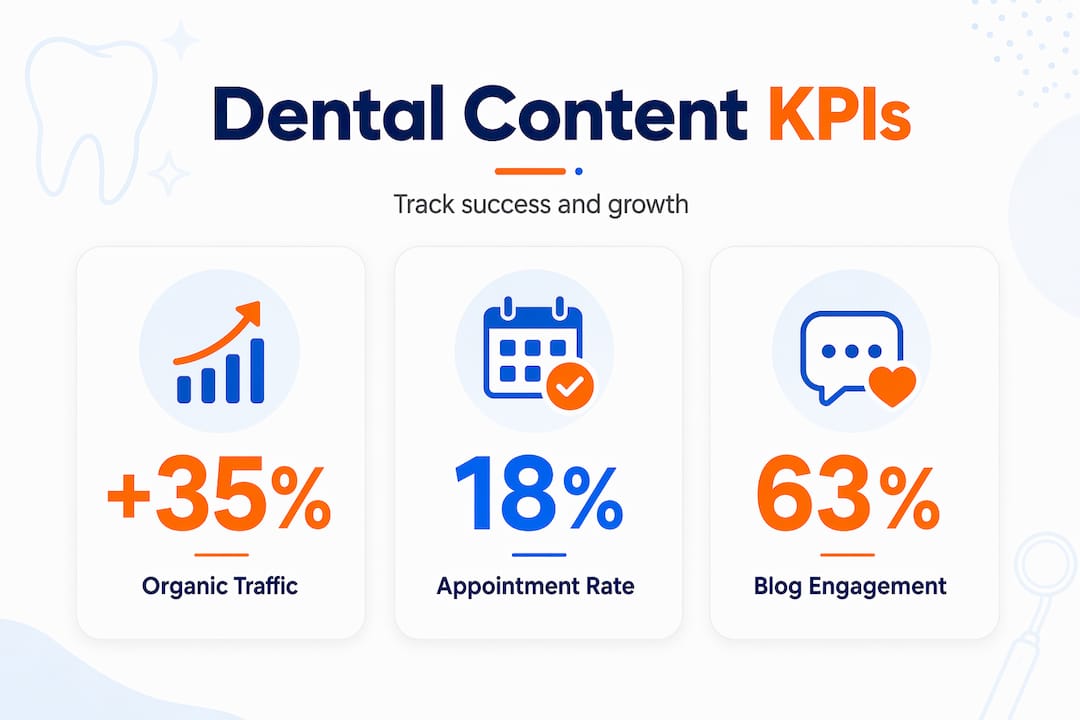
Building a feedback loop means you do not just look at data. You act on it. If a blog post about dental implants gets strong traffic but low form completions, you check whether the call to action is clear, whether the form is accessible and easy to complete, and whether the page loads quickly on mobile. Every weak metric points to a specific, fixable problem.
Schedule a full content audit every quarter. Review your top 10 and bottom 10 performing pages. Update outdated statistics, add new internal links, and fix any accessibility gaps you find. Dental marketing with video also benefits from this audit cycle. Refresh your video descriptions, add new chapters or timestamps, and verify that transcripts are current.
Pro Tip: Run a WCAG 2.2 AA compliance audit on your top five traffic-driving pages at least once per quarter. Accessibility gaps on high-traffic pages have an outsized negative impact on conversions.
Our expert perspective: Why accessibility is the hidden engine of dental content marketing
Most dental marketing conversations center on content quality, keyword strategy, and social media consistency. Those things matter. But the single most overlooked driver of content marketing results is accessibility, and we have seen this play out repeatedly with dental clients who had excellent content that simply was not converting.
Here is the uncomfortable truth: a beautifully designed dental website full of high-quality blog posts and patient videos can still fail completely if a patient using a screen reader cannot complete the appointment request form, if images have no alt text, or if the heading structure is so disorganized that both users and search engines cannot follow the page hierarchy. The importance of accessibility in dental content marketing is not a compliance checkbox. It is a direct revenue issue.
We have seen clinics increase appointment bookings by double digits simply by fixing their form labels and adding proper heading structure to existing pages. No new content was created. No ad budget was spent. The content was already there. Accessibility is what made it work.
The conventional wisdom in dental marketing says: publish great content and patients will come. The more accurate version is: publish great content that every patient can actually use, and patients will come. Those are meaningfully different things. Visual design trends change every few years. Accessibility standards evolve incrementally. Clinics that prioritize accessible content structure are building an asset that stays valuable longer and converts more consistently than any trend-driven redesign.
Take your dental clinic’s marketing to the next level
Building a content marketing strategy that actually fills your schedule takes more than good intentions. It takes the right structure, the right keywords, and the right technical foundation working together.
At ibrand.media, we work with dental clinics and small healthcare practices to build content strategies that combine SEO, accessibility, and conversion optimization into one system. Whether you are starting from scratch or trying to get more out of what you have already published, our team builds tailored plans that match your goals and budget. Start with our guide to optimizing dental websites for search, or explore our complete SEO for small businesses resource to see how the right technical foundation amplifies every piece of content you create.
Frequently asked questions
What is the most effective content type for dental clinics?
Video and blog posts consistently deliver the highest engagement and conversion rates for dental clinics, with video boosting engagement by 40% compared to text-only formats.
Why does accessibility matter for dental websites?
Accessible websites ensure every patient can interact, book appointments, and find information regardless of ability, while accessible structure also improves how search engines understand and index your content.
How do I measure content marketing success in my clinic?
Track organic website traffic, appointment form completions, bounce rate, keyword rankings, and video engagement to get a complete picture of how your content is performing and where to improve.
What are common mistakes with dental content marketing?
Ignoring accessibility and compliance is the most costly mistake because foundational accessibility gaps mean even high-quality content fails to convert patients who cannot navigate or complete appointment requests reliably.
Recent Comments