
TL;DR:
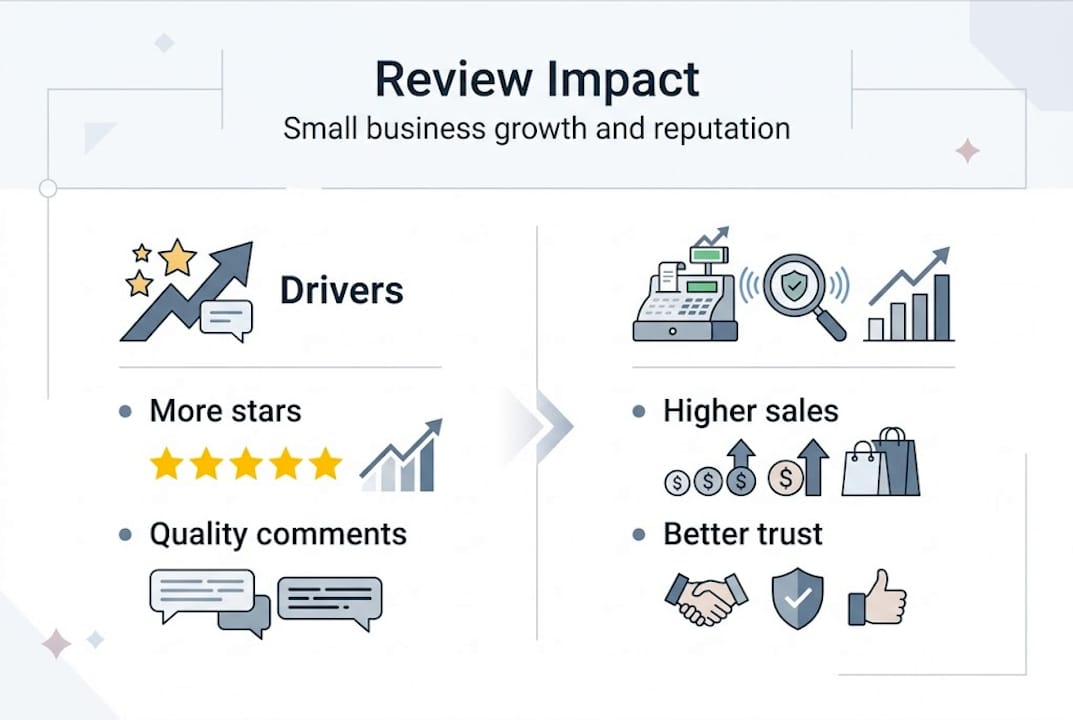
- Online reviews significantly influence search rankings, customer trust, and revenue growth.
- Building a high volume of authentic, detailed reviews strengthens reputation and resilience against fake reviews.
- Implementing a structured review management system is essential for sustainable business success.
A single extra star in your online rating can boost revenue by 5 to 9%, yet most small business owners still treat reviews as an afterthought rather than a core growth strategy. That mindset is costing you real money. Reviews are not a vanity metric or a digital pat on the back. They are a direct line between your reputation and your revenue, shaping how customers find you, trust you, and choose you over a competitor. This guide breaks down the real financial stakes of online reviews, explains what makes them work, and gives you a practical system for managing them like a pro.
Table of Contents
- The real impact of online reviews on business success
- How review structure and quality drives helpfulness
- The challenge of fake reviews and protecting your reputation
- Building a review management system for sustainable growth
- The uncomfortable truth: Reviews aren’t just marketing — they’re survival
- Ready to turn reviews into revenue? Explore more resources
- Frequently asked questions
Key Takeaways
| Point | Details |
|---|---|
| Reviews drive revenue | An extra star on your rating can boost your business income by up to 9%. |
| Quality and quantity matter | More positive, detailed reviews increase trust and generate greater visibility for your business. |
| Fake reviews threaten growth | Combatting fake reviews and responding professionally is essential to protect your business reputation. |
| Structure boosts review value | Well-structured, specific reviews are more helpful to potential customers and support your credibility. |
| Effective management builds trust | Strategic review management using tools and timely responses helps sustain growth and customer loyalty. |
The real impact of online reviews on business success
Most people assume reviews matter because they influence feelings. The truth is sharper than that. Reviews influence search rankings, click-through rates, and purchasing decisions in ways that show up directly in your bank account.
Consider this: businesses with 100+ reviews earn 52% more revenue than those with fewer than 10. That is not a marginal difference. It is the gap between a thriving local business and one that struggles to fill its calendar. Volume signals trustworthiness to both customers and search algorithms. Google interprets a high review count as proof that a business is active, legitimate, and worth showing to searchers.
“Review quantity is not just a social proof signal. It is a ranking factor that determines whether customers ever find you at all.”
The content of those reviews matters just as much as the count. Research into small business Google reviews shows that staff friendliness accounts for 13.1% of what drives 5-star ratings, alongside professionalism, product selection, and fair pricing. Customers are not just rating outcomes. They are rating the entire experience, from the moment they walk in to the moment they leave.

Here is a comparison of how review volume correlates with typical business outcomes:
| Review count | Average star rating impact | Estimated revenue effect |
|---|---|---|
| Fewer than 10 reviews | Low trust, often skipped | Baseline |
| 10 to 49 reviews | Moderate trust | Up to 20% more than baseline |
| 50 to 99 reviews | Strong trust signal | Up to 35% more than baseline |
| 100+ reviews | High trust, strong SEO boost | Up to 52% more than baseline |
Understanding business success with reviews starts with recognizing that every review is a data point. The top reasons customers leave 5-star reviews include:
- Feeling genuinely welcomed by friendly staff
- Experiencing professional, competent service
- Finding the product or service selection matched their needs
- Feeling they received fair value for their money
- Having a problem resolved quickly and without friction
On the flip side, 1-star reviews cluster around payment processing errors, inaccurate business information online, and feeling ignored or disrespected. Many of these triggers are entirely preventable with basic operational hygiene. Keeping your Google Business Profile updated, training staff on customer communication, and fixing checkout friction are not glamorous tasks, but they protect your rating in ways that directly protect your revenue. The importance of online reviews for local businesses cannot be overstated when you see the numbers laid out this clearly.
How review structure and quality drives helpfulness
Getting reviews is one thing. Getting reviews that actually convert curious browsers into paying customers is another challenge entirely.
Review structure affects helpfulness in measurable ways. For high-rated products and services, reviews that build progressively in positivity, starting with context and ending with a strong endorsement, are rated most helpful by readers. For lower-rated businesses, reviews that open with a neutral or positive observation before transitioning into honest critique tend to be taken more seriously and trusted more than pure rants.
This matters for you as a business owner because it tells you what kind of reviews to encourage. A review that says “Great haircut, fast service, will return” is fine. A review that says “I came in for a last-minute cut before a job interview, and Maria had me looking sharp in 20 minutes. She was friendly, professional, and the price was totally fair. Booked my next appointment before I left” is far more persuasive. It tells a story. It names specifics. It builds building online credibility in a way that a generic five-star rating simply cannot.
Here is how different review structures compare in perceived helpfulness:
| Review type | Structure | Perceived helpfulness |
|---|---|---|
| Generic positive | “Great service!” | Low |
| Specific positive | Names staff, service detail, outcome | High |
| Balanced critique | Positive opening, honest issue, resolution | Very high |
| Pure negative rant | No context, no specifics | Low to medium |
| Detailed negative | Context, specific issue, fair conclusion | High |
The elements that make a review genuinely useful to future customers include:
- Specific service or product mentioned so readers know what to expect
- Staff name or department to humanize the experience
- Context for the visit such as a special occasion or urgent need
- Outcome or result so readers can picture the benefit
- Pricing or value judgment to help budget-conscious shoppers decide
Pro Tip: When asking customers for a review, give them a gentle prompt. Something like “If you could mention the service you received and how it helped you, that would mean a lot to future customers.” This nudge dramatically improves review quality without coaching them on what to say, which violates platform guidelines.
Understanding online reputation importance is not just about collecting stars. It is about collecting stories that do your marketing for you, 24 hours a day, long after the customer has gone home.
The challenge of fake reviews and protecting your reputation
Here is where things get uncomfortable. The review ecosystem is not a level playing field. An estimated 30 to 40% of online reviews are fake, and platforms remove millions of them every year. Despite those removals, enough slip through to distort ratings, harm honest businesses, and erode consumer trust across the board.
For small businesses, fake reviews are an existential threat in two directions. Competitors can flood your profile with negative fake reviews to drag your rating down. Or, businesses that buy positive fake reviews gain an unfair advantage that makes your genuine 4.6-star rating look less impressive than their artificially inflated 4.9. Both scenarios hurt you.
“Fake reviews create an arms race where honest businesses are forced to compete not just on quality of service, but on the integrity of their digital presence.”
The challenge of countering fake reviews is real, but it is not hopeless. Here is what to watch for and how to respond:
- Sudden spike in negative reviews with no corresponding service issues internally
- Reviews from profiles with no history or profiles that only review businesses in your niche
- Generic language with no specifics about your actual location, products, or staff
- Reviews mentioning services you do not offer or details that do not match your business
- Clusters of reviews posted within hours of each other, often overnight
When you spot suspicious activity, flag the reviews through the platform’s reporting tool and document your case with screenshots. Respond publicly and professionally to every negative review, genuine or fake. Future customers read your responses just as carefully as they read the reviews themselves.
Pro Tip: The best defense against fake negative reviews is a high volume of genuine positive ones. A business with 200 real reviews and a 4.7 rating is far less damaged by a handful of fake 1-star reviews than a business with 12 total reviews. Volume creates resilience.
Protecting your business reputation requires consistent vigilance. Set up Google Alerts for your business name and monitor your review profiles at least weekly. Platforms like Google and Yelp have dedicated processes for disputing fraudulent reviews, and managing online reputation proactively gives you the best chance of catching problems before they spiral.
Building a review management system for sustainable growth
Defense is necessary, but offense wins the game. The businesses that consistently outperform competitors in reviews are not just lucky. They have systems.
Research confirms that online reputation management enhances small business performance through customer orientation, and the effect is amplified in competitive markets. In other words, the more competitors you have, the more your review strategy matters. A strong ORM (online reputation management) system is not optional in a crowded local market. It is a competitive weapon.
Here is how to build one from scratch:
- Audit your current review presence. Check Google, Yelp, Facebook, and any industry-specific platforms. Know your baseline rating and total review count on each.
- Claim and optimize every profile. Accurate hours, photos, service descriptions, and contact information reduce the operational complaints that generate 1-star reviews.
- Create a review request workflow. After every completed service or purchase, send a follow-up message with a direct link to your Google review page. Timing matters. Ask within 24 to 48 hours while the experience is fresh.
- Set up monitoring alerts. Use Google Alerts, or invest in a dedicated reputation management tool to catch new reviews in real time.
- Respond to every review within 48 hours. Positive or negative, a response shows you are engaged and that you value customer feedback.
- Track your metrics monthly. Monitor average rating, review velocity (how many new reviews per month), and response rate. These numbers tell you whether your system is working.
The dos and don’ts of review solicitation are worth spelling out clearly:
- Do ask every customer, not just the ones you think are happy
- Do make the process easy with a direct link or QR code
- Do personalize your request with the customer’s name and the specific service
- Don’t offer incentives in exchange for reviews. This violates platform terms and can get your profile penalized
- Don’t ask customers to write positive reviews. Ask them to share their honest experience
- Don’t batch-request reviews from a large list all at once. Platforms flag sudden surges as suspicious
Pro Tip: AI tools can help you draft personalized review responses at scale. Paste the review text into a tool like ChatGPT with a prompt like “Write a professional, warm response to this customer review for a local plumbing business.” Then edit it to add specific details before posting. Speed plus personalization is the goal.
Improving your online reputation is not a one-time project. It is a habit. Businesses that treat managing their reputation as an ongoing operational priority consistently outperform those that only pay attention after something goes wrong.
The uncomfortable truth: Reviews aren’t just marketing — they’re survival
Here is what most advice columns miss. Reviews are not a marketing channel you can opt into when convenient. For small businesses in 2026, they are infrastructure. Your digital reputation is as foundational as your physical storefront.
The arms race created by fake reviews has raised the stakes for everyone. Honest businesses now need to actively generate genuine reviews just to stay visible, because platforms weight recency heavily. A business with 300 reviews from three years ago is losing ground to a competitor with 80 reviews from the last six months.
We have also seen that high customer expectations have permanently shifted the baseline. A 4.2-star rating used to be respectable. Now, many customers filter search results to show only 4.5 stars and above. The margin for error has shrunk.
The businesses that survive and grow understand that authenticity and volume matter more than perfection. You will get bad reviews. Some will be unfair. What separates thriving businesses is how they respond and how consistently they generate new positive reviews to keep the narrative balanced. Understanding the full reputation stakes for SMBs means accepting that your digital reputation is not a reflection of your business. For most customers, it is your business.
Ready to turn reviews into revenue? Explore more resources
Managing reviews is only one piece of the puzzle. The businesses that grow fastest connect their review strategy to a broader digital presence that includes strong SEO, a well-optimized website, and targeted local marketing.

At ibrand.media, we help small businesses build that full picture. Whether you are focused on optimizing your website for search, learning how to boost local sales with SEO, or following a step-by-step local marketing guide, our resources are built specifically for local and small business owners who want real results without a corporate-sized budget. Explore our guides and take the next step toward a reputation that works for you around the clock.
Frequently asked questions
How many reviews do I need to see a revenue impact?
Businesses with 100+ reviews typically earn 52% more revenue than those with fewer than 10, so building volume consistently is the fastest path to measurable financial impact.
What types of reviews drive the most positive business outcomes?
Reviews that highlight staff friendliness, professionalism, product selection, and fair pricing are the strongest drivers of 5-star ratings and the customer trust that follows.
How can I effectively respond to negative or fake reviews?
Respond professionally and promptly to every review, encourage genuine feedback from real customers, and use monitoring tools to detect and report suspicious activity to the platform.
Does review structure matter for customer decisions?
Yes. Review structure shapes helpfulness significantly: specific, progressively positive reviews perform best for high-rated businesses, while balanced critiques with honest context are most trusted for lower-rated ones.
Are there tools or templates to streamline review management?
Absolutely. AI-based response tools can draft replies quickly, while aggregation platforms help you monitor reviews across multiple channels, though personalizing every response before posting remains essential.
Recent Comments