
TL;DR:
- PPC ads target high-intent local patients, delivering immediate visibility and measurable results.
- Most dental practices see up to 400% ROI and higher conversion rates with focused PPC campaigns.
- Launching PPC is quick, cost-controlled, and essential to stay competitive in the evolving dental market.
Most dentists assume digital advertising is either too expensive or too complicated to be worth the effort. That assumption is costing real patients. 85% of searchers who type “dentist near me” are ready to book within 48 hours, which means every day without a PPC campaign is a day your competitors are filling those appointment slots instead. PPC, which stands for pay-per-click advertising, puts your practice at the top of search results precisely when someone in your area needs a dentist. This guide breaks down exactly how PPC works, what results you can realistically expect, and how to launch your first campaign without wasting your budget.
Table of Contents
- Understanding PPC: What it means for dentists
- Why PPC works: Evidence and results for dental practices
- PPC vs. other marketing: How does it compare?
- How to start PPC: Action steps for dentists
- A fresh perspective: Why dentists must master PPC now
- Ready to get more patients? Your next step
- Frequently asked questions
Key Takeaways
| Point | Details |
|---|---|
| High conversion potential | Dentist PPC campaigns deliver rapid, high-intent patient growth, especially for emergency services. |
| Evidence-backed ROI | Statistics show PPC can provide up to 400% return on investment for dental practices. |
| Actionable steps | Dentists can launch effective PPC campaigns by targeting the right keywords and tracking results closely. |
| Strategic comparison | PPC outperforms other marketing methods in speed and targeting, but works best combined with SEO and remarketing. |
Understanding PPC: What it means for dentists
PPC is straightforward in concept. You create an ad, choose the search terms you want to appear for, and pay a small fee only when someone clicks on your ad. No clicks, no charge. That model is fundamentally different from paying for a billboard or a newspaper ad where you pay regardless of whether anyone notices.
For dental practices, PPC is most commonly run through Google Ads, since Google handles the overwhelming majority of local health searches. Your ad can appear above the organic search results the moment someone searches “emergency dentist near me” or “teeth whitening in [your city].” The people clicking those ads are not casually browsing. They are looking for a dentist right now.
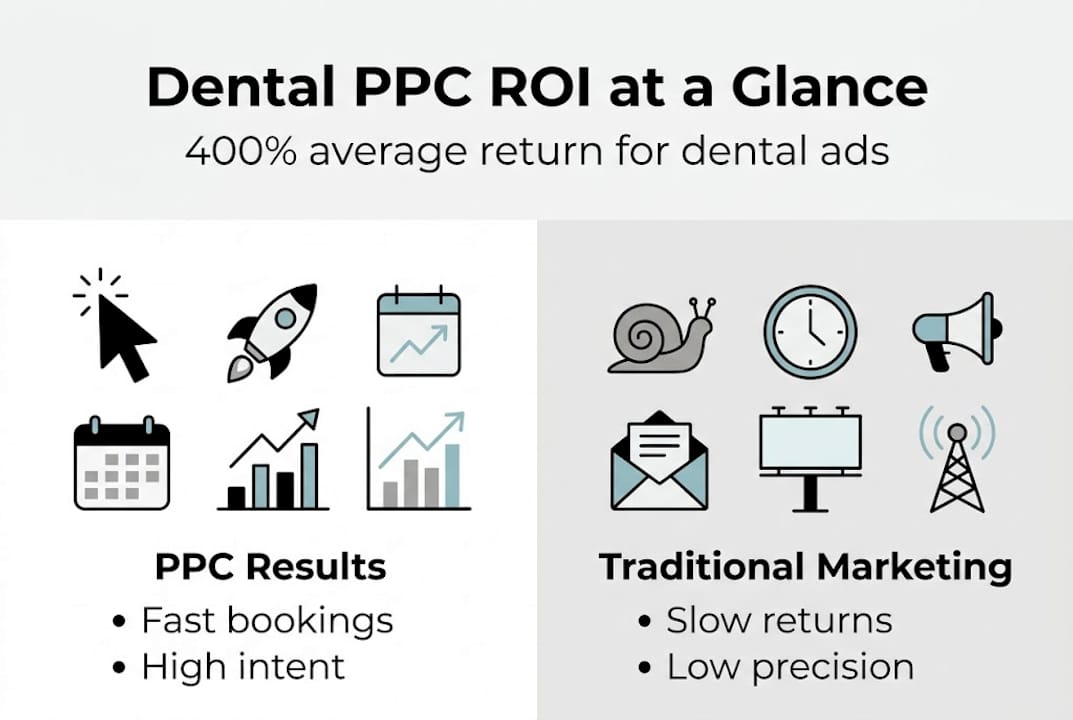
This intent-based targeting is what separates PPC from almost every other marketing channel available to you. Emergency keywords deliver 60% higher conversions, and dental PPC generates a 400% average ROI compared to traditional marketing methods. Those numbers explain why practices investing in affordable dental marketing through PPC consistently outperform competitors relying on word-of-mouth alone.
Here are the core features that make PPC campaigns uniquely suited to dental practices:
- Geographic targeting: Your ads only show to searchers within a defined radius of your office, so your budget reaches people who can actually visit you
- Budget control: You set a daily or monthly spending cap, so you never accidentally overspend
- Real-time analytics: Every click, impression, and phone call is tracked, giving you clear data on what works
- High purchase intent: Searchers using terms like “dentist near me” are actively seeking care, not passively scrolling
- Ad scheduling: You can show ads only during hours when your office is open and staff can answer the phone
A common misconception is that PPC requires a massive budget to compete. In reality, a focused local campaign with even a modest daily budget can outperform broader, unfocused spending.
“PPC is not about who spends the most. It is about who targets the right patient at the right moment with the right message.”
Another myth is that once you launch an ad, you are locked into a contract or long campaign. You can pause, adjust, or stop a Google Ads campaign at any time. That flexibility makes PPC one of the most accessible entry points into online dental marketing for practices of any size.
Why PPC works: Evidence and results for dental practices
Data does the convincing here. Dental PPC is not a theory. It is a measurable, trackable system that delivers patient appointments you can count.

Let’s start with intent. 85% of “dentist near me” searchers are ready to book within 48 hours. That means the traffic coming through a PPC ad is pre-qualified before they even land on your website. They already need a dentist. Your ad just needs to get them to choose you.
Here is a breakdown of how common dental keywords perform:
| Keyword type | Avg. conversion rate | Typical cost per click |
|---|---|---|
| Emergency dentist near me | 12% to 18% | $8 to $15 |
| Dentist near me | 8% to 12% | $5 to $10 |
| Teeth whitening [city] | 5% to 9% | $3 to $7 |
| Dental implants [city] | 6% to 11% | $10 to $20 |
| Pediatric dentist near me | 7% to 10% | $4 to $9 |
Those conversion rates are significantly higher than most industries. For context, the average landing page converts at around 2% to 4%. Dental PPC routinely doubles or triples that because of searcher intent.
Three reasons PPC consistently outperforms traditional local marketing for dentists:
- Precision targeting: You reach only people actively searching for dental care in your zip code, not a generic local audience that mostly ignores your ad
- Instant visibility: Unlike building organic rankings, a PPC ad can appear at the top of search results within hours of launching
- Measurable results: Every dollar is tracked to specific keywords, clicks, and booked appointments, eliminating the guesswork that plagues print ads and direct mail
These advantages are why a growing number of practices use dental ad comparisons to benchmark PPC against other channels before committing budget.
Key stat: Dental PPC campaigns average 400% ROI, meaning every $1 spent returns $4 in patient revenue when campaigns are managed well.
PPC vs. other marketing: How does it compare?
Every marketing option promises results. The difference is in speed, precision, and accountability. Here is how PPC stacks up against the alternatives dental practices commonly use.
| Marketing channel | Startup speed | Targeting precision | Avg. cost | Measurable ROI |
|---|---|---|---|---|
| PPC (Google Ads) | Hours | Very high (location, intent) | Medium | Yes, direct |
| SEO | 3 to 6 months | Medium (organic) | Low to medium | Indirect |
| Social media ads | Days | Medium (interest-based) | Low to medium | Partial |
| Print/direct mail | Weeks | Low (geographic only) | High | Difficult |
| Local TV/radio | Weeks | Very low | Very high | Very difficult |
PPC campaigns drive measurable ROI and allow precise targeting that traditional ads and organic strategies simply cannot match for short-term patient acquisition.
PPC strengths that matter most for dental practices:
- Ads reach patients at the exact moment they are searching for care
- You control daily spend with no long-term contracts
- Results are visible within days, not months
- Campaigns can be paused or redirected instantly based on performance
- Every booked appointment can be traced back to a specific keyword
That said, PPC is not a replacement for everything. Dental SEO strategies build long-term organic authority that compounds over time. Avoiding social media pitfalls while maintaining consistent posting builds community trust. The smartest practices use PPC as their primary patient acquisition engine while SEO quietly builds their long-term foundation.
Pro Tip: Launch PPC first to generate immediate patient bookings and cash flow. Then invest a portion of that revenue into SEO. Within 12 months, you will have both a fast-acting and a long-term patient acquisition system running simultaneously.
How to start PPC: Action steps for dentists
Launching a PPC campaign does not require a marketing degree. It requires a clear plan and a few hours of focused setup. Here is a practical sequence to follow.
- Choose your platform: Google Ads is the starting point for most dental practices. It captures search intent better than any other platform. Microsoft Ads (Bing) can supplement this at a lower cost per click.
- Research your keywords: Focus on local, high-intent terms first. “Emergency dentist [city],” “dentist near me,” and “same-day dental appointment” are strong starting points. Use Google’s Keyword Planner to identify search volume and estimated cost.
- Set a realistic budget: For most local dental campaigns, a daily budget of $30 to $75 is enough to generate meaningful data within the first two weeks. Scale up once you identify which keywords convert.
- Write your ad copy: Your headline should address the patient’s immediate need. “Same-Day Emergency Dental Care in [City]” outperforms generic headlines every time. Include your phone number and a clear call to action.
- Build a dedicated landing page: Do not send ad traffic to your homepage. Create a focused page that matches the ad, shows your location, lists your services, and has one clear next step: call or book online.
- Set up conversion tracking: Install Google’s call tracking and form submission tracking before the campaign goes live. This is non-negotiable. Without it, you cannot measure what is working.
- Monitor and refine weekly: Check your search terms report to find irrelevant clicks and add negative keywords. Shift budget toward keywords that book appointments.
Conversion rates and ROI are maximized when campaigns target local intent and emergency search terms rather than broad or generic keywords.
Common mistakes to avoid:
- Sending traffic to your homepage instead of a dedicated landing page
- Ignoring negative keywords, which wastes budget on irrelevant searches
- Setting too broad a geographic radius and attracting patients who will not drive to you
- Neglecting mobile optimization, since most searches happen on phones
- Running ads 24/7 when your office is only open certain hours
Pro Tip: Add remarketing for dentists to your PPC strategy. Remarketing shows follow-up ads to people who visited your site but did not book, recapturing a significant portion of leads who needed a second nudge.
A fresh perspective: Why dentists must master PPC now
Here is the uncomfortable truth most marketing guides avoid. The dentists who hesitate on PPC are not saving money. They are handing market share to the practice down the street that figured this out six months ago.
We see this pattern repeatedly. A practice finally launches PPC after years of delay, and within 90 days they are booked solid with new patients they had never reached before. The regret is not about the ad spend. It is about the years spent waiting.
The compounding advantage is real. Every month you run PPC, you collect data on which keywords, ads, and landing pages convert best. That data makes your next month more efficient. Practices that started in 2024 now have two years of campaign intelligence their competitors cannot replicate overnight.
Dentists who leverage PPC see up to 400% average ROI compared to traditional marketing. That is not a guarantee, but it is a realistic benchmark for a well-run campaign. The question is not whether PPC works. It is whether you will let video engagement trends and shifting patient behavior pass you by while you decide.
Act now. The window for low-competition, high-return local dental PPC is still open, but it narrows every year as more practices catch on.
Ready to get more patients? Your next step
If you have made it this far, you already know PPC is not optional for a growing dental practice. It is the fastest, most accountable way to put your name in front of local patients who are ready to book.
At ibrand.media, we help dental practices cut through the complexity and launch campaigns that actually deliver appointments. Whether you need to brush up on online advertising basics, work through a website optimization guide before your campaign goes live, or explore full-service dental marketing solutions built specifically for practices like yours, we have a clear path forward. No guesswork, no wasted budget. Just more patients in your chair.
Frequently asked questions
What is PPC in dental marketing?
PPC stands for pay-per-click advertising, where dental practices pay for targeted online ads only when potential patients click their listing. PPC campaigns drive measurable ROI for dentists by reaching high-intent local searchers at the exact moment they need care.
How much does PPC cost for dentists?
PPC costs vary based on keyword demand and geographic targeting, but most practices can start with a manageable daily budget to test local campaigns. Keyword conversion rates and cost per click differ by service type, with emergency terms typically costing more but delivering stronger returns.
Which keywords deliver the best results for dental PPC?
Keywords focused on emergency dental services and “dentist near me” generate the highest conversion rates and ROI for dental practices. Emergency keywords deliver 60% higher conversions than general health or wellness terms.
Is PPC better than SEO for dentists?
PPC delivers immediate results and captures high-intent leads, while SEO builds long-term organic visibility over months. The strongest practices combine both, using PPC vs. SEO as complementary tools rather than choosing one over the other.
How can dentists track PPC success?
Dentists can measure PPC results by tracking clicks, phone calls, form submissions, and new patient appointments tied directly to ad campaigns. PPC campaigns deliver measurable results that make it clear exactly which keywords and ads are filling your schedule.
Recommended
- 7 Affordable Marketing Strategies for Dentists | Ibrandmedia
- SEO strategies for dentists to attract patients in 2026 | Ibrandmedia
- Master Dental Practice Online Marketing for Local Growth | Ibrandmedia
- Why Dentists Need Remarketing for Patient Growth | Ibrandmedia
- Patients Were Waiting. Systems Were Lagg… | Orloff Phillips
Recent Comments