
Most American dental practices lose up to half their patients within eighteen months, affecting long-term growth and stability. In an industry pressured by rising costs, affordable digital marketing is no longer optional for practice owners who want to strengthen patient relationships. Learn how effective remarketing can reconnect with lapsed patients, boost return visits, and keep your American dental office thriving despite fierce local competition.
Table of Contents
- Defining Remarketing For Dental Practices
- Types Of Remarketing Campaigns Dentists Use
- How Remarketing Works In Digital Dentistry
- Increasing Patient Retention And Reactivation
- Cost Efficiency Compared To Other Strategies
- Mistakes To Avoid In Dental Remarketing
Key Takeaways
| Point | Details |
|---|---|
| Effective Audience Segmentation | Create remarketing lists based on specific patient behaviors to increase ad relevance and conversion rates. |
| Personalized Ad Campaigns | Utilize tailored messaging to engage potential patients by addressing their specific interests and needs. |
| Multi-channel Approach | Implement remarketing strategies across various platforms like social media, email, and display networks to enhance visibility. |
| Cost Efficiency | Focus resources on remarketing, targeting users already interested in services, leading to higher returns on investment compared to traditional methods. |
Defining Remarketing for Dental Practices
Remarketing represents a strategic digital marketing approach specifically designed to reconnect with potential patients who have previously interacted with a dental practice’s online platforms. Marketing strategies in dental practices demonstrate that this technique allows dental professionals to create targeted advertising campaigns that re-engage individuals who have shown initial interest but haven’t scheduled an appointment.
At its core, remarketing works by tracking website visitors through digital tracking pixels and creating customized ad experiences across search engines, social media platforms, and display networks. When a potential patient visits a dental practice’s website and then leaves without booking an appointment, remarketing allows that practice to display specific, tailored advertisements to that individual across other websites they subsequently visit. These ads serve as strategic reminders about the practice’s services, keeping the dental office top of mind and increasing the likelihood of conversion.
The primary mechanisms of remarketing for dental practices include audience segmentation, personalized messaging, and strategic ad placement. Practices can create different remarketing lists based on specific patient behaviors – such as those who viewed teeth whitening pages, dental implant information, or emergency dental services. This granular approach enables dentists to craft highly specific advertisements that speak directly to patient interests and potential treatment needs, making the marketing message significantly more compelling and relevant.
Pro tip: Start by creating remarketing lists that segment patients based on specific services they viewed, allowing for more personalized and targeted advertising approaches.
Types of Remarketing Campaigns Dentists Use
Dental practices can leverage several strategic remarketing campaign types to reconnect with potential patients and drive practice growth. Digital advertising for dental practices typically includes five primary remarketing approaches that help practices stay connected with their target audience and increase patient conversion rates.
The first type is Website Visitor Remarketing, which targets individuals who have previously visited the dental practice’s website but did not schedule an appointment. These campaigns display targeted ads across social media platforms and display networks, featuring specific services like teeth whitening, dental implants, or routine checkups that the visitor previously viewed. By presenting tailored advertisements, practices can gently remind potential patients about their available services and unique value proposition.

Another powerful remarketing strategy is Email List Remarketing, where practices use existing patient email databases to create custom audience segments. This approach allows dentists to develop highly personalized advertising campaigns targeting patients who have previously received treatment, those overdue for regular checkups, or individuals who have shown interest in specific dental procedures. By segmenting audiences based on past interactions and treatment histories, dental practices can create more precise and engaging marketing messages that resonate with specific patient groups.
Additionally, Social Media Remarketing has emerged as a sophisticated technique for dental practices. This method involves creating targeted ad campaigns on platforms like Facebook, Instagram, and LinkedIn that specifically reach users who have interacted with the practice’s social media content, watched video testimonials, or engaged with previous advertisements. These campaigns can showcase patient success stories, highlight advanced treatment technologies, and build trust through consistent, strategic visibility.
Pro tip: Create remarketing audiences with granular segmentation, focusing on specific service interests and patient behaviors to maximize ad relevance and conversion potential.
Here is a summary comparing common remarketing campaign types used by dental practices:
| Campaign Type | How It Targets Patients | Unique Benefit |
|---|---|---|
| Website Visitor | Follows users across web & social | Recaptures unbooked leads |
| Email List | Uses existing patient email data | Engages past patients |
| Social Media | Targets social media interactions | Boosts brand visibility |
| Search Engine | Displays ads after site searches | Reaches active inquiries |
| Display Network | Shows ads on related websites | Expands audience reach |
How Remarketing Works in Digital Dentistry
Digital dentistry remarketing is a sophisticated technological approach that transforms patient engagement through intelligent tracking and personalized communication strategies. Marketing strategies in digital dentistry demonstrate how advanced tracking technologies enable dental practices to create highly targeted advertising experiences that reconnect with potential patients.
The technical mechanism of remarketing begins with digital tracking pixels, small pieces of code embedded on a dental practice’s website that anonymously follow user interactions. When a potential patient visits specific service pages like teeth whitening or dental implants, these pixels create a unique audience profile. This profile allows practices to display customized advertisements across various digital platforms, including social media, search engines, and display networks, ensuring that relevant dental service ads follow the potential patient during their online browsing experience.
Moreover, remarketing in digital dentistry leverages sophisticated audience segmentation techniques that go beyond simple website tracking. Practices can create intricate remarketing lists based on multiple parameters such as specific service interest, appointment history, treatment complexity, and patient demographics. For instance, a patient who viewed orthodontic services but did not schedule a consultation can be targeted with specialized ads showcasing before-and-after treatment images, patient testimonials, and limited-time consultation offers, dramatically increasing the probability of conversion.
The strategic implementation of remarketing also integrates advanced analytics and machine learning algorithms that continuously optimize ad delivery. These technologies analyze user engagement metrics, click-through rates, and conversion patterns to refine targeting precision, ensuring that dental practices invest their marketing budgets more efficiently and effectively.
Pro tip: Implement a dynamic remarketing strategy that creates at least three distinct audience segments based on specific patient behaviors and service interests to maximize ad relevance and conversion potential.
Increasing Patient Retention and Reactivation
Patient retention represents a critical challenge for dental practices, with remarketing emerging as a powerful strategic solution to reconnect and reengage individuals who might otherwise slip away from consistent dental care. Marketing strategies in dental practices reveal that personalized digital communication can dramatically improve patient return rates and long-term practice sustainability.
The core mechanism of patient reactivation through remarketing involves creating sophisticated, segmented communication strategies tailored to different patient groups. Dental practices can develop targeted campaigns for patients who have missed routine checkups, those with incomplete treatment plans, or individuals who have shown interest in specific dental services but never followed through. By crafting personalized messages that address individual patient needs and concerns, practices can effectively reignite patient interest and motivate them to schedule appointments.
Technologically advanced remarketing approaches enable dental practices to implement multi-channel reengagement strategies. These might include automated email sequences highlighting the importance of preventive care, social media ads featuring patient success stories, or personalized reminder campaigns about overdue dental procedures. The key is creating a consistent, non-intrusive communication approach that provides genuine value to patients, demonstrating the practice’s commitment to their long-term health and well-being.
Moreover, successful patient retention through remarketing requires a data-driven approach that continuously analyzes patient interaction patterns, engagement metrics, and conversion rates. By leveraging advanced analytics, dental practices can refine their remarketing strategies, identifying the most effective messaging, timing, and communication channels for different patient segments.
Pro tip: Create a comprehensive patient reactivation workflow that segments patients based on their last appointment date, treatment history, and engagement level to develop hyper-targeted remarketing campaigns.
Cost Efficiency Compared to Other Strategies
Cost efficiency stands as a critical consideration for dental practices evaluating marketing strategies, and remarketing emerges as a significantly more economical approach compared to traditional advertising methods. Dental marketing cost analysis reveals that remarketing provides an unparalleled return on investment by targeting users who have already demonstrated genuine interest in dental services.
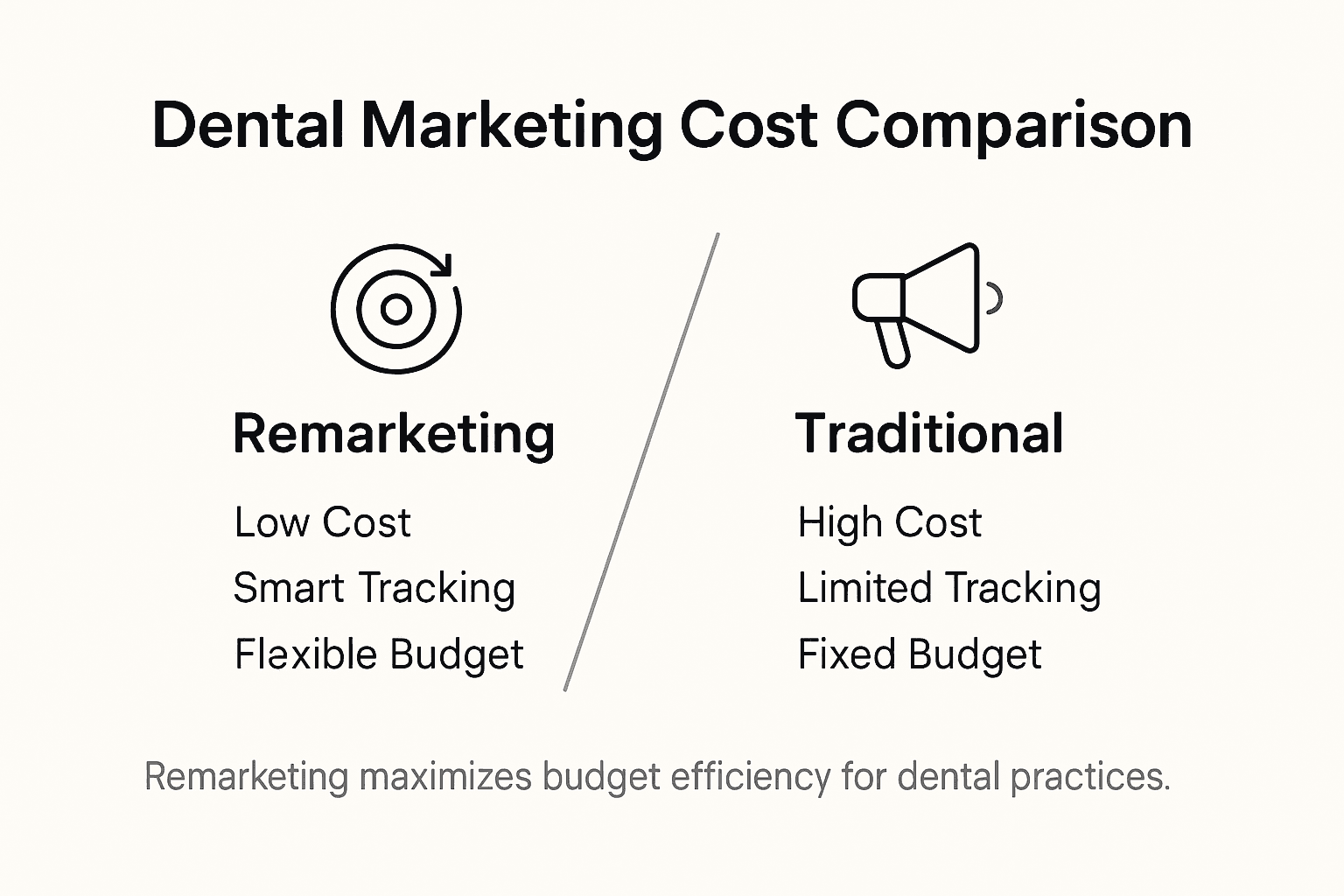
Traditional marketing strategies like print advertising, radio spots, and broad-spectrum digital campaigns often require substantial upfront investments with uncertain returns. In contrast, remarketing operates on a precision-driven model that minimizes wasted ad spend by exclusively targeting individuals who have previously engaged with a dental practice’s online platforms. This targeted approach means dental practices can allocate their marketing budgets more strategically, focusing resources on potential patients who are already partially convinced and more likely to convert.
The financial advantages of remarketing become particularly pronounced when examining cost-per-acquisition metrics. While traditional marketing channels might require extensive spending to reach thousands of potential patients, remarketing allows practices to create highly specific audience segments. By using advanced tracking technologies and data analytics, dental practices can design campaigns that reach individuals most likely to schedule appointments, thereby reducing overall marketing expenses and improving conversion rates.
Additionally, remarketing provides unprecedented flexibility in budget management. Practices can start with minimal investment, gradually scaling their campaigns based on performance metrics. This approach stands in stark contrast to traditional marketing methods that often demand significant upfront costs with limited ability to track or adjust strategies in real-time. Digital remarketing platforms offer granular control over spending, enabling dental practices to optimize their marketing investments continuously.
Pro tip: Start with a modest monthly budget of $200-$500 for remarketing campaigns, using performance data to incrementally adjust targeting and spending for maximum cost efficiency.
For a quick reference, here’s a comparison of remarketing cost efficiency versus traditional dental marketing:
| Marketing Approach | Cost Control | Tracking Capabilities | Typical ROI |
|---|---|---|---|
| Remarketing Campaigns | Highly flexible | Real-time analytics | High for targeted leads |
| Print Advertising | Fixed, expensive | Limited tracking | Low for niche services |
| Radio/TV Spots | High upfront cost | Minimal audience tracking | Broad but inefficient |
| General Digital Ads | Variable | Basic conversion data | Moderate for wide reach |
Mistakes to Avoid in Dental Remarketing
Remarketing mistakes can significantly undermine a dental practice’s digital advertising efforts, potentially wasting valuable marketing resources and alienating potential patients. Common digital marketing mistakes reveal critical errors that dental practices must carefully navigate to ensure successful patient acquisition and retention.
One of the most prevalent mistakes is generic ad messaging that fails to create meaningful connections with potential patients. Dental practices often make the error of using broad, non-specific advertisements that do not address individual patient needs or concerns. This approach results in low engagement rates and minimal conversion potential. Instead, remarketing campaigns should leverage detailed patient data to create highly personalized, targeted messages that speak directly to specific dental concerns, treatment interests, or past interaction histories.
Technical implementation errors can also compromise remarketing effectiveness. Dental marketing compliance highlights critical mistakes such as over-saturating potential patients with repetitive advertisements, which can quickly transform targeted marketing into perceived harassment. Successful remarketing requires a delicate balance – maintaining consistent visibility without becoming intrusive. Practices must carefully manage ad frequency, ensuring that their remarketing efforts remain helpful and informative rather than annoying and counterproductive.
Moreover, many dental practices overlook the critical importance of mobile optimization and comprehensive performance tracking. With increasing numbers of patients using mobile devices to research dental services, remarketing campaigns must be seamlessly responsive across various screen sizes and platforms. Failing to implement robust analytics and continuous performance monitoring means practices cannot refine their strategies, leading to progressively diminishing returns on marketing investments.
Pro tip: Implement a frequency cap of 3-5 ad impressions per week for each audience segment to maintain engagement without causing advertisement fatigue.
Unlock Patient Growth with Targeted Remarketing Solutions
Struggling to convert website visitors into loyal patients is a common challenge for dental practices. The detailed strategies in this article highlight how remarketing can address key pain points such as reclaiming lost leads, personalizing patient outreach, and maximizing cost efficiency for sustainable growth. By using techniques like audience segmentation and personalized messaging, your practice can stay top of mind and reactivate past patients with precision and care.
Discover how partnering with a digital marketing agency that understands these specific challenges can transform your patient acquisition efforts. At ibrand.media, we specialize in crafting tailored remarketing campaigns that directly connect with your prospective patients’ interests and behaviors. Start leveraging detailed segmentation, mobile-optimized ads, and real-time performance tracking today. Visit our Uncategorized category to explore actionable digital strategies and let us help you grow your patient base with proven remarketing approaches. Take the next step now and boost your dental practice’s growth with expert help from ibrand.media.
Frequently Asked Questions
What is remarketing and how does it benefit dental practices?
Remarketing is a digital marketing strategy that targets potential patients who have previously interacted with a dental practice’s website. It benefits dental practices by allowing them to create specialized ads that remind these individuals of the services offered, increasing the likelihood of re-engagement and appointment bookings.
How can dental practices effectively segment their remarketing audiences?
Dental practices can segment their remarketing audiences based on specific patient behaviors, such as the services viewed on their website (e.g., teeth whitening or dental implants), appointment history, and treatment interests. This targeted approach helps create personalized advertisements that resonate with the individual needs of different patient groups.
What are the common types of remarketing campaigns dental practices can use?
Common types of remarketing campaigns for dental practices include website visitor remarketing, email list remarketing, social media remarketing, search engine remarketing, and display network advertising. Each type targets specific user interactions to engage potential patients effectively.
What mistakes should dental practices avoid in their remarketing efforts?
Dental practices should avoid generic ad messaging, over-saturating potential patients with repetitive ads, and neglecting mobile optimization. By ensuring personalized messaging, balancing ad frequency, and optimizing for mobile devices, practices can enhance their remarketing effectiveness.
Recommended
- Dental Clinic Marketing Challenges: Growing in 2024 | Ibrandmedia
- Best 7 Digital Ads for Dental Practices – Expert Comparison 2025 | Ibrandmedia
- Master Dental Practice Online Marketing for Local Growth | Ibrandmedia
- Marketing Compliance for Dentists: Complete Guide | Ibrandmedia
- 7 Customer Segmentation Ideas to Boost Your Sales – ApusNest Blog | ApusNest
Recent Comments