
TL;DR:
- Effective ad copy combines research and a structured approach to persuade viewers and drive actions. It needs a specific hook, credible body content, proof, a clear CTA, and alignment with the landing page to maximize conversions. Continuous testing and specificity are essential to prevent common mistakes and improve ad performance over time.
Writing effective ad copy is the practice of crafting short, persuasive messages that capture attention, communicate a clear benefit, and motivate a specific action. For small business owners, this skill separates ads that drain budgets from ads that generate real customers. The industry term for this discipline is direct response copywriting, and it runs on three pillars: a strong hook, credible body copy, and a clear call to action. This article walks you through each pillar using proven frameworks like PAS, data from Facebook’s scroll-speed research, and testing methods that can lift ad performance by up to 50%.
What are the essential components of writing effective ad copy?
Every high-converting ad shares the same skeleton. Before you write a single word, you need to understand two things: where your customer is in the decision-making process and what your landing page actually delivers. Misaligned ads and landing pages cause high bounce rates and low conversions. If your ad promises a 20% discount and the landing page shows full-price products, you lose the customer immediately.
Understanding the decision funnel stage your customer occupies shapes every word you write. A cold audience needs education and curiosity. A warm audience needs proof and urgency. Writing the same copy for both groups wastes money.
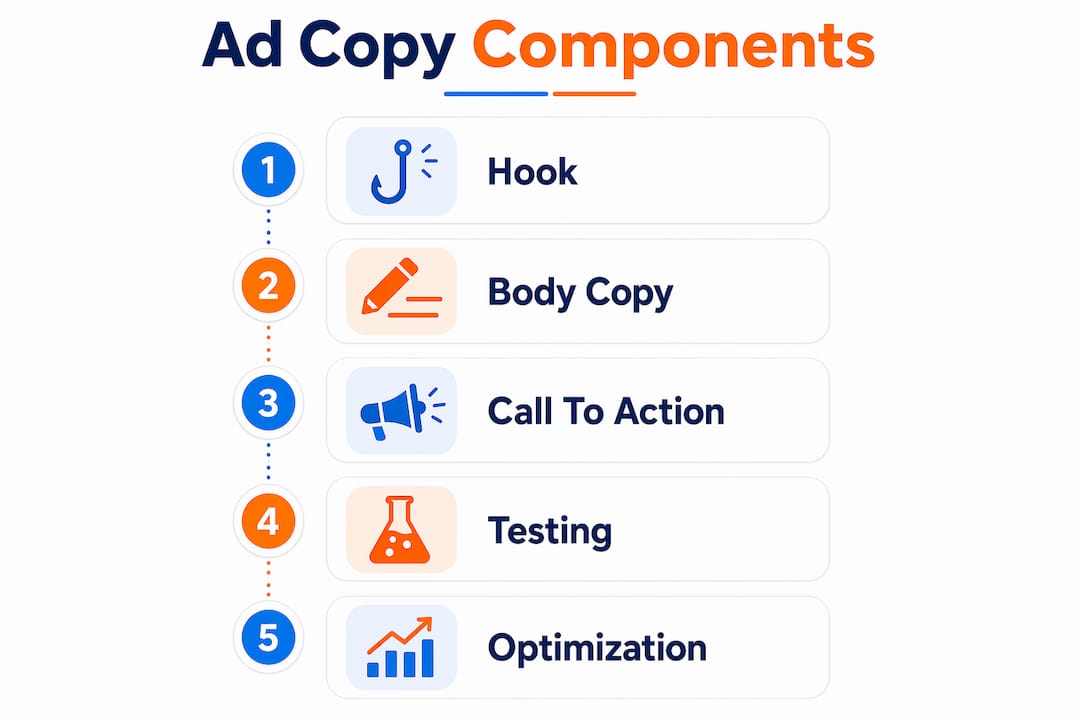
Here are the five must-have components of any effective ad:
- Hook: The first 1–2 sentences that stop the scroll and earn attention.
- Body: The explanation that builds desire, addresses objections, and provides proof.
- Social proof: A testimonial, statistic, or case study that reduces skepticism.
- Call to action (CTA): A clear instruction telling the reader exactly what to do next.
- Offer alignment: The promise in the ad must match what the landing page delivers.
The table below shows how each component functions and what failure looks like:
| Component | Purpose | Common Failure |
|---|---|---|
| Hook | Stops the scroll and earns attention | Too vague or generic |
| Body copy | Builds desire and addresses objections | Overloaded with multiple claims |
| Social proof | Reduces skepticism and builds trust | Missing entirely or too generic |
| CTA | Directs the reader to act | Passive language like “Learn more” |
| Offer alignment | Matches ad promise to landing page | Landing page contradicts the ad |
Ad copy effectiveness is 30% craft and 70% research. That means before you write, you should study competitor ads, read customer reviews, and collect the exact language your audience uses to describe their problems.
How do you craft a hook that stops the scroll?
The hook is the most important sentence in your ad. Facebook’s scroll-speed research shows you have fewer than 2 seconds to earn a reader’s attention before they move on. That number should change how you approach every first line.

The most effective hooks share one trait: specificity. “Tired of slow website traffic?” is weak. “Your Google ranking dropped 3 spots last month. Here’s why.” is strong. The second version names a concrete situation, which triggers recognition in the right reader and filters out everyone else.
Here are four hook formats that work across platforms like Google Ads, Facebook, and Instagram:
- The problem hook: Name a specific pain point your audience experiences right now.
- The result hook: Lead with a concrete outcome. “Lost 12 pounds in 6 weeks without cutting carbs.”
- The curiosity hook: Tease information the reader does not yet have. “Most plumbers in Austin charge $40 more than they should.”
- The social proof hook: Open with a customer result. “Sarah went from 0 to 200 bookings in 90 days using this system.”
Testing more than 5 hook variants per ad concept using click-through rate data can improve ad performance by 35–50%. That is not a small gain. It means the difference between a campaign that breaks even and one that scales.
Pro Tip: Write your hooks before you write the rest of the ad. Generate 8–10 options, then pick the top 3 to test. Use CTR data from the first 3–5 days to identify the winner before spending more budget.
What techniques build desire and credibility in body copy?
The body of your ad does the heavy lifting. Its job is to build desire, handle objections, and provide proof that your offer is real. The most reliable structure for this is the PAS framework: Problem, Agitate, Solution.
The PAS framework works by starting with the customer’s problem, intensifying the pain of that problem, and then presenting your product as the logical solution. A plumber running a Facebook ad might write: “Leaky pipes don’t fix themselves. Every day you wait, water damage spreads and repair costs grow. Our licensed team arrives within 2 hours and fixes the problem the first time.” That structure is PAS in three sentences.
Specificity is the most powerful credibility tool you have. Specific claims with numbers convert 68% better than vague promises. “Helped 2,347 brands increase ROAS by 40%” outperforms “helped thousands of brands” every time. The exact number triggers mental simulation. The reader pictures a real outcome, not a marketing claim.
Here are the best practices for persuasive body copy:
- Use one strong proof point rather than several weak ones. A Nielsen Neuroscience study found that one specific proof point scored 23% higher recall than multi-claim ads.
- Include social proof like customer testimonials, star ratings, or named case studies to reduce skepticism.
- Address the top objection your customer has before they raise it. If price is the concern, acknowledge it and reframe the value.
- Keep paragraphs to 1–3 sentences. Short paragraphs improve readability and engagement, especially on mobile devices where most ads are consumed.
Pro Tip: Pull exact phrases from your customer reviews and use them in your body copy. When a reader sees their own words reflected back at them, trust builds instantly. This is called “voice of customer” copy and it outperforms internally written messaging most of the time.
How do you write calls to action that drive conversions?
A call to action is not a button label. It is a complete instruction that tells the reader what to do and what they get in return. Effective CTAs must state both the action and the benefit clearly. “Click here” fails both tests. “Get your free quote in 60 seconds” passes both.
Follow these steps to write and optimize your CTAs:
- Start with a strong verb. Use words like Get, Try, Start, Register, Claim, or Book. These verbs signal immediate action.
- Name the benefit. Tell the reader what they receive. “Download the free checklist” beats “Download now.”
- Match the funnel stage. Cold audiences respond to low-commitment CTAs like “See how it works.” Warm audiences respond to “Book your free call today.”
- Align with the landing page. If your CTA says “Get a free audit,” the landing page must open with a free audit offer. Any gap between the two kills conversions.
- Test your CTA out loud. Read it and ask: what am I doing, and what do I get? If you cannot answer both questions in one sentence, rewrite it.
You can go deeper on CTA optimization tactics to understand how button placement, color, and copy interact to affect conversion rates. The copy is only one variable, but it is the one you control most directly.
What mistakes should you avoid when optimizing ad copy?
The most common ad copy mistake is making a promise the landing page cannot keep. Vague and unsupported claims destroy trust and spike bounce rates. If your ad says “the best pizza in Chicago” and your landing page shows no reviews, no awards, and no proof, the reader leaves.
The second most common mistake is overloading the ad with multiple claims. Each additional claim you add splits the reader’s attention and reduces the impact of your strongest point. Pick one core message per ad and build everything around it.
Watch for these pitfalls before you publish:
- Ignoring objections: If your audience worries about price, contract length, or delivery time, address it in the copy. Silence reads as confirmation of the fear.
- Mismatching intent and offer: A search ad targeting “emergency plumber near me” should not lead to a general services page. Match the specific intent with a specific offer.
- Skipping A/B testing: Running one version of an ad is guesswork. Test hooks, body copy, and CTAs separately to isolate what drives performance.
- Forgetting mobile format: Dense text walls cause readers to skip content. Write for a 5-inch screen first.
Review your common marketing mistakes regularly to catch patterns across campaigns, not just individual ads. Systematic testing and website conversion alignment between your ads and landing pages are the two levers that compound over time.
Pro Tip: Set a 3-day review checkpoint for every new ad. Check CTR, cost per click, and bounce rate together. If CTR is high but bounce rate is also high, the hook is working but the landing page is not delivering on the promise.
Key takeaways
Writing effective ad copy requires research, a clear structure, and systematic testing before any creative instinct pays off.
| Point | Details |
|---|---|
| Research before writing | Ad effectiveness is 30% craft and 70% audience research and angle discovery. |
| Hook specificity wins | Vague hooks lose readers in under 2 seconds; specific, concrete hooks earn attention. |
| Use the PAS framework | Structure body copy as Problem, Agitate, Solution to build desire and relevance. |
| One proof point beats many | A single specific claim or statistic drives 23% higher recall than multi-claim ads. |
| Test hooks and CTAs | Testing more than 5 hook variants can improve ad performance by 35–50%. |
The uncomfortable truth about ad copywriting
Most small business owners I work with believe their ads underperform because of budget. The real reason is almost always the copy. Specifically, it is the absence of specificity.
Generic ads feel safe to write. “Quality service at a great price” offends no one and convinces no one. The ads that actually convert are the ones that name a real problem, quote a real number, and make a promise the business can keep. That level of specificity requires you to know your customer deeply, not just demographically but emotionally.
The other thing I have seen consistently is that small business owners treat ad copy as a one-time task. They write one version, run it for a month, and conclude that ads “don’t work.” The businesses that grow through paid advertising treat copy as a living system. They test hooks weekly, rotate proof points, and update CTAs based on what the data shows.
You do not need to be a natural writer to produce ads that convert. You need a process: research your audience’s language, build your copy on the PAS structure, test at least three hook variants, and let the data tell you what to keep. That process is learnable, repeatable, and worth far more than any single clever headline.
— TONY
How Ibrand helps small businesses turn ads into results
Strong ad copy is only one piece of the puzzle. If your website is slow, hard to navigate, or not showing up in search results, even the best copy cannot save your conversion rate.
Ibrand works with small businesses to align every part of their digital presence, from the ad that earns the click to the page that closes the sale. Whether you need help with local SEO for small businesses, paid ad strategy, or building a site that converts visitors into customers, Ibrand builds a plan around your specific goals and budget. The team tracks performance in real time so you always know what is working. If you are ready to stop guessing and start growing, Ibrand is the partner that makes it practical.
FAQ
What is direct response copywriting?
Direct response copywriting is ad writing designed to produce an immediate, measurable action from the reader, such as a click, sign-up, or purchase. It differs from brand advertising by prioritizing a specific response over general awareness.
How long should ad copy be?
Ad copy length depends on the platform and funnel stage. Facebook and Instagram ads perform well with 1–3 short paragraphs, while Google Search ads are limited to headlines of 30 characters and descriptions of 90 characters.
How many hooks should i test per ad?
Test at least 5 hook variants per ad concept. Data shows that testing more than 5 hooks using CTR metrics can improve overall ad performance by 35–50%.
What makes a CTA effective?
An effective CTA names both the action and the benefit in one phrase. “Get your free quote in 60 seconds” works because it tells the reader exactly what to do and what they receive.
Why do specific numbers improve ad performance?
Specific numbers trigger mental simulation and purchasing intent. Claims with exact figures convert 68% better than vague equivalents because they signal a real, verifiable outcome rather than a marketing generalization.
Recent Comments