
TL;DR:
- Performance marketing is a results-driven advertising model where businesses pay only when a measurable action occurs, such as a click or sale. It emphasizes tracking, attribution, and optimization across channels like paid search, social media, and affiliate marketing to improve efficiency and ROI. Small businesses can effectively use this model by validating product fit, focusing on creative testing, and combining paid efforts with organic growth strategies.
Performance marketing is a digital advertising model where you pay only when a specific, measurable action occurs, such as a click, lead, or sale. Unlike traditional advertising, where you pay upfront for exposure with no guarantee of results, performance marketing ties every dollar directly to an outcome. For small business owners, that distinction matters enormously. Platforms like Google Ads and Meta Ads have made this model accessible to businesses of any size, and tools like Salesforce and Mailchimp help track and automate the results. This guide explains what performance marketing is, how it works, and how you can use it to grow your business without wasting your budget.
What is performance marketing and how does it work?
Performance marketing is a results-driven advertising approach where advertisers pay only when a defined action is completed. That action could be a click on an ad, a form submission, a phone call, or a completed purchase. The advertiser sets the goal, the platform delivers the audience, and payment is triggered by results.

The core payment models in performance marketing are Cost Per Click (CPC), Cost Per Lead (CPL), and Cost Per Acquisition (CPA). Each model shifts financial risk away from the advertiser and toward the publisher or platform. That accountability is what separates performance marketing from traditional advertising, where you pay for a billboard or a TV spot regardless of how many customers walk through your door.
Performance marketing sits within the broader discipline of what is digital marketing, but with a sharper focus on conversion rather than awareness. Channels like paid search, paid social, affiliate marketing, and programmatic display all fall under this umbrella. The unifying principle is simple: if you cannot measure it, you do not pay for it.
What are the key channels and metrics?
Performance marketing includes PPC (pay-per-click), affiliate marketing, paid social media ads, programmatic display, and native advertising. Each channel serves a different role in your funnel, and understanding those roles prevents wasted spend.
Here is a breakdown of the primary channels:
- PPC (Google Ads, Microsoft Ads): Captures users who are already searching for what you sell. High intent, higher cost per click.
- Paid social (Meta, TikTok, Pinterest): Surfaces your offer to users who match your audience profile. Builds demand rather than capturing it.
- Affiliate marketing: Partners promote your product and earn a commission per sale. Low upfront risk for the advertiser.
- Programmatic display: Automated ad buying across thousands of websites, optimized by algorithms in real time.
- Native advertising: Ads that match the look and feel of the content around them, typically used for top-of-funnel traffic.
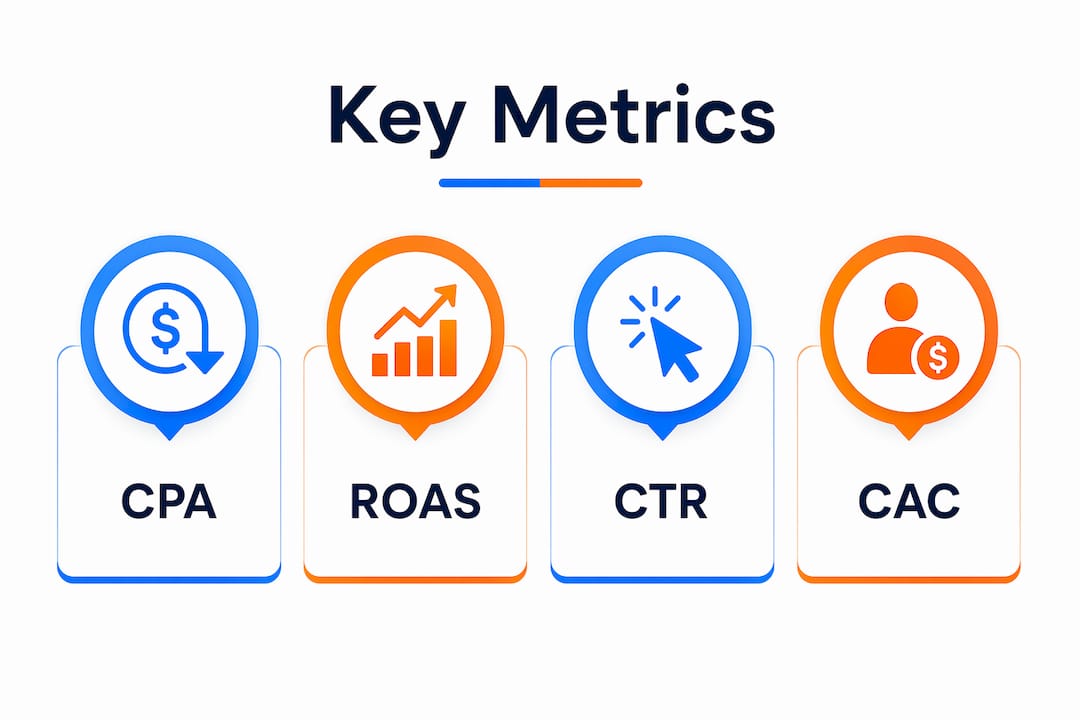
The metrics that matter most in performance marketing are CPA (cost per acquisition), ROAS (return on ad spend), CTR (click-through rate), and CAC (customer acquisition cost). Performance marketing targets measurable outcomes like CPA and ROAS rather than impressions or brand awareness. Impressions tell you how many people saw your ad. ROAS tells you whether the campaign made money.
Tracking and attribution are the backbone of this model. Without accurate attribution, you cannot tell which channel or ad drove the sale. Tools like Google Analytics 4, Triple Whale, and Northbeam help small businesses connect ad spend to revenue across multiple touchpoints.
Pro Tip: Set up conversion tracking before you spend a single dollar on ads. Without it, you are flying blind and optimizing for the wrong signals.
Performance marketing vs. traditional and digital marketing
Understanding the differences between performance marketing, brand marketing, and SEO helps you allocate your budget with confidence.
| Marketing Type | Primary Goal | Payment Model | Time to Results | Key Metric |
|---|---|---|---|---|
| Performance Marketing | Conversions and sales | Pay per action (CPC, CPA) | Days to weeks | ROAS, CPA |
| Brand Marketing | Awareness and recall | Pay for exposure | Months to years | Reach, brand lift |
| SEO | Organic traffic growth | Time and content investment | 3–12 months | Rankings, organic sessions |
| Direct Response | Immediate action | Pay per placement | Days to weeks | Response rate, CPL |
Performance marketing focuses on short-term ROI, while SEO impacts are slower and build organic growth over time. That does not make one better than the other. They serve different purposes and work best together.
Brand marketing builds the trust and recognition that makes your performance ads convert better. SEO creates organic demand that lowers your paid CAC over time. Integrating organic content can lower CAC and improve the effectiveness of paid ads. Think of performance marketing as the engine and organic marketing as the fuel that makes it run more efficiently.
The key difference between performance marketing and traditional marketing comes down to accountability. A newspaper ad costs the same whether it generates zero calls or 500. A Google Ads campaign charges you only when someone clicks. For a small business with a limited budget, that accountability is not just convenient. It is necessary.
How to build a performance marketing strategy for your business
A performance marketing strategy is not a list of tactics. A genuine strategy involves demand mapping, funnel architecture, measurement logic, and budget allocation based on marginal returns. Here is how to build one that works for a small business.
-
Validate product-market fit first. Scaling paid ads without a validated product-market fit or sufficient repeat purchase rate can worsen financial losses. Before you increase your ad spend, confirm that customers are buying, returning, and referring others.
-
Define your conversion goal. Decide what action you are paying for. A lead generation campaign optimizes for form fills. An e-commerce campaign optimizes for purchases. Mixing goals creates conflicting signals for the algorithm.
-
Map your funnel. Paid social creates or surfaces latent demand, while paid search captures existing intent. This fundamental difference affects how you attribute results and where you allocate budget. Use paid search to capture buyers who are ready now. Use paid social to build awareness with buyers who are not ready yet.
-
Choose your starting channel. Most small businesses should start with one channel, prove profitability, and then expand. Google Ads works well for service businesses with clear search intent. Meta Ads works well for product businesses with strong visual creative.
-
Test creative aggressively. Operators now spend around 90% of their time on creative production and only 10% on campaign settings, leveraging AI for targeting. The ad platform handles the targeting. Your job is to give it enough creative variations to find what works.
-
Measure and reallocate. Track your campaign performance metrics weekly. Cut what is not working. Increase budget on what is profitable. Repeat.
Pro Tip: Start with a daily budget you can afford to lose entirely while learning. Treat the first 30 days as paid research, not revenue generation.
What are the common pitfalls in performance marketing?
Performance marketing fails in predictable ways. Knowing the traps in advance saves you money and frustration.
- Chasing vanity metrics. A high CTR feels good but means nothing if it does not produce sales. Always trace the metric back to revenue.
- Neglecting creative volume. Creative volume and relevance are prioritized by major platforms after iOS 14 changes, making diverse and frequent creative production critical. Running one ad variation is not a test. It is a guess.
- Ignoring organic demand. Paid ads amplify demand that already exists. If no one is searching for your product or talking about it organically, paid ads will struggle to create that demand from scratch.
- Scaling too early. Increasing budget before you have a profitable baseline does not fix a broken campaign. It accelerates the losses.
- Misreading attribution. Last-click attribution gives all credit to the final touchpoint before purchase. That model undercounts the role of social ads and content in the decision process.
“A simple tactics list without strategic context can mislead businesses into spending money on channels that do not fit their funnel stage or customer behavior.” — Performance Marketing Strategy: Fix the Architecture
The fix for most of these pitfalls is the same: slow down, measure accurately, and build on what the data actually shows rather than what you hope it shows.
Key takeaways
Performance marketing delivers measurable ROI because every dollar is tied to a specific, trackable action rather than vague exposure.
| Point | Details |
|---|---|
| Pay only for results | Performance marketing uses CPC, CPL, and CPA models so you pay when an action occurs. |
| Creative drives performance | Spend 90% of your effort on ad creative; AI handles targeting on major platforms. |
| Validate before scaling | Confirm product-market fit and positive margins before increasing paid ad budgets. |
| Combine paid and organic | SEO and content lower your CAC and make paid campaigns more profitable over time. |
| Attribution accuracy matters | Use tools like Google Analytics 4 or Triple Whale to connect spend to actual revenue. |
Why creative is the real competitive edge now
The biggest shift I have seen in performance marketing over the past few years is not about bidding strategies or audience targeting. It is about creative. After Apple’s iOS 14 privacy changes reduced the signal quality available to ad platforms, the algorithms compensated by leaning harder on creative signals. The ad that resonates most with the right person now does more of the targeting work than any audience setting you configure manually.
What that means practically is that small businesses with strong creative output can compete with much larger advertisers. You do not need a massive budget. You need a steady stream of honest, specific ads that speak directly to your customer’s situation. The businesses I have seen waste the most money are the ones running one or two polished ads and wondering why performance drops after two weeks. The ones winning are testing five to ten variations at a time and letting the data pick the winner.
The other thing I would push back on is the idea that performance marketing is a replacement for building a real brand. It is not. Paid ads capture demand. They rarely create it. If you are a new business with no organic presence, no word of mouth, and no search volume around your category, performance marketing will feel expensive and discouraging. Build some organic foundation first through local SEO strategies and content, then use paid channels to accelerate what is already working.
The future of this space is moving toward AI-driven creative generation and better cross-channel attribution. Both trends favor businesses that understand the fundamentals well enough to evaluate what the tools are actually doing.
— TONY
How Ibrand helps small businesses get measurable results
Running performance marketing campaigns takes more than a budget. It takes the right tracking setup, the right channel mix, and the right creative strategy working together.
Ibrand works with small and medium-sized businesses to build advertising programs that connect paid performance channels with strong organic foundations. From SEO optimization for small businesses to social media management and real-time campaign tracking, Ibrand builds the infrastructure that makes every ad dollar accountable. If you are ready to stop guessing and start measuring, Ibrand offers personalized plans built around your goals and budget. Explore what a performance-focused digital marketing strategy looks like for your business.
FAQ
What is performance marketing in simple terms?
Performance marketing is an advertising model where you pay only when a specific action occurs, such as a click, lead, or sale. It ties your ad spend directly to measurable business outcomes.
How does performance marketing differ from traditional marketing?
Traditional marketing charges you for exposure regardless of results. Performance marketing charges you only when a defined action is completed, making it more accountable and budget-efficient for small businesses.
What are the most important performance marketing metrics?
The key metrics are CPA (cost per acquisition), ROAS (return on ad spend), CTR (click-through rate), and CAC (customer acquisition cost). ROAS and CPA are the most direct indicators of campaign profitability.
Can small businesses use performance marketing effectively?
Yes. Platforms like Google Ads and Meta Ads are accessible at any budget level. The key is validating product-market fit before scaling spend and combining paid ads with organic channels to lower acquisition costs.
What channels are included in performance marketing?
Performance marketing channels include PPC, paid social media ads, affiliate marketing, programmatic display, and native advertising. Each channel plays a different role in the customer journey from awareness to purchase.
Recent Comments