
TL;DR:
- PPC is a pay-per-click model offering targeted, immediate traffic by paying for clicks, not impressions.
- Success depends on relevance, quality score, and proper strategy, not just budget size.
- Small businesses should focus on long-tail keywords, negative keywords, and relevant landing pages to optimize results.
Pay-per-click advertising confuses a lot of small business owners, and that confusion is expensive. Many assume it’s the same as SEO, others think it means buying a banner ad, and some jump in without a strategy and burn through their budget in weeks. PPC is actually one of the fastest ways to drive targeted traffic to your website, but only when you understand how it works. This guide breaks down exactly what PPC is, how the auction process works, which strategies deliver results for small and medium-sized businesses, and the mistakes you need to avoid before spending a single dollar.
Table of Contents
- Understanding pay-per-click: The basics explained
- How does pay-per-click advertising work?
- Essential pay-per-click strategies for small businesses
- Common pay-per-click mistakes and how to avoid them
- Expert perspective: What most PPC guides miss for small businesses
- Get expert help scaling your PPC and online marketing
- Frequently asked questions
Key Takeaways
| Point | Details |
|---|---|
| PPC gets fast traffic | Pay-per-click advertising gives businesses immediate visibility with a flexible budget. |
| Relevance beats broad reach | Targeted keywords and tight ad groups boost ROI and reduce wasted spend. |
| Landing pages matter most | Sending users to dedicated, relevant landing pages dramatically increases conversions. |
| Avoid common PPC pitfalls | Frequent errors like ignoring negatives or poor tracking can sink campaigns unless corrected early. |
| Test, measure, improve | Regular adjustments and tracking of ROAS, not just clicks, ensure long-term PPC success. |
Understanding pay-per-click: The basics explained
PPC stands for pay-per-click. It’s a form of online advertising where you only pay when someone actually clicks your ad. You’re not paying for impressions or eyeballs. You pay for action. That model makes PPC fundamentally different from traditional advertising, where you pay upfront regardless of results.
PPC ads appear across several channels. Search engines like Google and Bing show text ads at the top of results pages. Social platforms like Facebook, Instagram, and LinkedIn serve ads inside users’ feeds. Display networks place banner ads on third-party websites. Each channel serves a different purpose, but the pay-per-click billing model ties them all together.
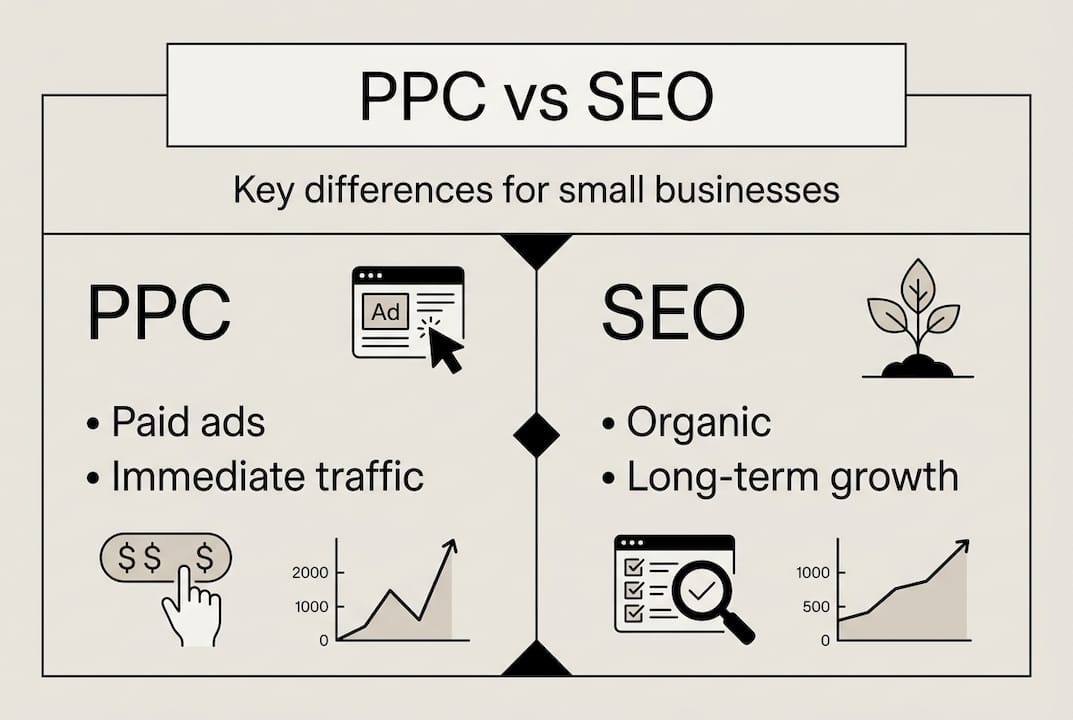
One of the most common points of confusion is the difference between SEO and SEM. Here’s a quick breakdown:
| Channel | Type | Speed | Cost |
|---|---|---|---|
| PPC | Paid | Immediate | Per click |
| SEO | Organic | Long-term | Time and effort |
| SEM | Both | Varies | Mixed |
As Search Engine Journal explains, PPC delivers immediate paid traffic and is a subset of SEM, while SEO is organic and long-term. If you want visibility today, PPC gets you there. If you want sustainable free traffic over months, SEO is the play. Smart businesses use both.
The major PPC platforms include Google Ads, Microsoft Advertising (Bing), Meta Ads (Facebook and Instagram), and LinkedIn Ads. Google Ads commands the largest share of search ad spend, making it the default starting point for most SMBs.
Here’s how the typical PPC auction process works:
- You create an ad and choose the keywords or audience you want to target
- You set a maximum bid, the most you’re willing to pay per click
- A user triggers a search or visits a page where your ad could appear
- An auction runs instantly, evaluating your bid alongside competitors
- Your ad rank is calculated based on bid, relevance, and quality factors
- The winner’s ad displays, and you’re charged only if the user clicks
The benefits of PPC for small businesses are real. You control the budget, you can pause campaigns at any time, and every result is measurable. Compare that to SEO vs paid advertising and you’ll see why many SMBs use PPC to generate leads while their organic strategy builds in the background.

How does pay-per-click advertising work?
Understanding the mechanics behind PPC helps you spend smarter. The process starts the moment a user types a search query or loads a page where ads can appear. An automated auction fires off in milliseconds, and your ad either wins a spot or doesn’t.
Your position in that auction is not determined by budget alone. Google uses a metric called Ad Rank, which combines your maximum cost-per-click (CPC) bid with your Quality Score. Quality Score is a 1 to 10 rating based on three factors: the relevance of your ad copy to the keyword, the expected click-through rate (CTR), and the quality of your landing page experience.
As search engine strategists note, Quality Score is crucial because bidding alone does not guarantee a top position.
This is actually good news for small businesses. A well-written, highly relevant ad with a strong landing page can outrank a competitor with a bigger budget. You win on relevance, not just dollars.
Here’s a comparison of the two main bidding approaches:
| Bidding type | How it works | Best for |
|---|---|---|
| Manual CPC | You set bids for each keyword | Branded terms, tight budget control |
| Automated bidding | Google’s AI adjusts bids in real time | Scaling campaigns with conversion data |
The step-by-step journey from ad creation to a paying customer looks like this:
- Write your ad with a headline, description, and display URL
- Choose your target keywords and match types
- Set your daily budget and maximum CPC bid
- Your ad enters the auction when a relevant search occurs
- If your Ad Rank wins, your ad displays
- The user clicks and lands on your chosen page
- The landing page experience determines whether they convert
That last step matters more than most people realize. Your PPC advertising online visibility depends on getting the click, but your ROAS (return on ad spend) depends entirely on what happens after the click. A weak landing page wastes every dollar you spent getting someone there. For a deeper look at how this all fits together, paid advertising explained walks through the full picture in plain language.
Pro Tip: Improving your Quality Score from a 4 to a 7 can reduce your cost per click by up to 50%. Focus on tightening ad relevance and improving landing page load speed before increasing your budget.
Essential pay-per-click strategies for small businesses
Now that the mechanics make sense, here’s where small businesses can actually win. The biggest mistake SMBs make is copying what large brands do. Large brands chase volume. You should chase relevance.
Start with long-tail keywords. Instead of bidding on “shoes,” bid on “women’s running shoes for flat feet in Austin.” These longer, more specific phrases have lower competition, lower cost per click, and higher purchase intent. Pair this with local PPC advertising strategies to capture nearby buyers who are ready to act.
According to key SMB strategies for effective PPC campaigns, using long-tail and negative keywords, dedicated landing pages, exact match types, and manual bidding on branded terms consistently outperforms generic broad approaches for small advertisers.
Here’s a practical checklist of strategies that work:
- Use negative keywords to block irrelevant searches and protect your budget
- Build dedicated landing pages that mirror your ad copy exactly
- Start with $1,000 or more per month to gather enough data to optimize
- Use exact match and phrase match before experimenting with broad match
- Keep campaign structures simple so Google’s AI can learn faster
- Track ROAS and CPA, not just click-through rate
Landing pages deserve special attention. When someone clicks an ad for “affordable logo design,” they expect to land on a page about logo design, not your general services homepage. Matching the ad message to the landing page message is called message match, and it directly impacts both Quality Score and conversion rates.
Pro Tip: Create one landing page per ad group, not one landing page for your whole campaign. The tighter the match between ad and page, the lower your cost per conversion.
For broader context on where PPC fits in your overall marketing mix, effective online advertising tips and a look at the best online advertising channels for SMBs are worth exploring.
Common pay-per-click mistakes and how to avoid them
Even experienced advertisers make these errors. Knowing them upfront saves real money.
Skipping negative keywords is the most expensive mistake. Without a negative keyword list, your ad for “commercial cleaning services” might show up for “cleaning service jobs” and “DIY cleaning tips.” You pay for every click, even the useless ones. Build your negative list before you launch, and review it weekly.
Sending clicks to your homepage kills conversions. Your homepage serves everyone. Your ad serves one specific audience with one specific intent. When those two things don’t match, visitors leave immediately. That’s wasted spend.
Broad match without guardrails is another common trap. Broad match lets Google show your ad for loosely related searches, which sounds useful but often means your ad appears for completely irrelevant queries. As Google Ads mistakes to avoid in 2026 points out, neglecting negative keywords, using broad match without target CPA or ROAS goals, inconsistent tracking, and poor AI oversight are among the top budget killers for small advertisers.
Here’s a quick list of the most common pitfalls:
- No conversion tracking: You can’t optimize what you can’t measure
- Over-segmenting campaigns: Too many small campaigns confuse the algorithm
- Trusting automation blindly: AI needs human checks or it will optimize for the wrong goal
- Ignoring search term reports: These show exactly what triggered your ads
- Setting it and forgetting it: PPC requires weekly attention, not monthly
Pro Tip: Run a full account audit every 30 days. Check your search term report, update your negative keyword list, verify conversion tracking is firing correctly, and review your landing page performance. Thirty minutes a month can cut wasted spend by 20% or more.
For budget-conscious advertisers, affordable advertising tips offer practical ways to stretch every dollar further. And if you want a refresher on the fundamentals, PPC advertising explained covers the core concepts clearly.
Expert perspective: What most PPC guides miss for small businesses
Most PPC guides focus on clicks. We think that’s the wrong obsession.
The businesses that consistently win at paid search are not the ones with the biggest budgets. They’re the ones who treat every click as a conversation that starts before the ad and ends long after the landing page. Relevance is not a Quality Score trick. It’s a business philosophy.
Automation is a tool, not a manager. Google’s Smart Bidding is genuinely powerful, but it optimizes toward the goal you give it. If your conversion tracking is broken or your goal is set to “maximize clicks” instead of “maximize conversions,” the AI will happily spend your entire budget chasing the wrong outcome. As winning at paid search in 2026 confirms, human oversight on automation prevents AI pitfalls, and post-click testing drives ROAS more than bid adjustments ever will.
Small businesses also underestimate A/B testing. Testing two headlines or two landing page layouts costs almost nothing but can double your conversion rate. That’s a competitive advantage no budget increase can replicate. For practical PPC tips that put this into action, the fundamentals always come back to relevance over volume.
Get expert help scaling your PPC and online marketing
If you’re ready to take the confusion out of PPC and drive results faster, our resources and expert solutions help you get started.
At ibrand.media, we work with small and medium-sized businesses to build paid and organic traffic strategies that actually convert. Whether you need help optimizing your website for search, want to master the online advertising basics, or are looking for a long-term edge through SEO for small business, we have the tools and experience to move the needle. Book a free consultation and let’s build a plan that fits your budget, your market, and your goals.
Frequently asked questions
What is the main difference between PPC and SEO?
PPC is paid and immediate while SEO builds organic traffic over time. Both are valuable, and the strongest digital strategies use them together.
How much should a small business budget for PPC?
Most SMBs start seeing meaningful results at $1,000 or more per month, though the right number depends on your industry, competition, and goals.
What are the top three PPC mistakes small businesses make?
The biggest errors are skipping negative keywords, sending ad traffic to a generic homepage instead of a dedicated landing page, and using broad match without a clear conversion goal.
Which PPC platforms work best for small businesses?
Google Ads is the go-to for capturing high-intent search traffic, while Facebook and Instagram Ads excel at visual storytelling and local audience targeting.
How do I know if my PPC campaign is working?
Look beyond click-through rate and track ROAS and CPA to understand whether your ad spend is actually generating profitable returns.
Recommended
- Paid Advertising Explained: Simple Guide for Small Businesses 2025 | Ibrandmedia
- Online Advertising Basics: Complete Guide for SMBs | Ibrandmedia
- Understanding Online Advertising: A 2025 Guide for Small Business | Ibrandmedia
- Effective Online Advertising Tips for Small Businesses 2025 | Ibrandmedia
- AI-Powered SEO & PPC for Retail: Grow Local Leads & Rankings
Recent Comments