
TL;DR:
- Effective ad copy connects a clear benefit to the audience’s mindset and prompts immediate action. Most ads fail because they try to say too much to too many people, instead of focusing on one specific message. Research customer language, craft a compelling hook within three seconds, and tailor the CTA to the audience’s awareness stage for better results.
Effective ad copy is a precisely engineered message that matches one clear benefit to the reader’s current mindset and drives a single, immediate action. Most ads fail not because of poor writing but because they try to say too much to too many people at once. The discipline of ad copywriting, as practiced by professionals at agencies like Ibrand, treats every word as a deliberate choice tied to audience psychology and platform behavior. This guide breaks down the core components, research-backed techniques, and platform-specific tactics you need to write ads that actually convert in 2026.
How to write effective ad copy: core components
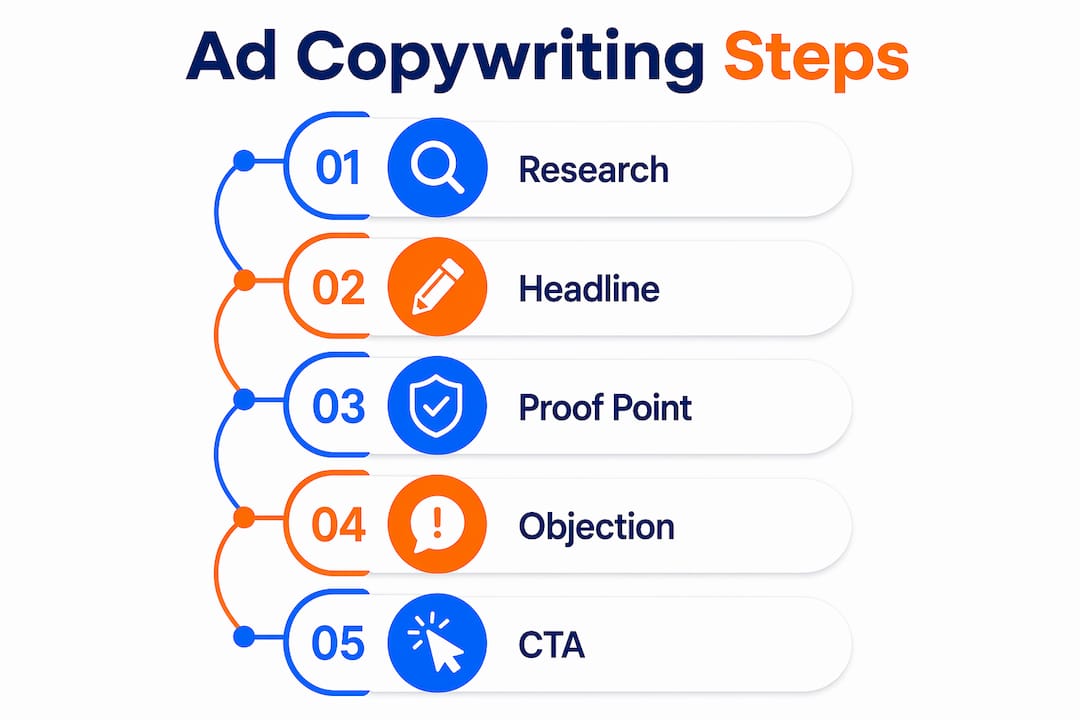
Great ad copy is built from four distinct parts, each with a specific job. Understanding what each part does prevents the most common mistake: writing copy that sounds good but fails to move anyone.

| Component | Traditional Approach | Modern Best Practice |
|---|---|---|
| Headline | Clever slogan or brand name | Specific pain point or concrete benefit |
| Body Copy | Feature list or product description | Single promise with one proof point |
| Objection Handling | Ignored or buried in fine print | Addressed directly in the ad body |
| Call to Action | “Learn More” or “Click Here” | Specific verb tied to immediate next step |
The headline is your first and only chance to stop the scroll. It must speak directly to a pain point or desire your audience already feels, not introduce a new idea they need to process. A Facebook ad for a project management tool that opens with “Stop losing track of tasks” lands harder than “Introducing TaskFlow Pro” because it mirrors what the reader already experiences.
Body copy carries one job: substantiate the headline’s promise with a single, believable proof point. Multi-claim ads split attention and dilute the credibility of the primary message. Ads that focus on one concrete proof point score 23% higher on audience recall. That number tells you something direct: more claims do not build more trust.
Objection handling belongs inside the ad, not on the landing page. If your audience’s biggest fear is “this won’t work for my situation,” address it in one sentence within the body copy. Trying to handle multiple objections at once signals insecurity and dilutes your message.
Pro Tip: Read your ad aloud after writing it. If it takes more than 15 seconds to read comfortably, cut it. Ads that feel long in your mouth feel longer on screen.
How do you research your audience’s language for ad copy?
The most effective ad copy uses the exact words your customers already use to describe their problem. This is not a creative exercise. It is a research exercise.
- Pull language from reviews. Amazon reviews, Google reviews, and G2 or Trustpilot entries for your product category are a direct feed of how real buyers describe their pain and desired outcome. Copy the phrases that appear repeatedly.
- Mine competitor ads. Meta’s Ad Library lets you see what competitors are running and how long those ads have been active. Long-running ads are profitable ads. Study their language, not just their format.
- Review support transcripts. Your own customer service emails and chat logs contain the exact objections and frustrations buyers bring to a purchase decision. These are gold for objection-handling copy.
- Tag and categorize. Build a simple spreadsheet with columns for pain phrases, outcome phrases, and objection phrases. This corpus becomes your copy brief before you write a single word.
- Test hooks against real data. Run two or three hook variations as short-form ads on Meta or Google before committing to a full campaign. Let click-through rate tell you which angle resonates.
Mirroring actual customer language from reviews and forums outperforms generic creative power words every time. The reason is simple: your reader recognizes their own words and feels understood, which builds trust faster than any clever phrase you could invent.
Matching your ad angle to the reader’s awareness stage matters more than the quality of your writing. A reader who has never heard of your product needs a different hook than someone who has already visited your website twice. Awareness-stage mismatch is the single biggest reason well-written ads fail to convert.
Pro Tip: Use Google Ads’ Search Terms report to see the exact phrases people typed before clicking your ad. Those phrases are free copy research. Paste the highest-volume terms directly into your next headline test.
What makes a headline hook work in under 3 seconds?
Attention on digital platforms is measured in fractions of a second. On Meta’s feed, the average viewer decides within the first 3 seconds whether an ad is worth their time. Copy that adheres to this window can improve click-through rates by 2–3x compared to generic messaging. That is not a marginal gain. It is the difference between a campaign that breaks even and one that scales.
A hook is not just an opening sentence. It is a contract between your claim and the reader’s existing belief. Hook-rate measures this contract: if fewer than 25% of people who see your ad engage past the first line, your hook is mismatched to your audience’s awareness stage. Fix the angle before you fix the words.
Specificity is the fastest path to a strong hook. “Lose weight fast” is ignored. “Drop 11 pounds in 6 weeks without cutting carbs” stops a scroll because it is concrete, measurable, and addresses a specific objection in the same sentence.
Here are the headline formulas that consistently perform across platforms:
- Number + Outcome: “3 Reasons Your Google Ads Aren’t Converting”
- Direct Question: “Still paying too much for business insurance?”
- How-To: “How to fill your service calendar in 30 days”
- Urgency + Specificity: “Last chance: 40% off ends Friday at midnight”
- Negative Hook: “The one mistake killing your Facebook ad results”
Avoid writing hooks that try to appeal to everyone. A hook written for a 35-year-old small business owner in the home services space will outperform a generic hook written for “all business owners” every single time. Narrow your audience in the copy itself, and the right people will self-select in.
How do proof points and body copy build trust?
Persuasive body copy does one thing well: it makes the headline’s promise believable. The structure is straightforward. State the benefit, explain the mechanism behind it, and show one piece of evidence that confirms it works.
| Body Copy Element | Purpose | Example |
|---|---|---|
| Benefit Statement | Restates the headline promise in different words | “You’ll book more jobs without spending more on ads” |
| Mechanism | Explains how or why the benefit happens | “Because we target buyers already searching for your service” |
| Proof Point | Provides one concrete, credible piece of evidence | “Our clients average a 3.2x return on ad spend in 90 days” |
| Imagined Outcome | Helps the reader picture life after the purchase | “Imagine a full schedule every Monday morning” |
| Objection Pre-empt | Removes the single biggest barrier to action | “Works even if you’ve tried Google Ads before and lost money” |
Benefit-led copy triggers purchase intent more effectively than feature-focused copy because it helps readers vividly imagine the outcome. The mechanism sentence is what separates believable copy from hype. When you explain why something works, the claim becomes credible without requiring the reader to take it on faith.
One proof point beats three every time. Ads focused on a single concrete claim score significantly higher on recall than ads stacking multiple statistics. Choose your strongest number or testimonial and build the entire body around it.
Pro Tip: Steal your best proof point from a customer testimonial. Find the review where a customer described a specific, measurable result and quote it directly. Real words from real buyers carry more weight than any statistic you write yourself.
You can find more guidance on writing ads that focus on benefits rather than features in Ibrand’s resource library for small businesses.
How should you write ctas for cold vs. warm audiences?
The call to action is where most small business ads lose the conversion they already earned. A weak CTA wastes every dollar spent getting the reader to that point.
The core rule is this: your CTA must restate the value from your hook and specify the exact next step. CTAs that restate the hook’s value and use specific verbs consistently outperform vague phrases. “Get the 90-day playbook” outperforms “Learn More” because it tells the reader exactly what they receive and when.
Match your CTA to where the reader sits in the buying process:
- Cold audience (never heard of you): Use low-commitment language. “See how it works,” “Get the free guide,” or “Watch the 2-minute demo” reduce friction for someone who is not ready to buy.
- Warm audience (visited your site or engaged with content): Use moderate-commitment language. “Start your free trial,” “Book a strategy call,” or “Claim your discount” work because this reader already trusts you enough to take a step.
- Hot audience (added to cart or requested a quote): Use direct, urgent language. “Complete your order,” “Grab your spot before it fills,” or “Finalize your plan today” close the gap for someone already decided.
A/B testing full ads, not just isolated CTA text, gives you the most reliable signal about what drives clicks. Test the headline, body, and CTA together as a unit. Changing only the CTA while keeping a weak headline will not reveal the real problem.
Pro Tip: Read your CTA aloud and ask: “What am I actually getting, and what do I do right now?” If the answer is unclear in under 5 seconds, rewrite it. Clarity always beats cleverness in a CTA.
For a broader look at how digital ad funnels connect copy to conversion at each stage, Ibrand’s guide breaks down the full structure for small business campaigns.
Key takeaways
Effective ad copy is an engineering process: match one clear benefit to the reader’s awareness stage, back it with a single proof point, and close with a specific CTA.
| Point | Details |
|---|---|
| One claim wins | Ads focused on a single proof point score 23% higher on recall than multi-claim ads. |
| Research before writing | Build a corpus of real customer language from reviews and support logs before drafting. |
| Hook in 3 seconds | Ads that communicate core value within 3 seconds improve click-through rates by 2–3x. |
| Match CTA to audience stage | Cold, warm, and hot audiences need different commitment levels in the call to action. |
| Test full ads, not parts | A/B test headlines, body, and CTAs together to get reliable performance data. |
The part of ad copywriting nobody talks about enough
I have reviewed hundreds of ad accounts for small businesses over the years, and the pattern is almost always the same. The owner wrote the ad in 20 minutes based on what they thought sounded good. The copy is polished, the design is clean, and the ad spends money for three weeks without producing a single qualified lead.
The problem is almost never the writing. It is the absence of research before the writing. Small businesses skip the step of reading their own reviews, studying competitor ads in Meta’s Ad Library, or pulling their Google Ads search terms report. They go straight to the blank page and write from instinct. Instinct is not useless, but it is not a strategy.
The shift that changes results is treating ad copy the way an engineer treats a problem. You gather data first. You form a hypothesis about which angle will resonate with a specific awareness stage. You write the simplest possible version of that hypothesis. Then you test it against one alternative and let the numbers decide.
I have seen a single copy rewrite, grounded in three hours of review mining and competitor research, turn a $4 cost-per-click into a $1.40 cost-per-click on the same budget. The ad was shorter, plainer, and less “creative” than the original. It just used the exact words the customer had already written in a five-star review.
Patience matters here too. Small businesses often pull ads after five days because results look flat. Most platforms need 7–14 days of data before the algorithm optimizes delivery. Give your copy a fair test window before you judge it.
The mindset shift from “I need to write something clever” to “I need to find the right angle and say it plainly” is the single biggest upgrade most small business owners and marketing professionals can make.
— TONY
Ready to put better ad copy to work?
Writing great copy is only half the equation. The other half is making sure your ads reach the right people on the right platforms with a strategy built around your specific business goals.
Ibrand works with small and medium-sized businesses to build ad campaigns grounded in audience research, tested copy frameworks, and real-time performance tracking. Whether you are running Google Ads, Meta campaigns, or local display ads, Ibrand builds the strategy around what your customers actually say, not what sounds good in a boardroom. If you want ads that convert rather than just spend, explore Ibrand’s digital advertising guide for SMBs or check out the SEO and ad strategy resources built specifically for small business growth.
FAQ
What is the most important element of effective ad copy?
The headline is the most critical element because it determines whether anyone reads the rest of the ad. A specific, benefit-driven headline tied to the reader’s awareness stage drives significantly higher engagement than a generic or brand-focused opener.
How long should ad copy be?
Ad copy length depends on the platform and audience temperature. Cold traffic ads on Meta perform best when the hook delivers the core value within 3 seconds. Google PPC ads require tight, keyword-aligned headlines under 30 characters per field, while display ads need a single sentence and a clear CTA.
How do i know if my ad copy is working?
Hook-rate is the fastest signal: if fewer than 25% of viewers engage past your opening line, the angle is mismatched to your audience. Track click-through rate, cost-per-click, and conversion rate together rather than any single metric in isolation.
Should i use humor or emotion in ad copy?
Emotion works when it is specific and grounded in a real pain point your audience recognizes. Generic emotional appeals feel manipulative. Humor works only when it does not obscure the core benefit or confuse the call to action.
How often should i test new ad copy?
A/B test full ads rather than isolated elements, and run each test for at least 7–14 days before drawing conclusions. Rotate new copy variations every 4–6 weeks on active campaigns to prevent audience fatigue and maintain performance.
Recommended
- Effective Online Advertising Tips for Small Businesses 2025 | Ibrandmedia
- Creating calls to action that convert: a step-by-step guide | Ibrandmedia
- Increase Website Conversions: Proven Strategies for 2025 Success | Ibrandmedia
- How to Run Social Ads: A 2025 Guide for Local Small Businesses | Ibrandmedia
Recent Comments