
TL;DR:
- Retargeting in advertising involves showing paid ads to users who previously visited a website but left without converting. It helps recover lost opportunities and typically results in higher conversion rates and lower costs per acquisition. Building first-party data and segmenting audiences are essential for effective retargeting strategies.
Retargeting in advertising is the practice of showing paid ads to users who previously visited your website or engaged with your brand but left without converting. The average website converts just 2.35% of visitors on the first visit, meaning 98% of your traffic walks away without taking action. Retargeting exists to recover that lost opportunity. Platforms like Meta Ads, Google Ads, and HubSpot all offer retargeting tools that let you follow those visitors across the web with personalized messages. Done right, it turns “almost customers” into buyers at a fraction of the cost of acquiring new ones.

How does retargeting in advertising work?
Retargeting works by tracking user behavior and then serving ads to those users on other platforms after they leave your site. The mechanics rely on three core components: pixels, cookies, and audience lists.
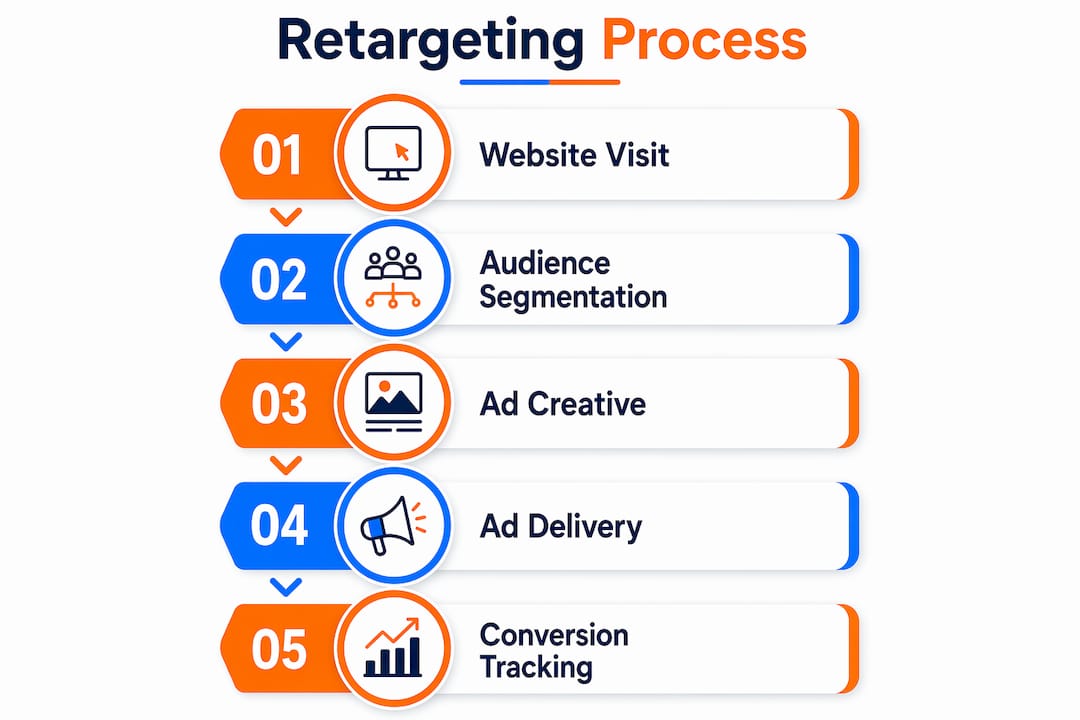
The step-by-step process looks like this:
- A visitor lands on your website. A small piece of code called a tracking pixel, placed on your site by platforms like Meta or Google Ads, fires and drops a cookie in the visitor’s browser.
- The cookie records the visit. It logs which pages they viewed, which products they clicked, or whether they abandoned a shopping cart.
- The user leaves without converting. They browse other websites, scroll through social media, or watch YouTube.
- Your ad follows them. The platform recognizes the cookie and serves your retargeting ad to that specific user across its network.
- The user returns and converts. A well-timed, relevant ad brings them back to complete the purchase or sign up.
The second method is list-based retargeting. Instead of a pixel, you upload a CSV of existing contacts, such as email subscribers or CRM leads, directly into Meta Ads or Google Ads. The platform matches those emails to user accounts and shows your ads to those specific people. This approach is especially useful for re-engaging lapsed customers or promoting a new offer to warm leads.
Pro Tip: Set up your Meta Pixel and Google Ads tag before you launch any campaign. You need at least 30 days of audience data before retargeting becomes statistically meaningful.
The technical landscape is shifting fast. Third-party cookies are being phased out, pushing retargeting toward first-party data sources like CRM lists, email subscribers, and loyalty program data. Marketers who build their own data assets now will have a significant advantage in 2026 and beyond. Pixel-based retargeting still works within platforms like Meta’s closed ecosystem, but cross-site tracking is becoming less reliable without first-party foundations.
What are the measurable benefits of using retargeting campaigns?
Retargeting campaigns consistently outperform standard display advertising on every major metric. The numbers are not marginal improvements. They are structural advantages.
Retargeted users are 70% more likely to convert than first-time visitors. That single statistic explains why retargeting budgets have grown faster than almost any other digital ad format. You are not guessing at audience intent. You are advertising to people who already raised their hand.
Key performance benefits include:
- Higher click-through rates. Retargeting ads achieve click-through rates 10x higher than standard display ads. That means your budget generates far more qualified traffic per dollar spent.
- Lower cost per acquisition. Retargeting campaigns reduce cost-per-acquisition by 40–60% compared to cold audience campaigns. You spend less to close each sale.
- Strong return on ad spend. Campaigns regularly achieve 4–10x ROAS, with e-commerce benchmarks frequently hitting 8:1. That is the kind of return that justifies scaling.
- Improved brand recall. Repeated exposure to your brand across multiple touchpoints builds familiarity. Users who see your retargeting ads are more likely to choose you when they are ready to buy, even if they do not click immediately.
- Better audience segmentation. You can separate cart abandoners from blog readers and serve each group a different message. A user who viewed your pricing page needs a different ad than someone who only read a blog post.
For small businesses with limited ad budgets, these efficiencies matter enormously. Spending $500 on retargeting a warm audience almost always outperforms spending $500 on cold prospecting. You can track campaign performance to confirm which segments deliver the strongest returns and reallocate accordingly.
What is the difference between retargeting and remarketing?
These two terms are used interchangeably in most marketing conversations, but they have a technical distinction that affects which tools you use and how you design your campaigns.
| Term | Primary channel | Common platforms | Typical method |
|---|---|---|---|
| Retargeting | Display ads, social media | Meta Ads, Google Display Network | Pixel-based tracking |
| Remarketing | Email, search ads | Google Ads, email platforms | CRM lists, email sequences |
Retargeting is the standard term on Meta platforms, where pixel data drives ad delivery across Facebook and Instagram. Remarketing is more commonly associated with Google’s ecosystem and email-based follow-up sequences. A Google Ads remarketing campaign might show search ads to past visitors when they search for related terms. A Meta retargeting campaign shows image or video ads in the social feed.
The practical implication is this: if you are running display or social ads to past visitors, you are retargeting. If you are sending a follow-up email sequence to people who abandoned a cart, you are remarketing. Both strategies target the same warm audience, but through different channels and with different creative formats. Understanding the distinction between retargeting and remarketing helps you build a complete re-engagement strategy rather than relying on a single channel.
Most high-performing campaigns use both. A user abandons a cart, receives a retargeting ad on Instagram the next day, and gets a follow-up email two days later. That multi-channel pressure, applied with good timing, closes a significant percentage of otherwise lost sales.
What are effective retargeting strategies to improve campaign success?
Knowing how retargeting works is one thing. Running campaigns that actually convert requires deliberate strategy. These are the approaches that separate profitable retargeting from wasted spend.
Segment your audience by behavior, not just by visit. A visitor who spent four minutes on your pricing page is not the same as someone who bounced after five seconds. Build separate audience segments for cart abandoners, product page viewers, checkout starters, and blog readers. Each group needs a different message and a different offer. You can find guidance on identifying your audience segments to build this structure before you write a single ad.
Use dynamic creative ads for e-commerce. Dynamic ads serve personalized content based on exactly which products a user viewed. If someone browsed running shoes on your site, they see those specific shoes in their feed, not a generic brand ad. Meta and Google both support dynamic product ads natively. This approach consistently outperforms static creative for product-based businesses.
Set frequency caps. Showing the same ad to the same person 20 times in a week does not increase conversions. It increases annoyance. Cap frequency at 3–5 impressions per user per week as a starting point, then adjust based on performance data. Personalized follow-ups should feel helpful and timely, not aggressive. The goal is to guide users through the funnel, not chase them away.
Limit your retargeting window. A user who visited your site 90 days ago is not the same prospect as someone who visited yesterday. Segment by recency. Run your most aggressive offers to users within the first 7 days. Use softer brand awareness messaging for users in the 8–30 day window. Drop users from your audience after 60 days unless you have a specific reason to keep them.
Build your first-party data foundation now. With third-party cookie deprecation reshaping retargeting, your email list, CRM data, and loyalty program are your most durable targeting assets. Every campaign you run should include a mechanism to capture first-party data, whether that is an email signup, a lead magnet, or a loyalty program enrollment.
Pro Tip: Create a separate retargeting campaign for users who visited your site from a paid search ad but did not convert. These users have the highest purchase intent of any segment and typically convert at the lowest cost.
For small businesses running online advertising, retargeting is often the highest-ROI campaign type available. Start with a simple cart abandonment campaign before building out more complex audience segments.
Key takeaways
Retargeting in advertising is the highest-efficiency channel available to marketers because it focuses budget on users who have already demonstrated interest in your brand.
| Point | Details |
|---|---|
| Core definition | Retargeting shows paid ads to past visitors who left without converting, using pixels or audience lists. |
| Performance advantage | Retargeted users are 70% more likely to convert, with click-through rates 10x higher than standard display ads. |
| Retargeting vs. remarketing | Retargeting uses display and social ads; remarketing typically uses email and Google search networks. |
| First-party data is critical | Cookie deprecation makes CRM lists and email subscribers your most reliable retargeting foundation in 2026. |
| Segmentation drives results | Separate audiences by behavior and recency to deliver relevant messages that convert without annoying users. |
The retargeting mistake most small businesses keep making
Most small businesses I work with set up a single retargeting audience, all website visitors from the past 30 days, and run one generic ad to all of them. Then they wonder why performance is mediocre.
The problem is not retargeting. The problem is treating a warm audience like a cold one. A user who spent eight minutes reading your service page and then left is not the same as someone who bounced in three seconds. Serving them the same ad is a missed opportunity and a waste of budget.
What I have seen work consistently is a tiered approach. High-intent visitors, those who hit pricing pages, contact forms, or checkout, get your most direct offer within 48 hours. Mid-funnel visitors get social proof: testimonials, case studies, or a comparison. Top-of-funnel visitors get brand content that builds familiarity without pushing a hard sell.
The other mistake is ignoring frequency. I have watched small business owners burn through their entire monthly ad budget in two weeks because they had no frequency cap. Users saw the same ad 15 times and started actively avoiding the brand. Retargeting that respects user experience builds long-term customer retention. Retargeting that ignores it destroys brand equity.
My honest advice: start with one well-segmented campaign targeting cart abandoners only. Master that before expanding. The data you collect from that single campaign will teach you more about your audience than any broad prospecting effort.
— TONY
How Ibrand can help you run smarter retargeting campaigns
Retargeting is one of the most cost-effective advertising strategies available, but it requires the right setup, the right segmentation, and consistent optimization to deliver results. Ibrand works with small and medium-sized businesses to build digital advertising campaigns that go beyond basic targeting. From pixel setup and audience segmentation to dynamic creative and performance tracking, Ibrand handles the technical and strategic work so you can focus on running your business. If you are ready to stop losing warm leads to competitors, explore Ibrand’s digital advertising solutions and see how a structured retargeting program fits into your broader small business marketing plan.
FAQ
What is retargeting in advertising?
Retargeting is a paid advertising method that shows ads to users who previously visited your website or app but did not convert. It uses tracking pixels or audience lists to identify those users and serve them relevant ads on platforms like Meta and Google.
How does retargeting differ from prospecting ads?
Prospecting ads target new users who have never interacted with your brand. Retargeting focuses exclusively on warm audiences who already know you, which is why conversion rates and ROAS are significantly higher.
What is remarketing vs. retargeting?
Remarketing typically refers to email-based or Google search follow-up campaigns targeting past visitors. Retargeting refers to display and social media ads served to the same audience. Both re-engage warm prospects but through different channels.
Why use retargeting campaigns for a small business?
Retargeting reduces cost-per-acquisition by 40–60% compared to cold audience campaigns, making it one of the most budget-efficient options for small businesses with limited ad spend.
How do I start a retargeting campaign?
Install a tracking pixel from Meta Ads or Google Ads on your website, build an audience of past visitors, create segmented ad groups by behavior, and set frequency caps to avoid overexposure. Start with cart abandoners for the fastest results.
Recent Comments