
TL;DR:
- Retargeting recovers 20-30% of abandoned visitors, boosting conversions and ad ROI.
- Focus on high-intent segments like recent visitors and inquiry abandoners for effective campaigns.
- Building trust and personalized messaging in retargeting enhances long-term customer loyalty.
Most service businesses lose between 95% and 98% of their website visitors without ever capturing a lead. Those people browsed your services, maybe even started filling out a contact form, and then disappeared. The good news is that retargeting recovers 20-30% of cart abandons, with conversion rates 70% higher than cold audiences. Retargeting lets you follow up with those warm prospects using targeted ads across the web, bringing them back when they’re ready to buy. This guide walks you through exactly how to set up, optimize, and measure retargeting campaigns so your service business stops leaving money on the table.
Table of Contents
- Why retargeting works for service businesses
- Getting started: Tools, setup, and audience segments
- Building your first retargeting campaign: Step-by-step
- Measuring success: Tracking results and optimizing performance
- Our take: The real reason retargeting wins repeat business
- Ready to boost your website conversions?
- Frequently asked questions
Key Takeaways
| Point | Details |
|---|---|
| Retargeting boosts conversions | Retargeting website visitors can achieve up to 70% higher conversion rates than standard ads. |
| Segment for better results | Splitting your audiences by intent and recency leads to more relevant and effective retargeting campaigns. |
| Benchmarks guide improvement | Monitor CTR, ROAS, and CPA to ensure your retargeting campaigns match or exceed proven industry stats. |
| Privacy and trust matter | Privacy-first messaging and opt-in tactics help sustain trust and performance over time. |
Why retargeting works for service businesses
Retargeting means showing paid ads specifically to people who already visited your website. Instead of spending your entire budget on cold audiences who’ve never heard of you, you’re focusing on people who already showed interest. That distinction matters enormously for service businesses.
Service companies, whether you run a landscaping company, a dental practice, or a consulting firm, often have longer decision cycles than e-commerce stores. A prospect might visit your site three or four times before they pick up the phone. Retargeting keeps your brand visible during that consideration window, which is exactly when it counts.
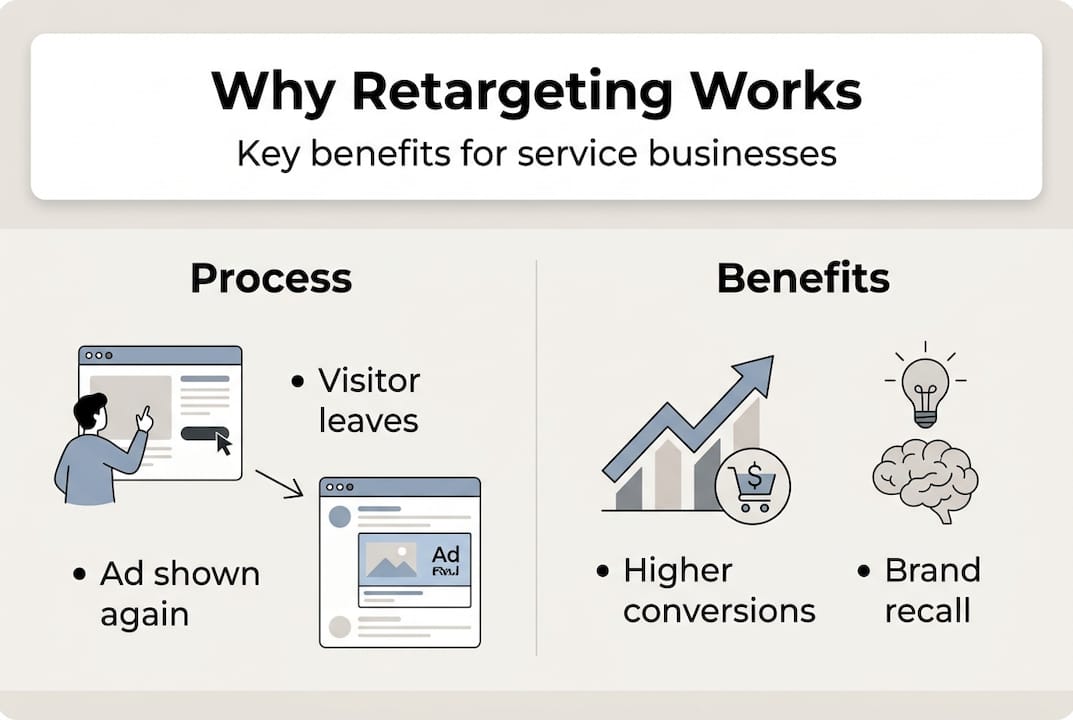
The numbers back this up. Retargeting achieves 0.7-1.1% CTR, a 5-8% conversion rate (70% higher than cold traffic), a return on ad spend (ROAS) of 4-10x, and a cost per acquisition (CPA) that runs 50-55% lower than standard acquisition campaigns. Those aren’t small improvements. That’s a fundamentally different economics of advertising.
Research also shows that the service sector demonstrates more stable remarketing outcomes, and AI-driven personalization is actively reducing ad fatigue by delivering more relevant messages at the right time. This means your ads don’t feel like spam to your audience. They feel timely.
Here’s a quick comparison of retargeting versus standard display advertising:
| Metric | Standard display ads | Retargeting ads |
|---|---|---|
| Click-through rate (CTR) | ~0.07% | 0.7-1.1% |
| Conversion rate | ~2-3% | 5-8% |
| ROAS | 1-2x | 4-10x |
| CPA | Baseline | 50-55% lower |
For service businesses, the practical benefits include:
- Re-engaging visitors who viewed a specific service page
- Reminding prospects who started but didn’t submit an inquiry form
- Staying top of mind during a client’s multi-week decision process
- Promoting limited-time offers to warm audiences who already know you
If you want a deeper foundation, read up on remarketing fundamentals or explore service sector retargeting examples to see how other businesses apply these strategies.
Getting started: Tools, setup, and audience segments
Armed with an understanding of why retargeting matters, let’s look at what you’ll need to put a campaign in motion.
The first decision is platform. The most widely used options for service businesses are:
- Google Ads (Display Network and YouTube): Broad reach, strong intent signals, works well for local service businesses
- Meta Ads (Facebook and Instagram): Strong for visual storytelling and local audience targeting
- LinkedIn Ads: Best for B2B service businesses targeting professionals or companies
- CRM-based tools (HubSpot, Klaviyo, Mailchimp): Ideal for email retargeting based on your existing contact list
Each platform requires a tracking code installed on your website. For Google, that’s the Google Tag. For Meta, it’s the Meta Pixel. Installation is straightforward: you paste a short snippet of code into the header section of your website, or use a plugin if you’re on WordPress or Shopify. Most platforms offer step-by-step guides and verification tools to confirm it’s working.
Once tracking is active, audience segmentation is where the real power kicks in. Not all visitors are equal. Here’s how to break them down:
- Recent visitors (last 7-14 days): Highest intent, most likely to convert quickly
- Service page viewers: Visited a specific service page but didn’t inquire
- Inquiry starters: Began filling out a contact or booking form but didn’t finish
- Newsletter subscribers: Already opted in, warm relationship, great for upsell campaigns
- Past customers: Excellent for cross-sell or seasonal promotions
Research on combining site and search retargeting shows that using both can yield nuanced results, but over-reliance on either approach risks fragmenting your sales funnel. Balance is key.

Pro Tip: Build separate audience segments for visitors who viewed your highest-margin service pages within the last 14 days. These are your hottest leads and deserve a dedicated ad set with a specific, relevant message.
For more guidance on choosing the right platform, check out these ad platform selection tips and review online promotion essentials to see how retargeting fits into a broader growth strategy.
Building your first retargeting campaign: Step-by-step
With your toolkit in place, let’s walk through creating a campaign tailored to your service business.
- Install your tracking pixel or tag: Confirm it fires correctly on all key pages using the platform’s diagnostic tool.
- Define your audience segments: Start with recent visitors (7-14 days) and inquiry abandoners. Keep each segment focused.
- Set your budget: Start conservatively. Even $10-20 per day is enough to test a retargeting campaign for a small service business.
- Choose your ad format: Static image ads work well for quick offers. Video ads build trust. Carousel ads let you showcase multiple services.
- Write your ad creative: Use a real customer testimonial, a limited-time offer, or a direct call to action like “Still thinking it over? We’re ready when you are.”
- Set frequency caps: Limit how often the same person sees your ad. Three to five impressions per week is a reasonable starting point.
- Launch and monitor: Check performance after 48-72 hours. Look at CTR, conversions, and cost per lead.
Ad creative is often where service businesses underinvest. Generic stock photos and vague headlines don’t cut through. Use real images of your team or your work. Mention a specific service or local area. Add urgency where it’s genuine, such as a seasonal promotion or limited availability.
“Privacy-first personalization is no longer optional. Blending CRM pipelines with site retargeting can outperform generic campaigns while building the trust that turns one-time clients into repeat customers.” Source: MDPI Sustainability
CRM-based retargeting deserves a special mention. If you have a list of past leads or clients who went quiet, uploading that list to Google or Meta lets you run reactivation campaigns directly to them. This is one of the highest-ROI moves available to service businesses with an existing contact database.
Pro Tip: Pair your retargeting creative with consistent branding for retargeting. Visitors who recognize your brand’s visual identity are far more likely to click. If you’re still building that foundation, start with branding fundamentals to get the basics right before scaling ad spend.
Measuring success: Tracking results and optimizing performance
Launching is just the start. Here’s how you track, interpret, and troubleshoot campaign results for ongoing sales growth.
The four metrics that matter most for service business retargeting are:
- CTR (click-through rate): Are people clicking? A healthy retargeting CTR is 0.7-1.1%.
- Conversion rate: Are clicks turning into leads or bookings? Target 5-8% for warm audiences.
- ROAS: Are you getting at least 4x return on your ad spend?
- CPA: Is your cost per acquired lead or customer reasonable for your service margins?
Retargeting CTR runs 10x standard display, and ROAS can reach 4-10x with CPA running 50-55% lower than new customer acquisition. If your numbers fall short of these benchmarks, something needs adjusting.
Here’s a simple troubleshooting framework:
| Symptom | Likely cause | Fix |
|---|---|---|
| Low CTR | Weak creative or wrong audience | Refresh ad visuals, tighten segment |
| High CTR, low conversions | Landing page mismatch | Align ad message with page content |
| High CPA | Audience too broad | Narrow to higher-intent segments |
| Ad fatigue | Too many impressions | Lower frequency cap, rotate creatives |
A/B testing is your best optimization tool. Run two versions of the same ad with one variable changed, such as the headline, image, or call to action. Let each version run for at least 7-10 days before drawing conclusions. Then keep the winner and test the next variable.
Update your audience lists monthly. People who visited six months ago are far less likely to convert than someone who was on your site last week. Keeping your lists fresh ensures your budget goes toward the highest-intent prospects.
For a complete picture of how to measure what’s working, explore tracking campaign success, learn how to track measurable growth, and use these tools to track digital ROI across all your marketing channels.
Our take: The real reason retargeting wins repeat business
Most advice about retargeting focuses almost entirely on recency. Target recent visitors, chase cart abandoners, act fast. That logic isn’t wrong, but it misses the deeper opportunity.
The service businesses we see sustaining the best retargeting results aren’t just chasing warm bodies. They’re building campaigns around quality segments and values-focused messaging. Instead of a generic “Come back!” ad, they show a testimonial from a client in the same industry. Instead of a discount, they offer a free consultation that respects the prospect’s intelligence.
Remarketing and trust are more connected than most marketers admit. When your retargeting ads feel relevant and respectful rather than pushy and repetitive, they don’t just drive clicks. They build the kind of brand familiarity that makes a prospect choose you over a competitor they’ve never seen before.
Privacy-first personalization is the real growth engine here. Collecting only what you need, being transparent about how you use data, and delivering messages that genuinely serve the prospect’s needs will outperform aggressive frequency tactics every time. The brands winning the most long-term business pair smart segmentation with authentic messaging, and that combination is hard to replicate.
Ready to boost your website conversions?
Retargeting is one of the highest-ROI strategies available to service businesses, but setting it up correctly takes time, the right tools, and ongoing attention to performance data. If you’re ready to stop losing warm prospects to competitors, Ibrandmedia can help you build campaigns that actually convert.
From optimizing your website for search to managing your benefits of social media management and running targeted ad campaigns, we build the full picture for small service businesses. Our SEO for small businesses strategies are designed to bring more of the right traffic to your site so your retargeting lists fill faster and your campaigns perform better. Reach out today and let’s put a plan together that works for your budget and your goals.
Frequently asked questions
How much does retargeting typically cost for small service businesses?
Retargeting is generally more affordable than standard advertising because CPA runs 50-55% lower than new customer acquisition campaigns, making it a smart starting point for budget-conscious businesses.
How quickly can I expect results from a new retargeting campaign?
You can often see improved click and conversion activity within the first week, since retargeting CTR runs 0.7-1.1% and conversion rates hit 5-8% for warm audiences, especially when you target recent visitors.
What’s the difference between site retargeting and search retargeting?
Site retargeting shows ads to people after they visit your website, while search retargeting targets users based on their search behavior. Combining both approaches can be effective, though over-reliance on either risks fragmenting your funnel.
Can retargeting annoy or alienate my website visitors?
It can, if ads are overused or irrelevant. AI personalization reduces ad fatigue significantly, and setting frequency caps keeps your campaigns effective without overwhelming your audience.
How do I know which visitors to retarget for the best results?
Start with visitors from the last 7-14 days, people who began but didn’t complete an inquiry form, and those who viewed your highest-value service pages. These groups show the strongest purchase intent and deliver the fastest results.
Recommended
- Increase Website Conversions: Proven Strategies for 2025 Success | Ibrandmedia
- Targeting Local Customers Online: Proven Strategies for 2025 | Ibrandmedia
- How to Get More Website Leads: 8 Proven Strategies for 2025 | Ibrandmedia
- How to Engage Customers Online: Boost Your Business Success | Ibrandmedia
- The Free Retargeting Ads Playbook – ION Hospitality – Restaurant Marketing & Advertising Agency, New York, NY
- Push Notifications: Retargeting on steroids
Recent Comments