
Nearly 90% of startups fail because they miss critical online promotion steps. For small and medium U.S. businesses, getting online visibility right is not optional. This guide arms you with affordable, measurable promotion strategies that boost traffic, sales, and local reach in 2026.
Table of Contents
- Understanding The Importance Of Online Promotion
- Core Online Promotion Strategies
- Cost-Effective Online Promotion Tactics
- Common Misconceptions About Online Promotion
- Measurement And Optimization Of Online Promotion
- Bridging Theory To Practice: Implementing Your Online Promotion Plan
- Enhance Your Online Promotion With Ibrand.media
- Frequently Asked Questions
Key Takeaways
| Point | Details |
|---|---|
| SEO drives sustainable growth | SEO increases organic traffic by 20-30% when executed well. |
| Social ads deliver strong ROI | Social media advertising produces a median 4:1 return on ad spend for small businesses. |
| Local targeting works | Local SEO and geo-targeted ads boost acquisition by up to 25% in nearby markets. |
| Budget tactics matter | Free publicity and coupon campaigns increase retention by 15-20% at minimal cost. |
| Tracking optimizes results | Many SMBs miss optimization by not tracking promotion metrics systematically. |
Understanding the Importance of Online Promotion
Small businesses make up 99.9% of all U.S. businesses, forming the economic backbone of the nation. Yet nearly 90% of startups fail, often because they overlook effective online promotion. Without strategic digital visibility, even great products disappear into the noise.
Online promotion is your lifeline in a competitive digital landscape. It connects your business to customers actively searching for solutions you offer. Skipping this step means losing market relevance before you even establish traction.
Consider these critical realities:
- Customers research online before buying, making visibility essential
- Competitors already use digital channels to capture your potential clients
- Affordable promotion tactics exist but require strategic application
- Ignoring online promotion accelerates the path to the 90% failure statistic
The gap between thriving businesses and failed ventures often lies in promotion execution. Understanding this importance shifts your mindset from optional marketing to survival necessity.
“Effective online promotion is not about spending more; it’s about reaching the right people with the right message at the right time.”
The economic impact of small businesses demands that owners master affordable promotion. Your business contributes to a vast network of enterprises driving American commerce. Strategic online visibility ensures you capture your fair share of that market.
Core Online Promotion Strategies
Three primary strategies form the foundation of effective online promotion for SMBs. Each delivers measurable results when implemented correctly.
Search Engine Optimization (SEO) builds sustainable organic traffic. When you optimize your website and content, SEO increases organic traffic by 20-30% over time. This growth compounds as your site gains authority and rankings improve. SEO works while you sleep, delivering customers without ongoing ad spend.
Social Media Advertising provides immediate traffic and targeted reach. The data shows social media advertising produces a median 4:1 return on ad spend for small businesses. You can start with modest budgets, test audiences quickly, and scale what works. Platforms like Facebook and Instagram offer precise targeting options unavailable in traditional media.

Local SEO and Geo-Targeted Campaigns dominate for businesses serving specific geographic areas. Research confirms local SEO and geo-targeted ads boost local client acquisition by up to 25%. When you optimize for “near me” searches and target ads to your service area, you capture high-intent customers ready to buy. This approach works exceptionally well for service businesses, retail stores, and restaurants.
Effective promotion blends multiple tactics:
- Advertising (paid search, social ads, display)
- Publicity (media coverage, influencer mentions, PR)
- Sales promotion (discounts, contests, limited offers)
- Direct outreach (email campaigns, SMS marketing)
The key is integration. Your SEO content supports your ads. Your social presence amplifies your publicity. Your email list converts traffic from all sources. Benefit-focused messaging throughout these channels boosts engagement significantly.
| Strategy | Primary Benefit | Typical Timeline | Budget Level |
|---|---|---|---|
| SEO | Sustainable organic traffic | 3-6 months | Low to Medium |
| Social Ads | Immediate targeted reach | Days to weeks | Medium |
| Local SEO | Geographic dominance | 2-4 months | Low |
| Email Marketing | Direct customer connection | Ongoing | Very Low |
Pro Tip: Start with one core strategy based on your immediate need. If you need traffic now, begin with social ads. If you want long-term growth, prioritize SEO. Master one channel before expanding to others.
For practical implementation, explore proven local marketing ideas and tactics for marketing to local customers that align with your business model.
Cost-Effective Online Promotion Tactics
Budget constraints should not stop you from promoting effectively. Several affordable tactics deliver strong results without breaking the bank.
Free Publicity offers maximum impact at zero direct cost. Media releases and social media coverage can be among the most cost-effective promotion tools available to small businesses. Write compelling press releases about your business milestones, new products, or community involvement. Local media outlets actively seek small business stories. Organic social media posts cost nothing but time and can reach thousands when content resonates.
Strategic Discounts and Coupons drive both acquisition and retention. Data shows discounts and coupon campaigns increase acquisition and retention by 15-20% when executed properly. First-time customer discounts lower the barrier to trial. Loyalty rewards keep customers returning. Limited-time offers create urgency that speeds purchase decisions.
Small Business Grants provide funding specifically for marketing initiatives. Small business grants can provide up to $4,000 for marketing support, offsetting your promotion costs entirely. Research federal, state, and local grant programs. Many target specific industries or underserved communities. The application process requires effort but delivers free capital.
Additional budget-friendly tactics include:
- Product samples that let customers experience quality firsthand
- Customer testimonials and reviews that build social proof
- Referral programs that turn satisfied customers into promoters
- Strategic partnerships with complementary businesses
- Content marketing through blogs and videos that establish expertise
Focus on maximizing impact per dollar spent. A well-crafted email campaign to your existing list costs pennies per contact. An optimized Google Business Profile delivers free local visibility. User-generated content from happy customers creates authentic promotion without production costs.
Pro Tip: Combine free and paid tactics for amplification. Create great organic content, then boost the best performers with small ad budgets. This hybrid approach stretches your resources while maintaining consistent visibility.
Discover more budget-conscious approaches in our guide to cost-effective promotion ideas and affordable ad tips tailored for small business realities.
Common Misconceptions About Online Promotion
Clearing up confusion about online promotion helps you avoid costly mistakes and plan more effective campaigns.
Misconception: Promotion and Marketing Are the Same Thing
They are not. Promotion is a subset focused on communication tactics within broader marketing strategies, not synonymous with marketing itself. Marketing encompasses product development, pricing, distribution, and promotion. Promotion specifically covers advertising, publicity, sales promotions, and direct communication. Understanding this distinction helps you allocate resources correctly across your entire marketing mix.
Misconception: Online Promotion Alone Guarantees Success
Promotion drives visibility, but you still need a solid product, competitive pricing, and excellent service. Online promotion amplifies what you offer; it does not fix fundamental business problems. Integration with your overall strategy matters more than promotion volume.
Misconception: Social Media Ads Are Too Expensive for Small Businesses
The opposite is often true. Social platforms offer precise targeting that eliminates wasted spend on uninterested audiences. With social media advertising producing a median 4:1 return on ad spend, even modest budgets generate positive ROI. You can start with as little as $5 per day and scale based on performance.
Misconception: You Need a Large Following Before Advertising Works
Paid promotion builds your following; you do not need a large audience first. Ads reach people who do not know you yet, making them ideal for growth. Organic and paid strategies work together, with ads accelerating what organic efforts alone would take months to achieve.
Key clarifications:
- Quality content matters more than quantity in online promotion
- Small, targeted campaigns outperform large, unfocused ones
- Consistency beats occasional big pushes in building long-term visibility
- Most successful SMBs use multiple promotion channels, not just one
Misunderstanding these points leads to poor budget allocation and ineffective campaigns. The difference between digital marketing and promotion becomes clearer when you see promotion as the communication arm of your marketing strategy, not the entire strategy itself.
Measurement and Optimization of Online Promotion
Tracking performance separates guesswork from strategy. Without measurement, you cannot identify what works or optimize for better results.
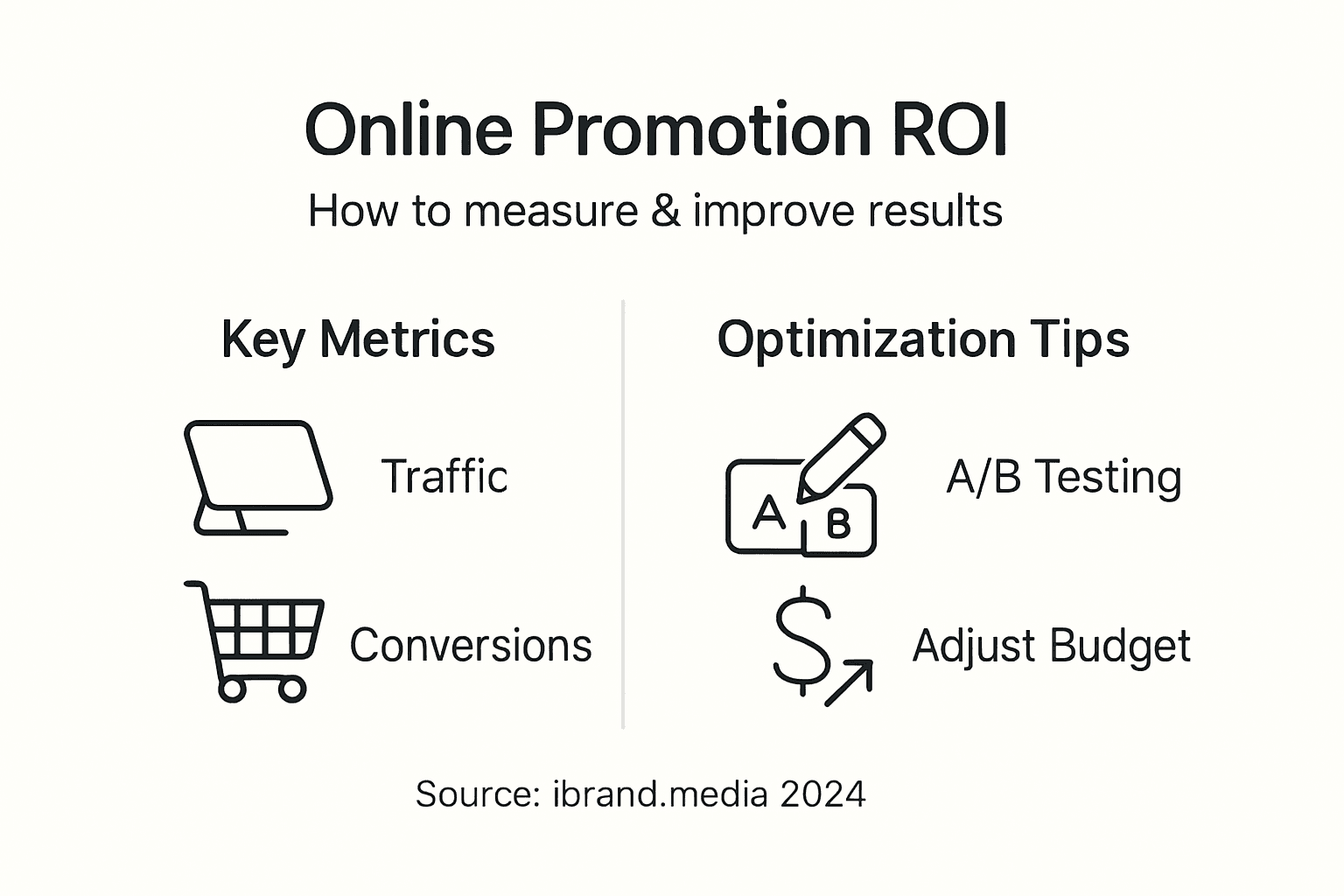
Many small business owners underestimate the importance of tracking online promotion performance metrics, severely limiting their optimization ability. This gap keeps them repeating ineffective tactics while missing opportunities to scale successful ones.
Essential Metrics to Track:
-
Traffic Sources: Identify which channels (organic search, paid ads, social media, referrals) drive visitors to your site. This reveals where to focus resources.
-
Conversion Rates: Measure the percentage of visitors who complete desired actions (purchases, form submissions, calls). Low conversion rates signal messaging or user experience problems.
-
Cost Per Acquisition (CPA): Calculate how much you spend to acquire each customer through different promotion channels. This metric guides budget allocation.
-
Return on Ad Spend (ROAS): Track revenue generated per dollar spent on advertising. A 4:1 ROAS means every ad dollar returns four dollars in revenue.
-
Engagement Metrics: Monitor likes, shares, comments, and time on site. High engagement indicates resonant content worth amplifying.
-
Customer Lifetime Value (CLV): Understand total revenue from a customer relationship, not just first purchase. This justifies higher acquisition costs for valuable long-term customers.
Use real-time analytics tools to make agile decisions. Google Analytics tracks website behavior. Facebook Ads Manager shows campaign performance. Email platforms report open and click rates. These tools provide immediate feedback, letting you pause underperforming campaigns and boost winners.
Optimization Process:
- Set clear baseline metrics before launching campaigns
- Run promotions for sufficient time to gather meaningful data
- Analyze results against goals and identify patterns
- Test variations (different headlines, images, audiences) systematically
- Scale what works and eliminate what does not
- Repeat the cycle continuously
Data-driven adjustments improve engagement, conversions, and ROI over time. Start by tracking just three key metrics if measurement feels overwhelming. Add more as you become comfortable with the process.
For implementation guidance, review strategies for optimizing online ads that maximize your promotion effectiveness through systematic testing and refinement.
Bridging Theory to Practice: Implementing Your Online Promotion Plan
Knowledge means nothing without action. Here is your step-by-step path from planning to execution.
1. Define Clear Promotional Goals
Link promotion objectives directly to business outcomes. Examples: increase website traffic by 30%, generate 50 qualified leads monthly, boost local store visits by 20%. Specific goals enable focused strategies and clear success measurement.
2. Identify and Segment Your Target Audience
Who are your ideal customers? What problems do they face? Where do they spend time online? Create detailed audience profiles including demographics, interests, pain points, and online behaviors. Segmentation allows personalized messaging that resonates.
3. Choose Tactics That Fit Goals and Budget
Match promotion methods to your objectives. Need immediate sales? Use paid ads. Building long-term authority? Invest in SEO and content. Serving local customers? Prioritize local SEO and geo-targeted campaigns. Start with one or two tactics you can execute well rather than spreading resources thin.
4. Implement Benefit-Focused Messaging
Every promotion piece should answer “What’s in it for me?” from the customer perspective. Highlight outcomes and transformations, not just features. “Save 3 hours weekly” beats “automated scheduling tool” in driving action.
5. Launch, Track, and Iterate
Begin with small tests before committing large budgets. Monitor your chosen metrics daily during initial campaigns. Make data-informed adjustments quickly. Scale successful elements while cutting underperformers. This iterative approach minimizes risk while maximizing learning.
6. Consider Professional Partnership
Agency expertise accelerates results and avoids common pitfalls. Professional teams bring specialized knowledge, established processes, and time savings that let you focus on running your business. The investment often pays for itself through improved campaign performance.
Pro Tip: Document your promotion plan in a simple one-page document. Include goals, target audience, chosen tactics, budget allocation, and success metrics. This clarity keeps you focused and provides a baseline for measuring progress.
Practical resources for execution include our guides on website optimization, SEO for beginners, and social media management benefits that support your promotional efforts.
Enhance Your Online Promotion with Ibrand.media
Executing effective online promotion while running your business creates time and expertise challenges. Professional support bridges that gap.
Ibrand.media specializes in SEO, advertising, and social media management tailored specifically for small and medium businesses. Our team handles the technical complexity while you focus on serving customers. We deliver measurable results through strategies proven to boost visibility and sales.
Our affordable service packages fit small business budgets without sacrificing quality. Whether you need comprehensive SEO for small businesses, guidance on affordable online advertising, or expert social media management, we provide solutions that scale with your growth. Partnering with professionals helps you avoid costly mistakes, accelerate implementation, and achieve the 4:1 ROAS and 25% local growth benchmarks discussed throughout this guide.
Frequently Asked Questions
What is the difference between marketing and promotion?
Marketing encompasses your entire go-to-market strategy including product development, pricing, distribution channels, and customer communication. Promotion is specifically the communication component covering advertising, publicity, sales promotions, and direct outreach. Think of promotion as one tool within your broader marketing toolkit.
How can small businesses measure online promotion success effectively?
Track three core metrics initially: traffic sources to identify which channels work, conversion rates to measure action completion, and cost per acquisition to understand efficiency. Use free tools like Google Analytics and platform-specific dashboards. Set baseline numbers before campaigns launch, then compare results weekly to spot trends and optimization opportunities.
What are the most cost-effective online promotion tactics for tight budgets?
Free publicity through media releases and organic social media posts delivers strong visibility at zero direct cost. Strategic email marketing to existing contacts costs pennies per message. Google Business Profile optimization provides free local search visibility. When you do spend, start with small social media ad tests that offer precise targeting and rapid feedback at $5-10 daily budgets.
How do I effectively target and reach local customers online?
Optimize your Google Business Profile completely with accurate information, photos, and regular posts. Use location-based keywords in your website content and meta tags. Run geo-targeted ads on Facebook and Google that only show to people within your service radius. Encourage customer reviews since local search rankings heavily weight review quantity and quality.
What common mistakes should I avoid in online promotion?
Avoid spreading your budget across too many channels before mastering one. Do not skip performance tracking, which leaves you blind to what works. Never use generic messaging that fails to highlight specific customer benefits. Resist the urge to constantly change tactics before gathering sufficient data. Finally, do not ignore mobile optimization since most online promotion traffic now comes from smartphones.
Recommended
- Effective Online Advertising Tips for Small Businesses 2025 | Ibrandmedia
- Boost Your Revenue: Increasing Local Sales Online | Ibrandmedia
- How to Target Local Customers for Rapid Business Growth | Ibrandmedia
- How to Run Local Ads: A Complete Guide for 2025 | Ibrandmedia
- Puoi diventare grande grazie al marketing strategico localizzato?
- Social Media Marketing: non solo Facebook Ads | The Rope
Recent Comments