
TL;DR:
- Customer journey mapping identifies all customer interactions from awareness to advocacy.
- Small businesses can leverage existing data and customer interviews to improve their journey.
- Regularly updating journey maps helps optimize touchpoints and increase online sales.
Customer journey mapping: a guide to boost online sales
Most small business owners assume customer journey mapping is something reserved for companies with massive marketing departments and six-figure research budgets. That assumption costs real money. When you understand the path your customer takes from first discovering your business to making a purchase (and coming back again), you gain a direct line to higher conversions, fewer abandoned carts, and stronger loyalty. This article breaks down what the customer journey really is, how to map it with the tools you already have, and how to turn those insights into sales that actually stick.
Table of Contents
- What is the customer journey and why it matters
- Key stages and touchpoints in digital customer journeys
- Gathering and using customer journey data
- Turning journey insights into action for higher sales
- Our take: why most small businesses undervalue journey mapping
- Ready to map and optimize your customer journeys?
- Frequently asked questions
Key Takeaways
| Point | Details |
|---|---|
| Customer journey matters | Understanding and mapping customer journeys can reveal issues and opportunities for small businesses to boost online sales. |
| Use existing data | Start with CRM, analytics, and direct feedback to identify key moments that shape buying decisions. |
| Take practical action | Apply insights from journey mapping by fixing pain points and personalizing marketing for each stage. |
| Continuous improvement | Regularly update your customer journey maps to keep pace with changing buyer behaviors and preferences. |
What is the customer journey and why it matters
The customer journey is the complete experience a person has with your business, starting from the very first moment they hear about you and ending long after they’ve made a purchase. It’s not just the checkout process. It covers every interaction, every search, every review they read, every email they open, and every social post they scroll past.
Think of it this way: a potential customer might see your Facebook ad on a Tuesday, forget about you, Google your business name on Thursday, read three reviews, visit your website, leave without buying, get a retargeting ad on Friday, and finally convert on Saturday. That whole sequence is the customer journey. And if you don’t know it exists, you can’t improve it.
The journey is typically broken into five stages:
- Awareness: The customer realizes they have a problem or need, and discovers your business for the first time.
- Consideration: They actively compare options, read reviews, and weigh your offer against competitors.
- Decision: They choose to buy. This is where trust, pricing, and urgency close the deal.
- Retention: You keep them happy after the purchase and bring them back for repeat business.
- Advocacy: Loyal customers recommend you to others, becoming your most cost-effective marketing channel.
Each stage involves different questions, emotions, and motivations. The mistake most small businesses make is treating all customers the same, regardless of where they are in the journey. Sending a “Buy Now” email to someone in the Awareness stage pushes them away. Sending educational content to someone ready to buy wastes their time.
The building blocks of a journey map are touchpoints, the specific moments when a customer interacts with your business, whether that’s your website, a phone call, an Instagram post, or a Google Business Profile listing. Touchpoints are not the same as journey stages. A single stage can have dozens of touchpoints.
“Customer journey mapping involves creating visual representations of customer interactions across stages like Awareness, Consideration, Decision, Retention, and Advocacy, incorporating touchpoints, emotions, pain points, and data from CRM, analytics, and interviews.”
When you map these interactions, you immediately see where people are dropping off, where they’re frustrated, and where they’re happiest. Businesses that invest in journey mapping typically see improvements in conversion rates because they’re removing friction that previously went unnoticed. If you’re new to how this connects to your revenue flow, start with understanding sales funnel basics to see how journey stages overlap with your buying pipeline.

For small businesses, this kind of mapping is not a luxury. It is a competitive advantage. Large companies take months to gather and process journey data. You can talk to your own customers next week.
Key stages and touchpoints in digital customer journeys
Digital customer journeys are messier than the textbook version suggests. People do not move neatly from one stage to the next. They loop back, skip steps, and sometimes jump straight from an Instagram reel to checkout. But understanding the general pattern at each stage gives you something to work with.
Here’s how each stage typically plays out online:
- Awareness: A prospect Googles a problem, not your brand. They might search “how to fix slow website” or “best coffee shop near downtown.” Your blog post, Google Ad, or local listing surfaces. This is your first impression, and it needs to match the language of their problem, not your solution.
- Consideration: Now they know you exist. They check your reviews on Google, browse your website, compare your pricing, and look at your social media to assess credibility. This is the stage where most SMBs lose people due to weak review profiles or confusing websites.
- Decision: The customer is ready to commit. They want reassurance. A clear call to action, a simple checkout process, and visible trust signals (testimonials, guarantees, secure payment badges) matter enormously here. Small friction kills big purchases.
- Retention: After the sale, the experience continues. Confirmation emails, follow-up messages, support responsiveness, and loyalty incentives all determine whether this customer returns or disappears. Customer loyalty strategies can dramatically improve lifetime value here.
- Advocacy: Happy retained customers share, refer, and review. This stage costs almost nothing and generates leads that convert at two to five times the rate of cold traffic.
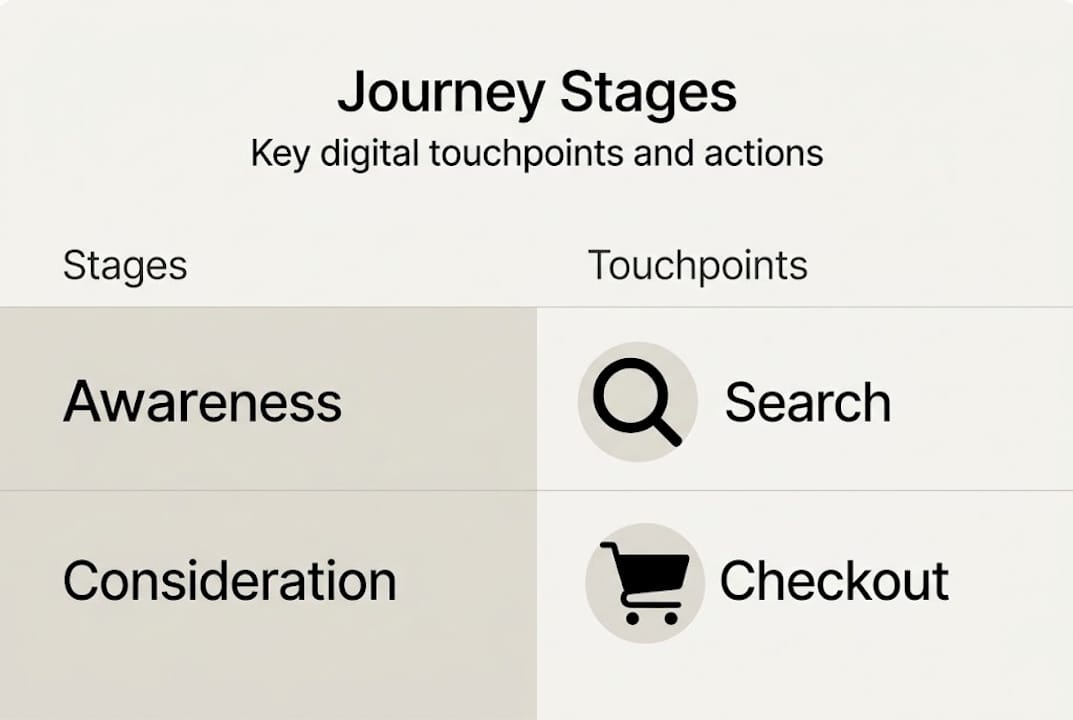
Here’s a quick view of how digital touchpoints and emotions map across stages:
| Stage | Key digital touchpoints | Common customer emotion |
|---|---|---|
| Awareness | Google Search, social ads, blog posts | Curious, problem-focused |
| Consideration | Reviews, website, comparison pages | Skeptical, cautious |
| Decision | Checkout page, pricing page, chat | Anxious, impatient |
| Retention | Email follow-ups, support, loyalty programs | Satisfied or disappointed |
| Advocacy | Social sharing, referral links, reviews | Proud, enthusiastic |
Notice how the emotional state shifts dramatically. A customer in Consideration is skeptical. Your job at that stage is not to push a hard sell but to reduce doubt. A customer in Advocacy is enthusiastic. Your job is to give them an easy way to share. Matching your content and tone to the emotional state at each stage is what separates effective digital marketing from generic broadcasting.
Pro Tip: To find hidden pain points at any stage, filter your Google Analytics by exit pages and session duration. Pages with high exit rates and short session times signal a mismatch between what the customer expected and what they found. Pair that with data from your CRM or support tickets to understand why they left. This approach to website conversion strategies uncovers friction you’d never spot just by looking at your homepage.
Gathering and using customer journey data
You cannot map a journey you haven’t observed. The good news is that small businesses often have richer data than they realize. They just haven’t organized it yet.
The most useful data sources for SMBs are:
- Google Analytics: Shows you which pages people visit, in what order, how long they stay, and where they exit. It reveals behavioral patterns across the Consideration and Decision stages especially.
- CRM systems: Track individual customer timelines, from first contact to purchase and beyond. Even basic CRMs like HubSpot Free or Zoho CRM capture enough to reveal common pathways.
- Support tickets and chat logs: These are gold mines of pain-point data. When customers ask the same question repeatedly, that’s a gap in your journey map.
- Customer interviews: A 15-minute phone call with five recent customers will reveal more about your journey than a week of data analysis. Ask them how they found you, what almost stopped them from buying, and what made them choose you.
Here’s how each data source maps to what it reveals:
| Data source | What it reveals |
|---|---|
| Google Analytics | Behavioral flow, drop-off pages, traffic sources |
| CRM data | Customer timelines, conversion rates by channel |
| Support tickets | Common frustrations, unanswered questions |
| Customer interviews | Emotional context, hidden motivations |
| Social media comments | Sentiment, recurring concerns or praise |
According to customer journey mapping research, the most effective maps combine hard analytics data with qualitative insights from real interviews, because numbers tell you what is happening and conversations tell you why.
Tools that work well for small businesses tracking customer journeys include:
- Google Analytics 4 for behavioral data
- Google Search Console for organic search intent
- Hotjar for heatmaps and session recordings
- HubSpot CRM for contact and deal tracking
- Typeform or Google Forms for customer surveys
Learn how to use website analytics tools to start building your data picture. You don’t need all of these at once. Start with two: one behavioral tool (Google Analytics) and one qualitative source (customer interviews). That combination alone is enough to build a useful first journey map. The importance of analytics becomes clear fast when you see how even basic data eliminates guesswork.
Pro Tip: If you have limited data, look for patterns rather than percentages. If three out of five interviewed customers say they almost didn’t buy because your pricing page was confusing, that’s enough to justify a fix, even without a statistically significant sample size.
Turning journey insights into action for higher sales
Data without action is just a dashboard. The real value of journey mapping shows up when you use what you’ve learned to make specific, targeted improvements at each stage.
Here is a step-by-step approach to fixing one of the most common SMB problems: drop-off between the Consideration and Decision stages:
- Identify the drop-off point. Use Google Analytics to find pages with high exit rates in the Consideration phase, typically your pricing page, product pages, or service detail pages.
- Audit the customer experience at that page. Read it as a skeptical first-time visitor. Is your value proposition clear? Are there visible trust signals? Is the next step obvious?
- Add social proof. Insert a relevant customer testimonial or case study directly on that page. A single specific quote can lift conversions noticeably.
- Simplify the call to action. One clear button, one clear message. Too many options cause people to choose nothing.
- Test and measure. Run your changes for at least 30 days and compare exit rates and conversion rates before and after.
Here’s a real composite example that reflects what we see often with SMB clients. A local home services company noticed that 70% of visitors left their “Get a Quote” page without submitting the form. After mapping their customer journey, they found that customers in the Consideration stage were anxious about price surprises. The company added a “How our pricing works” section and a single customer video testimonial directly above the form. Within 60 days, form submissions increased by 38%.
Small changes in messaging can also have a big impact. For instance, changing your Awareness-stage blog headlines from feature-focused language (“Our cleaning services”) to problem-focused language (“How to get your office ready for clients in one day”) attracts more relevant traffic from Google and delivers people to your site already aligned with what you offer.
For businesses serving a local area, the local customer marketing guide offers stage-specific ideas tailored to neighborhood-level reach. And combining journey insights with smart online loyalty tips creates a loop where happy buyers fuel new Awareness through referrals.
When you’re ready to scale, choosing marketing channels that match specific journey stages prevents budget waste and keeps your message relevant.
Pro Tip: Review and update your journey map every quarter. Customer behavior changes with seasons, trends, and market shifts. A journey map that was accurate in January may miss entirely new touchpoints by July. Treat it as a living document, not a finished diagram.
Our take: why most small businesses undervalue journey mapping
Here’s the uncomfortable truth: most small businesses skip journey mapping not because they lack the data, but because they assume the exercise is too formal or too corporate for their size. That belief is expensive.
We’ve seen businesses spend thousands on ad campaigns driving traffic to websites that lose people in the Consideration stage every single day. The ads aren’t the problem. The journey is. No amount of traffic fixes a leaky bucket.
Small businesses actually have a structural advantage here. You can call your last ten customers personally. A Fortune 500 company can’t. That kind of qualitative data, straight from real buyers in plain language, is more valuable than any enterprise software output. The businesses we work with that get the fastest wins are the ones who combine that personal customer knowledge with basic analytics for small business growth to prioritize which stage to fix first.
The biggest mistake we see? Treating a journey map as a one-time project. They build it once, present it in a meeting, and file it away. Markets shift. Customer behavior changes. A journey map is only useful if you update it regularly and act on what it shows you.
Ready to map and optimize your customer journeys?
Understanding your customer’s journey is only the first move. Executing on it requires the right combination of strategy, content, and technical optimization across every digital channel.
At ibrand.media, we help small and medium-sized businesses turn journey insights into real revenue growth. Whether that means optimizing your website to reduce Consideration-stage drop-off or building local marketing strategies that reach the right audience at the Awareness stage, we create plans built around how your specific customers actually behave. Stop guessing what your customers need at each step. Let’s map it out and fix the gaps that are costing you sales right now.
Frequently asked questions
What is a customer journey map?
A customer journey map is a visual tool that shows how customers interact with your business at every stage, from first learning about you to becoming loyal advocates. According to journey mapping research, effective maps incorporate touchpoints, emotions, pain points, and data from multiple sources.
Why should small businesses map their customer journeys?
Mapping your customer journey helps you spot gaps and improve the experience at every touchpoint, making it easier to move leads toward a purchase. Small businesses that map their journeys can make targeted, low-cost improvements that have an outsized impact on conversions compared to broad marketing spending.
How can I create a customer journey map if I have limited data?
Start by mapping out your main touchpoints and stages based on your own observations and simple customer interviews, then fill in more details as you gather data. Even five customer conversations can reveal patterns that transform how you structure your website, emails, and messaging. According to customer journey mapping best practices, qualitative data from interviews is just as critical as analytics.
What’s the difference between a sales funnel and a customer journey?
A sales funnel focuses mostly on the path to purchase, while a customer journey covers the entire relationship, including loyalty and advocacy after the sale. The journey gives you a fuller picture of customer behavior and a better foundation for long-term business growth.
Recent Comments