
Attracting steady clients can feel unpredictable for many American service providers, even when your phone rings from time to time. The real challenge is turning online interest into paying customers while making sure no one slips through the cracks. Understanding the basics of the sales funnel—and busting common misconceptions—gives you the tools to improve every step, help more prospects say yes, and spend less on wasted marketing efforts.
Table of Contents
- Sales Funnel Basics And Common Misconceptions
- Key Stages In A Typical Sales Funnel
- Popular Funnel Types For Small Businesses
- How Sales Funnels Drive Conversions Online
- Mistakes Businesses Make With Sales Funnels
Key Takeaways
| Point | Details |
|---|---|
| Understanding Your Sales Funnel | Recognize the stages of your sales funnel to tailor marketing messages effectively and guide prospects through their journey. |
| Flexibility is Key | Acknowledge that the buying process is not linear and adjust your approach to meet customers at various touchpoints. |
| Analyze Conversion Metrics | Regularly assess where prospects drop off in your funnel to identify and rectify inefficiencies for higher conversion rates. |
| Post-Purchase Engagement | Maintain communication with customers after purchases to foster loyalty and increase referrals, transforming one-time buyers into repeat clients. |
Sales Funnel Basics and Common Misconceptions
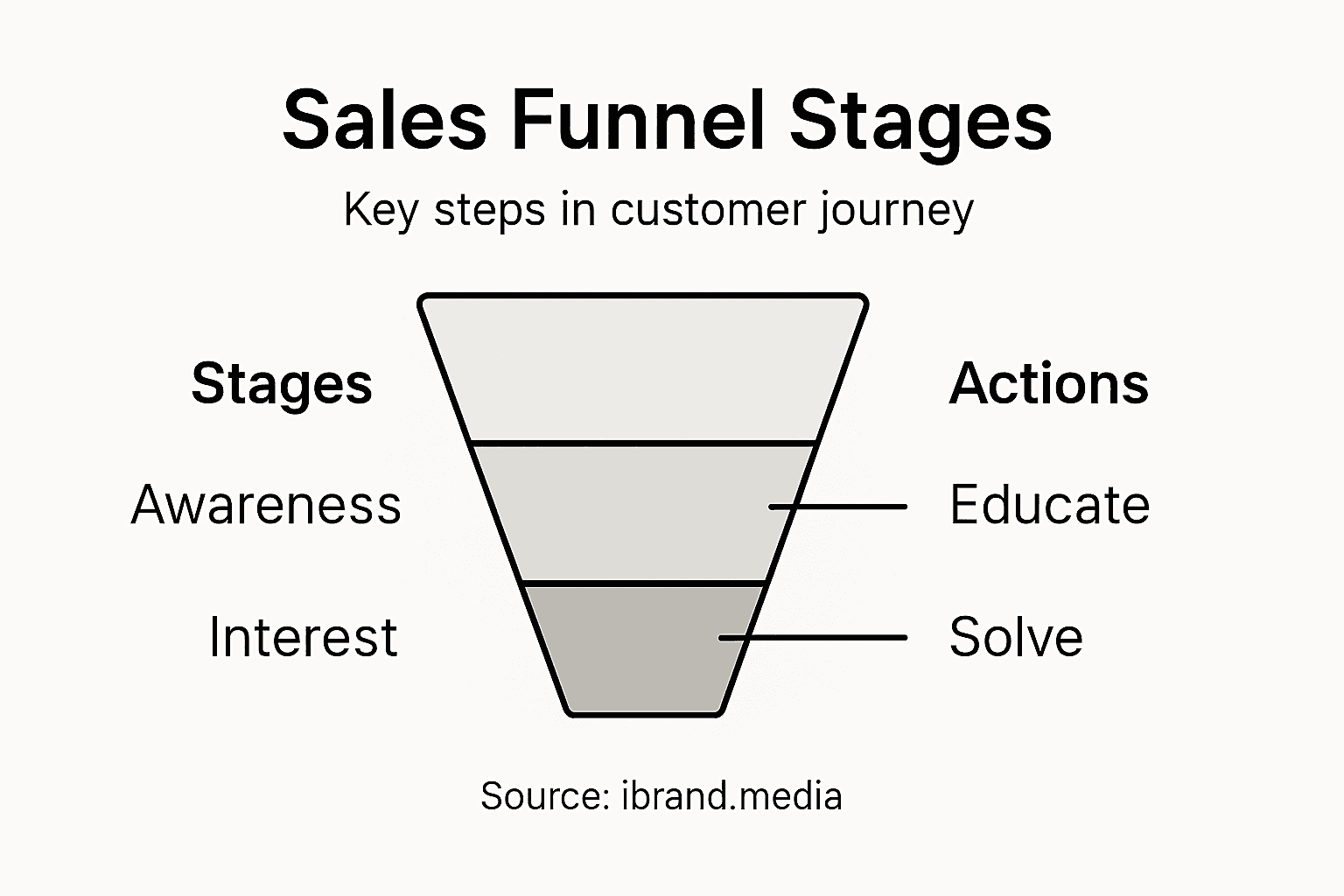
A sales funnel is a visual representation of the customer journey from the moment someone first becomes aware of your business until they make a purchase. Think of it like a physical funnel: wide at the top where many prospects enter, and narrower at the bottom where fewer (but more qualified) customers emerge. For local service providers, this model helps you understand why you might attract 100 website visitors but only close 5 clients. Each stage of the funnel represents a different level of buyer readiness, and your job is to move people through each stage strategically.
The traditional funnel follows four main stages. Awareness is where potential customers first discover your business, whether through a Google search, a neighbor’s recommendation, or a local Facebook ad. Interest happens when someone clicks through to learn more about what you offer. Consideration is when they compare you against competitors or think about whether they can afford your service. Finally, Decision is when they actually hire you or make a purchase. However, here’s what catches many service providers off guard: the buying process has become far more dynamic than this simple sequence suggests. Modern customers don’t always follow a straight path. Someone might become aware, jump to consideration, go back to interest, then decide. They might leave and return weeks later. Some visit your site three times before calling. This multi-path reality means your funnel needs flexibility, not rigidity.
Common misconceptions about sales funnels trip up local businesses constantly. The biggest mistake is assuming all leads convert at the same rate. A plumber who gets a lead from a homeowner saying “my pipe burst today” converts that lead much faster than someone who clicked an ad about “preventative maintenance.” Another frequent misconception is treating the funnel stages as completely separate. Many providers think if someone moves from awareness to interest, they automatically understand what makes the business different. They don’t. You need tailored engagement at every stage. Someone in the awareness phase needs basic information. Someone in the consideration phase needs social proof, pricing clarity, and answers to objections. Ignoring these differences wastes your marketing budget. Finally, many assume that getting traffic solves everything. But traffic means nothing if those visitors aren’t the right fit for your services.
Pro tip: Map your own customer journey this week by documenting how your last five clients found you and how long it took from first contact to hired. You’ll quickly spot where prospects get stuck and where your funnel leaks money.
Key Stages in a Typical Sales Funnel
Understanding the stages of a sales funnel gives you a roadmap for where your marketing efforts should focus. Each stage represents a different mindset and a different type of action from your prospect. For a local HVAC contractor or landscaper, recognizing these stages means you can stop wasting money on ads aimed at people who aren’t ready to buy yet. Instead, you can create targeted messages that speak directly to where prospects are in their journey.
The funnel typically starts with Awareness, where potential customers first realize they have a problem or need your service. Someone’s air conditioner breaks down on a hot day, or they notice their lawn hasn’t been maintained in months. They might search “emergency AC repair near me” or ask friends for recommendations. Your job at this stage is to be visible and easy to find. Next is Interest, where prospects actively learn more about what you offer. They visit your website, read reviews, or call to ask questions. They’re comparing you mentally to other options and trying to understand if you’re worth their time. The Evaluation stage is where real competition happens. Prospects now compare multiple service providers, check pricing, read testimonials, and decide if your business solves their problem better than alternatives. Many local service providers lose deals here because they haven’t clearly explained why they’re different.
Then comes Decision, where the prospect decides to hire you or make a purchase. This stage often includes negotiation on pricing, scheduling, or service details. After the transaction, don’t assume your funnel work is finished. Repeat purchases and customer loyalty are critical in B2B and service-based businesses. A satisfied customer who had a great experience is far more likely to call you again next year or refer you to neighbors. Many local service providers miss this completely and treat every customer as a one-time transaction. The reality is that a customer who uses your service once might need you again in 6 months, a year, or whenever their next issue arises. Building relationships and staying top-of-mind during this post-purchase stage turns single transactions into recurring revenue streams.

Each stage requires different messaging and different actions. At awareness, you’re educating. At interest, you’re proving competence. At evaluation, you’re removing objections. At decision, you’re making the transaction smooth. And after purchase, you’re delivering excellence and staying connected. Skipping or rushing any stage costs you deals and money.
Here’s a summary of how different funnel stages require unique marketing approaches:
| Funnel Stage | Prospect Mindset | Effective Message Type | Business Impact |
|---|---|---|---|
| Awareness | Recognizing a need | Educational, trust-building | Increases visibility and reach |
| Interest | Seeking more information | Benefits, proof of expertise | Nurtures leads for conversion |
| Evaluation | Comparing options | Differentiators, testimonials | Reduces drop-off, boosts wins |
| Decision | Ready to purchase | Clear action, negotiation | Maximizes close rate |
| Post-Purchase | Evaluating service received | Follow-up, loyalty messaging | Drives referrals, repeat sales |
Pro tip: Audit your current marketing materials and identify which funnel stage each one targets. If everything focuses on awareness and decision but nothing addresses evaluation and objections, you’ve found where you’re losing deals to competitors.
Popular Funnel Types for Small Businesses
Not every sales funnel looks the same, and that’s actually good news for you. Different business models require different funnel structures. A plumber’s funnel looks different from a digital marketing agency’s funnel, which looks different from a personal training business. Understanding which funnel type matches your business helps you stop guessing and start executing a strategy that actually works. The key is choosing a funnel architecture that reflects how your customers actually buy.
The Awareness Funnel is where many local service providers start. This funnel emphasizes getting your name in front of people through social media, Google searches, local directories, and word-of-mouth. The goal here is pure visibility. You’re not trying to close deals yet, just make sure that when someone needs your service, they know you exist. For example, a roofing company runs Facebook ads targeting homeowners in their zip code or invests in local SEO so they show up when someone searches “roof repair near me.” The Consideration Funnel takes people who already know about you and nurtures them with valuable content. This might include email campaigns explaining the benefits of roof maintenance, before and after photos, customer testimonials, or comparison guides between different roofing materials. You’re building trust and answering questions before they even call. The Conversion Funnel is all about closing the deal once someone is ready to buy. This funnel uses clear calls-to-action, retargeting ads, limited-time offers, and simplified booking processes to push prospects across the finish line.
For small service businesses specifically, a practical model combines these three into what we might call a Lead-to-Customer Funnel. This starts with identifying and qualifying leads to separate serious buyers from browsers. A plumber gets 20 calls a month but only 5 are from people actually ready to hire someone. Qualifying quickly saves you time and money. Next comes the proposal or quote stage, where you present your solution and pricing. Finally comes the customer sale, where you close and deliver service. Throughout this process, you measure key metrics like how many leads you generate, what percentage convert to customers, and how long the average sales cycle takes. These numbers tell you exactly where your funnel is leaking money.
The funnel type you choose depends on your business model and sales cycle. A service business with emergency calls (like plumbing or electrical) might emphasize availability and quick response over long nurturing campaigns. A business selling bigger projects might emphasize the consideration phase heavily. The mistake most small businesses make is trying to use someone else’s funnel blueprint without customization. Your funnel should match your actual customer behavior, not someone else’s.
Here is a comparison of popular funnel types for small businesses and their strategic focus:
| Funnel Type | Primary Goal | Best For Businesses That | Key Success Metric |
|---|---|---|---|
| Awareness Funnel | Increase visibility | Emergency service firms | Brand recall in local searches |
| Consideration Funnel | Build trust, educate leads | Project-based providers | Engagement rate on content |
| Conversion Funnel | Prompt action, facilitate sale | High-volume businesses | Booking or inquiry conversion rate |
| Lead-to-Customer Funnel | Qualify, quote, close deals | Small local providers | Percentage of leads converted |
Pro tip: Write down your last 10 customer sales and trace exactly how each one moved through your funnel. Did they call directly after seeing an ad, or did they research for months first? This real data tells you which funnel type actually matches your business.
How Sales Funnels Drive Conversions Online
The entire purpose of a sales funnel is simple: move more prospects toward a purchase. A well-designed online funnel does this automatically by guiding people through a logical sequence of steps, removing friction at each stage, and addressing their concerns before they even voice them. Think of it like a physical store layout. A good grocery store doesn’t dump you in a random aisle. They put essentials like milk and bread at the back so you walk through the entire store and see other products. Your online funnel works the same way. It strategically sequences information, builds trust gradually, and removes obstacles that would stop someone from becoming a customer.
Online sales funnels drive conversions by addressing user needs at exactly the right moment. When someone first discovers your business, they need proof that you exist and are legitimate. Show them testimonials, Google reviews, or before-and-after photos. When they’re comparing you to competitors, they need specific information about your pricing, process, and guarantee. Answering these questions before they ask prevents them from clicking away to a competitor’s website. Conversion funnel optimization involves identifying where prospects drop off and fixing those exact points. If 100 people visit your website but only 10 call, you have a leak. Maybe your phone number isn’t visible enough. Maybe your service area isn’t clear. Maybe people don’t understand what makes you different. By analyzing where visitors leave, you can fix the problem and recover lost sales. Small improvements at each stage compound dramatically. If you improve the awareness stage by 10 percent and the consideration stage by 10 percent, your overall conversion rate doesn’t increase by 10 percent, it increases by much more because more people are reaching each subsequent stage.
The data-driven approach to funnels is what separates businesses that grow from those that spin their wheels. Instead of guessing why prospects aren’t converting, use your website analytics, customer relationship management data, and marketing platform information to identify exact drop-off points. Systematic analysis of user behavior across multiple channels reveals patterns you’d never spot otherwise. Maybe visitors from Facebook spend longer on your site than those from Google, suggesting one audience is more interested. Maybe people who view your pricing page are far less likely to call than those who view your portfolio. These insights let you test changes and measure results. You might change your headline, simplify your contact form, or add a video. Then you measure if conversions went up. This testing cycle is how top-performing local service businesses systematically increase their conversion rates month after month.
For local service providers on a tight budget, this doesn’t require expensive software or hiring a specialist. Start with Google Analytics (free) to see where visitors come from and what they click. Use your phone to note where calls come from and what question they ask first. Connect these dots and you’ll spot obvious friction points. Maybe your website mentions you serve three counties but your Google Business profile mentions only one, confusing prospects. Maybe your contact page buries the phone number below a lengthy form. These fixes cost nothing but unlock faster conversions from traffic you’re already generating.
Pro tip: Set up Google Analytics goal tracking this week to measure what percentage of visitors complete each step: visit site, view pricing, click call button, submit contact form. This baseline data shows you exactly where your biggest leaks are, so you can focus your efforts on fixes that matter most.
Mistakes Businesses Make With Sales Funnels
Most local service businesses have never deliberately built a funnel. They have customers, sure, but they’re not strategically guiding prospects through stages. They’re hoping people will magically know what to do next. This reactive approach costs money every single day. And when these businesses finally try to create a funnel, they often make predictable mistakes that actually hurt their conversion rates. Understanding these pitfalls helps you avoid them and outcompete businesses that are still guessing.
The biggest mistake is assuming customers follow a straight path from awareness to purchase. Reality doesn’t work that way anymore. A homeowner might see your roofing company’s Google ad today, forget about it, then Google “roof repair” three weeks later and find you through search instead, then spend two weeks comparing you to three competitors before calling. They’re bouncing between awareness and consideration multiple times across different channels. Many businesses build funnels assuming this linear journey, then get frustrated when prospects don’t cooperate. The fix is simple but requires a mindset shift: stop thinking of your funnel as a straight slide and start thinking of it as a web where people can enter and exit from multiple points. Your prospect might enter through Facebook, leave, re-enter through Google, leave again, then finally convert through a friend’s recommendation. Your job is to stay visible and useful at every touch point.
Another critical error is failing to analyze where prospects actually drop off. You might have 500 monthly website visitors but only get 20 calls. Where are the other 480 going? Without funnel analysis, you’re flying blind. Maybe 300 visitors leave after viewing the homepage because it’s unclear what you do. Maybe 150 view pricing and never call because your rates seem high compared to competitors. Maybe 30 get to the contact form but don’t submit because they see a form asking for 15 pieces of information. Each of these is a different problem requiring a different solution. Without data, you’re just guessing and making random changes that rarely help. The businesses that grow are the ones that measure, identify the exact drop off point, and fix it.
A third mistake is treating your funnel as static. You build it once and expect it to work forever. But customer behavior changes. Technology changes. Competitors change. Your funnel needs constant optimization. Many businesses over rely on traditional funnel thinking and miss evolving buyer expectations. Someone who needed a service five years ago might now expect to book online, see pricing upfront, and get confirmation via text message. If your funnel still requires a phone call and a week of back and forth, prospects go elsewhere. Successful businesses test small changes continuously. One month they simplify the contact form. The next month they add customer testimonials to the pricing page. They measure results and keep what works.
Finally, many businesses neglect the post-purchase stage. They close a deal and immediately stop communicating. But this is where you build loyalty and get referrals. A satisfied customer is your best marketing tool. Send a follow up email asking how the service went. Share maintenance tips. Remind them you’re here if they need you again. This costs almost nothing but transforms one-time customers into repeat clients and referral sources.
Pro tip: Choose ONE funnel stage this week where you suspect prospects are dropping off. Add one small improvement: clearer messaging, a testimonial, simplified form, or faster response time. Measure calls or inquiries for two weeks before and after to see if it made a difference. This one test often reveals exactly where your biggest opportunity is.
Unlock the Full Power of Your Sales Funnel With Expert Digital Marketing Support
If you have struggled to move prospects smoothly through your sales funnel stages from awareness to decision you are not alone. The article highlights how important it is to understand each funnel phase like Interest and Evaluation so you deliver the right message at the right time. Without a flexible and measurable funnel strategy your marketing budget might be wasted on the wrong audience or ineffective content. Common pain points include unclear messaging that lets prospects drop off and missing post-purchase follow-up that stops loyal customers from returning.
At ibrand.media we specialize in helping small to medium-sized businesses build custom digital marketing funnels that drive real conversions. Our comprehensive services include SEO optimization, local marketing, targeted advertising, and engaging social media management all designed to fit your unique sales cycle. We combine mobile-friendly design with real-time performance tracking so you see exactly where visitors leave and how to fix it. With a proven process to build trust at every funnel step and simplify the buying journey we empower you to increase leads and close more deals faster.
Stop guessing why your sales funnel leaks leads and start optimizing it strategically today. Explore how ibrand.media can design a funnel plan tailored to your business. Take the first step toward building lasting customer relationships and maximizing your conversions now by contacting us for a custom digital marketing strategy.
Frequently Asked Questions
What is a sales funnel?
A sales funnel is a visual representation of the customer journey, depicting the stages a potential customer goes through from awareness of a business to making a purchase.
Why does understanding the sales funnel matter for local service providers?
Understanding the sales funnel helps local service providers identify and target their marketing efforts at each stage of the customer journey, ultimately improving conversion rates and sales outcomes.
What are the main stages of a sales funnel?
The traditional sales funnel consists of four main stages: Awareness, Interest, Evaluation, and Decision. Each stage requires unique messaging and marketing strategies to guide potential customers toward making a purchase.
How can businesses analyze their sales funnel effectiveness?
Businesses can analyze their sales funnel effectiveness by tracking key metrics such as visitor behavior on their website, conversion rates at each stage, and identifying where prospects drop off, allowing for targeted improvements.
Recent Comments