
Small business owners know that attracting new customers costs far more than keeping existing ones, yet online customer loyalty remains elusive for many. Traditional loyalty programs often fail because they demand too much effort for too little reward, leaving customers frustrated and businesses wondering where they went wrong. This guide delivers practical, affordable digital marketing strategies specifically designed for small to medium-sized businesses ready to transform one-time buyers into repeat customers. You’ll learn how to avoid common pitfalls, design rewards that actually motivate action, and measure success without breaking your budget.
Table of Contents
- Why Many Online Loyalty Programs Fail And How To Avoid Common Pitfalls
- Preparing Your Business To Build Effective Customer Loyalty Online
- Step-By-Step Strategies To Build And Maintain Online Customer Loyalty Affordably
- Measuring Success And Troubleshooting Common Issues In Online Loyalty Programs
- Explore Expert Digital Marketing Services To Boost Your Online Loyalty
Key takeaways
| Point | Details |
|---|---|
| Balance effort and value | Customers abandon programs when earning rewards requires excessive effort compared to the benefit received. |
| Personalization drives engagement | Tailored rewards and communications based on customer data dramatically increase participation and satisfaction. |
| Simplicity builds trust | Complex rules and irrelevant perks quickly erode customer confidence and program effectiveness. |
| Measurement enables improvement | Tracking redemption rates and customer feedback reveals friction points and optimization opportunities. |
Why many online loyalty programs fail and how to avoid common pitfalls
The harsh reality is that most loyalty programs fail because the effort to get a reward is higher than the reward itself. Customers calculate value instinctively, and when they realize they need to spend $500 to earn a $5 discount, they disengage immediately. This imbalance creates frustration rather than loyalty, turning what should be a positive experience into a source of resentment.
Irrelevant rewards compound this problem by demonstrating that you don’t understand your customers at all. When a vegan customer receives a coupon for steakhouse dining or a budget-conscious shopper gets exclusive access to premium-priced items, the disconnect becomes obvious. These misaligned perks don’t just fail to motivate, they actively damage the relationship by showing customers their preferences don’t matter to you.
Operational disconnects create another fatal weakness in many programs. Your marketing team promises expedited shipping as a loyalty perk, but your fulfillment center operates on the same timeline for everyone. Customers redeem points for priority customer service, only to wait on hold for 45 minutes like any other caller. These broken promises destroy trust faster than any competitor ever could, because you’ve proven your loyalty program exists only as a marketing gimmick rather than a genuine value exchange.
Consider these common failure patterns:
- Requiring customers to create separate accounts or download apps just to participate
- Setting expiration dates on points that punish infrequent purchasers
- Offering rewards only on products customers never buy
- Making redemption processes so complicated that customers give up halfway through
“A loyalty program should feel like a gift, not a second job. The moment customers need a manual to understand your rewards, you’ve already lost them.”
Successful digital marketing for retailers recognizes that loyalty is fundamentally an exchange where both parties must perceive fair value. Your customers invest their money, time, and attention. In return, they expect rewards that genuinely enhance their experience, delivered through processes that respect their time. When this exchange feels unbalanced, no amount of marketing can salvage the program.
Preparing your business to build effective customer loyalty online
Before launching any loyalty initiative, you must understand exactly who your customers are and what they actually value. Generic assumptions lead to generic programs that fail to resonate with anyone. Analyze your purchase data to identify patterns: which products do repeat customers buy most frequently, what’s the average time between purchases, and which customer segments generate the highest lifetime value. This foundation prevents you from building a program based on wishful thinking rather than customer reality.
Setting realistic goals aligned with your operational capacity protects you from the expectation trap that sinks many programs. If you can’t consistently deliver products within three business days, don’t promise expedited shipping as a loyalty perk. If your customer service team already struggles with response times, don’t offer priority support you can’t provide. Your loyalty program goals must match what your business can actually execute, because broken promises damage relationships more than modest but reliable rewards build them.
Integration across your entire operation ensures that loyalty isn’t just a marketing department fantasy. Your point-of-sale system needs to track purchases and apply rewards automatically. Customer service representatives must have instant access to loyalty status and redemption history. Fulfillment teams need clear protocols for handling loyalty perks. When these systems work together seamlessly, customers experience the program as effortless, which is exactly what drives continued participation.
Follow these preparation steps systematically:
- Survey existing customers about their preferences and pain points
- Audit your operational capabilities to identify realistic reward options
- Map the complete customer journey to find natural reward integration points
- Test your program internally before launching to customers
- Create clear documentation for staff across all customer-facing departments
Pro Tip: Schedule quarterly reviews of customer feedback and program metrics to catch problems early and adjust your approach before small issues become major failures.
Keep your program rules transparent and simple enough that customers can explain them to a friend without confusion. If you need more than three sentences to describe how customers earn and redeem rewards, you’ve overcomplicated things. Complexity creates friction, and friction kills participation faster than almost any other factor. Your goal is to make loyalty feel automatic and rewarding, not like solving a puzzle.
Understanding balancing promotion and value online helps you avoid the trap of using loyalty programs solely as discount mechanisms. While price incentives play a role, programs built entirely on discounts train customers to wait for deals rather than developing genuine brand preference. The most effective programs blend tangible rewards with recognition, exclusive experiences, and genuine appreciation that money can’t buy.
Consider how targeting local customers online intersects with loyalty building. Local businesses have unique advantages in creating personal connections and community-focused rewards that national chains can’t replicate. Your preparation should identify these local strengths and incorporate them into your loyalty strategy for maximum differentiation.
Step-by-step strategies to build and maintain online customer loyalty affordably
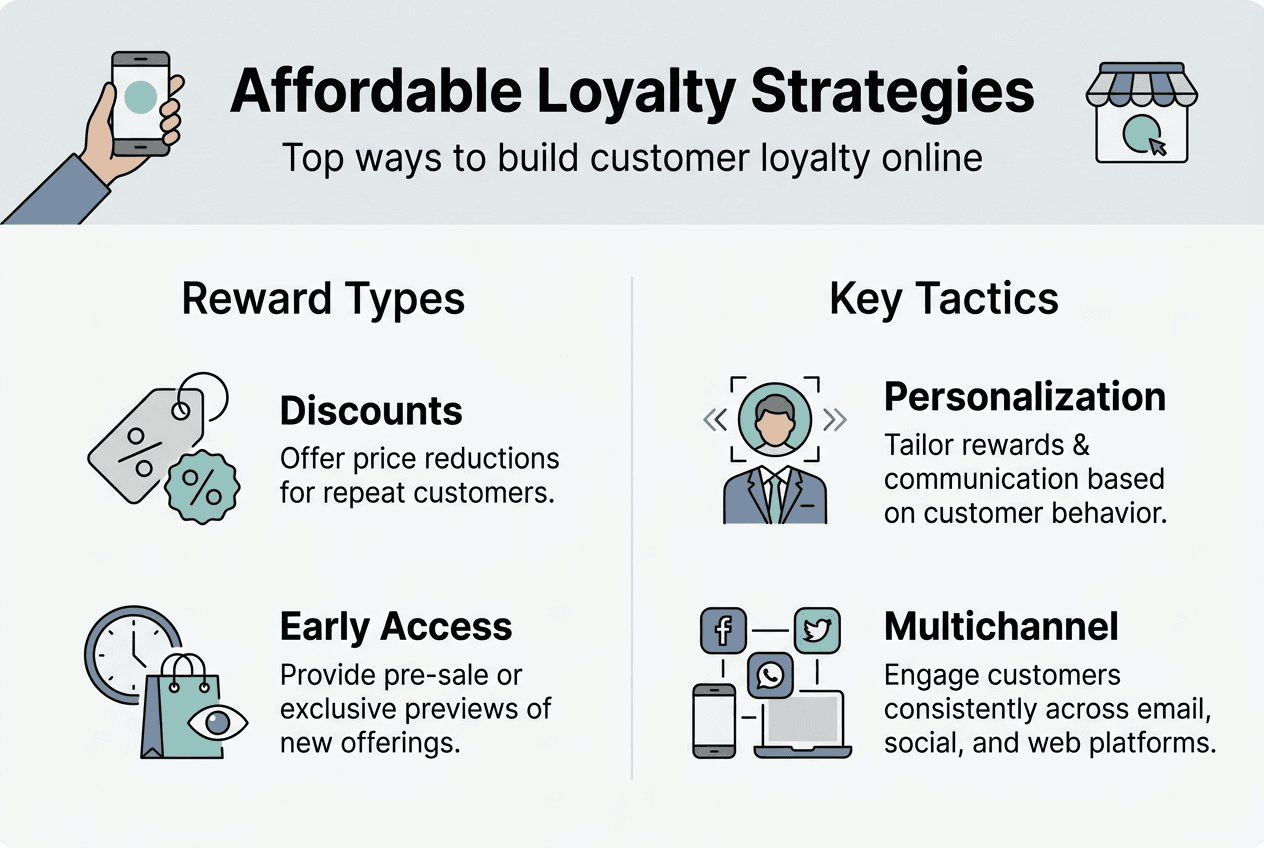
Personalization transforms generic programs into experiences that feel custom-built for each customer. Use purchase history to recommend products they’ll actually want, send birthday rewards that acknowledge them as individuals, and segment your communications so customers only receive messages relevant to their interests. Over 80% of customers prefer personalized experiences, and businesses that deliver this see dramatically higher engagement rates. You don’t need expensive software to start, basic email marketing tools and your existing customer database provide enough data to create meaningful personalization.

Reward design makes or breaks your program’s effectiveness. Start with achievable milestones that new customers can reach quickly, creating early wins that demonstrate value immediately. A customer who earns their first reward after just two purchases feels motivated to continue, while someone facing a ten-purchase requirement before any benefit may never engage at all. Structure your rewards in tiers that provide frequent small wins alongside aspirational larger rewards for your best customers.
Implement these core strategies systematically:
- Create a welcome reward that new customers receive immediately upon joining
- Set the first milestone at 20% of your average customer’s monthly spending
- Offer multiple redemption options so customers can choose rewards they actually want
- Use surprise bonuses occasionally to delight customers beyond their expectations
- Recognize loyalty milestones with personalized messages, not just automated emails
Multi-channel communication keeps your program visible without becoming annoying. Email remains essential for detailed updates and personalized offers. Social media works perfectly for announcing flash bonuses and celebrating customer milestones publicly. SMS delivers time-sensitive offers that drive immediate action. The key is matching message type to channel, not blasting the same content everywhere and hoping something sticks.
Affordable technology tools have democratized loyalty program management for small businesses. You don’t need enterprise software costing thousands monthly. Many platforms offer tiered pricing starting under $50 per month, providing point tracking, automated rewards, and basic analytics. Some e-commerce platforms include loyalty features in their standard packages. Focus on tools that integrate with your existing systems rather than forcing you to rebuild your entire tech stack.
Pro Tip: Avoid over-relying on discounts as your primary reward mechanism, instead offer early access to new products, exclusive content, or recognition in your community to build emotional connections that transcend price.
Consider this comparison of cost-effective reward types and recommended communication frequencies:
| Reward Type | Estimated Cost | Customer Appeal | Best Communication Frequency |
|---|---|---|---|
| Percentage discounts | 5-15% of purchase | High for price-sensitive customers | Monthly for general offers, weekly for VIP tiers |
| Free shipping | $5-12 per order | Very high for online shoppers | Every purchase for loyalty members |
| Early product access | Minimal | High for brand enthusiasts | Quarterly for new launches |
| Exclusive content | Time investment only | Moderate to high | Bi-weekly for engaged segments |
| Birthday rewards | Variable | High for personalization | Once annually plus anniversary |
Your online brand building efforts should integrate seamlessly with loyalty initiatives, creating a cohesive experience where customers feel recognized and valued at every touchpoint. Loyalty programs amplify brand building by giving customers tangible reasons to choose you repeatedly, while strong branding makes your loyalty rewards feel more valuable and desirable.
Effective online promotion essentials include loyalty programs as a core component rather than an afterthought. When you plan promotional campaigns, consider how they can reward existing loyal customers first before broadcasting to cold audiences. This approach shows appreciation while potentially turning satisfied customers into active advocates who share your promotions with their networks.
Strategies for increasing local sales online gain extra power when combined with loyalty programs that acknowledge and reward your community’s support. Local businesses can offer rewards tied to community events, partnerships with neighboring businesses, or recognition in local media, creating loyalty mechanisms that national competitors simply cannot match.
Measuring success and troubleshooting common issues in online loyalty programs
Tracking the right metrics reveals whether your program actually drives the behavior you want. Redemption rate shows what percentage of earned rewards customers actually use, indicating whether your rewards hold genuine appeal. A low redemption rate often means rewards are either too difficult to use or not valuable enough to motivate action. Repeat purchase frequency measures how often loyalty members buy compared to non-members, directly quantifying the program’s impact on customer behavior. Customer lifetime value among program members versus non-members provides the ultimate measure of program ROI.
Monitor these key performance indicators consistently:
- Active participation rate: percentage of enrolled customers who engage monthly
- Average time to first reward redemption
- Customer satisfaction scores specifically about the loyalty program
- Cost per reward issued compared to incremental revenue generated
- Referral rate among loyalty members versus general customers
Identify friction points by analyzing where customers drop off in the loyalty journey. If many customers earn points but never redeem them, your redemption process likely contains hidden obstacles. When customers join enthusiastically but stop engaging after a few weeks, your ongoing communication or reward pace may be failing to maintain interest. Survey tools and direct customer feedback reveal these issues faster than data analysis alone, because customers will often tell you exactly what’s wrong if you simply ask.
The statistic that 33% of consumers will leave their preferred brands when offered irrelevant rewards demonstrates how quickly misalignment erodes value. Regular audits of your reward catalog against actual customer preferences prevent this costly mistake. What seemed appealing when you launched may no longer resonate six months later as customer needs and market conditions evolve.
Compare these approaches to loyalty program management:
| Approach | Reactive Management | Proactive Management |
|---|---|---|
| Problem detection | Wait for complaints to surface | Monitor metrics weekly for early warning signs |
| Reward updates | Change only when participation drops | Refresh quarterly based on trends and feedback |
| Customer communication | Send only when promoting something | Regular engagement with value-added content |
| Technology maintenance | Fix issues as they break | Scheduled audits and preventive updates |
| Competitive analysis | Ignore what others do | Quarterly review of competitor programs |
Pro Tip: Regularly refresh your rewards and communications every 90 days to sustain interest and prevent your program from becoming invisible background noise that customers ignore.
When you identify problems, act quickly and communicate transparently with affected customers. If a technical glitch prevents reward redemption, acknowledge it publicly and compensate affected customers generously. When customer feedback reveals a reward nobody wants, remove it and replace it with something your audience actually requested. This responsiveness builds trust and demonstrates that your loyalty program genuinely prioritizes customer needs rather than just extracting value.
Understanding challenges in digital promotion helps you anticipate obstacles before they derail your loyalty efforts. Many challenges that plague general digital marketing, like message fatigue and attribution complexity, manifest differently in loyalty programs but require similar strategic thinking to overcome.
Continually balancing promotion and value ensures your loyalty program never devolves into a pure discount mechanism that erodes margins without building genuine preference. The most successful programs deliver value that customers couldn’t easily obtain elsewhere, creating differentiation that transcends price competition.
Explore expert digital marketing services to boost your online loyalty
Building customer loyalty online requires more than good intentions, it demands strategic execution across multiple digital channels working in harmony. Professional digital marketing services bring the expertise and tools to amplify your loyalty efforts while you focus on running your business. From optimizing your website for conversion to managing social media communities where loyal customers gather, specialized support accelerates results and avoids costly mistakes.
iBrand Media specializes in helping small to medium-sized businesses create integrated digital marketing strategies that drive measurable results. Our SEO services ensure your loyalty program reaches customers actively searching for businesses like yours. Professional social media management builds the engaged communities where loyalty naturally flourishes. When you’re ready to transform casual buyers into devoted advocates, explore our comprehensive guide to marketing local customers online and discover how expert support can maximize your loyalty program’s impact.
FAQ
How can I make my loyalty program simple enough for my customers?
Keep reward requirements clear and easy to understand by using straightforward language like “earn 1 point per dollar spent” rather than complex formulas. Limit the steps required to redeem rewards to no more than three clicks or actions, and provide visual progress indicators so customers always know how close they are to their next reward. Test your program with real customers before launching to identify any confusing elements.
What types of rewards best encourage repeat purchases online?
Personalized offers tailored to individual customer preferences and purchase history consistently outperform generic rewards. Experiences or recognition beyond simple discounts, such as early access to new products, exclusive content, or public acknowledgment in your community, create emotional connections that drive loyalty. Easy-to-redeem and relevant perks that align with what customers already buy naturally motivate them to return sooner and spend more.
How important is personalization in an online loyalty program?
Personalization dramatically increases relevance and customer satisfaction by making each member feel individually valued rather than just another number. Programs lacking personalization see lower engagement rates and higher churn because customers perceive them as generic marketing rather than genuine appreciation. Research shows that over 80% of customers prefer personalized experiences, making this approach essential rather than optional for program success.
What common mistakes should I avoid when launching a loyalty program?
Making rewards too hard to redeem by requiring excessive purchases or complicated processes kills participation before it starts. Offering irrelevant or generic perks that don’t match customer preferences wastes your investment and damages credibility. Ignoring operational alignment means your marketing promises exceed what customer service and fulfillment can deliver, creating broken expectations that destroy trust. Overemphasizing discounts over brand value trains customers to wait for deals rather than developing genuine preference for your business.
Recent Comments