
TL;DR:
- Trust signals like reviews and credentials are crucial for converting website visitors into customers.
- Usability, design, and local SEO must work together to generate leads effectively.
- Building credibility and local authority results in higher revenue and better online visibility.
Most plumbing business owners think launching a website is the finish line. It isn’t even close to the starting line. Studies show that 86% of consumers read online reviews before hiring a service provider, yet the majority of plumbing sites have fewer than ten reviews, no visible credentials, and layouts that frustrate potential customers into clicking away. This guide breaks down the five most common reasons plumbing websites quietly bleed leads every single day, and gives you concrete, actionable steps to reverse each one before your competitors do.
Table of Contents
- The invisible problem: Why most plumbing sites aren’t trusted
- Common design and usability mistakes that drive visitors away
- Overlooking social proof: The revenue impact of missing reviews
- Ignoring local SEO: How visibility and leads are lost
- Why quick fixes rarely work: A strategic mindset for plumbing sites
- How to turn your website into a plumbing business asset
- Frequently asked questions
Key Takeaways
| Point | Details |
|---|---|
| Trust is essential | Websites without reviews, real photos, and credentials will lose customer confidence. |
| Design drives results | Modern, easy-to-use sites with clear calls to action convert more visitors into leads. |
| Reviews boost revenue | Plumbing businesses with 50+ reviews earn significantly higher revenue and trust. |
| Local SEO matters | Being visible on Google and in local searches turns more browsers into paying customers. |
| No single quick fix | Long-term success comes from integrating trust, design, and SEO strategies. |
The invisible problem: Why most plumbing sites aren’t trusted
Let’s start by digging into the root cause: trust. A potential customer lands on your website after a pipe bursts at 11 PM. They have thirty seconds to decide if you’re legitimate. What do they see? If the answer is a stock photo, no license number, and a generic “About Us” page, they’re gone. That’s not a design problem. That’s a trust problem.
Most plumbing websites fail silently because they skip the basics that build immediate credibility. Visitors can’t shake your hand or see your truck, so your website has to do all of that work for you. Here’s what most sites are missing:
- Business license and certification numbers displayed prominently
- Real photos of your team, vehicles, and completed jobs
- Named owner or technician profiles with genuine bios
- Badges and association memberships (e.g., licensed, bonded, insured)
- Verified customer reviews embedded directly on service pages
Reviews are not optional. They are the single most powerful trust signal on your site. Businesses with 50+ reviews generate 54% more revenue than those without, which is a staggering gap that cannot be ignored.
“Customers don’t hire plumbers they don’t trust. And they don’t trust plumbers they can’t verify online.”
Think about building trust with social proof the same way you’d think about a referral from a neighbor. It removes skepticism instantly. Social proof in marketing works because people follow the behavior of others when they’re unsure, which is exactly the emotional state someone is in when they discover a leak. One genuine photo of your team fixing a real job in your area is worth more than ten polished stock images.
The fix here is not complicated, but it requires action. Audit your homepage right now. Ask yourself: if a stranger landed here, would they know within five seconds that you are licensed, local, and trusted by real customers?
Common design and usability mistakes that drive visitors away
Once trust signals are in place, usability and design flaws are a common next hurdle. A plumbing site can have five stars and still lose leads because the contact button is buried, the page takes six seconds to load, or the menu makes no sense on a phone. These are not small annoyances. They are conversion killers.
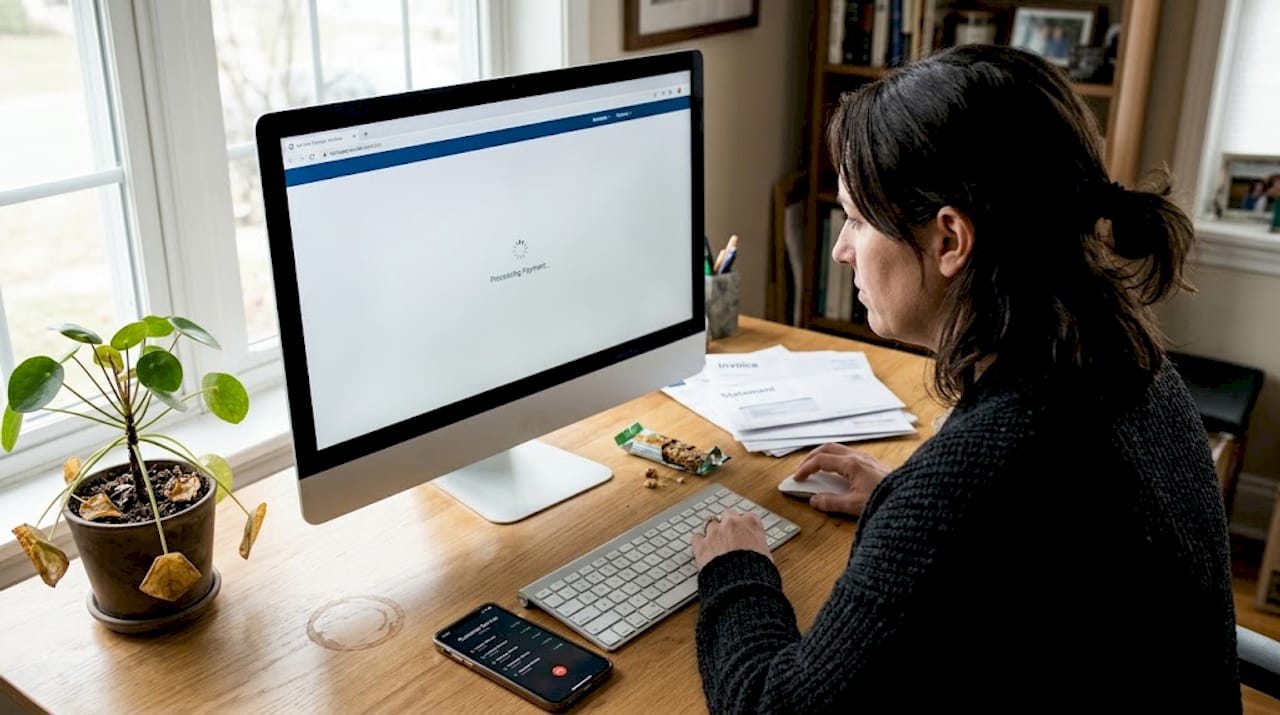
Insufficient trust and poor clarity are two of the primary reasons plumbing websites fail to generate business. Here’s a comparison that shows exactly where the gap lies:
| Design element | High-performing site | Failing site |
|---|---|---|
| Contact info | Visible on every page, top right | Buried on a separate contact page |
| Call to action | Bold, repeated, above the fold | Absent or hidden at the bottom |
| Mobile layout | Clean, thumb-friendly, fast | Pinch-to-zoom, broken buttons |
| Page speed | Under 3 seconds | 5+ seconds load time |
| Navigation | Simple: Home, Services, Contact | 10+ menu items, confusing labels |
The most common mistakes we see on plumbing sites include:
- No phone number in the header
- Service pages with no pricing estimate or clear next step
- Outdated templates that look like they were built in 2010
- Dense paragraphs of text with no visual breaks
- No emergency or after-hours call option
Pro Tip: Keep your layout brutally simple. One primary call to action per page, your phone number at the top of every page, and a mobile test every time you make changes. If your cousin can’t figure out how to contact you from their phone in under ten seconds, your site is failing.
Exploring the right marketing channels for plumbers starts with making sure your website can actually convert the traffic you send to it. A beautiful ad campaign pointing to a broken website is money thrown away. Use tools like Google PageSpeed Insights to check load times and fix them before spending a dollar on ads. And if you’re serious about growth, understanding how to grow your plumbing business online goes far beyond just having a fast website.
Overlooking social proof: The revenue impact of missing reviews
Lack of social proof is especially impactful. Let’s break down why reviews and ratings truly matter beyond just looking good.
Most plumbing business owners think five or ten reviews is “enough.” It isn’t. The data is clear: 50 or more reviews is the threshold where you start seeing a 54% revenue increase compared to businesses with fewer. That’s not a marginal gain. That’s a business-changing number.
Here’s how review count correlates with customer behavior:
| Number of reviews | Estimated trust impact | Likely outcome |
|---|---|---|
| 0 to 5 | Very low | Most visitors leave without contacting |
| 6 to 20 | Moderate | Some inquiries, but hesitation remains |
| 21 to 49 | Growing trust | Competitive but not dominant |
| 50+ | High trust | 54% more revenue, higher conversion |
Getting to 50 reviews is not as hard as it sounds if you build a simple system. Here’s a numbered process that works:
- Ask immediately after the job. While the customer is still happy, send a text with a direct link to your Google review page.
- Make it effortless. One link, no login required. Remove every possible barrier.
- Follow up once. If they didn’t leave a review, send one polite reminder three days later.
- Respond to every review. Both positive and negative. This signals you’re active and accountable.
- Feature reviews on your site. Don’t just collect them on Google. Embed them on your homepage and service pages.
Pro Tip: Always respond to negative reviews within 24 hours. A calm, professional response to a bad review often impresses potential customers more than a page full of five-star ratings.
Reviews also feed your search rankings. Google’s algorithm rewards businesses that are active and trusted. Using reviews for trust is one of the fastest ways to improve both your reputation and your local visibility at the same time. If you’re just getting started or rebuilding your online presence, the step-by-step approach to launching online covers how to stack these fundamentals from the ground up.
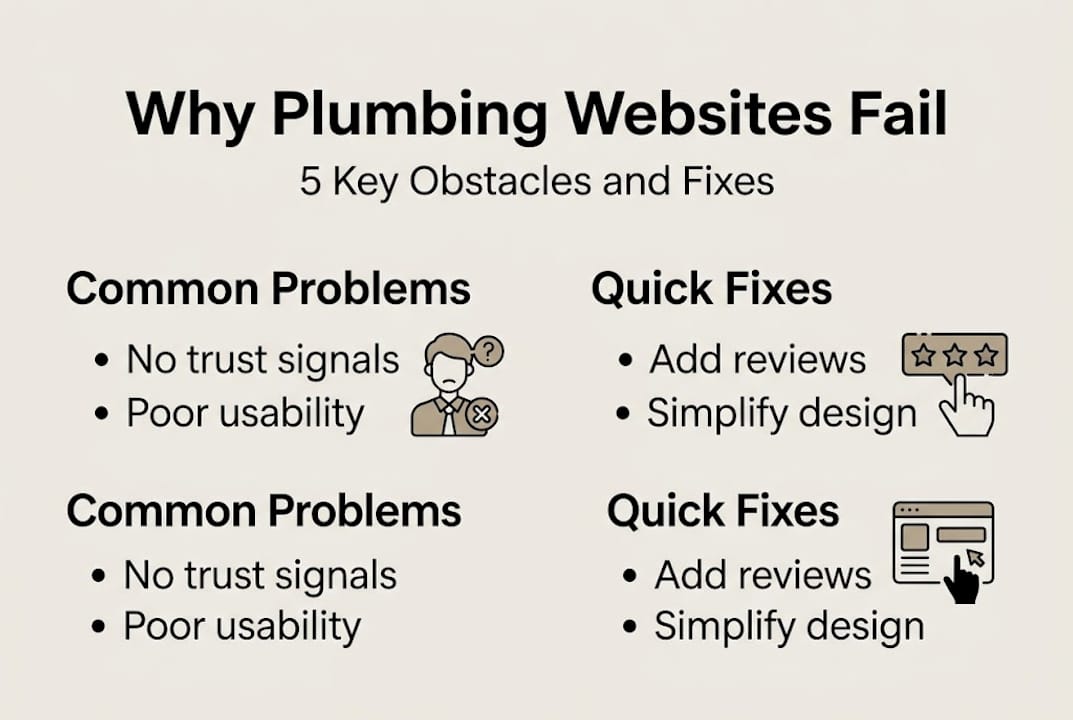
Ignoring local SEO: How visibility and leads are lost
Beyond reviews, your website must be found by locals when they need you. SEO makes or breaks this. You can have a perfect website that no one ever sees because it doesn’t rank in local search results. For plumbers, local SEO is not a nice-to-have. It is the core of your digital strategy.
Here’s what most plumbing sites are ignoring:
- Google Business Profile not claimed or not updated. This is the first thing customers see in local search. If it’s incomplete, you lose.
- No local keywords on service pages. Writing “drain cleaning” instead of “drain cleaning in Phoenix” misses the entire point of local intent.
- Missing local citations. Listings on Yelp, Angi, HomeAdvisor, and local directories reinforce your address and service area.
- No location pages. If you serve five cities, each one should have its own page on your website.
- Zero backlinks from local sources. Sponsoring a local event or getting mentioned by a neighborhood blog builds authority.
Backlinks are a key trust factor for plumbing websites in local search, and most owners never build a single one. Even three to five quality local links can push you ahead of competitors who are equally optimized on everything else.
Pro Tip: Post an update to your Google Business Profile at least once a week. Include a photo, mention a specific service area, and use natural language like a customer would search. This keeps your profile active and signals relevance to Google.
If you want a full picture of what drives results in 2026, the digital marketing guide for plumbers covers every layer of this strategy. For a focused look at visibility specifically, boosting your plumbing business visibility walks through the exact tactics that move the needle. And don’t overlook social media for plumbing companies as an additional signal that supports your local authority.
Why quick fixes rarely work: A strategic mindset for plumbing sites
Here’s the uncomfortable truth most marketing articles won’t tell you: the majority of plumbing websites don’t fail because of one bad decision. They fail because owners layer patches instead of building strategy. A new logo doesn’t fix a broken trust signal. Buying Google ads doesn’t fix a site that loads in seven seconds. Switching website templates doesn’t solve the absence of 50 real reviews.
We’ve seen plumbers spend thousands on ad campaigns pointing to a site with no license displayed, no reviews, and a contact form that nobody checks. The result is always the same: frustration and wasted budget. The real problem was never visibility. It was credibility.
The businesses that see lasting results understand that trust, usability, social proof, and local SEO are not separate projects. They are one interconnected system. When all four work together, leads compound. When even one is broken, the others underperform. That’s not a theory. That’s what the data consistently shows.
Before investing in ad strategies for plumbers, ask yourself if your site can actually convert the traffic. Ads amplify what’s already there. If what’s already there isn’t working, ads just amplify the problem faster.
How to turn your website into a plumbing business asset
Ready to fix the root causes and build a high-performing plumbing website? Everything covered in this guide points to the same conclusion: your website needs to work as a trust-building, lead-generating machine, not just a digital business card.

At ibrand.media, we help plumbing businesses like yours implement the exact strategies that make the difference: optimized site structure, local SEO setup, review system integration, and design that converts visitors into calls. Our website optimization approach for small businesses addresses every layer, and our local marketing strategies are built specifically for service businesses competing in tight geographic areas. Let’s turn your site into the asset it should already be.
Frequently asked questions
What are the top signs a plumbing website is failing?
Low or zero inquiries, no visible reviews, and your business not showing up in local Google results are the clearest warning signs. If visitors can’t find your credentials or contact info fast, they leave without calling.
How many customer reviews does a plumbing business need to build trust?
Aim for at least 50 reviews. Businesses with 50+ reviews generate 54% more revenue, making that number a concrete target rather than just a vanity milestone.
Why is local SEO vital for plumbers?
Local SEO puts your business in front of customers who are actively searching in your area right now. Visibility and backlinks build the local authority that determines whether you show up in the top three results or not at all.
What are quick fixes that won’t solve website failure?
Buying ads or switching website templates without addressing credibility gaps, slow load times, and missing reviews will not move the needle. You have to fix the foundation before scaling traffic.
How do I get more reviews for my plumbing website?
Ask every satisfied customer immediately after completing the job using a direct Google review link, then respond to all feedback promptly to show you’re engaged and accountable.
Recommended
- Effective Ways to Grow Your Plumbing Business Online Presence | Ibrandmedia
- Digital Marketing for Plumbers: 2025 Success Guide | Ibrandmedia
- Start a Plumbing Business Online: A Step-by-Step Guide | Ibrandmedia
- Why plumbers need digital marketing: 92% choose page 1 | Ibrandmedia
- Recognise 5 signs of blocked drains and resolve fast
Recent Comments