
TL;DR:
- Video marketing boosts patient engagement and trust through transparency and authentic content.
- Strict HIPAA compliance, including obtaining written consent and avoiding PHI, is essential.
- Building clear workflows and systems allows safe, effective, and confident use of dental videos for growth.
Dental practices are fighting for attention in one of the most crowded local markets online. Patients today research their dentist before they ever pick up the phone, and static images or text alone rarely close that trust gap. Video content changes the equation. It lets prospective patients see your team, hear real stories, and understand your approach before their first appointment. But dental video marketing is not like running a quick social ad for a coffee shop. HIPAA regulations, patient privacy, and consent requirements add a layer of complexity that can trip up even experienced marketers. This guide covers strategy, compliance, production, and promotion so you can use video confidently.
Table of Contents
- Why video marketing matters for dental practices
- Laying the groundwork: Strategy, compliance, and consent
- Step-by-step: Producing powerful, compliant video content
- Amplifying results: Publishing, promoting, and analyzing safely
- Our perspective: The power—and pitfalls—of dental video marketing
- Take your dental marketing to the next level
- Frequently asked questions
Key Takeaways
| Point | Details |
|---|---|
| Video builds trust | Authentic, informative videos foster greater patient confidence and set practices apart online. |
| Compliance is crucial | Written consent and privacy-conscious workflows are essential to avoid costly violations. |
| Plan before you film | Strategic preparation—including goal setting and checklists—reduces the risk of errors. |
| Publish safely | Use approved platforms, manage analytics carefully, and monitor for privacy risks. |
| Real results require balance | Combining impactful storytelling with strict compliance delivers the best marketing outcome. |
Why video marketing matters for dental practices
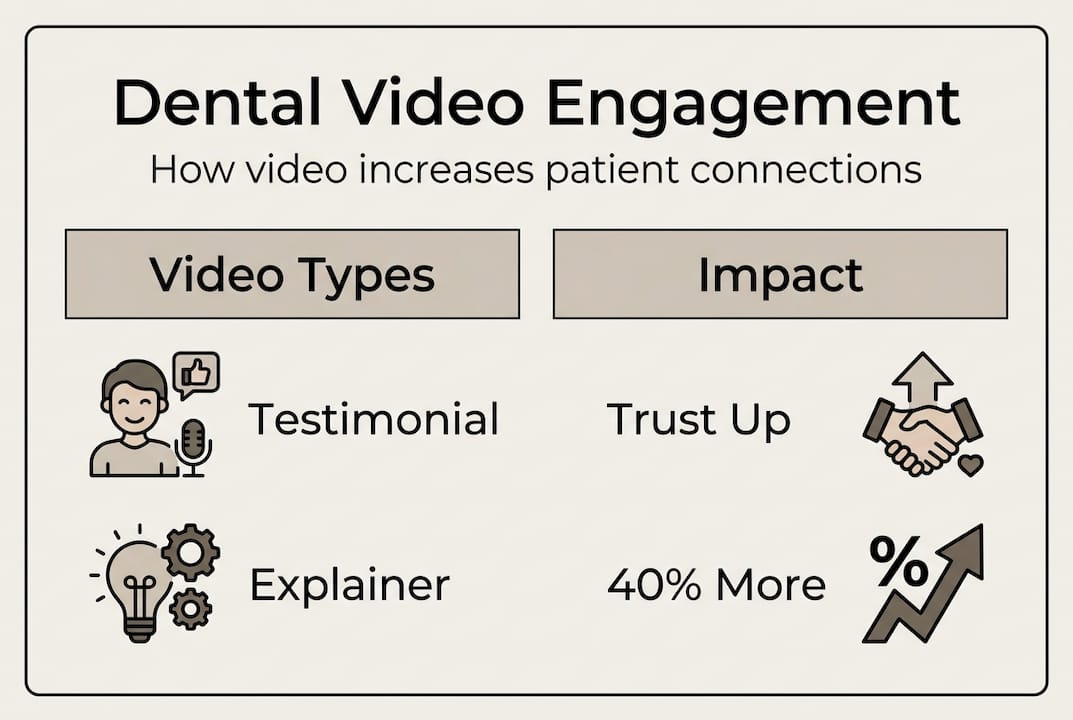
Video has moved from a “nice to have” to a core driver of patient acquisition. Practices using video content saw 40% more engagement on social platforms compared to those relying on static posts. That gap is widening as platforms like Instagram and YouTube continue to prioritize video in their algorithms. For dental practices, this means video is one of the fastest ways to grow organic reach without increasing your ad spend.
Patients are also more selective than ever. They want to see who will be working in their mouth before they commit. Video satisfies that need for transparency in a way that a headshot and a bio simply cannot. A 60-second office tour or a dentist explaining a procedure builds more trust than a paragraph of credentials.
Top-performing video types for dental practices:
- Patient testimonials: High trust, high conversion, but require careful consent management
- Educational explainers: Walk patients through procedures like whitening, implants, or Invisalign
- Q&A videos: Answer the questions patients are afraid to ask in the chair
- Before and after showcases: Powerful visual proof, but require explicit written consent
- Meet the team intros: Humanize your practice and reduce first-visit anxiety
What separates dental video from generic small business video is the compliance layer. HIPAA-compliant video marketing requires that you never reveal Protected Health Information (PHI) in any public content. PHI includes patient names, faces, treatment details, or anything that could identify someone as a patient at your practice.
| Video type | Patient trust impact | Compliance complexity | Recommended frequency |
|---|---|---|---|
| Testimonial | Very high | High | Monthly |
| Educational explainer | High | Low | Weekly |
| Office tour | Medium | Low | Quarterly |
| Before and after | Very high | Very high | Case by case |
| Meet the team | Medium | Low | Annually or on hire |
Practices that skip video entirely because compliance feels overwhelming are leaving real growth on the table. The key is building a workflow that makes compliance automatic, not an afterthought.
Laying the groundwork: Strategy, compliance, and consent
Having established the value and unique requirements for dental video, the next step is to build the right foundation. Before a camera turns on, you need a clear strategy and a compliance-first workflow in place.

Start by defining your goal. Are you trying to attract new patients in your zip code? Educate existing patients about a new service? Reduce no-shows by setting expectations? Each goal points to a different video type and distribution channel. Mixing goals without clarity leads to content that does neither well.
Pre-filming compliance checklist:
- Identify which team members will appear on camera and confirm their consent
- Map out areas of your office that are off-limits for filming (treatment rooms with visible patient records, reception screens)
- Prepare written media release forms for any patient participants
- Assign a compliance reviewer who watches the final cut before publishing
- Confirm your video host (YouTube, your website, etc.) is configured to protect patient data
Consent is the foundation of everything. You must obtain written patient consent before filming or sharing any media that includes a patient. A verbal agreement is not enough. Your media release form should specify exactly where the video will be published, how long it will be used, and what the patient has the right to revoke. Keep signed copies in a secure, HIPAA-compliant file.
For dental marketing compliance, the ADA (Americans with Disabilities Act) also applies to your digital content. Captions and transcripts are not optional extras; they are accessibility requirements for video published on your website.
“A compliant video program is not a limitation on creativity. It is the structure that lets you use your most powerful content types safely.”
Pro Tip: Avoid discussing or showing PHI in any public video. This means no patient names, no visible charts or screens, and no details about specific treatments a patient received, even if the patient is present and willing. The HIPAA privacy rules are clear: authorization must be documented before any PHI is shared in marketing content. When in doubt, cut it out.
For practices just starting out, pairing your video strategy with marketing for local dental growth helps you prioritize the channels where your target patients are already spending time.
Step-by-step: Producing powerful, compliant video content
Once preparation and consent are set, it is time to create your actual video content with care. A structured production process protects you legally and results in better, more watchable content.
Step-by-step production workflow:
- Write your script or storyboard first. Review every line for potential PHI exposure before filming begins. Ask: does this reveal anything about a specific patient’s identity or treatment?
- Collect signed consent forms from every person who will appear on camera, whether a patient or a team member.
- Choose your video style based on your goal. Patient testimonials carry the highest trust value but the highest compliance risk. Educational explainers are lower risk and easier to produce consistently.
- Set up your filming environment. Use consistent lighting (a ring light or softbox works well), a clean background that reflects your brand, and a lapel or directional microphone for clear audio.
- Film with privacy in mind. Keep cameras away from areas where PHI might be visible. Blur or remove any identifiable information captured accidentally.
- Edit with a compliance review pass. Before you finalize the video, have a second person watch specifically for identifying details, patient names, or visible records. This is not a creative review; it is a legal one.
- Get peer or legal sign-off before publishing any patient-facing content, especially testimonials or before-and-after videos.
You should avoid sharing PHI or patient-identifying details in video content at every stage of production, not just at the end. Building privacy into the script and storyboard phase catches problems before they become expensive editing fixes.
Pro Tip: Shoot educational explainer videos in batches. Film four or five in a single afternoon with your dentist in a clean, branded setting. This keeps production costs low and gives you a content library that covers common patient questions for months.
For more on avoiding video mistakes that could hurt your practice’s reputation or compliance record, review common pitfalls before you publish. And if you plan to run paid promotions alongside your organic video content, top digital ad tips for dental practices can help you allocate budget effectively.
Make sure your ADA-compliant dental content includes captions on every published video. Auto-generated captions from platforms like YouTube are a starting point, but always review and correct them manually.
Amplifying results: Publishing, promoting, and analyzing safely
With your compliant video content produced, the final phase is delivering it to the right audience without risking privacy. Where and how you publish matters as much as the content itself.
Best platforms for dental video distribution:
- Your website: Embed videos on service pages and your homepage for SEO lift and dwell time improvement
- YouTube: The second-largest search engine in the world; ideal for educational content and procedure explainers
- Instagram Reels and Stories: Short-form content for local reach and brand awareness
- Facebook: Effective for community engagement and reaching the 35 and older patient demographic
- Google Business Profile: Video uploads here directly influence local search visibility
Never auto-publish video content to patient portals or platforms where PHI might be exposed. If your website has a patient login area, make sure your video content lives on the public-facing side only, with no crossover.
Analytics are essential for improving your video strategy, but they come with compliance risks. You must prevent analytics tracking on PHI pages where applicable to stay compliant. This means configuring your analytics platform to exclude patient portal pages, appointment booking confirmations, and any page that handles sensitive health data.
For privacy-compliant publishing, use anonymized data wherever possible. Track video views, watch time, and click-through rates on public pages without connecting that data to individual patient records.
Common compliance failures in video publishing include:
- Responding publicly to patient reviews in a way that confirms a patient relationship
- Enabling third-party tracking pixels on pages that handle appointment or health data
- Sharing video content in private Facebook groups that include identifiable patient information
- Using retargeting audiences built from PHI-adjacent pages
Pairing your video content with strong SEO strategies for dental video ensures your content ranks for the procedure and location searches your prospective patients are already making. And if you want to re-engage patients who have already visited your site, remarketing for dentists is a powerful complement to your organic video strategy, as long as it is configured to exclude PHI pages from your audience lists.
Our perspective: The power—and pitfalls—of dental video marketing
Here is something we see consistently: the practices most afraid of compliance mistakes are often the ones producing no video at all. And ironically, that caution costs them more than a minor misstep would.
Avoiding video entirely because HIPAA feels complicated is not a safe strategy. It is a growth penalty. The practices generating real video engagement results are not the ones taking shortcuts on compliance. They are the ones who built a clear consent and review process once, then used it confidently to produce testimonials, before-and-afters, and educational content that their competitors are too nervous to touch.
The uncomfortable truth is that compliance and creativity are not opposites. A documented consent workflow actually frees you to use your most persuasive content types without hesitation. When you know the paperwork is solid, you can publish a powerful patient testimonial without second-guessing every frame. That confidence shows in the content, and patients notice it. The goal is not to play it safe by doing less. It is to build the systems that let you do more, better, and without risk.
Take your dental marketing to the next level
Video is one of the highest-leverage tools available to dental practices right now, but it works best as part of a connected digital strategy. Compliance, creative quality, and consistent promotion all have to move together.
At ibrand.media, we help dental practices build digital marketing systems that are both effective and compliant. Whether you need to optimize your dental website for better video performance and local search, or want to understand the full value of social media management benefits for your practice, we have the guides and the expertise to support you. Our approach is practical, personalized, and built around the real constraints dental practices face. Reach out to start building a video and digital marketing strategy that actually brings new patients through your door.
Frequently asked questions
What types of video work best for dental practices?
Testimonial, educational explainers, and office introduction videos typically drive the highest patient engagement for dental practices. Patients respond best to testimonial and educational video content in dental marketing.
How can dentists ensure their marketing videos are HIPAA compliant?
Obtain written patient consent before filming, avoid sharing PHI, and do not use tracking or analytics on PHI-related pages. Consent and privacy workflows are essential for any patient-identifying video content.
What are some common compliance mistakes in dental video marketing?
Typical errors include posting videos with patient names or faces without consent and enabling analytics on patient-sensitive web pages. You should avoid sharing treatment details and prevent analytics on PHI pages to stay compliant.
Can dental videos be used in paid ads and social promotion?
Yes, as long as you have secured the proper consents and removed any PHI, videos can be effective in paid ads and on social media platforms.
How should practices handle negative or public comments on video content?
Never confirm a patient relationship publicly; manage replies generically and take private conversations offline to avoid HIPAA violations. Public replies to reviews can inadvertently confirm treatment, so always keep responses generic per HIPAA guidance.
Recommended
- Dental Marketing in 2026: 40% More Engagement with Videos | Ibrandmedia
- How blogging grows your dental practice: 67% more leads – Ibrandmedia
- Master Dental Practice Online Marketing for Local Growth | Ibrandmedia
- SEO strategies for dentists to attract patients in 2026 | Ibrandmedia
- How Social Engagement Transforms Your Customer Base | Rule27 Design
Recent Comments