
TL;DR:
- User experience directly impacts customer loyalty, bookings, and reputation for small businesses.
- Common UX mistakes include slow load times, confusing navigation, and poor mobile optimization.
- Simple, budget-friendly improvements can significantly enhance user confidence and online growth.
User experience is one of the most underestimated growth levers available to small businesses and local service providers. Most owners assume UX is a luxury reserved for tech giants with massive design budgets. The truth is the opposite. Small, targeted improvements to how customers interact with your website or service flow can directly increase bookings, reduce drop-offs, and build the kind of loyalty that no ad spend can buy. This article breaks down what UX really means for your business, shows you the data behind its impact, and gives you practical steps you can start using right now.
Table of Contents
- What is user experience? The business basics
- How strong user experience drives real business results
- Common user experience mistakes small businesses make
- Simple steps to start improving your user experience today
- What most experts miss: User experience is your hidden sales engine
- Level up your user experience with expert guidance
- Frequently asked questions
Key Takeaways
| Point | Details |
|---|---|
| UX fuels business growth | Small changes in user experience can drive more conversions and loyalty for local businesses. |
| Better UX boosts efficiency | Strong UX helps resolve issues faster and accelerates business projects, according to research. |
| Avoid common mistakes | Addressing website pitfalls like slow load times or poor navigation can quickly improve results. |
| Start with small steps | Even modest UX upgrades, like streamlining contact forms or improving site speed, deliver measurable benefits. |
What is user experience? The business basics
User experience, often shortened to UX, describes every interaction a customer has with your business online. It is not just about how your website looks. It covers how easy it is to navigate, how quickly pages load, whether your contact form works on a phone, and whether a visitor can find what they need without frustration.
Think of UX as the digital version of walking into a well-organized store. Everything is labeled clearly, the staff is easy to find, and checkout is fast. Now imagine the opposite: cluttered shelves, no signs, and a broken cash register. That second experience drives customers out the door. The same happens online.
The core components of UX include:
- Usability: Can visitors complete tasks easily, like booking an appointment or finding your hours?
- Accessibility: Can people with disabilities or older devices still use your site?
- Aesthetics: Does the visual design build trust and match your brand?
- Interaction: Do buttons, forms, and menus respond correctly and quickly?
- Value: Does the content answer the questions your customers actually have?
For local businesses, understanding user experience in these terms is a game changer. A plumber, a hair salon, or a neighborhood bakery all compete online now, whether they want to or not. Customers Google you before they call. They judge your credibility in seconds.
Research confirms this is not just theory. Superior CX/UX maturity in SMBs leads to significantly better operational outcomes compared to businesses that ignore it. That means more sales, fewer complaints, and stronger customer relationships. UX is not a design project. It is a business strategy.
How strong user experience drives real business results
With a firm understanding of UX basics, let’s look at concrete data and stories about how UX impacts real business performance.
The numbers are hard to ignore. Businesses that prioritize customer experience and UX see measurable gains across every part of their operation. According to research on SMB performance, companies with strong UX resolve issues 48% faster and advance projects 2.3 times more often during disruptions and crises. That kind of operational edge is enormous for a small team.

| UX maturity level | Issue resolution speed | Customer satisfaction | Project advancement |
|---|---|---|---|
| Low maturity | Slow, reactive | Below average | Stalled frequently |
| Medium maturity | Moderate | Average | Occasional progress |
| High maturity | 48% faster | Significantly higher | 2.3x more advanced |
Think about what that means in practice. A local plumbing company redesigns its website booking flow. Instead of a confusing phone-only system, customers can now book online in under two minutes, get a confirmation text, and leave a review with one click after the job. No-shows drop. Five-star reviews climb. The owner spends less time on the phone and more time on jobs.
“When customers can get what they need quickly and easily, they don’t just come back. They tell their friends.”
This is the compounding effect of good UX. Happy customers become loyal customers. Loyal customers become advocates. For a small business operating on a tight budget, word-of-mouth fueled by great experience is worth more than most paid campaigns.
Exploring the user experience factors that drive these results helps you prioritize where to invest your time and money first. Not every improvement costs money. Many of the highest-impact changes are free or low-cost.
Common user experience mistakes small businesses make
While strong UX pays dividends, many businesses fall into avoidable traps. Here’s what to watch for and how to address each issue.
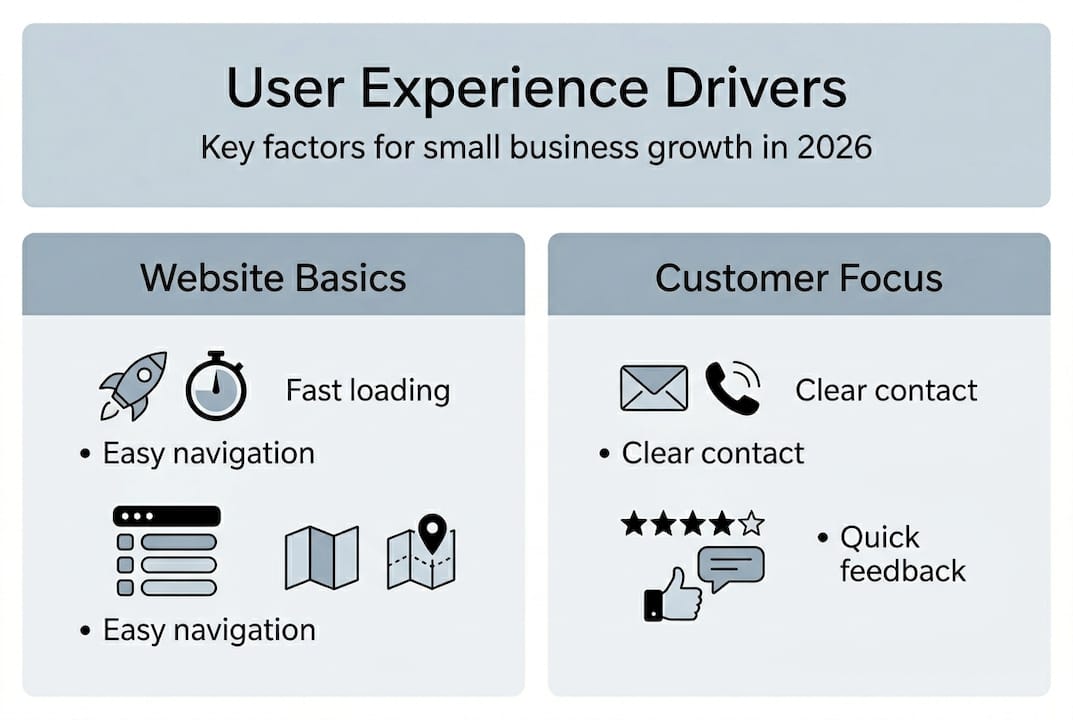
Small business websites often share the same frustrating problems. These are not minor annoyances. They actively cost you customers. Here are the most common UX mistakes and how to fix them:
- Slow page load times. If your site takes more than three seconds to load, most visitors leave. Compress your images and use a reliable hosting provider.
- Confusing navigation. If visitors cannot find your services or contact page within two clicks, they give up. Simplify your menu to five items or fewer.
- Not mobile-friendly. Over 60% of local searches happen on phones. A site that breaks on mobile sends customers straight to a competitor.
- Missing or buried contact information. Your phone number, address, and hours should be visible without scrolling on every page.
- Broken forms or links. Test every form and link on your site monthly. A broken booking form is a silent revenue killer.
- Generic or unclear content. Visitors need to know in seconds what you do, who you serve, and why they should choose you.
Customer frustration from these issues is immediate and often silent. Most unhappy visitors do not complain. They just leave and never return. Superior CX/UX maturity in SMBs consistently separates businesses that grow from those that stagnate.
The good news is that fixing website UX issues does not require a full redesign. Start by asking three recent customers to try to book or contact you through your website while you watch. Their confusion will reveal your biggest problems faster than any analytics tool.
Pro Tip: Set up a free Google Form and email it to customers after a purchase or service. Ask two questions: “Was it easy to find what you needed on our website?” and “What would you improve?” You will get honest, actionable feedback within days.
Simple steps to start improving your user experience today
Knowing what to avoid is crucial, but the next step is taking action. Here are simple, budget-friendly ways to start improving your UX right now.
You do not need a big budget or a web developer on staff to make meaningful UX improvements. The key is to prioritize changes that have the highest impact on your customers’ ability to find, trust, and hire you.
| Quick wins (do this week) | Advanced upgrades (plan for next quarter) |
|---|---|
| Compress all images on your site | Redesign navigation based on user testing |
| Add your phone number to the header | Build a dedicated FAQ or help page |
| Test your contact form on mobile | Implement live chat or a chatbot |
| Update your hours and address | Add customer testimonials with photos |
| Fix any broken links | Create a streamlined online booking flow |
Here is a basic checklist to guide your first improvements:
- Run your site through Google PageSpeed Insights and fix the top three issues
- Open your website on your phone and try to complete a booking or inquiry
- Ask someone unfamiliar with your business to find your pricing in under 30 seconds
- Check that every page has a clear call to action, like “Call now” or “Book online”
- Read your homepage out loud. If it sounds robotic or vague, rewrite it in plain language
Gathering feedback does not have to be complicated. Tools like Hotjar offer free heatmaps that show where visitors click and where they stop scrolling. That data tells you exactly where your UX breaks down.
Building a strong online brand presence starts with making sure your website works for real people, not just search engines. And UX and brand building go hand in hand. When customers trust your site, they trust your business.
Superior CX/UX maturity in SMBs is not a one-time achievement. It is a habit. Review your site every quarter and treat customer feedback as your most valuable data source.
Pro Tip: Focus your first round of improvements on the single page that gets the most traffic. For most local businesses, that is the homepage or the contact page. Fixing one high-traffic page well beats making small tweaks across ten pages.
What most experts miss: User experience is your hidden sales engine
Most business owners hear “user experience” and picture a designer rearranging buttons. That framing sells UX short in a significant way.
UX is really about one thing: making customers feel capable and confident when they interact with your business. When someone lands on your site and immediately understands what you offer, how to reach you, and why you are the right choice, you have already made a sale before a single conversation happens.
For small businesses, this matters even more than for large brands. You do not have the name recognition of a national chain. Every touchpoint has to work harder. The good news is that building brand awareness through great UX is often faster and cheaper than running ads. A well-designed booking flow or a clear service page can generate leads around the clock without ongoing spend.
The compounding effect is real. Each UX improvement builds on the last. Better load times improve SEO. Better SEO brings more visitors. A clearer homepage converts more of those visitors. More conversions mean more reviews. More reviews mean more trust. This cycle does not require a big budget. It requires consistency and a genuine focus on what your customers need.
UX is the local differentiator most businesses ignore. That makes it your biggest opportunity.
Level up your user experience with expert guidance
Ready to put these insights into action? The steps in this article give you a strong starting point, but getting the details right matters.
At ibrand.media, we work with small businesses and local service providers to build websites and digital strategies that actually convert visitors into customers. Whether you want to optimize your website for search, explore web design for small business options that fit your budget, or dig into website design tips you can apply right now, we have the resources to help you move forward with confidence. Your customers deserve a great experience. Let’s build it together.
Frequently asked questions
How does user experience affect customer retention for small businesses?
Good UX removes friction, making it easier for customers to return and recommend your business. Research shows that SMBs with strong UX maturity consistently outperform competitors on satisfaction and loyalty metrics.
What are some fast, low-cost UX improvements any small business can implement?
Speed up your site using free tools like Google PageSpeed Insights, simplify your navigation to five items or fewer, and make sure your contact information is visible on every page. These three changes alone can meaningfully reduce bounce rates and increase inquiries, as SMBs with better UX consistently see stronger outcomes.
How can I measure improvements in user experience on my website?
Track bounce rate, average session duration, and conversion rate in Google Analytics before and after any changes, and combine that data with direct customer feedback for a complete picture.
Does user experience really matter if most of my customers come from word of mouth?
Absolutely. Referrals almost always check your website before reaching out, and a confusing or slow site can undermine the trust that word-of-mouth built before a single conversation happens.
Are there tools that help small businesses improve user experience?
Yes. Free and low-cost options like Google PageSpeed Insights, Hotjar for heatmaps, and Google Forms for customer feedback give you actionable data without requiring a large investment.
Recent Comments