
TL;DR:
- Effective web design for contractors goes beyond aesthetics, shaping trust, credibility, and search engine ranking within seconds. Faster load times, clear messaging, authentic visuals, and local SEO support are crucial for converting visitors into leads. Regular site performance monitoring and strategic design choices are essential to maximize marketing investment and sustain steady lead flow.
Most contractors think their website just needs to look good. That’s the wrong starting point. The role of web design in contractor marketing goes well beyond aesthetics. It determines whether a visitor trusts you in three seconds, whether Google ranks your service pages, and whether someone searching for a roofer in your city ever finds you at all. Your website isn’t a digital business card. It’s your most active salesperson, working around the clock. This article breaks down the specific design decisions that bring in leads, build credibility, and make your marketing dollars work harder.
Table of Contents
- Key takeaways
- The role of web design in contractor marketing explained
- How site speed and performance shape your lead volume
- Design strategies that turn website visitors into clients
- Connecting web design to local SEO and steady lead flow
- My honest take on where most contractors get this wrong
- How Ibrand helps contractors turn design into real leads
- FAQ
Key takeaways
| Point | Details |
|---|---|
| Design drives leads, not just looks | Your website structure directly shapes how many visitors become paying clients. |
| Speed is a ranking and revenue factor | A half-second improvement in load time can raise conversions by up to 10%. |
| Mobile-first is non-negotiable | Over half of mobile users leave a page that takes more than three seconds to load. |
| SEO and design work together | Site architecture and local service pages determine whether high-intent searches find you. |
| Conversion metrics beat traffic numbers | Tracking leads per visitor reveals far more than total page views alone. |
The role of web design in contractor marketing explained
Web design is the scaffolding your entire online marketing strategy is built on. Without it being structurally sound, every other effort, whether paid ads, SEO, or social media, delivers weaker results. For contractors, this is especially true because most clients start their search online and make fast judgments about who to call.

Website visitors form opinions in under three seconds. If your site is cluttered, hard to read, or unclear about what you do and where you work, that visitor is gone. The opportunity to earn that lead disappears with them. This isn’t a design preference issue. It’s a revenue issue.
The importance of web design for contractors centers on three functions: clarity, trust, and discoverability. Clarity means a visitor immediately understands your services, service area, and how to contact you. Trust means your site signals professionalism and competence through its visual quality and structure. Discoverability means Google can read and rank your pages for the searches your potential clients are running.
Here’s what clear, marketing-focused design actually addresses:
- Messaging hierarchy: Your most important value proposition should be visible without scrolling.
- Intuitive navigation: Menus that mirror how homeowners think, not how contractors categorize their work.
- Consistent branding: Matching colors, fonts, and tone across every page reduce cognitive friction and reinforce professionalism.
- Contact accessibility: Phone numbers and contact forms placed where visitors naturally look, not buried in a footer.
Well-structured contractor websites anticipate what visitors need before they even know they need it. That design philosophy is what separates a site that generates calls from one that just sits online collecting dust.
Pro Tip: Add your service area, primary service type, and a phone number in your site header. This single change addresses three of the top four things a homeowner wants to confirm before they read anything else on your page.
How site speed and performance shape your lead volume
This is where how web design affects contractor marketing becomes measurable, not theoretical. Site performance has a direct line to both search rankings and the number of visitors who actually contact you.
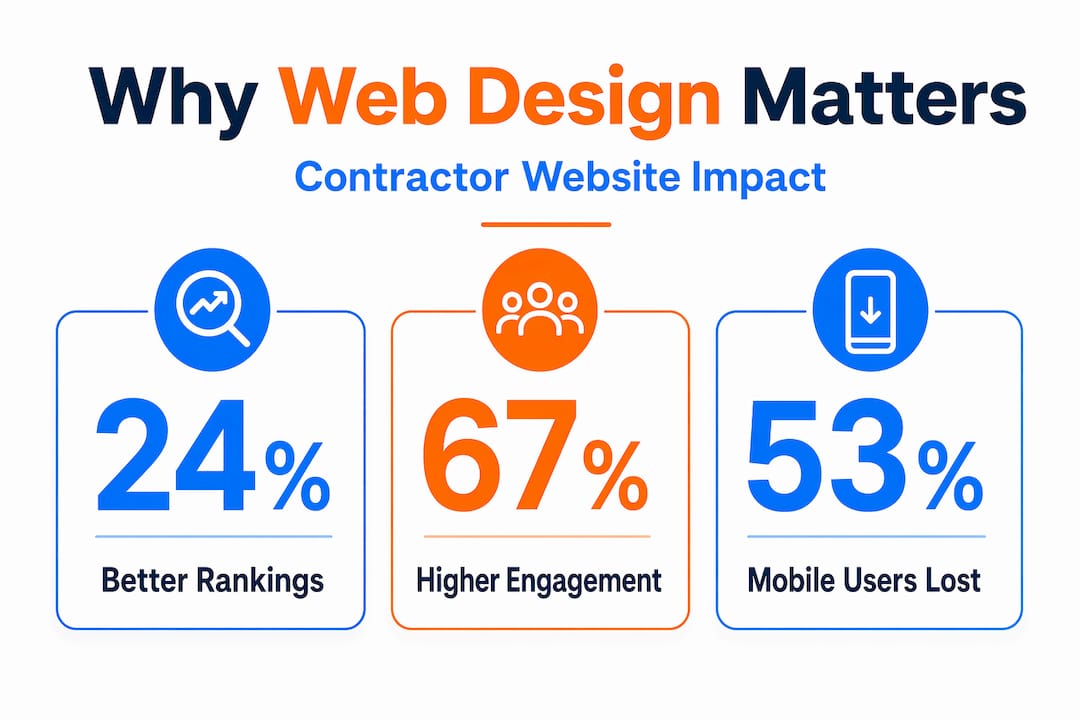
53% of mobile users abandon contractor websites that take more than three seconds to load. That’s not a bounce rate problem. That’s a lead destruction problem. Every slow-loading page is shedding potential clients before they even see your work.
Google made this even more concrete by introducing Core Web Vitals, a set of measurable performance signals that factor directly into search rankings. The key metrics contractors need to understand are Largest Contentful Paint (how fast your main content loads), Cumulative Layout Shift (whether your page jumps around as it loads), and Interaction to Next Paint, which replaced First Input Delay and measures how quickly your site responds to clicks or taps.
| Core Web Vital | What it measures | Target threshold | Impact if missed |
|---|---|---|---|
| Largest Contentful Paint (LCP) | Main content load speed | Under 2.5 seconds | Lower rankings, higher abandonment |
| Cumulative Layout Shift (CLS) | Visual stability during loading | Under 0.1 | Frustrating UX, lost clicks |
| Interaction to Next Paint (INP) | Responsiveness to user actions | Under 200ms | Reduced engagement, form drop-offs |
Contractor websites meeting all Core Web Vitals see roughly 24% better rankings and 67% higher engagement compared to those that don’t. Improving load time by just 0.5 seconds can push conversions up by as much as 10%. For a contractor doing $500,000 in annual revenue, that’s a meaningful number from a single technical fix.
Mobile-first design is the practical answer to this performance challenge. Since most “near me” searches happen on phones, your site needs to load fast, display cleanly, and make it effortless to tap a call button on a small screen. You can learn more about the technical side of this through Ibrand’s guide on boosting site speed for better conversions.
Pro Tip: Test your site on a three-year-old Android device using a 4G connection, not just your office WiFi. Real-user monitoring on older hardware reveals performance gaps that ideal conditions hide, and those gaps are exactly what your average client experiences.
Design strategies that turn website visitors into clients
Traffic without conversion is just noise. This is the core principle behind effective web design strategies for contractors. Getting someone to your site is only half the job. The design has to close the gap between “just browsing” and “I’m calling this company.”
Here are the design strategies that make the biggest difference:
- Prominent calls to action: Your “Get a Free Quote” or “Call Now” button needs to be above the fold on every page, not just the homepage. Use a color that contrasts with your background so it stands out without needing to read anything.
- Authentic project photos: Stock images of construction work look like stock images. Photos of your actual team, trucks, and completed projects build credibility that no graphic can replicate. Authentic visuals of real teams and projects are among the highest-converting elements on contractor sites.
- Social proof near the top: Reviews and testimonials don’t belong only on a dedicated page. A star rating average or a short client quote near your headline does more work than one hidden in a footer.
- Service pages written for buyer intent: A homeowner searching “bathroom tile installation cost Denver” has different intent than one searching “home remodeling ideas.” Your service pages need to speak directly to people ready to hire, not people still in the research phase.
- Avoiding design clutter: Too many fonts, too many colors, too many pop-ups, all of these increase cognitive load and send visitors away. Clean layouts with clear visual hierarchy communicate competence before a word is read.
One frequently overlooked web design tip for contractor businesses is the contact form itself. A form with ten fields asking for project details, budget, timeline, and photos creates friction. Start with three fields: name, phone number, service type. You can gather the rest during the follow-up call.
For a deeper look at what’s holding your site back, Ibrand’s breakdown of common contractor marketing mistakes is worth reading alongside this.
Connecting web design to local SEO and steady lead flow
You cannot separate the impact of website design on contractor sales from local SEO. They operate as a single system. Your design choices determine whether Google can properly read, index, and rank your pages for the searches that actually matter to your business.
Local SEO requires site structure and content aligned with contractor service searches. That means individual pages for individual services, each optimized for how real people search. “Roof repair in [city]” and “roof replacement cost [city]” are different searches with different intent. They deserve different pages, not one generic “roofing services” page.
The table below compares design approaches that either support or undermine your local search visibility:
| Design choice | Supports local SEO | Undermines local SEO |
|---|---|---|
| URL structure | /services/roof-repair-phoenix | /page?id=42 |
| Page titles | “Roof Repair in Phoenix, AZ” | “Our Services” |
| NAP consistency | Name, address, phone on every page | Contact info only in images |
| Schema markup | LocalBusiness schema implemented | No structured data |
| Google Business Profile link | Linked and consistent with site | Mismatched or missing |
Google Business Profile is a major factor in local search visibility, and your website amplifies or weakens it depending on how they’re connected. Your site address, business name, and phone number need to match exactly between your website and your Google profile. Discrepancies in any of these signals confuse Google and reduce your ranking reliability.
Organic lead generation from local SEO tactics carries lower acquisition costs than paid advertising over time. Web design that supports your SEO is one of the highest-return investments a contractor can make. Ibrand’s guide on SEO basics for contractors goes deeper on the technical setup that ties these two together.
My honest take on where most contractors get this wrong
I’ve worked with enough contractors to see the same pattern repeat itself. They spend money driving traffic to a website that isn’t built to convert, then conclude that digital marketing doesn’t work for their type of business. The website was always the problem.
The biggest mistake I see is focusing on visitor counts instead of conversion rates. Tracking call and form initiations on mobile is what reveals whether your website is actually doing its job. A site with 500 monthly visitors converting at 4% generates 20 leads. A site with 1,000 visitors converting at 1% generates 10. More traffic with a broken conversion funnel costs you more money for fewer results.
My honest advice: before you spend another dollar on ads or SEO, audit your site for the basics. Does it load in under three seconds on a phone? Is there a clear call to action above the fold? Are your service pages written for someone ready to hire? Most contractor sites fail at least two of these three.
Web design isn’t a one-time project either. Ongoing Core Web Vitals monitoring prevents performance regressions that silently kill your rankings and conversions over time. Treat your website like you’d treat your equipment. Maintenance isn’t optional if you want it to keep performing.
— TONY
How Ibrand helps contractors turn design into real leads

Ibrand works specifically with small and medium-sized businesses, including contractors and home service companies, to build websites that function as marketing tools, not just online brochures. If your site isn’t generating the leads your work deserves, the issue is usually structural, not cosmetic. Ibrand’s team combines search optimization for small businesses with conversion-focused design to make sure your site ranks for the right searches and converts visitors into phone calls. Whether you need a full site rebuild or targeted improvements to performance and local SEO, Ibrand offers a personalized plan built around your service area and revenue goals. Start with a custom assessment and see exactly where your site is losing leads.
FAQ
What is the role of web design in contractor marketing?
Web design shapes how visitors perceive your credibility, how easily they can contact you, and how well Google ranks your service pages. It functions as the foundation of every other marketing effort you make online.
How does website speed affect contractor lead generation?
53% of mobile users leave a site that takes more than three seconds to load. Faster sites rank higher in search results and convert significantly more visitors into leads.
What are the most effective web design strategies for contractors?
Prominent calls to action, authentic project photos, dedicated local service pages, and clean navigation are the most impactful design choices for generating contractor leads. Each addresses a specific stage of the visitor’s decision process.
How does web design support local SEO for contractors?
Site architecture, URL structure, and consistent contact information across your site and Google Business Profile all signal local relevance to search engines. Poor design choices in these areas directly reduce your visibility for high-intent local searches.
How do I know if my contractor website is actually working?
Divide your monthly leads by your monthly visitors to get your conversion rate. Lead math and attribution tracking through call tracking and form analytics tells you far more than total traffic numbers alone.
Recent Comments