
TL;DR:
- Programmatic advertising simplifies digital ad buying through real-time data-driven auctions and automated systems. It involves key platforms like DSPs, SSPs, and ad exchanges that work together to target audiences efficiently. Despite its complexity, starting with private deals and clear goals helps businesses achieve effective campaigns.
Programmatic advertising gets a reputation for complexity it doesn’t deserve. If you’ve ever tried to explain programmatic advertising to a colleague and watched their eyes glaze over, you’re not alone. The terminology is dense, the ecosystem has a lot of moving parts, and most explanations assume you already know half the answer. This article cuts through that. You’ll get a clear breakdown of how the technology works, what the key components do, how real-time auctions run, and what you need to know to actually run effective campaigns. No unnecessary jargon, no hand-waving.
Table of Contents
- Key takeaways
- Explain programmatic advertising: the core ecosystem
- How real-time bidding works
- Programmatic deal types compared
- Targeting, optimization, and campaign management
- Benefits, challenges, and what’s coming next
- My honest take on programmatic for first-timers
- Ready to run smarter ad campaigns with Ibrand?
- FAQ
Key takeaways
| Point | Details |
|---|---|
| Automation replaces manual buying | Programmatic ad buying eliminates manual negotiations by using algorithms to purchase impressions in real time. |
| RTB auctions happen in milliseconds | Every ad impression you see online is the result of an auction that completes in under 100 milliseconds. |
| Deal types affect control and scale | Open auctions offer scale; private marketplaces and programmatic guaranteed offer brand safety and pricing certainty. |
| First-party data is now the priority | With cookies fading out, your own customer data is the most reliable targeting asset you have. |
| Platform choice shapes campaign outcomes | DSPs optimized for specific channels consistently outperform generalist platforms for their respective use cases. |
Explain programmatic advertising: the core ecosystem
Before you can understand how campaigns run, you need to know who the players are. Programmatic advertising is not a single platform. It’s an ecosystem of interconnected technologies, each with a specific job.
The demand-side platform (DSP) is the tool advertisers use. Think of it as your campaign control center. You set your objectives, budgets, audience rules, creative assets, bid strategies, and frequency caps inside a DSP. The platform then evaluates each impression for bidding decisions and optimization automatically across multiple ad exchanges.
The supply-side platform (SSP) is the publisher’s equivalent. When a website has ad space to sell, it connects to an SSP to make that inventory available to buyers. The SSP works to maximize the price publishers receive for each impression.
Ad exchanges sit in the middle. They are the actual marketplaces where DSPs and SSPs meet. When a user loads a page, the publisher’s SSP sends available impressions to the exchange, which then opens the floor to DSPs competing to win that placement.
Data layers add precision to everything. Three types matter most:
- First-party data: Your own CRM records, website visitor behavior, and email lists. This is the most accurate and increasingly the most valuable.
- Third-party data: Purchased audience segments from data providers. Useful for scale, but declining in reliability as privacy regulations tighten.
- Contextual data: Signals about the content on the page where the ad will appear. A user reading a review of project management software is probably in the market for it.
Pro Tip: If you’re just starting with programmatic ad buying, connect your CRM data to your DSP before launching. First-party audience segments consistently outperform cold third-party lists because they’re built on people who already know your brand.
These components interact in real time every time a page loads. Understanding how these platforms interact is the foundation for understanding everything else.
How real-time bidding works
Real-time bidding, or RTB, is the auction mechanism that powers most programmatic transactions. The speed alone is remarkable. The entire auction completes in under 100 milliseconds, faster than a human blink.
Here is the step-by-step flow of what happens every time a user loads a web page:
- Bid request packaging. The publisher’s SSP detects that a page has loaded and an ad slot is available. It packages a bid request containing data about the user (where permitted), the page content, ad size, and placement details.
- Broadcast to exchanges. The SSP sends this request to one or more ad exchanges simultaneously.
- DSP evaluation. Each connected DSP receives the bid request and instantly checks it against campaign rules: Does this user match the target audience? Is the placement on the approved list? Does the budget allow another bid right now?
- Bid submission in CPM. DSPs that want the impression submit a bid expressed as a cost per thousand impressions (CPM). Higher bids reflect higher audience relevance or placement quality.
- Auction and winner selection. The exchange runs the auction and selects a winner. In a first-price auction, the winner pays exactly what they bid. In a second-price auction (now less common), they pay one cent above the second-highest bid.
- Ad serving. The winning creative loads in the ad slot, all before the page fully renders for the user.
Viewability is a direct economic signal in these auctions. The MRC standard requires 50% of pixels in view for at least one second, but placements that exceed this standard command meaningfully higher CPM bids because advertisers assign them greater value.
The data signals feeding into bid decisions include behavioral history (what sites the user has visited), location data, device type, time of day, and contextual relevance of the page. A DSP with strong first-party data integration will consistently make smarter bid decisions than one relying on third-party signals alone.
Programmatic deal types compared

Not all programmatic inventory is bought through open auctions. As the market matures, deal structures have multiplied to give advertisers and publishers more control. Choosing the right model should align with your campaign goals and the channel you’re using.
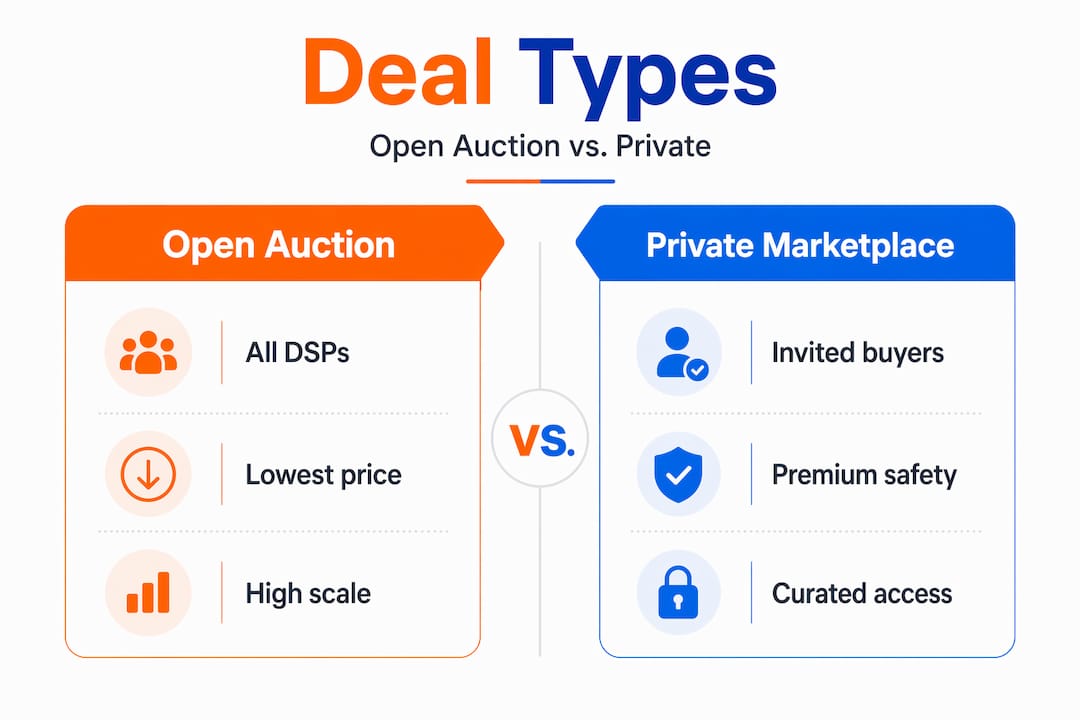
| Deal type | Access | Pricing | Brand safety | Best use case |
|---|---|---|---|---|
| Open auction | All DSPs | Dynamic CPM | Lower | Scale, prospecting, testing |
| Private marketplace (PMP) | Invited buyers only | Dynamic CPM with floor | Higher | Quality reach with curated publishers |
| Preferred deal | Single buyer, first look | Fixed CPM | High | Premium inventory without full reservation |
| Programmatic guaranteed | Single buyer, reserved | Fixed CPM | Highest | Brand awareness, seasonal campaigns |
Open auctions offer the most scale and the lowest barrier to entry. They are where most programmatic beginners start, and that’s fine. The downside is limited control over where your ad appears, which can create brand safety risks.
Private marketplaces (PMPs) are invitation-only auctions between a publisher and a curated set of buyers. You get access to better inventory with floor prices already set, which reduces the risk of your ad appearing next to low-quality content.
Preferred deals give a single advertiser first access to impression opportunities at a fixed price before they enter any auction. The publisher isn’t obligated to fill, and the advertiser isn’t obligated to buy, but it creates a reliable supply of premium placements.
Programmatic guaranteed reserves a specific inventory volume at a fixed CPM. It removes auction uncertainty entirely. This is the right structure for high-stakes brand awareness campaigns, particularly on connected TV (CTV) or premium news environments.
Targeting, optimization, and campaign management
This is where programmatic advertising shifts from a passive system into a performance tool. Your DSP gives you control over who sees your ads, how often, and in what context.
Audience targeting options available inside most DSPs include:
- Behavioral targeting: Reaching users based on websites they’ve visited, content they’ve consumed, or products they’ve browsed.
- Demographic targeting: Age, gender, household income, and similar attributes sourced from data providers or your first-party records.
- Contextual targeting: Matching your ad to the content of the page rather than a user profile. This works well now and will continue working after cookies are fully deprecated.
- Geographic targeting: Country, region, city, or even radius-based targeting around a physical location.
With cookie deprecation accelerating, first-party data is now the priority for any advertiser serious about sustainable targeting. Building your own data asset through email capture, CRM sync, and on-site behavioral tracking is not optional anymore. It’s the foundation.
Frequency caps and budget pacing are two of the most underestimated controls in a DSP. Setting frequency caps of 3 to 5 impressions per user per day for awareness campaigns prevents ad fatigue without sacrificing learning. Pacing delivery evenly across the first two weeks of a campaign gives the algorithm enough data to optimize without burning through the budget in the first 48 hours.
Pro Tip: When tracking campaign performance, watch view-through conversions alongside click-through rates in the early weeks. Programmatic often influences users who don’t click but do convert later, and ignoring this understates the channel’s real contribution.
Monitoring real-time campaign performance lets you make bid adjustments, pause underperforming placements, and shift budget to what’s working. The best programmatic campaigns are managed actively, not set and forgotten.
Benefits, challenges, and what’s coming next
Programmatic now accounts for roughly 90% of all digital display ad spending globally in 2026, with a market projected at USD 106.4 billion growing at a 24.6% CAGR. That adoption didn’t happen by accident.
The core benefits are scale, precision, and efficiency. You can reach millions of users across thousands of publishers from a single DSP interface. You can target with accuracy that manual media buying simply cannot match. And automation reduces manual tasks around negotiation, insertion orders, and reporting that used to eat up significant time.
The real challenges are worth naming honestly:
- Ad fraud: Bots generating fake impressions remain a persistent drain. Using fraud verification tools and blocking known bad inventory sources is non-negotiable.
- Brand safety: Open auctions can place your ad next to content that damages your brand. Inclusion and exclusion lists inside your DSP are your first line of defense.
- Data privacy: GDPR, CCPA, and evolving cookie policies are reshaping targeting options. Staying compliant while maintaining performance requires ongoing attention.
- Auction complexity: First-price auction dominance means overbidding is a real risk without proper bid shading strategies.
Looking ahead, server-side bidding is reducing latency and improving publisher yield. Contextual targeting is making a serious comeback as a cookieless solution. And platform specialization is growing: DSPs built specifically for CTV, mobile, or digital out-of-home (DOOH) consistently outperform generalist platforms in their respective environments.
Programmatic fits naturally into an omnichannel digital marketing strategy. It doesn’t replace search or social. It fills the awareness and consideration gaps that those channels can’t reach at scale.
My honest take on programmatic for first-timers
I’ve seen a lot of marketing teams hold off on programmatic because they’re convinced it requires a data science degree and a six-figure budget. That’s simply not true anymore.
What actually holds most businesses back isn’t complexity. It’s vague campaign goals and poor data hygiene. I’ve watched campaigns fail not because the platform was wrong, but because no one had defined what success looked like or bothered to connect a clean audience list. The technology is only as good as the instructions you give it.
In my experience, the fastest way to learn programmatic is to start with a private marketplace deal on a category-relevant publisher. You get controlled inventory, decent brand safety, and clear data to learn from, without the chaos of a fully open auction. Once you’ve seen how your audience responds, you expand.
I’d also push back on the instinct to automate everything from day one. Frequency caps, pacing rules, and placement exclusions deserve manual attention in the first few weeks. The algorithm needs time to learn, and if you let it optimize too freely without guardrails, you’ll burn budget on patterns that look good in-platform but don’t convert in the real world.
The businesses I’ve seen get the most out of programmatic advertising are the ones that treat it as a channel that rewards attention, not just automation. Start small, measure honestly, and build from data you actually trust.
— TONY
Ready to run smarter ad campaigns with Ibrand?
Understanding how programmatic advertising works is the first step. Actually running campaigns that perform is where the real work happens, and that’s where Ibrand helps.
Ibrand works with small and medium-sized businesses to build advertising strategies that go beyond clicks. From campaign setup and audience targeting to real-time performance tracking, the team handles the technical side so you can focus on results. If you’re ready to put your ad budget to work more efficiently, explore Ibrand’s digital advertising services or start by strengthening your organic foundation with the small business SEO guide to make your full digital strategy work together.
FAQ
What is programmatic advertising in simple terms?
Programmatic advertising is the automated buying and selling of digital ad impressions using software, data, and real-time auctions. Instead of negotiating placements manually, algorithms make buying decisions in milliseconds based on audience data and campaign rules.
How does programmatic advertising work step by step?
When a user loads a web page, the publisher’s system sends a bid request to ad exchanges, DSPs evaluate the impression against campaign criteria, competing bids are submitted in CPM, and the winning ad is served, all in under 100 milliseconds.
What is the difference between open auctions and private marketplaces?
Open auctions allow any DSP to bid on available inventory, offering scale but lower brand safety. Private marketplaces are invitation-only auctions between publishers and selected buyers, offering better inventory quality and greater control over where ads appear.
Why is first-party data important in programmatic advertising?
First-party data, your own CRM records, website visitors, and email subscribers, is the most accurate and privacy-compliant targeting asset available. With third-party cookies being deprecated, campaigns built on first-party data deliver more reliable targeting and better long-term performance.
How much does programmatic advertising cost?
Programmatic ad costs are expressed in CPM and vary widely by channel, deal type, and audience quality. Open auction CPMs can start under $2, while premium programmatic guaranteed deals on CTV or top-tier publishers can run $25 or higher, depending on targeting precision and inventory scarcity.
Recent Comments