
TL;DR:
- Small businesses must optimize existing website content to improve search rankings, engagement, and AI visibility. Technical performance, structured data, and regular updates are essential for staying competitive in AI-driven search environments by 2026. Focusing on content structure, speed, and existing pages yields faster, lower-cost results than constantly creating new pages.
Most small business owners understand that their website needs content. Fewer understand why optimize website content goes far beyond just adding keywords and hitting publish. Your website content directly controls how search engines rank you, how long visitors stay, and whether they buy. In 2026, with AI-driven search engines reshaping online visibility, the businesses winning traffic and conversions are those treating content as a living asset, not a one-time task. This guide breaks down exactly what you gain from optimizing, and what you risk by ignoring it.
Table of Contents
- Key takeaways
- Why optimize website content: the core reasons
- How technical performance affects your content
- Content optimization strategies for AI-driven search in 2026
- Optimizing existing content versus creating new pages
- My take on why optimization beats creation every time
- How Ibrand helps you optimize your website content
- FAQ
Key takeaways
| Point | Details |
|---|---|
| Optimization beats volume | Updating existing pages is faster and safer than constantly creating new competing content. |
| Speed and content are linked | Technical performance directly affects whether your optimized content gets seen or buried. |
| AI search changes the rules | Structured data and fact-dense content now determine visibility in AI-powered search results. |
| Recency drives rankings | Brands that update content monthly achieve significantly higher AI search coverage than those that do not. |
| Auditing first saves money | Identifying underperforming pages before publishing new ones delivers faster ROI for small businesses. |
Why optimize website content: the core reasons
The most common mistake small businesses make is treating their website like a brochure. You put it up, walk away, and hope people find it. Here is why that approach quietly kills your online growth.
Search rankings respond to structure and speed. Google does not just reward keyword relevance. It rewards pages that load fast, answer questions clearly, and are organized so that both humans and machines can extract information quickly. Optimized content directly improves these signals, which moves your pages up in search results.
Engagement and bounce rates are content problems. If a visitor lands on your page and leaves in 10 seconds, search engines register that as a failure. Optimized content matches what the reader came to find, uses clear headings, and delivers the answer without making them scroll through paragraphs of filler. That keeps them on the page and pushes them toward a next step.
Here is what the data says about the importance of website optimization:
- Improving mobile load times by just 0.1 seconds can increase retail conversion rates by 8.4% and average order values by 9.2%.
- Brands optimizing all four drivers (fact density, source authority, structured data, and recency) achieve 78% AI search coverage compared to just 9% for those that do not.
- Two-thirds of content gaps identified in audits are topics a website already covers, meaning optimization is more efficient than creating new pages from scratch.
Beyond rankings, there is a real competitive advantage in optimizing for AI search. Businesses that adapt their content to be extractable and structured get cited by AI tools like ChatGPT and Google’s AI Overviews. Those that do not, disappear from a growing share of searches. The benefits of optimizing content compound over time, while the cost of ignoring it grows by the month.
Pro Tip: Before publishing any new page, run a quick search to see if you already have a page covering that topic. Optimizing the existing page almost always outperforms splitting your authority between two similar ones.
How technical performance affects your content
You can write the best content on the web, but if your page takes five seconds to load, most of your audience will never read it. Technical performance and content quality are inseparable. The impact of website content on SEO only materializes when your site can actually deliver that content fast and cleanly.

Google’s March 2026 core update reinforced this. Sites passing Core Web Vitals thresholds (Largest Contentful Paint under 2.5 seconds, Interaction to Next Paint under 200 milliseconds, and Cumulative Layout Shift under 0.1) show measurably better rankings, especially on mobile. The problem is that only about 42% of mobile sites currently meet those thresholds.
| Technical factor | What it affects | Quick fix |
|---|---|---|
| Largest Contentful Paint (LCP) | How fast your main content loads | Compress images, use a CDN |
| Cumulative Layout Shift (CLS) | Page stability as it loads | Set image dimensions explicitly |
| Time to First Byte (TTFB) | Server response speed | Upgrade hosting or use caching |
| Render-blocking scripts | Delays before content appears | Defer or remove unnecessary JavaScript |
Hosting location matters more than most small business owners realize. If your server is in Europe and most of your customers are in Texas, every page request travels farther and arrives slower. A content delivery network routes users to the nearest server and cuts that gap significantly.
Pro Tip: Use Google’s free PageSpeed Insights tool to generate a full technical report on your site. Focus first on the three Core Web Vitals metrics. Fixing those alone can shift your rankings within weeks.
Unstable layouts are another silent traffic killer. When content jumps around as a page loads because images or ads pop in, users lose trust instantly. You can check your website performance metrics and identify these issues before they cost you rankings and customers.
Content optimization strategies for AI-driven search in 2026
Search in 2026 is not purely about matching keywords to queries anymore. AI search engines pull directly from web pages that are structured for extraction. Think of it this way: AI tools are scanning your content looking for specific facts they can quote. If your content is written as vague prose without clear answers, it gets skipped.
Modern optimization is about information design and semantic structure, not keyword stuffing. That shift changes how you should write every page on your site.
Here is what actually works for AI visibility in 2026:
- Use comparison tables. Adding structured comparison tables to your pages can increase AI search coverage by 34% within 14 days. Tables give AI something concrete to extract and cite.
- Add FAQ schema. FAQ schema markup on your pages lifts AI coverage by 28% within three weeks. It tells search engines exactly where your answers are.
- Write declarative, citable sentences. “Our service reduces setup time by 40%” is citable. “We offer great solutions for your needs” is not. Every page should have at least five fact-dense statements.
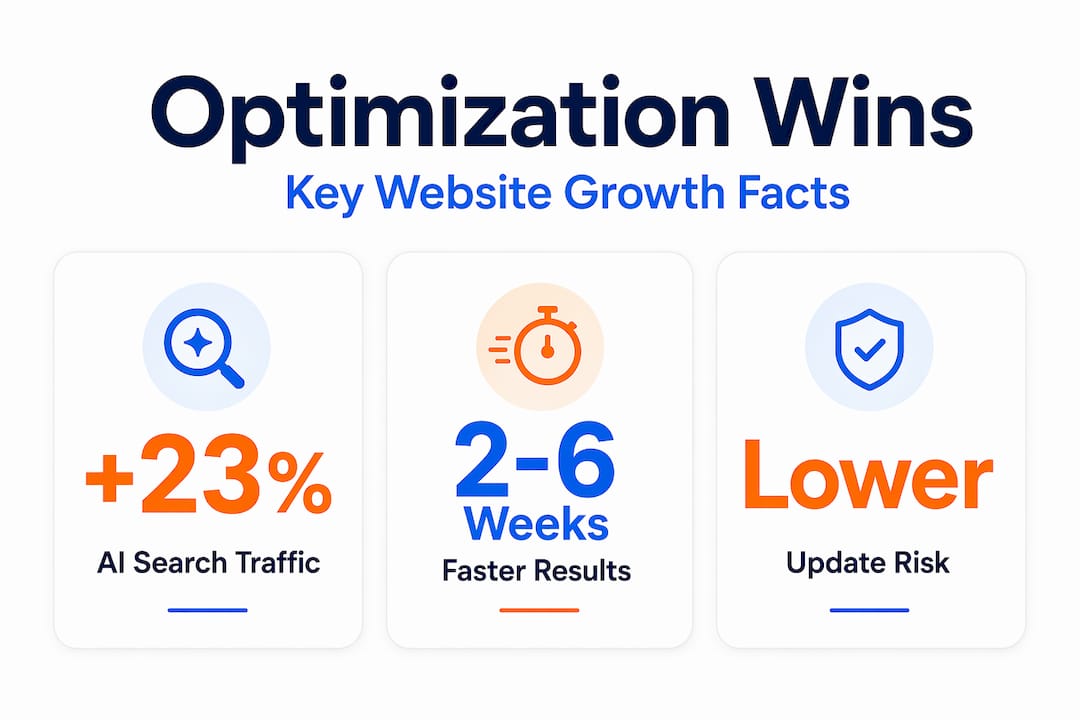
- Update content monthly. Brands updating content monthly achieve approximately 23% higher AI coverage than those with stale pages. Content sitting untouched for two or more years drops to just 18% coverage.
- Include third-party citations. Linking to credible external sources signals authority. AI tools favor content that itself references trustworthy data rather than making unsupported claims.
Content should be treated as a product optimized for answer-ready, extractable assets, not just a ranking vehicle. That mental shift is the difference between small businesses that grow through search in 2026 and those that stall.
Pro Tip: Add a short “Key facts” section near the top of each important page. Use bullet points with specific numbers and outcomes. This format is ideal for AI extraction and also keeps human readers engaged right from the start.
Optimizing existing content versus creating new pages
Most small business websites have more usable content than their owners realize. The problem is that existing pages are underperforming because they have never been optimized, not because they are irrelevant.
Here is a practical workflow for prioritizing your optimization efforts:
- Pull your Google Search Console data. Find pages ranking between positions 8 and 20. These are close to page one but not there yet. Small improvements to these pages often yield the biggest ranking jumps.
- Check for intent mismatch. Search your target keyword and compare your page to what Google actually returns. If your page is a product page but Google is showing guides and tutorials, you have an intent mismatch that no amount of keyword optimization will fix.
- Diagnose content cannibalization. If two of your pages target the same keyword, they compete against each other. Merge the weaker one into the stronger one or redirect it.
- Add internal links from strong pages. Internal linking from high-authority pages to underperforming pages is one of the most underused tactics in content optimization. It passes ranking strength directly to the pages that need it.
- Refresh and republish. Update statistics, add new sections, improve the structure, and update the publish date. This signals recency to both Google and AI engines.
The comparison below shows why this approach makes more financial sense than constantly publishing new content:
| Approach | Time to results | Risk level | Cost |
|---|---|---|---|
| Optimizing existing pages | 2 to 6 weeks | Low | Lower |
| Publishing new content | 3 to 9 months | Medium | Higher |
| Ignoring both | Declining rankings | High | Highest long-term |
Content optimization is a recurring process, not a one-time project. Algorithms shift, competitors update their pages, and audience questions evolve. Businesses that build a monthly review into their workflow stay ahead. Those that optimize once and move on find their rankings quietly eroding six months later.
My take on why optimization beats creation every time
I have worked with dozens of small businesses over the years, and the pattern is almost always the same. They spend money publishing new blog posts, landing pages, and service descriptions, then wonder why traffic stays flat. When we actually dig into their analytics, the answer is rarely that they need more content. It is that what they already have is not doing its job.
In my experience, the websites that see the fastest turnaround are the ones willing to stop creating for a few months and focus entirely on what they have. One local service business I worked with had 40 pages on their site. Twenty of them were targeting overlapping keywords, none had internal links pointing to them, and their load time was over four seconds on mobile. We merged duplicate pages, added internal links, compressed images, and updated outdated statistics. Rankings moved within three weeks without a single new page.
The other thing I would push back on is the idea that AI search optimization is too technical for small business owners. It is not. Writing clearly, using specific numbers, adding tables, and keeping your pages fresh are habits any business can build. The businesses that wait until AI search is “figured out” will spend years playing catch-up with competitors who started adapting now.
I tell every small business owner I work with the same thing: your website is not a billboard. It is a sales tool that either performs or costs you money. Conversion rate tactics and content optimization are not separate strategies. They are the same strategy. Treat optimization as a core business process and you will see it pay off in traffic, leads, and revenue consistently.
— TONY
How Ibrand helps you optimize your website content
If you have read this far and recognize your own website in some of these problems, you are not alone. Most small business owners have strong instincts about their business but limited time to audit, update, and structure their web content around 2026 search requirements.

Ibrand works specifically with small and medium-sized businesses to close that gap. From technical performance audits to content restructuring and local SEO, every plan is built around your actual site, not a generic template. If you are new to this, start with Ibrand’s guide to optimizing websites for small businesses for a step-by-step walkthrough of what to fix first. For businesses ready to move faster, the local SEO growth strategies resource shows how to turn optimized content into measurable sales growth. Pricing starts low and scales with your needs. No long contracts, no guesswork.
FAQ
Why does optimizing website content matter for small businesses?
Optimized content improves search rankings, keeps visitors on your site longer, and converts more of them into paying customers. Without optimization, even well-written content often goes unseen.
How often should I update my website content?
Monthly updates deliver the best results. Brands that refresh content monthly achieve approximately 23% higher AI search coverage compared to those that leave pages untouched.
What is the difference between new content and optimized content?
New content creates additional pages, while optimized content improves what already exists. Updating existing pages is typically faster, lower risk, and more cost-effective than building new pages from scratch.
How do Core Web Vitals affect my content’s visibility?
Core Web Vitals measure load speed, page stability, and interactivity. Sites that meet Google’s thresholds rank higher, especially on mobile, meaning your content reaches more people when your technical performance is clean.
Do I need structured data to rank in AI search results?
Yes. AI search engines prioritize content they can extract and cite directly. Structured formats like FAQ schema and comparison tables can lift your AI search coverage by 28% to 34% within just a few weeks.
Recommended
- Optimizing Websites for Search: A Guide for Small Businesses 2025 | Ibrandmedia
- How to Optimize Website Speed: Faster Sites for Small Businesses 2025 | Ibrandmedia
- Best Content for Home Service Websites That Converts – Ibrandmedia
- Improving Website Rankings: Step-by-Step Guide for Small Businesses | Ibrandmedia
Recent Comments