
Every second matters for any American business online, yet studies show that websites losing even one second in load time can miss out on up to 25% of potential revenue. Fast websites keep users engaged and improve trust, while slow sites turn visitors away before the page even appears. Understanding website speed and the metrics behind it is essential for any American small business owner aiming to attract customers, outshine competitors, and boost digital success.
Table of Contents
- Defining Website Speed And Core Metrics
- How Slow Sites Affect User Experience
- Website Speed And Its Role In Seo Rankings
- Conversion Rates Impacted By Website Performance
- Common Causes Of Slow Website Loading
- Best Practices For Improving Site Speed
Key Takeaways
| Point | Details |
|---|---|
| Importance of Website Speed | Website speed critically influences user engagement and business success, with sites loading in under 3 seconds retaining a majority of visitors. |
| Impact on SEO | Fast-loading websites rank better in search engine results, making speed optimization a key component of digital marketing strategies. |
| User Experience | Slow websites lead to increased bounce rates and decreased trust, emphasizing the need for effective loading animations to maintain user interest. |
| Optimization Strategies | Implementing image compression, minimizing HTTP requests, and utilizing content delivery networks can significantly improve loading times for small businesses. |
Defining Website Speed and Core Metrics
Website speed represents the rapid loading performance of web pages, measuring how quickly content becomes accessible and interactive for users. Web performance fundamentally tracks the efficiency and responsiveness of digital experiences, directly impacting user engagement and business outcomes.
Small businesses must understand core speed metrics that determine website performance. These critical measurements include page load time, time to first byte (TTFB), and time to interactive (TTI). Each metric reveals different aspects of website responsiveness. Page load time tracks total seconds needed to display full page content. TTFB measures how quickly a server responds to initial browser requests. Time to interactive indicates when a page becomes fully functional and ready for user interaction.
The impact of these metrics extends far beyond technical specifications. Websites loading in under 3 seconds typically retain 87% of visitors, while slower sites experience exponential drop-off rates. Google and other search engines actively penalize slow websites by reducing search rankings, making speed a crucial factor for online visibility. Optimizing website speed becomes not just a technical requirement but a strategic business necessity for small enterprises seeking digital success.
Key website speed metrics can be broken down into specific performance indicators:
- Page Load Time: Total seconds to fully render page content
- Time to First Byte: Server response speed
- First Contentful Paint: When first content appears
- Time to Interactive: Point of full page functionality
By understanding and improving these metrics, small businesses can create faster, more engaging online experiences that convert visitors into customers.
How Slow Sites Affect User Experience
Website performance directly influences user perception, behavior, and ultimately, business success. Slow loading times create immediate psychological barriers that prevent potential customers from engaging with online content. Research suggests that users form initial impressions within milliseconds, and website speed plays a critical role in those split-second decisions about whether to stay or leave.
Interestingly, online content loading animations can strategically moderate user frustration during wait times. Stanford research indicates that carefully designed loading experiences can actually enhance user engagement, challenging traditional assumptions about site speed. This nuanced approach reveals that pure speed is not the only factor in user satisfaction.
The tangible consequences of slow websites are stark. Websites that take more than 3 seconds to load can experience bounce rates exceeding 53%. Mobile users are even less patient, with 73% reporting they will abandon a site that loads too slowly. Search engines like Google penalize slow websites by reducing their search rankings, creating a compounding effect that diminishes online visibility and potential customer acquisition.
Key user experience impacts of slow websites include:
- Decreased Trust: Slow sites appear unprofessional
- Reduced Engagement: Users quickly lose interest
- Lower Conversion Rates: Potential customers abandon purchases
- Negative Brand Perception: Speed reflects perceived business quality
User experience factors demonstrate that technical performance is inseparable from customer satisfaction. Small businesses must recognize that website speed is not just a technical metric, but a fundamental aspect of digital customer service.
Website Speed and Its Role in SEO Rankings
Search engine optimization hinges critically on website speed, transforming technical performance into a decisive ranking factor for small businesses. Google and other major search engines prioritize fast-loading websites, recognizing that speed directly correlates with user experience and engagement. Websites that load quickly receive preferential treatment in search result placements, making site performance a strategic competitive advantage.

The algorithmic implications of website speed are profound. Search engines like Google utilize Core Web Vitals as key metrics for ranking websites, with loading performance being a primary consideration. Websites that demonstrate rapid content rendering, minimal interaction delays, and stable visual loading receive higher search rankings. Optimizing websites for search becomes not just a technical requirement but a critical marketing strategy for visibility and customer acquisition.
Small businesses face significant challenges in maintaining competitive website speeds. Mobile optimization presents an additional complexity, as search engines apply stricter speed standards for mobile platforms. Websites that fail to meet these performance benchmarks can experience dramatic drops in search visibility. Slow-loading sites may see rankings plummet by multiple pages, effectively burying them in search results and reducing organic traffic potential.
Key SEO speed ranking factors include:
- Page Load Time: Total seconds to render content
- Mobile Responsiveness: Performance across device types
- First Contentful Paint: Speed of initial content display
- Time to Interactive: Functional readiness of web pages
Website optimization tips highlight that consistent technical maintenance and strategic performance improvements can dramatically enhance search engine standings. Small businesses must view website speed not as a technical detail, but as a fundamental component of their digital marketing strategy.
Conversion Rates Impacted by Website Performance
Website performance directly influences conversion rates, serving as a critical determinant of online business success. Every second of loading delay can dramatically reduce the likelihood of potential customers completing purchases or engaging with business content. Research demonstrates that websites loading within 2 seconds experience conversion rates up to 3 times higher than slower counterparts.
Website speed and accessibility research reveals that slow-loading websites create significant psychological barriers for users. Potential customers experiencing prolonged wait times develop immediate negative perceptions about a business’s professionalism and reliability. These split-second judgments translate directly into lost sales opportunities and diminished trust.
The financial implications of website performance are substantial. E-commerce platforms can lose up to 25% of potential revenue for every additional second of loading time. Mobile users are particularly unforgiving, with 53% abandoning sites that take longer than 3 seconds to load. Small businesses must recognize that website speed is not just a technical metric, but a fundamental component of their digital sales strategy.
Key conversion rate impacts include:
- Immediate User Abandonment: Slow sites drive potential customers away
- Reduced Purchase Confidence: Performance signals business credibility
- Decreased Engagement: Users lose interest quickly
- Lower Return Visitor Rates: Negative experiences prevent repeat interactions
Increase website conversions strategies consistently emphasize the critical role of website performance. Small businesses must view their digital platform as a dynamic sales environment where every millisecond of loading time directly influences potential revenue.
Common Causes of Slow Website Loading
Website performance challenges stem from multiple complex technical factors that can significantly impede loading speeds. Unoptimized websites often suffer from a combination of issues that collectively create frustrating user experiences. Understanding these performance bottlenecks is crucial for small businesses seeking to maintain competitive digital platforms.
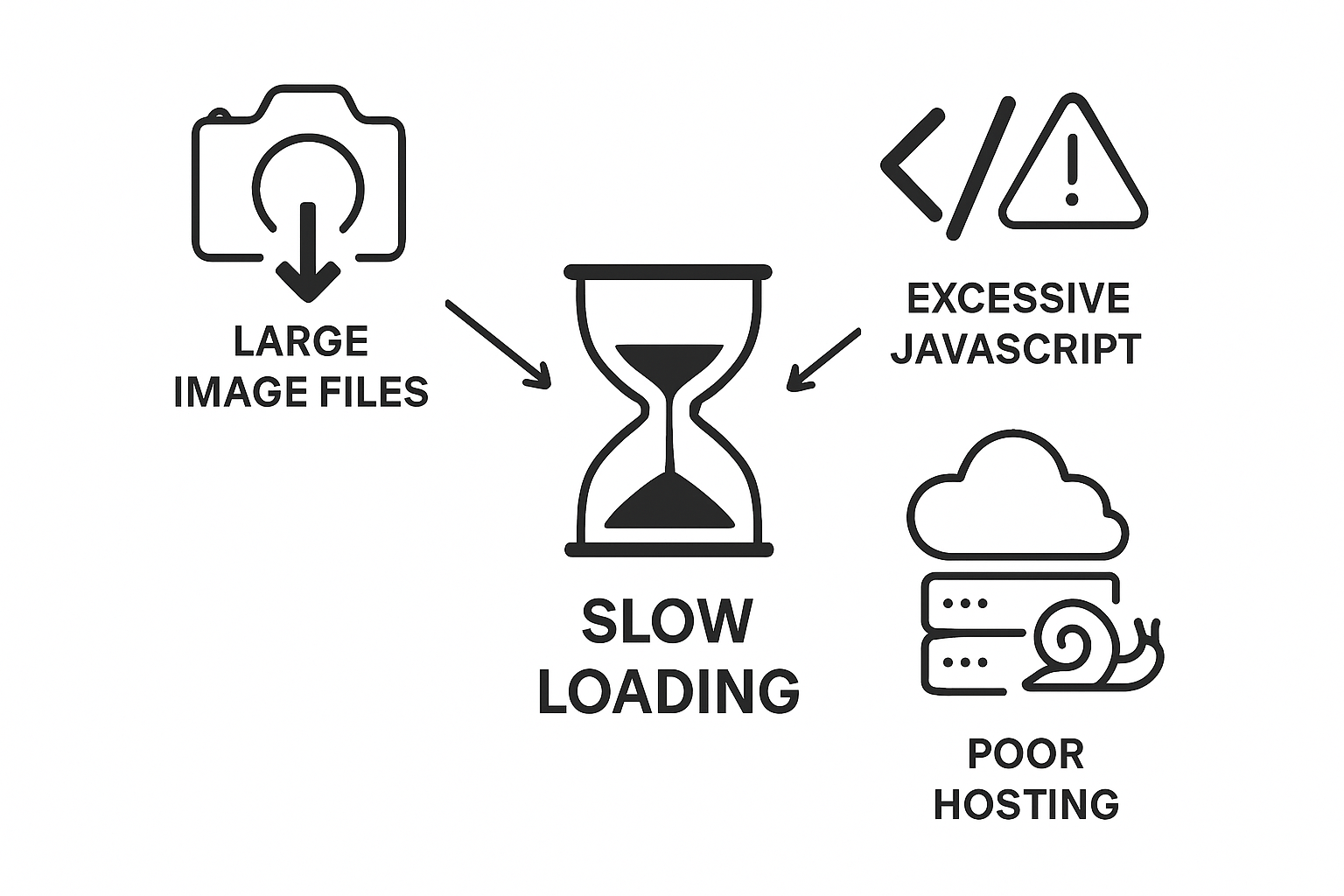
JavaScript complexity in modern web pages represents a primary performance challenge for small business websites. Research reveals that excessive scripting and dynamic content can dramatically slow page rendering, particularly on mobile devices. Uncontrolled JavaScript implementations create cascading performance problems, increasing load times and reducing overall site responsiveness. Small business websites frequently struggle with bloated code that prevents efficient content delivery.
Additional critical performance impediments include unoptimized image files, excessive third-party scripts, and inefficient hosting configurations. Websites loaded with high-resolution images, multiple tracking pixels, and complex plugin architectures experience substantial speed degradation. Mobile users are especially vulnerable to these performance issues, with slow-loading pages often abandoned within seconds of initial access.
Key causes of slow website loading include:
- Unoptimized Image Files: Large, uncompressed graphics
- Excessive JavaScript: Complex, unminified scripts
- Multiple Third-Party Scripts: Tracking and marketing tools
- Poor Hosting Infrastructure: Inadequate server resources
- Inefficient Caching: Limited local storage mechanisms
Why website speed matters fundamentally connects to these technical considerations. Small businesses must proactively address these performance challenges to maintain competitive digital experiences and retain potential customers.
Best Practices for Improving Site Speed
Enhancing website performance requires a strategic approach that addresses multiple technical dimensions. Small businesses must adopt comprehensive optimization techniques that systematically reduce loading times and improve overall digital user experience. The goal is not just speed, but creating seamless, responsive web interactions that retain and convert potential customers.
Website speed and accessibility research highlights critical optimization strategies for small business websites. Minimizing HTTP requests by combining CSS and JavaScript files can dramatically reduce page load times. Content delivery networks (CDNs) provide another powerful mechanism for accelerating website performance, distributing website content across multiple global servers to ensure faster access for users regardless of geographic location.
Technical optimization encompasses multiple interconnected strategies. Image compression represents a fundamental performance improvement technique, reducing file sizes without sacrificing visual quality. Server-side optimizations like enabling browser caching, implementing efficient database queries, and utilizing lightweight themes can substantially decrease response times. Mobile responsiveness becomes increasingly critical, with optimization techniques specifically targeting smaller screen performance and limited bandwidth environments.
Key website speed improvement practices include:
- Image Optimization: Compress and resize graphics
- Code Minification: Remove unnecessary characters
- Browser Caching: Store temporary website data
- Content Delivery Networks: Distribute website resources
- Responsive Design: Streamline mobile experiences
Website design best practices emphasize that speed optimization is an ongoing process requiring continuous monitoring and incremental improvements. Small businesses must view website performance as a dynamic challenge requiring regular technical maintenance and strategic refinement.
Unlock Faster Growth with Expert Website Speed Solutions
Struggling with slow website speeds that drive away potential customers and hurt your search rankings It is time to take action and transform your online presence. This article highlights the critical role of website speed metrics like page load time and time to interactive in improving user experience and increasing conversions. At Ibrandmedia, we understand these challenges and offer tailored digital marketing strategies designed specifically for small businesses who want faster, more engaging websites.

Discover proven techniques to optimize your site speed through expert SEO, mobile-friendly web design, and real-time performance tracking. Ready to boost your search rankings and convert visitors into loyal customers? Visit our Uncategorized Category to explore insightful resources and start your journey. Don’t let slow loading times hold your business back Take control today with a personalized plan from Ibrandmedia and see the difference fast performance can make.
Frequently Asked Questions
How does website speed affect my business’s online visibility?
Website speed is a crucial factor in search engine optimization (SEO). Search engines like Google prioritize fast-loading websites, which means a slow site may be penalized with lower rankings, reducing your online visibility and potential traffic.
What are the key metrics to measure website speed?
Key metrics include page load time, time to first byte (TTFB), first contentful paint, and time to interactive. These metrics help assess how quickly your website becomes accessible and functional for users.
What impact does slow website loading have on user experience?
Slow website loading negatively affects user experience by increasing bounce rates. Research shows that over 53% of users abandon sites that take more than 3 seconds to load, leading to decreased trust and engagement.
What are some best practices for improving website speed?
Best practices include optimizing images, minifying code, utilizing browser caching, implementing content delivery networks (CDNs), and ensuring responsive design for mobile users. These strategies collectively enhance loading times and user experience.
Recommended
- How to Optimize Website Speed: Faster Sites for Small Businesses 2025 | Ibrandmedia
- How to Optimize Website Speed: Faster Sites for Small Businesses 2025 | Ibrandmedia
- Complete Guide to Why Website Speed Matters | Ibrandmedia
- 8 Essential Website Optimization Tips for Small Businesses | Ibrandmedia
- 7 Powerful Small Business Advertising Ideas for Growth – Ads Daddy. Advertise on All Plattforms.
Recent Comments