
TL;DR:
- Dental branding builds trust and recognition that drives patient decisions before treatment begins. Consistent messaging and visual identity increase case acceptance, patient loyalty, and profit margins while reducing marketing costs. Starting with a clear brand strategy enhances growth and attracts top staff, making branding a vital investment for dental practices.
Dental branding is the strategic foundation that shapes how patients perceive, trust, and choose your practice before they ever sit in your chair. Why branding matters for dentists goes far beyond a logo or color scheme. Practices with defined brand positioning achieve 34% higher case acceptance and 28% faster new patient acquisition. That gap is not a marketing accident. It is the direct result of building a coherent identity that patients recognize, trust, and refer to others. This guide breaks down exactly how branding drives growth, what it requires, and how to build one that works.
Why does branding matter for dentists?
Branding is the promise your practice makes to every patient before they book an appointment. It is not just visual design. It is the sum of your messaging, your website, your staff’s tone, and the experience patients have from the first Google search to the final checkout. Branding is the foundational identity that makes your marketing memorable. Marketing alone cannot create trust.

Most dentists think about branding only when they need a new logo or a website refresh. That is the wrong starting point. A logo without a brand strategy is decoration. A website without a clear message is just an online brochure. The practices that grow fastest treat branding as a business decision, not a design project.
The industry term for this approach is “brand strategy,” and it covers everything from how you define your ideal patient to how your receptionist answers the phone. When every touchpoint tells the same story, patients feel confident. When touchpoints conflict, patients hesitate and look elsewhere.
How does branding influence patient trust and decision-making?
Patient trust starts online, long before the first appointment. 76% of patients judge a dental practice’s credibility based on website design and digital brand presence. That statistic means three out of four prospective patients have already formed an opinion about your practice before speaking to anyone on your team.
Consistent messaging reduces doubt. When your website, Google Business Profile, and social media all communicate the same values and visual style, patients feel they know what to expect. That predictability is the foundation of trust in healthcare. Patients are not just choosing a service. They are choosing a person and a place to be vulnerable.
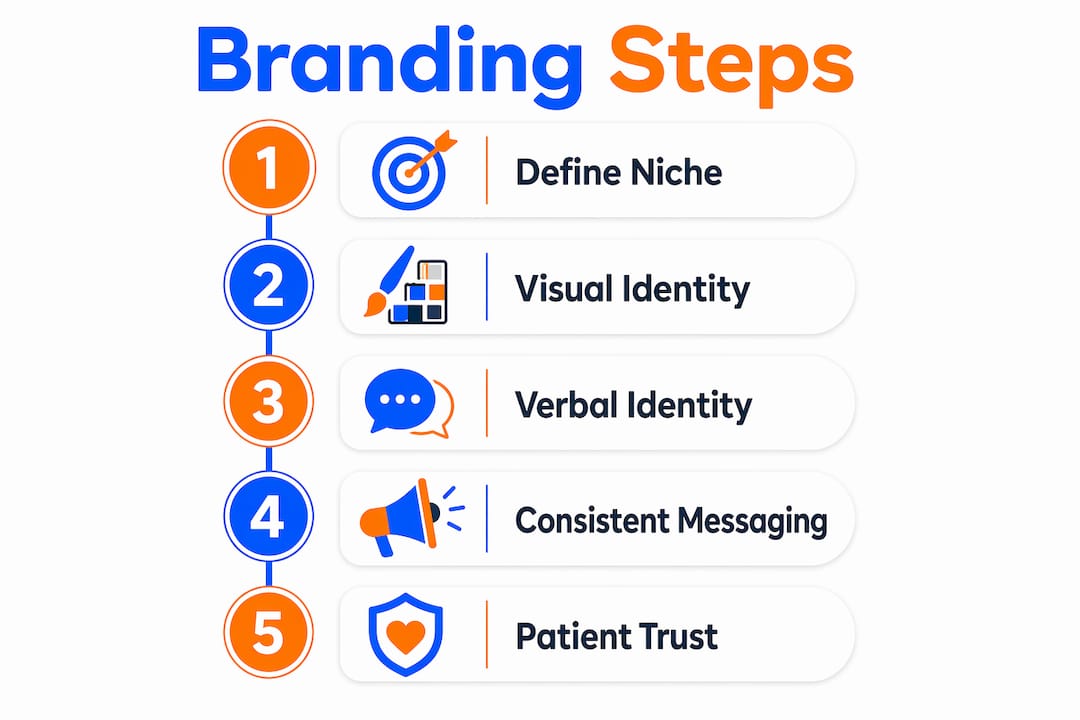
The concept known as the Congruence Effect explains this precisely. Brand congruence between online presence and clinical delivery produces higher patient confidence and case acceptance. When a patient sees a polished, warm, professional website and then walks into a practice that matches that feeling, their confidence spikes. When the two experiences clash, doubt replaces confidence and case acceptance drops.
The numbers confirm the impact. Practices that align website, messaging, and environment consistently increase conversion rates on high-intent pages from 3–5% to over 15%. That is a threefold improvement driven entirely by brand consistency, not by spending more on ads.
- Your website is your most powerful first impression. Invest in design that reflects your actual practice quality.
- Consistent visual identity across all platforms signals professionalism and reliability.
- Patient-facing language should match the tone patients experience in your office.
- Mismatched branding creates cognitive dissonance that kills conversions silently.
Pro Tip: Audit your own practice by Googling your name as a new patient would. Compare what you see online to what a first-time visitor experiences in person. Any gap you notice is a branding problem costing you patients.
What are the key components of effective dental branding?
A dental brand is built from two interlocking systems: visual identity and verbal identity. Both must work together to create a practice patients recognize and remember.
Visual identity
Your visual identity includes your logo, color palette, typography, and photography style. A defined brand identity system creates a cohesive, recognizable dental brand across every patient touchpoint. This means your business cards, your website header, your social media posts, and your office signage all look like they belong to the same family.
Verbal identity
Verbal identity covers your tone of voice, your messaging, and how your team communicates with patients. A family-focused practice should sound warm and reassuring. A cosmetic-focused practice should sound aspirational and confident. These are not the same voice, and using the wrong one for your niche confuses patients.
Here are the core components every dental brand needs:
- Logo and visual system. A professional logo with defined colors and fonts used consistently across all materials.
- Brand positioning statement. A one or two sentence description of who you serve, what you offer, and why patients should choose you.
- Tone of voice guide. Written guidelines for how your team communicates in emails, on the phone, and in person.
- Patient experience map. A document outlining every touchpoint from first search to post-visit follow-up, with brand standards for each.
- Content themes. Recurring topics and formats that reflect your brand values, such as patient education, team spotlights, or community involvement.
Pro Tip: Before redesigning your website, write your brand positioning statement first. Every design decision should serve that statement, not the other way around.
A scalable visual and verbal identity system is especially important for practices planning to grow or open additional locations. Building brand standards now prevents costly inconsistency later.
How can focused branding strategies drive practice growth and profitability?
Niche positioning is the most underused growth tool in dentistry. Practices that try to appeal to everyone end up attracting no one in particular, and often attract price-sensitive patients who push back on treatment plans. Practices targeting specific patient segments via focused branding achieve 42% higher profit margins than those with broad appeal. That margin difference is not trivial. It represents the financial gap between a practice that struggles and one that thrives.
Intentional exclusion is the mechanism behind this result. When you define a narrow, clear niche, such as cosmetic dentistry for professionals, pediatric care for anxious families, or implant dentistry for older adults, your messaging speaks directly to that group. Patients in that segment feel understood. They are far less likely to price-shop because your brand already answers their specific concerns.
Brand identity mismatch causes confusion and lost revenue. A practice charging premium fees while presenting budget-level branding sends a contradictory signal. Patients either distrust the quality or resent the price. Either outcome costs you the case.
Strong branding also affects your team. A strong brand attracts high-quality associates and retains staff by demonstrating clear vision and professionalism. The best dental professionals want to work somewhere they are proud of. A well-branded practice signals that leadership takes quality seriously, which reduces turnover and raises the standard of care.
- Niche branding reduces marketing waste by targeting patients most likely to accept treatment.
- Premium branding supports premium pricing without requiring justification at every consultation.
- Brand-aligned messaging turns one-time patients into loyal advocates who refer friends and family.
- A clear brand vision attracts top clinical talent and reduces costly staff turnover.
What practical steps can dentists take to build a strong brand?
Start with brand strategy before spending a dollar on web design or paid advertising. Skipping brand foundation before paid ads causes 30–40% wasted ad spend and six times higher lead costs. That is the single most expensive mistake dental practices make in marketing. Ads amplify your message. If your message is unclear, ads just amplify the confusion.
Building organic brand authority drastically lowers lead cost compared to paid ads alone. A practice with strong SEO, consistent content, and a recognizable brand earns patient trust without paying for every click. Your dental practice website is the anchor of that organic presence and must reflect your brand at every level.
Personal stories, team profiles, and community involvement build authentic brand content that drives patient loyalty. Dental branding is uniquely accessible through personal and community connections. A post introducing your hygienist of ten years builds more trust than any stock photo campaign. The power of storytelling in brand content is measurable in engagement, referrals, and patient retention.
Here is a practical sequence for building your brand:
- Define your brand strategy first. Identify your ideal patient, your core values, and your positioning before touching design.
- Audit your current touchpoints. Review your website, Google profile, social media, and in-office materials for consistency gaps.
- Train your team. Staff must understand and embody the brand voice in every patient interaction.
- Create authentic content. Use real patient stories (with permission), team introductions, and community involvement to build credibility.
- Monitor and adjust. Collect patient feedback regularly and use it to refine your brand experience over time.
Pro Tip: Ask three new patients each month how they found you and what made them choose your practice. Their answers reveal what your brand is actually communicating, which may differ from what you intend.
Authenticity in branding builds trust and long-term growth in ways that polished advertising alone cannot replicate. Patients who trust your brand stay longer, spend more, and refer others without being asked.
Key Takeaways
A dental practice’s brand is its most durable growth asset, and practices that invest in brand strategy before advertising consistently outperform those that do not.
| Point | Details |
|---|---|
| Branding drives case acceptance | Defined brand positioning produces 34% higher case acceptance rates across dental practices. |
| Consistency converts patients | Aligning website, messaging, and environment lifts conversion rates from 3–5% to over 15%. |
| Niche positioning raises margins | Focused branding targeting specific patient segments achieves 42% higher profit margins. |
| Brand before ads | Skipping brand strategy before paid advertising wastes 30–40% of ad spend and multiplies lead costs. |
| Authentic content builds loyalty | Team profiles, patient stories, and community content create the trust that advertising cannot buy. |
Why most dentists get branding backwards
Most dentists I have worked with treat branding as the last step, something to polish after the website goes live or the ads start running. That instinct is understandable. You trained for years in clinical excellence, not marketing strategy. But it is the single most costly sequence error I see in dental practice growth.
The practices that grow fastest do not have the biggest ad budgets. They have the clearest identity. They know exactly who they serve, they say so plainly, and every part of their practice confirms it. When a patient walks in and the experience matches the promise, trust is instant. That trust is worth more than any Google Ads campaign.
The other mistake I see constantly is confusing marketing with branding. Marketing gets attention. Branding earns trust. You need both, but in the right order. A practice that runs ads before building a brand is paying to send people to a confusing message. A practice with a strong brand turns every ad dollar into a confirmation of something patients already believe.
Your personal story and your community ties are brand assets most corporate dental groups cannot replicate. Use them. Patients choose local dentists partly because they want a human relationship, not a transaction. The dentist who shows up at the school fundraiser, who posts a genuine team birthday video, who writes a blog post about why they chose dentistry, that dentist wins the trust competition before the patient even calls.
— TONY
How Ibrand helps dental practices build a brand that grows
Ibrand works with dental practices that are ready to stop guessing and start building a presence that consistently attracts the right patients.
The team at Ibrand specializes in brand-aligned digital marketing for small and growing practices, covering everything from website strategy to local SEO. If your current online presence does not reflect the quality of care you deliver, that gap is costing you patients every week. Start with Ibrand’s guide to optimizing your practice website for search, and explore how affordable dental marketing strategies can turn a clear brand into a steady stream of new patients. The foundation is strategy. The result is growth.
FAQ
What is dental branding, exactly?
Dental branding is the complete identity of your practice, covering your visual design, messaging, patient experience, and reputation. It is the promise your practice makes and the feeling patients associate with your name.
How does branding affect new patient acquisition?
Practices with defined brand positioning acquire new patients 28% faster than those without a clear identity. A consistent brand presence also lifts high-intent website conversion rates from 3–5% to over 15%.
Should I brand my practice before running paid ads?
Yes. Skipping brand strategy before paid advertising wastes 30–40% of ad spend and produces lead costs six times higher than practices with a clear brand foundation in place.
How does niche branding increase profit margins?
Practices that target specific patient segments through focused branding achieve 42% higher profit margins than broad-appeal practices. Niche positioning attracts patients who are less price-sensitive and more likely to accept recommended treatment.
Can branding help me attract better staff?
A strong, well-presented brand signals professional vision and clinical standards. High-quality associates actively seek practices with clear identity and reputation, which reduces hiring difficulty and staff turnover over time.
Recent Comments