
TL;DR:
- Effective website content clearly communicates your value, answers visitor questions quickly, and guides readers toward action. Small business owners should focus on front-loading messages using the BLUF method and writing for their audience’s needs. Consistent updates, clear structure, and truthful data improve search visibility and customer engagement.
Effective website content is defined as copy that communicates your value clearly, answers visitor questions fast, and moves readers toward a specific action. Learning how to write website content is the single highest-return skill a small business owner can develop, because your website works around the clock whether you do or not. The industry term for this discipline is “web copywriting,” and it covers everything from your homepage headline to your service page descriptions. Get it right, and visitors stay, read, and buy. Get it wrong, and they leave in seconds.
How to write website content that actually works
Writing effective website content starts with one rule: put your most important message first. Users have about 54 seconds to engage with a webpage before deciding to stay or leave. That means your headline, your core offer, and your call to action must all appear before the visitor scrolls. This approach is called the BLUF method, short for Bottom Line Up Front, and it is the single most effective structural technique for web writing.

Most small business websites bury their value proposition three paragraphs down. By then, the visitor is gone. Front-loading your key message is not just good writing. It is a business decision.
Who is your audience and what do they need?
The most common mistake in web copywriting is writing for yourself instead of your visitor. Your audience does not care about your company history. They care about their problem and whether you can solve it. Successful content defines the page’s job to educate, engage, or convert visitors based on their specific needs.
Start by identifying your visitor’s core question. Use customer emails, support tickets, and Google Search Console queries to find the exact words your customers use. Those words belong in your headings and opening sentences. If your plumbing business gets calls asking “why is my water pressure low,” that phrase should appear on your service page, not just “residential plumbing services.”
Persona development takes this further. A persona is a one-page profile of your ideal customer: their age range, their biggest frustration, and the outcome they want. Targeting specific personas tailors your messaging for conversions far more effectively than writing for a generic audience. Even a simple two-persona setup, one for first-time buyers and one for repeat customers, produces noticeably better results.
- Know your visitor’s primary question before you write a single word
- Use real customer language from emails, reviews, and search queries
- Build at least one persona to anchor your tone and vocabulary
- Match your content goal (educate, engage, or convert) to each page’s purpose
- Align your call to action with where the visitor is in their decision process
Pro Tip: Read your one-star reviews. They reveal the exact pain points your content must address, written in your customers’ own words.
How should you structure web content for clarity?
Clear structure keeps visitors reading. Paragraphs should be no longer than 2–3 sentences, and average sentence length should stay between 15–20 words. Those are not arbitrary style rules. They reflect how people actually read on screens, which is in quick bursts, scanning for the answer they need.
Descriptive headings do most of the heavy lifting. A heading like “What our service includes” tells the visitor nothing. A heading like “What you get with our monthly lawn care plan” tells them exactly where they are and whether to keep reading. Write every heading as if it might be the only thing the visitor reads.
Odd-numbered lists with 3 or 5 items are easier for readers to remember than longer or even-numbered lists. Use them for benefits, steps, and features. Keep bullets short and parallel in structure. Omitting periods in bulleted lists maintains smoother eye movement and improves scan-ability.
- Use short paragraphs: 2–3 sentences maximum
- Write headings that answer a question or name a specific benefit
- Use odd-numbered lists (3 or 5 items) for better reader retention
- Skip periods at the end of bullet points to keep eye flow smooth
- Use white space generously. Dense text signals effort, and visitors avoid effort
Active voice increases clarity and reader engagement by making it clear who does what. “We install your system in one day” is stronger than “Your system will be installed.” Active sentences feel confident. Passive sentences feel evasive.
Pro Tip: Read your page aloud. If you stumble on a sentence, your visitor will too. Rewrite until it flows without effort.
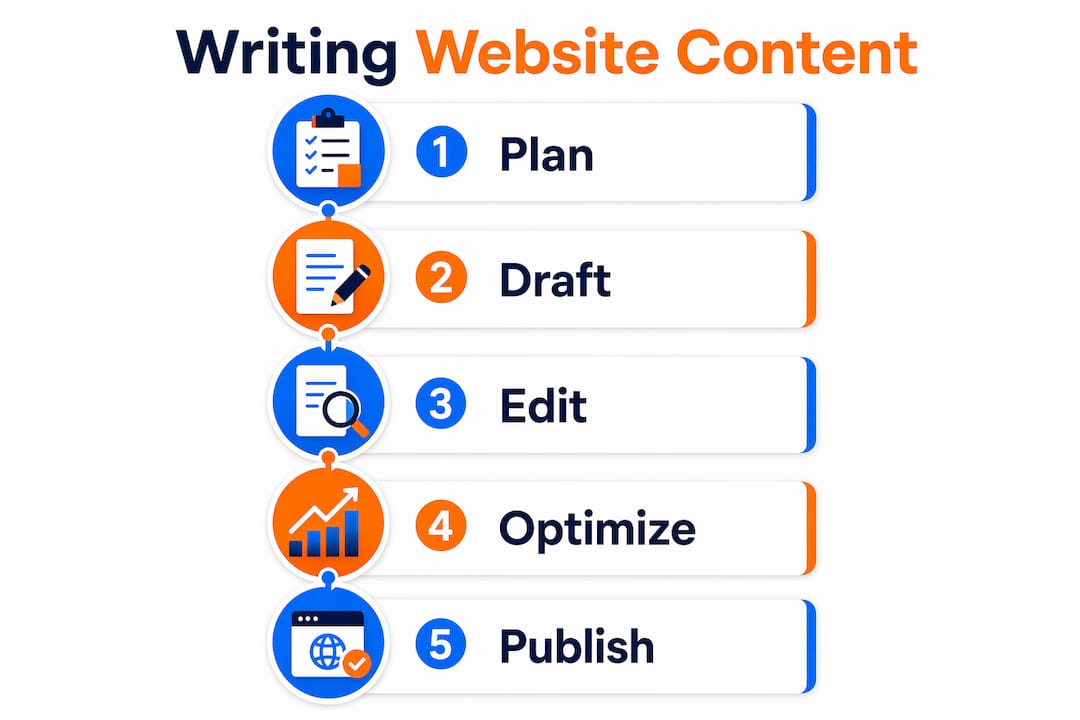
Step-by-step process for writing persuasive web copy
A repeatable process produces better content than inspiration alone. Follow these steps for every page you write.
- Write a content brief first. Skipping the content brief leads to project delays and message misalignment. Your brief should cover the page goal, the target visitor, the primary keyword, and the one action you want the reader to take.
- Research what visitors actually search. Use Google’s “People also ask” section and your own site search data to find real questions. These questions become your subheadings.
- Write the problem before the solution. Focusing on the visitor’s problem first makes content more credible and effective than leading with product features. State the problem in the visitor’s language, then position your service as the answer.
- Place your primary keyword in the title, first paragraph, and at least one subheading. Do not force it. If the sentence sounds unnatural, rewrite it.
- Write one call to action per page. Multiple CTAs split attention and reduce conversions. Pick one goal and build the page around it. For calls to action that convert, the button text should name the outcome, not the action. “Get my free quote” outperforms “Submit.”
- Edit for clarity. Cut every word that does not add meaning. Replace jargon with plain language. Read the page at a 10th-grade level.
- Apply SEO basics. Write a meta description of 150–160 characters that includes your keyword and a reason to click. Add descriptive alt text to every image. Link to related pages on your site to help visitors and search engines navigate.
| Writing element | Best practice |
|---|---|
| Page title | Include primary keyword, keep under 60 characters |
| Meta description | 150–160 characters, keyword plus a clear benefit |
| Paragraph length | 2–3 sentences, no exceptions |
| Sentence length | 15–20 words average |
| Call to action | One per page, outcome-focused button text |
Pro Tip: Write your meta description before you write the page. It forces you to define the page’s single purpose before you write a word of body copy.
Common mistakes that kill engagement and rankings
Most website content problems fall into a short list of repeatable errors. Recognizing them is the first step to fixing them.
- Writing about features, not outcomes. “We use premium materials” means nothing. “Your fence stays standing for 20 years” means everything
- Ignoring search intent. A visitor searching “how to fix a leaky faucet” wants instructions, not a sales pitch for your plumbing service. Match your content format to what the searcher actually wants
- Burying the main point. If your value proposition appears in paragraph four, rewrite the page. Put it in sentence one
- Using passive voice throughout. Passive writing feels weak and vague. Replace “services are offered” with “we offer”
- Over-relying on AI-generated content. Unique data, direct experience, and a clear point of view differentiate successful website content. AI drafts are a starting point, not a finished product
- Never updating old pages. Search engines favor fresh, accurate content. Set a calendar reminder to review your top pages every six months
- Writing too much or too little. A homepage needs 300–500 words. A service page needs 600–900. A blog post needs 1,000 or more. Match length to purpose
For a deeper look at how content connects to website conversion rates, the relationship between copy quality and conversion is direct and measurable.
Key Takeaways
Writing effective website content requires clear structure, audience focus, and a repeatable process that puts the visitor’s problem before your product.
| Point | Details |
|---|---|
| Front-load your message | Place your core offer and CTA in the first few lines using the BLUF method |
| Write for your visitor’s problem | Address the visitor’s question first; product features come second |
| Use short paragraphs and sentences | Keep paragraphs to 2–3 sentences and sentences to 15–20 words for scan-ability |
| One CTA per page | Focus each page on a single action to avoid splitting visitor attention |
| Update content regularly | Review top pages every six months to stay accurate and maintain search rankings |
What I’ve learned writing web copy for small businesses
The biggest shift I’ve seen in small business web copy is when owners stop writing about themselves and start writing about the visitor’s problem. It sounds obvious. Almost no one does it naturally. The default is to open with “Welcome to our business” or a paragraph about founding year. Visitors do not care. They arrived with a question, and they want the answer in the first five seconds.
The content brief is the tool most small business owners skip and most regret skipping. A one-page brief takes 20 minutes to write and saves hours of revision. It forces you to answer: who is reading this, what do they need, and what do I want them to do next? Without those answers written down, content drifts.
On AI writing tools: use them to draft, never to finish. AI content tools assist writing, but unique data and professional perspective are the real competitive edge. A tool can produce grammatically correct sentences. It cannot produce your customer’s exact story or your ten years of field experience. That specificity is what builds trust and ranks well over time. Use AI to break the blank page, then rewrite with your own voice and real examples.
Finally, measure what you write. Check your website performance metrics after every major content update. Time on page, bounce rate, and conversion rate tell you whether your copy is working. Writing without measuring is guessing.
— TONY
How Ibrand helps small businesses get found online
Small business owners who apply these writing principles consistently see real gains in search visibility and customer inquiries. Getting the content right is step one. Making sure search engines find and rank that content is step two.

Ibrand specializes in SEO and content optimization built specifically for small and local businesses. The team at Ibrand reviews your existing pages, identifies gaps between what you publish and what your customers search for, and builds a content plan that connects both. If you want your website to generate leads rather than just exist online, Ibrand offers transparent pricing and a personalized plan to get you there. Visit ibrand.media to see what a content-focused SEO strategy looks like for a business your size.
FAQ
What is the most important rule for writing web content?
Put your most important message in the first two sentences of every page. Visitors decide within seconds whether to stay, so your core offer must appear before they scroll.
How long should a small business website page be?
A homepage needs roughly 300–500 words, a service page 600–900 words, and a blog post 1,000 or more. Match length to the page’s purpose and the depth of the visitor’s question.
How do I use keywords without sounding unnatural?
Place your primary keyword in the page title, the first paragraph, and one subheading. Write the rest of the page in plain language. If a sentence sounds forced, rewrite it without the keyword.
Should I use AI to write my website content?
Use AI to create a first draft, then rewrite it with your own voice, real examples, and specific details. Generic AI output lacks the unique perspective and direct experience that build trust with visitors and search engines.
How often should I update my website content?
Review your most important pages every six months. Update any facts, prices, or service details that have changed, and add new examples or customer results to keep content current and accurate.
Recent Comments