
TL;DR:
- Fixing the customer experience is essential before implementing loyalty programs because trust influences repeat business. Personalized communication based on purchase history significantly increases customer retention and loyalty. Tracking metrics like repeat purchase rate, NPS, and customer lifetime value helps measure the effectiveness of retention strategies.
Repeat customer retention, the industry term for strategies that bring buyers back consistently, is the single most cost-effective growth lever available to small and medium-sized businesses. Loyal customers spend 31% more and are 64% more likely to make frequent purchases than one-time buyers. That gap in spending behavior is not a minor edge. It is the difference between a business that grinds for every dollar and one that builds compounding revenue from a reliable base. Knowing how to attract repeat customers means understanding that loyalty is earned through trust, consistent experience, and smart engagement, not just discount codes.
How to attract repeat customers: fix the experience first
Before you launch any loyalty program, audit what your customers actually experience. 93% of consumers say trust is a prerequisite for loyalty. That number tells you something direct: no points system fixes a broken onboarding process or a frustrating support interaction.
The moments that matter most are called “moments of truth.” These are the key touchpoints where a customer decides whether to come back or walk away. For most small businesses, the highest-risk moments are:
- Onboarding: Does the customer understand what they bought and how to use it?
- First value realization: Did they get the result they expected, and how quickly?
- Service interactions: Was their problem solved without friction?
- Renewal or repurchase: Was the path back to buying easy and obvious?
Loyalty programs built on top of a poor experience attract reward hunters, not brand loyalists. A customer who joins your points program only to chase a discount will leave the moment a competitor offers a better deal. Launching programs without fixing experience creates fragile loyalty that collapses under competitive pressure.
Pro Tip: Map your customer journey touchpoints before spending a dollar on rewards. Write down every step a customer takes from discovery to repurchase, then mark the ones where you have received complaints or seen drop-off. Fix those first.

Which loyalty program structures actually drive repeat purchases?
Once your core experience is solid, structured reward programs become a genuine multiplier. 84% of loyalty program members are more likely to make repeat purchases. The key is choosing the right structure for your business model and customer base.
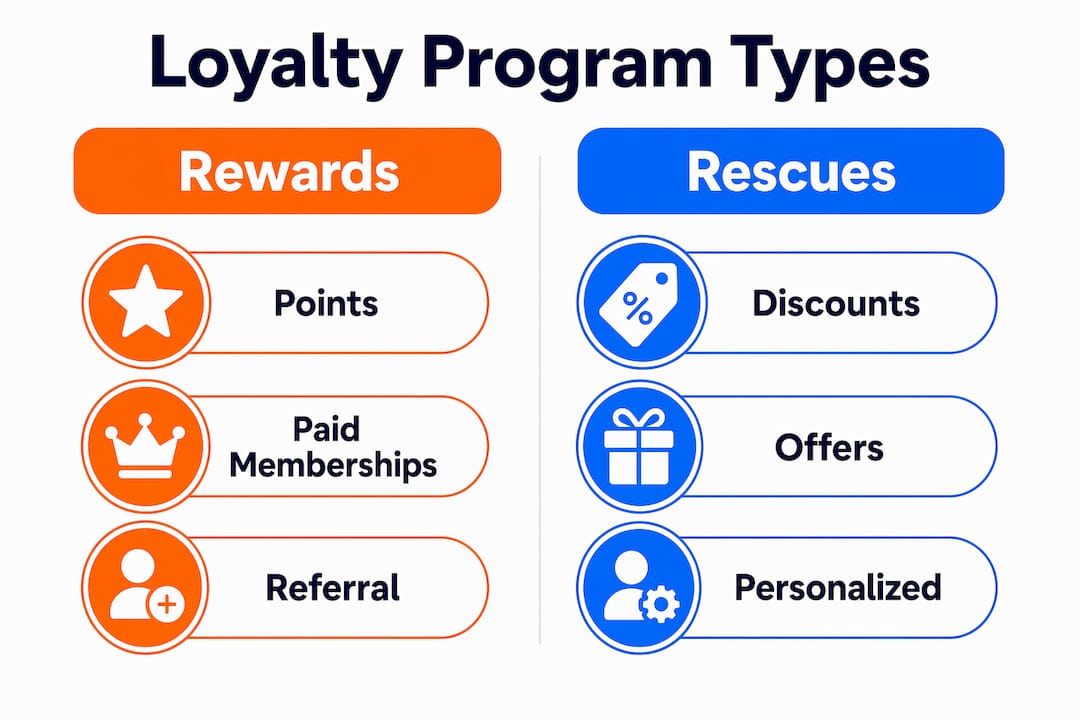
Loyalty strategies fall into two psychological categories: “rewards” that reinforce desired behaviors, and “rescues” that remove pain points like shipping costs or long wait times. The best programs combine both.
| Program type | How it works | Best for |
|---|---|---|
| Points-based | Customers earn points per purchase, redeemable for discounts or products | Businesses with frequent, lower-value transactions |
| Tiered | Higher spend unlocks better perks; motivates customers to increase their level | Businesses with a wide range of purchase frequencies |
| Paid membership | Customers pay upfront for exclusive benefits like free shipping or early access | Businesses with high-volume repeat buyers |
| Referral | Existing customers earn rewards for bringing in new buyers | Businesses looking to grow their base while retaining current customers |
Paid memberships deserve special attention. Paid loyalty members are 60% more likely to spend money with a brand. The psychology is straightforward: prepayment creates commitment. A customer who has paid for access is motivated to use it.
Referral programs work because they combine retention with acquisition. Your most loyal customers become your most credible marketers. A simple structure, such as “give $10, get $10,” costs less per acquisition than most paid advertising and delivers buyers who already trust your brand.
How does personalized communication keep customers coming back?
Personalization is the mechanism that turns a one-time buyer into a repeat customer. Anticipating needs through proactive, personalized communication is one of the most reliable ways to improve retention. The reason is simple: customers who feel understood feel valued, and valued customers return.
The practical foundation is purchase history. When you know what a customer bought, when they bought it, and how often, you can predict what they need next. A customer who buys coffee beans every three weeks does not need a generic newsletter. They need a reorder reminder on day 20 with a relevant offer attached.
Post-purchase communication is where most small businesses leave money on the table. A well-timed email sequence after a first purchase, covering product tips, a satisfaction check-in, and a relevant follow-up offer, can significantly increase the chance of a second purchase. SMS and app notifications work for time-sensitive offers, but email remains the most cost-effective channel for ongoing nurturing.
Predictive analytics, available through most modern CRM platforms, lets you identify at-risk customers before they churn. A customer who normally buys monthly but has gone six weeks without a purchase is a signal. An automated “we miss you” message with a small incentive costs almost nothing and can recover a relationship that would otherwise be lost.
Pro Tip: Pick one measurable retention KPI, such as 30-day repeat purchase rate, and run a focused test on a single message change. Changing subject lines, send times, and offer types all at once makes it impossible to know what worked. Isolate one variable per test cycle.
What metrics tell you if your retention strategy is working?
Tracking the right numbers separates businesses that improve from those that just stay busy. The four metrics every small business owner should monitor are repeat purchase rate, cohort retention, Net Promoter Score (NPS), and customer lifetime value (CLV).
Running focused 30-day tests on a single retention KPI produces more effective improvements than broad, unmeasured changes. That principle applies directly to how you read your metrics. Test one thing, measure one thing, and draw one conclusion before moving on.
| Metric | What it measures | Why it matters |
|---|---|---|
| Repeat purchase rate | Percentage of customers who buy more than once | Direct indicator of loyalty program effectiveness |
| Cohort retention | How a specific group of customers behaves over time | Reveals whether improvements are actually working |
| Net Promoter Score | Likelihood of customers recommending your brand | NPS predicts advocacy and correlates with loyalty |
| Customer lifetime value | Total revenue a customer generates over their relationship with you | Informs how much to spend on acquisition and retention |
CLV is the metric that changes how you think about spending. Customers with emotional bonds have 306% higher lifetime value than merely satisfied ones. That figure reframes every retention investment. Spending $50 to recover a high-CLV customer is not a cost. It is a return.
Customer surveys and feedback forms are underused by most small businesses. A two-question survey sent after a purchase, asking what went well and what could be better, gives you qualitative data that no dashboard can provide. Use that feedback to identify friction points before they become churn drivers. You can also use real-time analytics tools to track on-site behavior and spot where customers drop off before they even reach checkout.
Key Takeaways
Attracting repeat customers requires fixing the core experience first, then layering loyalty programs, personalized communication, and consistent measurement to build retention that compounds over time.
| Point | Details |
|---|---|
| Fix experience before rewards | Audit key touchpoints like onboarding and service before launching any loyalty program. |
| Choose the right program structure | Match points, tiered, paid, or referral programs to your transaction frequency and customer base. |
| Personalize post-purchase communication | Use purchase history and CRM data to send timely, relevant messages that bring customers back. |
| Track four core metrics | Monitor repeat purchase rate, cohort retention, NPS, and CLV to measure what is actually working. |
| Test one change at a time | Run focused 30-day experiments on a single KPI to identify what drives retention improvements. |
Why I think most SMBs are solving loyalty backwards
I have worked with enough small business owners to see a clear pattern. The first instinct when sales slow down is to launch a loyalty program. Print some punch cards, set up a points app, offer a birthday discount. It feels productive. It rarely works the way they expect.
The uncomfortable truth is that loyalty is an emotional loop, not a transaction. A customer does not come back because they have 200 points. They come back because your business made them feel good, solved their problem without drama, and remembered something about them. Points are a nudge. Trust is the engine.
What I have found actually works is starting with a brutal audit of the experience. Not a survey with leading questions. A real walk-through of every step a customer takes, from finding you online to getting help after a purchase. Most businesses discover two or three moments where the experience is genuinely poor. Fix those, and retention improves before you spend a dollar on rewards.
The other thing I push hard on is simplicity in measurement. Owners who try to track ten metrics at once end up tracking none of them well. Pick repeat purchase rate. Watch it weekly. Run one test at a time. That discipline, more than any specific tactic, is what separates businesses that build real loyalty from those that just talk about it.
Building customer trust online is not a campaign. It is a practice. The businesses that get this right treat every purchase as the start of a relationship, not the end of a transaction.
— TONY
How Ibrand helps SMBs build retention into their marketing
Ibrand works with small and medium-sized businesses that want their marketing to do more than attract first-time buyers. Retention starts with being found consistently by the right local customers, and that requires a website and SEO foundation built for repeat engagement.
Ibrand’s approach connects local SEO for small businesses with the kind of ongoing marketing that keeps your brand visible to customers between purchases. From real-time performance tracking to personalized campaign planning, Ibrand builds the infrastructure that makes retention strategies measurable and repeatable. If you are ready to turn one-time buyers into loyal customers, Ibrand’s team can help you build a plan that fits your budget and your market.
FAQ
What is the fastest way to increase repeat purchase rate?
Fix the post-purchase experience first. A well-timed follow-up email sequence after a first purchase, covering product tips and a relevant offer, is the fastest low-cost way to drive a second purchase.
Do loyalty programs actually work for small businesses?
Yes, when the core experience is solid. 84% of loyalty program members are more likely to make repeat purchases, but programs built on top of a poor experience attract reward hunters rather than genuine brand loyalists.
How do I measure customer loyalty for my small business?
Track repeat purchase rate and Net Promoter Score as your two primary indicators. NPS reveals emotional loyalty and advocacy likelihood, while repeat purchase rate shows whether customers are actually coming back.
What is customer lifetime value and why does it matter?
Customer lifetime value (CLV) is the total revenue a customer generates over their entire relationship with your business. Customers with strong emotional connections have 306% higher lifetime value than those who are merely satisfied, making CLV the most important metric for evaluating retention investments.
How often should I contact customers to keep them engaged?
Contact frequency should match your purchase cycle. A customer who buys monthly needs different touchpoints than one who buys annually. Use purchase history to time your messages, and prioritize relevance over volume to avoid unsubscribes.
Recommended
- How to Attract Local Customers in 2025: Smart Strategies for Small Businesses | Ibrandmedia
- 8 Cost-Effective Promotion Ideas for Small Businesses | Ibrandmedia
- Digital lead generation: A complete guide for SMB success – Ibrandmedia
- Boosting Online Sales Locally: Step-by-Step Guide for SMBs | Ibrandmedia
Recent Comments