
Every small business owner knows that waiting days for website reports can mean missing out on valuable opportunities. Fast, informed decisions often make the difference between gaining a sale or losing a prospect online. With real-time website analytics, you can watch visitors interact, see trends as they happen, and adjust your marketing strategy on the spot for greater visibility and sales.
Table of Contents
- Real-Time Website Analytics Defined and Debunked
- Key Metrics and How Tracking Works
- Top Tools and Platforms for SMBs
- How Real-Time Analytics Drives Decisions
- Common Pitfalls and Privacy Concerns
Key Takeaways
| Point | Details |
|---|---|
| Real-Time Analytics Advantage | Real-time analytics provides immediate insights, allowing small businesses to make rapid strategic adjustments. |
| Critical Metrics for Success | Key metrics such as page views, bounce rate, and conversion rate are essential for understanding user behavior and optimizing website performance. |
| Choosing the Right Tools | Selecting user-friendly analytics tools that fit budget and business goals is crucial for effective data tracking and analysis. |
| Privacy Considerations | Businesses must implement robust privacy strategies and obtain user consent to mitigate risks associated with data tracking. |
Real-Time Website Analytics Defined and Debunked
Real-time website analytics represents a powerful digital strategy that goes far beyond traditional data tracking. Continuous web data processing enables small businesses to understand their online performance instantaneously, transforming raw website data into actionable insights.
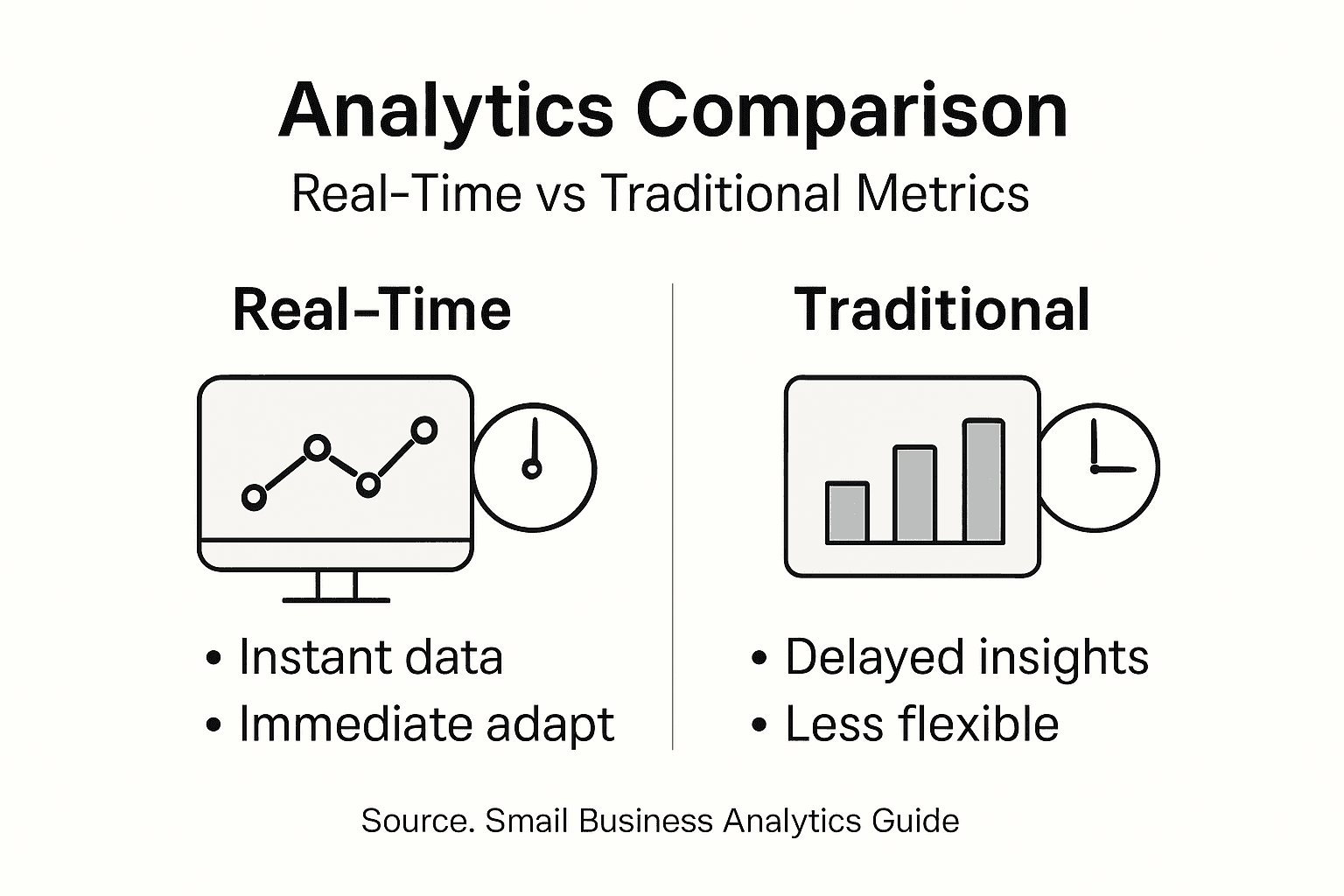
Traditionally, website analytics involved reviewing historical data in batches, which often meant making decisions based on outdated information. Real-time analytics disrupts this model by providing immediate insights. The key characteristics include:
- Instant data collection and processing
- Immediate performance visualization
- Quick identification of user behavior trends
- Rapid response to website interactions
- Dynamic tracking of marketing campaign effectiveness
Contrary to popular belief, real-time analytics does not mean absolutely zero latency. Streaming data analysis techniques allow for insights within seconds or minutes, which is substantially faster than traditional batch processing methods.
For small business owners, this means being able to monitor website traffic, understand user engagement, and make rapid strategic adjustments. Whether tracking conversion rates, analyzing user demographics, or measuring campaign performance, real-time analytics provides a competitive edge in the digital marketplace.
Here’s a concise comparison of real-time versus traditional website analytics methods:
| Aspect | Real-Time Analytics | Traditional Analytics |
|---|---|---|
| Data Availability | Immediate or near instant | Delayed, batched reviews |
| Decision Impact | Enables rapid adjustments | Changes require more time |
| User Trend Detection | Detects shifts quickly | Trends spotted after delay |
| Campaign Monitoring | Dynamic, ongoing insights | Periodic reporting |
Pro tip: Start with free real-time analytics tools to understand your website’s immediate performance without significant initial investment.
Key Metrics and How Tracking Works
Website analytics transform raw digital information into strategic business intelligence. Web tracking technologies enable small businesses to understand user behavior through sophisticated data collection methods that reveal critical performance insights.
The most important metrics for small business websites include:
- Page views: Total number of pages visited
- Bounce rate: Percentage of visitors leaving after one page
- Conversion rate: Visitors completing desired actions
- Session duration: Average time users spend on site
- Traffic sources: Where website visitors originate
Tracking mechanisms work through multiple sophisticated techniques. Quantitative data gathering involves embedding JavaScript scripts, utilizing cookies, and analyzing server logs to capture user interactions instantaneously. These tools collect granular information about user demographics, navigation patterns, and engagement levels.
Small business owners can leverage these insights to make data-driven decisions. By understanding which pages attract most traffic, where users drop off, and what content drives conversions, entrepreneurs can continuously optimize their online strategies and improve website performance.
Pro tip: Configure your analytics dashboard to track your most critical business metrics and review them weekly for continuous improvement.
Top Tools and Platforms for SMBs
Small and medium-sized businesses need powerful yet affordable web analytics platforms to track their online performance effectively. Web analytics tools for SMBs have evolved to provide comprehensive insights with user-friendly interfaces that don’t require advanced technical expertise.
The top recommended analytics platforms for small businesses include:
- Google Analytics 4: Free, comprehensive tracking
- Mixpanel: Advanced user behavior insights
- Matomo: Privacy-focused, open-source alternative
- Heap: Automatic event tracking
- Hotjar: Visual user experience mapping
Real-time tracking capabilities have become crucial for businesses wanting immediate performance feedback. These platforms offer dynamic dashboards that update instantly, allowing entrepreneurs to monitor visitor interactions, track marketing campaign effectiveness, and make rapid strategic adjustments.

When selecting an analytics tool, small business owners should consider factors like ease of use, integration capabilities, pricing, and specific feature sets that align with their unique business goals. The right platform can transform raw website data into actionable insights that drive growth and improve online performance.
A summary of factors to consider when choosing an analytics platform:
| Selection Factor | Why It Matters | Common SMB Considerations |
|---|---|---|
| Ease of Use | Faster onboarding | Intuitive navigation |
| Integration Options | Connects to other tools | API and CMS compatibility |
| Pricing Model | Fits budget constraints | Free tier and scalable plans |
| Privacy Features | Ensures data protection | Anonymization and user consent |
Pro tip: Start with a free tier of a robust analytics platform and gradually upgrade as your business tracking needs become more sophisticated.
How Real-Time Analytics Drives Decisions
Business decision-making has been revolutionized by the advent of real-time data transformation technologies that enable instant insights and proactive strategic planning. These powerful tools allow small business owners to move beyond traditional retrospective analysis and embrace a more dynamic, responsive approach to managing their online presence.
Key decision-driving capabilities of real-time analytics include:
- Detecting emerging customer behavior trends
- Identifying potential website performance issues
- Tracking marketing campaign effectiveness
- Personalizing user experiences dynamically
- Responding to operational challenges immediately
Continuous data stream insights provide small businesses with a competitive edge by enabling rapid adaptation to market changes. By monitoring live data streams, entrepreneurs can make informed decisions about marketing strategies, inventory management, and customer engagement in near real-time.
The true power of real-time analytics lies in its ability to transform raw data into actionable intelligence. Small business owners can now track website visitor behaviors, understand conversion bottlenecks, and optimize their digital strategies with unprecedented speed and precision.
Pro tip: Set up automated alerts in your analytics platform to notify you of significant performance changes or unusual visitor behaviors.
Common Pitfalls and Privacy Concerns
Real-time website analytics offer powerful insights, but small businesses must navigate complex privacy considerations carefully. Privacy risks in web tracking can expose businesses to legal challenges and erode customer trust if not managed strategically.
Common privacy pitfalls include:
- Collecting data without explicit user consent
- Insufficient anonymization of personal information
- Failing to disclose tracking mechanisms
- Storing unnecessary personal data
- Inadequate data protection protocols
- Sharing user information with third parties
Businesses must implement robust privacy protection strategies to mitigate risks. This involves developing transparent data collection policies, obtaining clear user consent, and ensuring strict adherence to regional privacy regulations like GDPR and CCPA. Implementing privacy-by-design principles helps build trust and demonstrates a commitment to responsible data handling.
Technical safeguards are crucial in protecting user privacy. Small businesses should utilize analytics platforms that offer advanced anonymization features, limit personally identifiable information collection, and provide users with clear opt-out mechanisms. Regularly auditing data collection practices and staying informed about evolving privacy standards can help businesses maintain ethical and legal data tracking approaches.
Pro tip: Conduct a quarterly review of your website’s data collection practices to ensure ongoing compliance with current privacy regulations.
Maximize Your Small Business Growth with Real-Time Website Analytics
Small businesses often struggle with making fast, informed decisions because they lack immediate insight into their website’s performance. Real-time analytics lets you detect user trends instantly and respond quickly to drive conversions and optimize marketing campaigns. Understanding key metrics like bounce rates and session durations is vital to stay ahead of the competition. At Ibrandmedia, we specialize in harnessing real-time data to tailor digital marketing strategies that deliver quick results and sustainable growth.
Ready to transform raw website data into actionable business intelligence? Explore how our expert team supports you with real-time performance tracking, mobile-friendly design, and transparent pricing. Start your journey toward smart decision-making today by visiting our Uncategorized Services page or connect directly through our main site at ibrand.media. Let us help you unlock the full potential of your online presence now.
Frequently Asked Questions
What are real-time website analytics?
Real-time website analytics refers to the continuous processing of web data, allowing businesses to monitor their online performance and user behavior instantly, providing actionable insights compared to traditional analytics.
How can small businesses benefit from real-time analytics?
Small businesses can use real-time analytics to monitor website traffic, identify user engagement trends quickly, and make rapid decisions to optimize their marketing campaigns and overall online performance.
What key metrics should small businesses track using real-time analytics?
Key metrics to track include page views, bounce rate, conversion rate, session duration, and traffic sources, as these provide valuable insights into user behavior and website effectiveness.
What tools are recommended for real-time website analytics?
Recommended tools for real-time analytics include Google Analytics 4, Mixpanel, Matomo, Heap, and Hotjar, each offering features to help small businesses track and improve their online performance.
Recommended
- Website Analytics: Driving Business Growth Online | Ibrandmedia
- Complete Guide to Online Analytics for Business | Ibrandmedia
- 8 Essential Website Optimization Tips for Small Businesses | Ibrandmedia
- Website Speed: Impact on Small Business Growth | Ibrandmedia
- Commentions – 7 Essential Social Media Growth Strategies for SaaS Founders
Recent Comments