
TL;DR:
- Improving local search visibility requires ongoing optimization and consistent management of your online listings.
- Starting with a comprehensive audit of existing profiles and then optimizing your Google Business Profile is essential for ranking higher in local results.
You offer excellent service, your customers love you, but when someone nearby searches for what you do, your business is nowhere to be found. That gap between effort and visibility is one of the most frustrating challenges local business owners face. The good news is that it is almost always fixable. With the right approach to local listings optimization, you can move from invisible to prominent in local search results, attract more foot traffic, and bring in customers who are actively looking for exactly what you offer. This guide walks you through every stage of that process.
Table of Contents
- Assess your current local listing status
- Optimize your Google Business Profile first
- Stage your local SEO efforts for maximum impact
- Master ongoing visibility: Reviews, consistency, and tracking
- Local listings optimization: What most guides don’t tell you
- Take the next step: Make your business stand out locally
- Frequently asked questions
Key Takeaways
| Point | Details |
|---|---|
| Audit first | Review your listings and rankings regularly to identify issues and track improvements. |
| Focus on Google | A complete, accurate Google Business Profile directly boosts your local search visibility. |
| Use phased steps | Break optimization into sprints for faster, more sustainable results. |
| Stay consistent | Keep your business details, citations, and reviews accurate across all platforms for ongoing success. |
Assess your current local listing status
Before we dive into action, it’s essential to know where you stand right now. Jumping straight into optimization without understanding your baseline is like repainting a house without checking for structural damage first. You need a clear picture of what listings you already have, what information is accurate, and where the gaps are.
Start by searching your business name on Google, Bing, Yelp, and Facebook. Screenshot the results. Note what appears, what’s missing, and whether your contact information looks the same across each platform. This is your starting audit, and it reveals more than you’d expect.
The critical details to gather include:
- Business name spelling (does it match exactly on every platform?)
- Physical address format (is “Street” abbreviated on one and spelled out on another?)
- Phone number (local vs. toll-free, and is it consistent everywhere?)
- Website URL (are any listings pointing to an outdated page?)
- Business hours (do they reflect your current schedule, including holidays?)
- Photos (are listings empty, outdated, or using low-resolution images?)
- Listing claim status (are you actually the verified owner of each profile?)
Here’s a simple table to help you track what you find during the audit:
| Platform | Claimed? | NAP Correct? | Photos Present? | Hours Updated? | Review Count |
|---|---|---|---|---|---|
| Google Business Profile | Yes / No | Yes / No | Yes / No | Yes / No | # |
| Bing Places | Yes / No | Yes / No | Yes / No | Yes / No | # |
| Yelp | Yes / No | Yes / No | Yes / No | Yes / No | # |
| Facebook Business | Yes / No | Yes / No | Yes / No | Yes / No | # |
Filling in that table gives you a snapshot of your real-world status. Experts recommend tracking local audits over time, not just on a single day, because local search visibility shifts month to month based on competitor activity, algorithm updates, and changes to your own listings. Understanding how you rank geographically, not just nationally, is what separates businesses that grow steadily from those that plateau.
For a deeper look at how using local listings for visibility drives real traffic, it helps to understand which platforms carry the most weight in your specific industry and location.
Pro Tip: Schedule a monthly 30-minute audit block in your calendar. Set a recurring reminder to re-check all four major platforms. Small inconsistencies compound over time and quietly hurt your rankings.
Optimize your Google Business Profile first
Once your base is set with an audit, focus on the most critical listing first: your Google Business Profile. No other single listing affects your local search presence more directly. When a potential customer searches “plumber near me” or “best pizza in [city],” the results they see in the local pack, that prominent map-based block of three businesses at the top of the page, pull almost entirely from Google Business Profile data.
Most information in Google local packs comes directly from your GBP, including your contact details, service categories, reviews, and photos. That means an incomplete or unverified profile is a direct ranking disadvantage.
Here is a step-by-step process to get your GBP fully optimized:
- Claim and verify your profile. Go to Google Business Profile and search for your business. If it exists but isn’t claimed, request ownership. Google will typically send a postcard or offer phone verification to confirm you’re the legitimate owner.
- Fill out every field completely. Business name, address, phone number, website, business hours, and description all need to be filled in without shortcuts. Partial profiles signal to Google that your listing may be unreliable.
- Select the right primary category. This is one of the most influential decisions you’ll make. Your primary category tells Google what type of business you are. Look at the categories your top-ranking competitors use and match or closely align with them.
- Add high-quality photos. Listings with photos receive significantly more clicks than those without. Include exterior shots, interior images, team photos, and product or service photos. Aim for at least 10 to 15 images to start.
- Write a compelling business description. Use 750 characters to describe what you do, who you serve, and what makes you different. Naturally include your primary service and location without keyword stuffing.
- Enable messaging. Customers who can send a quick message directly from your profile are more likely to reach out than those who have to call or visit a website first.
- Post updates regularly. Google Posts let you share offers, events, and news directly on your profile. Profiles with regular posting activity tend to appear more active and relevant in search results.
“Your Google Business Profile is not a form you fill out once and forget. It’s a living profile that rewards ongoing attention, just like your best-performing social media channels.”
For a complete walkthrough, our Google Business Profile guide covers every field in detail. You can also explore specific tips for Google Business Profile to squeeze out every competitive advantage, or follow the full process to optimize Google My Business from scratch.
Pro Tip: Compare your primary category, secondary categories, and the keywords in your business description against your top three competitors in the local pack. Close alignment with their category choices, combined with better photos and more reviews, is often enough to push you into that top-three position.
Stage your local SEO efforts for maximum impact
With the GBP foundation in place, it’s strategic to follow an order that accelerates results rather than scatter effort across a dozen tasks at once. The most effective approach treats local SEO as a sprint with clear phases so you build momentum instead of spinning your wheels.
Here’s what a phased approach looks like in practice:
- Phase 1 (Days 1 to 14): GBP fundamentals. Claim, verify, and fully complete your Google Business Profile. Fix all NAP inconsistencies across Google, Bing, Yelp, and Facebook. This is the foundation everything else sits on.
- Phase 2 (Days 15 to 35): Service and location pages. Build or improve dedicated pages on your website for each service you offer and each area you serve. These pages help Google understand your geographic relevance and service range.
- Phase 3 (Days 36 to 70): Reviews and local authority. Launch a systematic review-building effort. Reach out to past customers via email or text asking for honest feedback. Address inconsistent citations across local directories.
| Phase | Focus area | What to do | Expected result |
|---|---|---|---|
| Phase 1 | GBP fundamentals | Claim, verify, complete all fields | Immediate visibility boost |
| Phase 2 | Website content | Add service and location pages | Improved keyword relevance |
| Phase 3 | Reviews and citations | Build reviews, fix NAP consistency | Stronger local authority |
The reason this staged approach outperforms a scattered one is simple: each phase builds on the previous one. A strong GBP makes your service pages more effective. Strong service pages make your reviews more credible. Credible reviews and consistent citations convince Google you’re the authoritative choice.

For businesses working to improve their position in map results, our guide to improving local search rankings goes deeper on each phase. And if you want to see the broader picture of what works, our breakdown of local SEO strategies for small businesses covers additional tactics that accelerate results.
Avoid the temptation to do everything at once. When you try to simultaneously build backlinks, redesign your website, refresh all social media profiles, and fix citations, nothing gets done well. Focus beats multitasking every time.
Master ongoing visibility: Reviews, consistency, and tracking
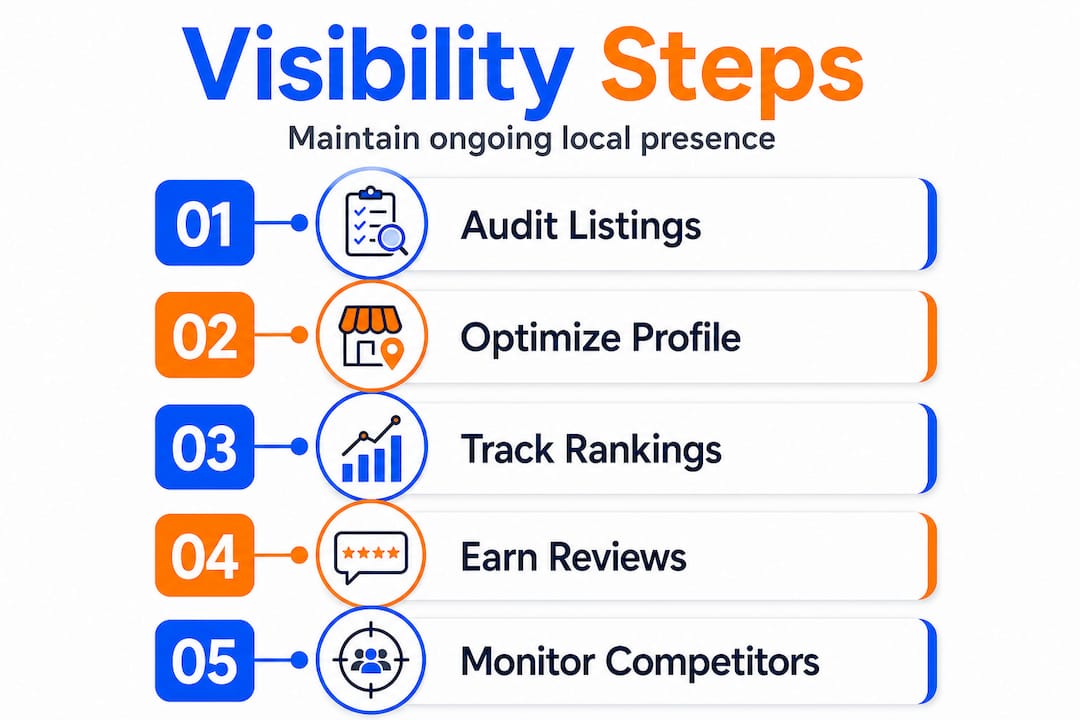
Once your listings are optimized and the sprints are underway, long-term success relies on strong reputation, consistency, and tracking. This is where most businesses fall short, because the work doesn’t stop at setup.
Reviews and local authority building, including consistent NAP citations, form Phase 3 of a results-driven local SEO plan. Here’s what ongoing management actually looks like day to day:
- Ask for reviews systematically. After every completed job, sale, or appointment, send a direct link to your Google review page. Make it easy. Most customers who have a good experience will leave a review if you ask directly and make the process simple.
- Respond to every review. Replying to reviews, positive and negative, signals to Google that your business is active and engaged. It also shows potential customers that you care about their experience.
- Keep NAP data identical everywhere. Your business name, address, and phone number must appear in exactly the same format on every platform, including local directories, Chamber of Commerce listings, industry sites, and social profiles. Even small differences like “Ave” vs. “Avenue” can create confusion for search engines.
- Monitor your local pack position monthly. Your position in the local three-pack can change based on competitor activity, seasonal trends, and algorithm shifts. Tracking local visibility over time and incorporating local-rank tracking by geography gives you early warning when you start slipping.
- Update listings whenever anything changes. New phone number, moved location, adjusted hours, added service. Update every platform within 48 hours of any change to prevent outdated information from hurting your ranking.
For a clear breakdown of what local listings actually are and how they work for you, start with explaining local business listings. And for tactical map-specific strategies, our Google Maps optimization tips page covers the details that move the needle.
Pro Tip: Set up alerts or use a local rank tracking tool to monitor when competitors in your category jump above you in the local pack. Knowing when you drop from position two to position four gives you the information you need to respond quickly, whether that means getting more reviews, adding fresh photos, or publishing a new Google Post.
Local listings optimization: What most guides don’t tell you
Most guides walk you through the steps and then leave you with the impression that optimization is a project you complete. Set it up, check the boxes, move on. That is genuinely dangerous advice in 2026.
We’ve worked with local businesses across dozens of industries, and the pattern is consistent. The ones who see lasting growth in local rankings are not the ones who did the best initial setup. They’re the ones who treat local listings as an ongoing channel, the same way they treat their best sales relationship or their most active marketing effort.
The uncomfortable truth is that a competitor with a slightly weaker profile can outrank you simply by posting more frequently, earning a handful of new reviews, or updating their photos while yours go stale. Google rewards signals of activity and relevance. A profile that hasn’t changed in six months looks inactive compared to one that was updated last week.
Another thing most guides skip over: geography matters more than most people realize. Local-rank tracking by geography shows that your position in the local pack can vary dramatically based on where the searcher is physically located. You might rank number one for someone two blocks from your shop and not appear at all for someone eight blocks in the other direction. Tracking your visibility across your entire service area, not just from your own address, reveals blind spots you’d never catch otherwise.
Review velocity matters too. A business that earns five reviews in one week looks more active to Google’s algorithm than one that has 200 reviews accumulated slowly over five years. Building a consistent, steady stream of reviews each month is more powerful than any one-time burst.
If you want practical strategies that go beyond the basics, our guide to getting found locally covers the real-world tactics that make a measurable difference for service-based businesses.
Take the next step: Make your business stand out locally
Ready to keep your momentum and turn online visibility into real-world results?
The steps in this guide give you a clear path forward, but executing them consistently while running a business is where many owners need support. At ibrand.media, we build and manage exactly these kinds of local visibility strategies for small and medium businesses that want sustainable growth, not short-lived spikes. Whether you’re just starting out or looking to improve an existing presence, our resources are built to meet you where you are. Start with our complete guide to SEO for small businesses, explore the local online marketing guide for strategies that connect to real customers, and review our website search optimization guide to make sure your website supports every local listing you build. Your next customer is already searching. Make sure they find you.
Frequently asked questions
What is the most important element of local listing optimization?
Completing and verifying your Google Business Profile is the single most impactful step, since most local pack results pull directly from GBP data including contact info, photos, and reviews.
How often should I audit my local listings?
Run audits monthly rather than just once, because local visibility trends shift with competitor activity and algorithm changes that a single-day snapshot will miss.
What are NAP citations and why do they matter?
NAP stands for Name, Address, and Phone, and consistent NAP data across all platforms tells search engines your business information is trustworthy, which directly supports local rankings.
Do customer reviews really help my local rankings?
Yes, because GBP reviews and photos are core signals Google uses to determine which businesses appear prominently in local search results.
How long does it take to see results from local listings optimization?
Visibility improvements can appear within a few weeks, but staged optimization over 90 days produces the most durable and significant ranking gains.
Recent Comments