
Most US small businesses pay somewhere between a few thousand dollars and $30,000 for a website redesign. The spread depends on who does the work, how many pages you have and how much custom functionality you need. A DIY redesign typically runs $100 to $3,000. A freelancer typically charges $2,000 to $5,000 for a simple project. An agency starts around $15,000 and climbs from there, according to HubSpot’s breakdown of redesign costs. Below, we explain what sits behind those numbers, what a quote usually leaves out and how to set a budget you can defend.
TL;DR
- A redesign costs $100 to $3,000 DIY, $2,000 to $5,000 for a simple freelancer job, and $15,000 to $30,000 or more through an agency. Large, complex sites run $40,000 to $75,000 or more.
- Price follows three things: the redesign method, site complexity and custom features. There is no single market rate.
- A refresh (new look, same structure) costs far less than a rebuild (new structure, new platform, new content).
- Budget separately for content, redirects, hosting, maintenance and post-launch fixes.
- Set a ceiling first, rank your must-haves, and ask every provider to quote against the same written scope.
Table of Contents
- What a website redesign costs in the US
- What drives the price up or down
- Refresh or full redesign: how the cost compares
- What a redesign quote usually includes, and what costs extra
- How to set a redesign budget
- Where a redesign pays off
- Our perspective on redesign budgets
- Work with a team that plans the whole project
- Protecting your search traffic during a redesign
- Ways to keep the cost down without cutting what matters
- FAQ
- Sources
What a website redesign costs in the US
Published price guides disagree, and the reason is simple: they describe different projects. One guide puts small business redesigns at $3,000 and up, another at $15,000 to $40,000, and a third sets the whole range at $10,000 to $200,000 or more. Each is describing a different buyer, from a one-person shop with eight pages to a company with a 100-page site and custom integrations.
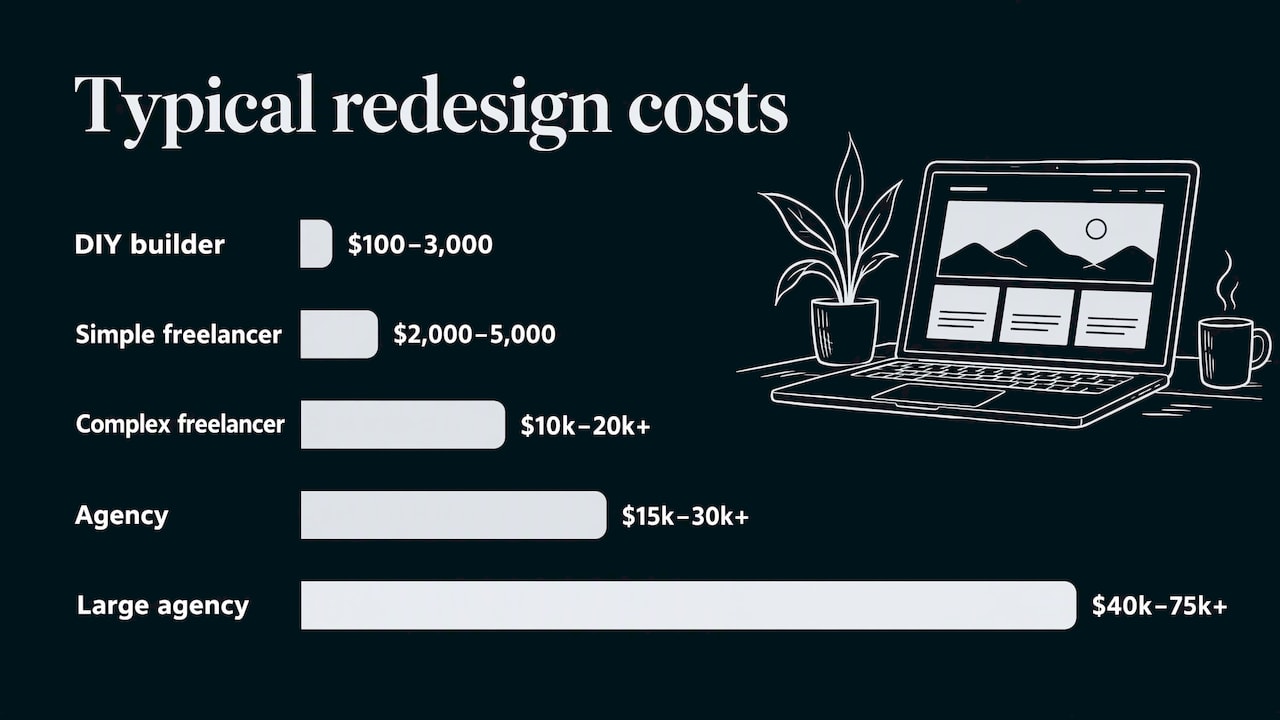
The most useful framing is by who builds it. These figures come from HubSpot’s redesign cost guide:
| Who builds it | Typical cost | Best for |
|---|---|---|
| DIY on a website builder | $100 to $3,000 | Very small sites, tight budgets, owners with time |
| Freelancer, simple project | $2,000 to $5,000 | Brochure sites, template-based designs |
| Freelancer, complicated project | $10,000 to $20,000 or more | Custom features, larger page counts |
| Agency | $15,000 to $30,000 or more | Strategy, design, development and SEO under one roof |
| Agency, large complex site | $40,000 to $75,000 or more | Many pages, integrations, e-commerce |
These are ranges for the one-time project. They do not include what you pay month after month to keep the site running, which we cover below.
For most local service businesses, such as a dental practice, an HVAC company, a med spa or a banquet venue, a site of 5 to 20 pages with good local search foundations is the realistic target. That puts you in the freelancer-to-small-agency part of the table, not the top.
What drives the price up or down
HubSpot’s guidance is that redesign pricing is driven chiefly by the method, the complexity of the site and the custom features you request. In practice, five levers move your quote.
Page count and templates
Every unique page layout has to be designed, built, tested on phones and loaded with content. A site with a homepage, a service page template, a location page template and a contact page is a much smaller job than one with twelve different layouts. Ask whether the quote counts pages or templates. Ten service pages built on one template cost far less than ten one-off designs.
Custom design versus a template
A premium template adapted to your brand is faster and cheaper. A fully custom design built from a blank canvas takes more design hours and more development hours. Neither is wrong. A plumber who needs to rank in three towns and collect calls usually gains more from clear service pages and fast load times than from bespoke animation.
Features and integrations
Online booking, quote calculators, payment processing, membership areas, inventory sync and CRM connections each add scope. A contact form is nearly free. A venue calendar that blocks dates automatically and takes deposits is real development work.
Content
New photography, new copy and video are often billed separately or left to you. Outdated or thin content is one of the main reasons a site underperforms, so it is worth budgeting for rather than copying old text into a new design. Our guide on writing web content for small businesses covers what to prepare before the project starts.
Search visibility
If your current site brings in calls and form fills from Google, the redesign has to protect that. That means mapping old URLs to new ones, keeping page titles and useful content, and setting redirects. Google’s documentation on site moves with URL changes explains how to change URLs while limiting damage to your search results. Skipping this step is the most expensive shortcut in a redesign, because the cost shows up later as lost leads.
Refresh or full redesign: how the cost compares
Searchers often type “website refresh cost” when they want something smaller than a rebuild. The two are different jobs.
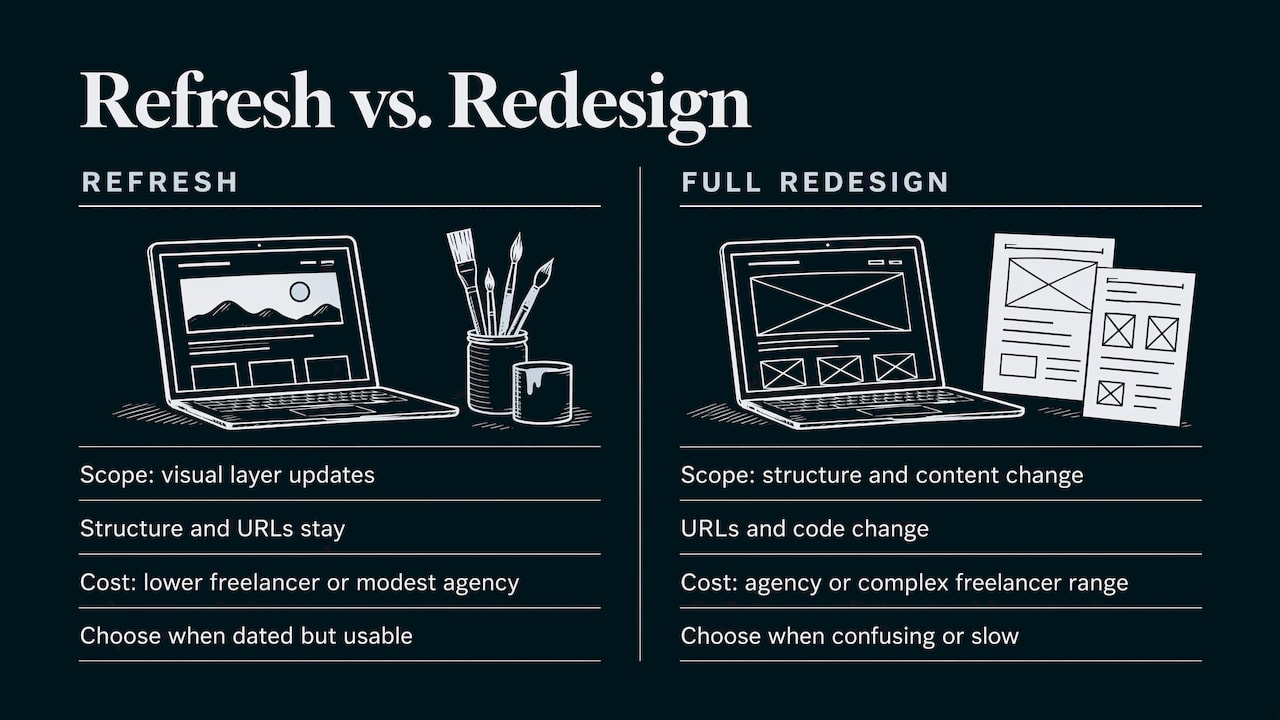
A refresh updates the visual layer. New colors and fonts, a cleaner homepage, updated photos, better buttons and a fix for mobile layout problems. The structure, platform and URLs stay the same. That keeps the scope small, and it fits the lower end of the freelancer range or a modest agency project.
A full redesign changes the structure as well: new navigation, new page types, new content strategy, possibly a new platform. Because the URLs and the code change, it carries the full migration work and sits in the agency and complex-freelancer ranges.
A simple test helps you pick. If visitors can find what they need and the site converts reasonably but looks dated, refresh it. If visitors bounce because the site is confusing, slow, hard to use on a phone or impossible for you to update, rebuild it.
We lay out the basics of what a good small business site includes in our guide to website design basics for local businesses, which is a useful checklist for deciding which camp you are in.
What a redesign quote usually includes, and what costs extra
Two quotes for “a redesign” can differ by thousands because one includes things the other leaves out. Here is how to read a proposal.
Usually included
- Discovery: goals, audience, a review of your current site
- Design of the homepage and key page templates
- Mobile-responsive development
- Setup on a content management system you can edit
- Basic on-page SEO such as titles, headings and image descriptions
- Contact forms and basic analytics
- Testing and launch
Often billed separately
- Copywriting and photography
- Migrating a large number of old pages or blog posts
- Redirect mapping for every old URL
- E-commerce setup and product uploads
- Custom integrations with booking, CRM or payment tools
- Training for your staff
- Ongoing hosting, security and updates
- Extra revision rounds beyond what the contract allows
Costs after launch
The project fee is not the whole budget. Hosting, a domain, security updates, backups and small edits recur every month or year. Plan for them as a line item. A site with no one responsible for maintenance slowly breaks and ages, and you end up paying for another redesign sooner.
If your plan includes e-commerce, a booking engine or anything similar, price those parts on their own line so you can see what the core site costs.
How to set a redesign budget
Here is a process that works for owners who do not want to be surprised.
- Start with what the site must earn. Count how many calls, bookings or orders the site produces now and what a typical customer is worth. A site that brings in one extra $2,000 job per month can justify a different spend than one that is a business card.
- Set a ceiling. Decide the most you will spend, including content and the first year of upkeep, before you talk to anyone. Our marketing budget planning guide for small businesses shows how to place website spending inside your wider marketing budget.
- Rank your features. Split a list into must-have, nice-to-have and later. The “later” list is where budgets are saved.
- Write the scope down. Page count, templates, features, content responsibilities, revision rounds and timeline. A tight written scope protects both sides, and a one-page creative project scope is a good model for keeping it short and enforceable.
- Ask for itemized quotes. Collect at least three, all against the same scope, and compare line by line, not by the total.
- Hold back a contingency. Keep roughly 10 to 15 percent of the budget for surprises such as extra pages or content delays. That figure is a common planning habit, not a rule.
- Phase it if you must. Launch the core pages first and add a blog, a booking tool or location pages in a second phase.
Where a redesign pays off
A redesign is a cost only if the site does not work harder afterward. The returns come from a few places: more visitors converting on a phone, faster load times, clearer service pages that match what people search for and a structure that lets you add content without a developer. Our overview of why investing in web design pays off for small businesses goes through these in detail.
To know whether it worked, you need numbers from before and after. Record current traffic, calls, form submissions and conversion rate. Then follow the steps in our guide on how to track marketing ROI so the redesign has a measurable result rather than a general feeling that it looks better.
Our perspective on redesign budgets
We see the same pattern with local business owners. They get three quotes, one at $2,000 and one at $30,000, and cannot tell what separates them. The difference is almost never the design. It is the scope: who writes the content, who handles redirects, who maintains the site and whether anyone thinks about search.
Our view is that a small business does not need an enterprise budget to get a site that works. It needs a plan for each part of the project, a design that is mobile-friendly from the start and a way to see results in real time once the site is live. That is how we approach it: a custom plan for each client, built around what the business actually needs, with clear pricing and hands-on support rather than a package sold off the shelf.
If your current site brings in customers, protect that traffic. If it does not, a redesign is the moment to build one that does, with local search and tracking set up from day one.
TONY
Work with a team that plans the whole project
Ibrand Media works with small and local businesses, including home service companies, dentists, med spas and venues, on web design, website development, SEO, local marketing and advertising. We build a custom plan for each client, and our Realtime Stats service lets you follow performance after launch. If you want a quote built against a written scope, tell us about your project on our site and we will put a plan together.

If you are still comparing options, our guides on affordable web design for small businesses and what a small business website really costs are a good next read.
Protecting your search traffic during a redesign
This step deserves its own checklist because it is where redesigns most often lose money.
- Crawl your current site and list every URL before you change anything.
- Map each old URL to its new home one to one wherever possible. Google’s guidance on redirects explains the types and when each applies.
- Keep the redirects live for a long time. Google’s Search Console help recommends keeping them for at least 180 days, and longer if you still see traffic arriving through them.
- Keep pages that rank and convert and improve them rather than rewriting from scratch.
- Check Google Business Profile details so your name, address and phone number match the new site.
- Watch traffic and calls weekly for the first two months and fix problems quickly.
If local search brings you most of your customers, a redesign is also a good time to strengthen it. Our guide to SEO for small businesses shows what to build into the new site.
Ways to keep the cost down without cutting what matters
- Use fewer templates. Reusing one well-designed service page layout across all services is the biggest saving in most projects.
- Prepare content yourself. Gather photos, team bios, service descriptions and testimonials before the project starts, so no one waits on you and bills for it.
- Cut features, not quality. Launch without a blog or a booking tool and add them when the core site is earning.
- Choose a platform you can edit. If you can change a phone number or add a service page without a developer, you save on every small change afterward.
- Limit revisions to a stated number. Consolidate feedback from all decision makers into one document per round.
- Redesign what is broken. If your service pages are strong but your homepage and mobile layout are weak, start there.
FAQ
How much does a website redesign cost for a small business?
For a small business, a redesign commonly falls between $2,000 and $30,000, depending on who builds it and how much custom work you need. DIY builds run $100 to $3,000, simple freelancer projects $2,000 to $5,000 and agency projects $15,000 to $30,000 or more, per HubSpot. Your own number depends on page count, features and content.
How much does a website refresh cost compared with a redesign?
A refresh costs less because it changes the look and leaves structure, platform and URLs alone. It usually fits within a simple freelancer or small-agency budget. A full redesign adds new structure, content and migration work, so it lands in the higher ranges above. Ask any provider to quote both so you can compare.
Does a redesign hurt my Google rankings?
It can if URLs change without redirects or if ranking content is removed. Following Google’s site move guidance, mapping old URLs to new ones and keeping redirects in place protects most of your search visibility. Monitor traffic after launch to catch problems early.
How long does a redesign take?
It depends on scope and on how quickly you supply content and feedback. A small template-based site can move quickly, while a custom site with integrations takes longer. Delays most often come from late content and unclear approvals, so agree a timeline in the written scope.
Should I hire a freelancer or an agency?
A freelancer often suits a simple site with a clear scope and a lower budget. An agency suits projects that need design, development, SEO and ongoing support from one team. Choose based on your scope and how much hands-on help you want after launch.
Sources
- What Does It Cost to Redesign a Website? (HubSpot)
- Site Moves and Migrations (Google Search Central)
- Redirects and Google Search (Google Search Central)
- Change of Address tool (Search Console Help)
Recent Comments