
Google Local Services Ads (LSAs) have no fixed price. You pay per valid lead, not per click, and the price of each lead depends on your location, your job type, your lead type and your bidding mode. Your real cost is the weekly budget you choose, divided by how many of those leads turn into paid jobs. This guide shows how the charges work, what moves the price, and how to run the math for your own business before you spend a dollar.
TL;DR
- Google charges per valid lead (a call, message or booking request from your ad), not per click, and the price varies by location, job type, lead type and bidding mode.
- You set a weekly budget and a bidding mode. Google recommends a budget equal to about 10 leads a week with Maximize leads, and the system needs roughly two weeks to learn.
- Invalid leads (wrong numbers, spam, out-of-area, services you do not offer) can be disputed within 30 days in the U.S. and credited.
- The number that matters is cost per booked job, not cost per lead. Track both from week one.
Table of Contents
- How Google charges for Local Services Ads
- What actually sets the price of a lead
- Choosing a bidding mode
- How to set a Local Services Ads budget
- When the cost makes sense for your business
- Ways to lower your cost per booked job
- LSAs, Google Ads and local SEO: where the budget goes
- Our perspective: judge ads by booked jobs, not clicks or leads
- Get a plan built around your numbers
- FAQ
- Sources
How Google charges for Local Services Ads
Local Services Ads work on a pay-per-lead model. Google’s own help page says lead prices may vary by location, job type, lead type or bidding mode, and every lead you receive counts toward your budget.
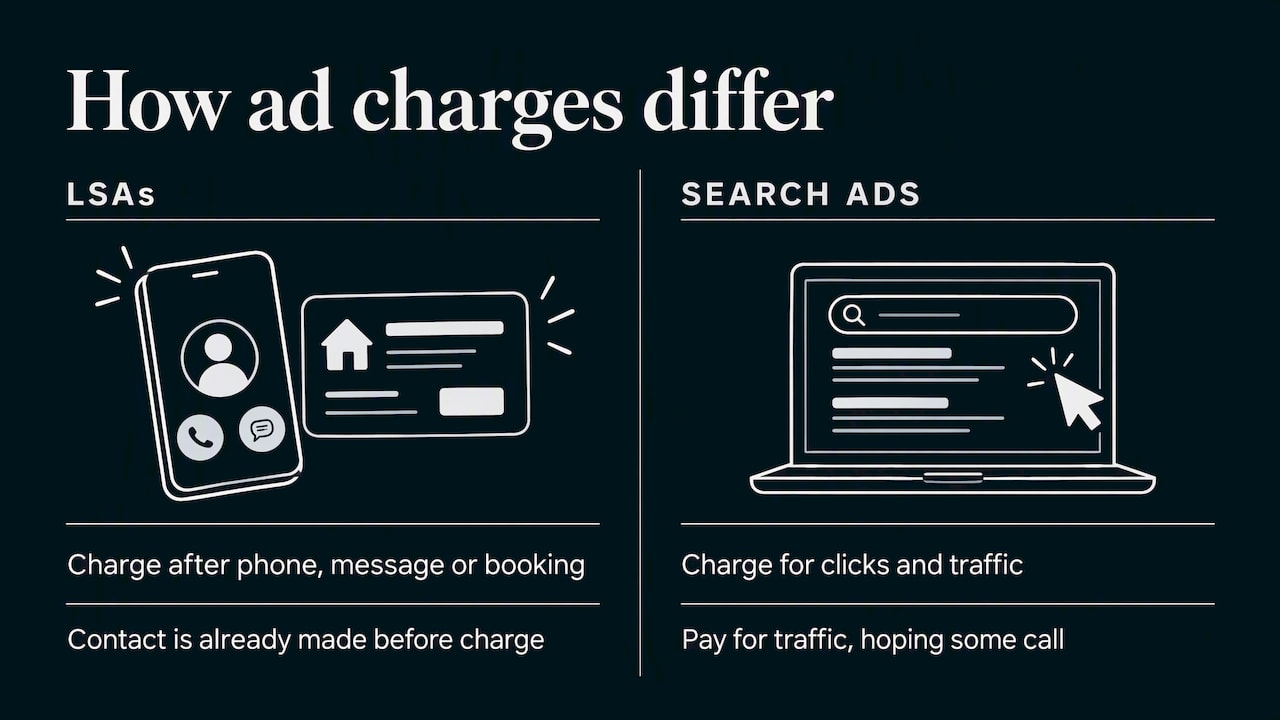
Google’s U.S. guide explains that you are charged when a prospect reaches out by phone call, message or appointment booking directly from the ad. Nothing is charged for an impression or for someone looking at your profile.
That is the main difference from a standard search campaign. In a click-based campaign you pay for traffic and hope some of it calls. With LSAs you pay when someone has already made contact. That sounds cleaner, and for many trades it is. It also means the quality of your leads, and how fast you answer them, decides whether the spend pays back.
What counts as a billable lead
Google lists several kinds of valid leads. In the United States and Canada, a valid lead can be a spoken phone call, a voicemail, a text or email, a booking request, or a missed call without voicemail followed by a return contact.
Follow-ups from the same person are not billed over and over. According to the same page, if the customer keeps interacting through the same phone number or email within 15 days, those follow-ups are not charged again. After 15 inactive days, a new qualifying contact can create a new charge.
Disputing leads you should not pay for
In the U.S., you can dispute a charged lead within 30 days for listed reasons. These include wrong numbers, solicitation, spam, customers outside your service area, services you do not offer, store or product inquiries and duplicate follow-ups. Successful disputes are credited, and Google also reviews leads itself and credits the ones it identifies as invalid (Google’s lead rules).
Practical habit: review every lead weekly, not monthly. A 30-day window is easy to miss when you are on a job site. Flag the wrong-service calls and out-of-area requests as you go, and keep a note of why each one qualifies.
What actually sets the price of a lead
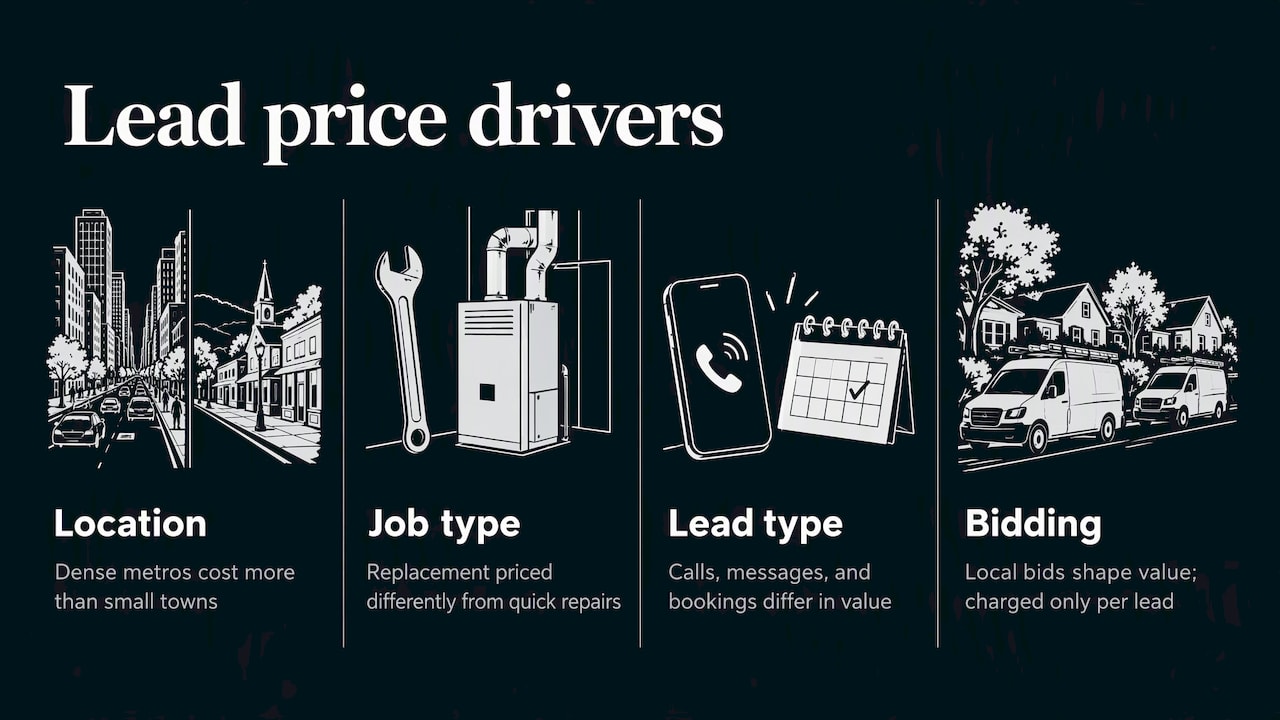
Google does not publish a rate card, and anyone quoting you one number for “LSA cost” is simplifying. Four things move the price.
Location. A lead in a dense metro with many competing providers costs more than the same lead in a small town. You are effectively bidding against nearby businesses.
Job type. Google lets you choose the jobs you want to receive. A high-value job like a full system replacement is priced differently from a quick repair or a drain clearing. Narrowing your job types to what you want to sell protects your budget from low-value calls.
Lead type. A phone call, a message and a booking request are not identical in value, and Google notes lead type as a price factor.
Bidding mode and competing bids. Google explains that bids from similar local businesses help determine what a lead is worth, and that you pay only when you receive a lead. If you bid low in a competitive area, you may simply get fewer leads and a lower position.
Industry benchmark reports usually show home-service leads costing in the tens of dollars, and legal and other high-ticket categories costing noticeably more. Treat any benchmark as a starting guess. Your own account data after a few weeks is far more reliable than an average drawn from other markets and trades.
Choosing a bidding mode
Google documents three bidding modes: Maximize leads, Target cost per lead and Max per lead.
| Bidding mode | How it works | Best for |
|---|---|---|
| Maximize leads | Google sets bids to get the most leads within your budget | New accounts and owners who want volume with little management |
| Target cost per lead | You name the average price you want to pay per lead | Businesses that know their break-even lead cost |
| Max per lead | A manual ceiling on what you will pay for any single lead | Owners who want strict control and can watch the account |
For most small businesses starting out, Maximize leads is the simplest way to learn what the market charges. Once you have a few weeks of data and know your cost per booked job, switch to a target or a ceiling so the account works to your numbers.
How to set a Local Services Ads budget
Google’s process is straightforward. Set an average weekly budget based on how many leads you want, then pick a bidding mode. Weekly spend can run above the average, but it will not exceed the monthly maximum. When that maximum is reached, your ads stop for the rest of the month unless you raise the budget.
Two details from Google’s bidding guidance matter for planning. First, Google recommends a minimum budget equivalent to 10 leads per week for best results with Maximize leads. Second, the system may take about two weeks to learn before results become accurate. Do not judge the campaign after three days.
Google also points advertisers to a budget calculator on its U.S. Local Services Ads page for an estimate in your category and area.
A worked example (hypothetical numbers)
These numbers are illustrations to show the method, not prices you should expect.
Say a plumbing company sees leads at $50 each. Ten leads a week is $500 a week, roughly $2,000 a month.
- Of 40 leads a month, 10 are wrong service, spam or out of area. A good dispute habit gets many of those credited, but assume you recover only some.
- Of the 30 valid leads, you answer 24 and book 12 jobs.
- Cost per booked job: about $2,000 divided by 12, or roughly $167.
- If the average job brings in $450 in revenue, the campaign is profitable before overhead. If the average job is $150, it is not.
Change one input and the answer changes. If you answer 18 of the 30 calls instead of 24, your cost per booked job climbs sharply, with no change in ad price. That is why the next section matters more than the bid.
When the cost makes sense for your business
LSAs are not right for every business, but the test is simple. Work through four questions.
- What is a booked job worth to you? Use gross profit per job, not revenue. Lifetime value counts if customers return, as in HVAC maintenance plans or recurring med spa treatments.
- What share of your leads do you book? Track calls answered, estimates given and jobs won. A business that books one in two valid leads can pay more per lead than one that books one in four.
- Can you answer fast? LSA leads are people who are ready to talk now. A missed call that goes to voicemail is a paid lead you may lose to the next business on the list. Set up call routing, a staffed line during ad hours and a text-back for after hours.
- Is your profile strong? Reviews, response speed, a complete profile and your verification status all shape how Google ranks you. A better rank means more leads for the same budget.
If the numbers hold, LSAs can be one of the more direct ways to get calls from local searchers. If you are at a very small budget, a smaller test across fewer job types is better than spreading thin across everything you do. For help on the budget question in a click-based campaign, see our note on dayparting on small budgets.
Ways to lower your cost per booked job
You rarely win by simply cutting the bid. These steps usually do more.
- Trim your job types. Turn off services you do not want. Every off-target call is a charge you must dispute, if it qualifies at all.
- Set tight service areas. Out-of-area leads are disputable, but avoiding them is easier than chasing credits.
- Answer every call, or return it quickly. Google counts a missed call followed by a return contact as a valid lead, so the sooner you call back, the more of those you convert.
- Dispute invalid leads weekly. Use the 30-day window and keep notes.
- Collect reviews steadily. Ask after each finished job. Reviews help your profile rank and convert.
- Adjust hours. If your team cannot answer on weekends, do not pay for weekend leads you cannot take.
- Review by job type. Some jobs will book at much higher rates than others. Shift budget toward the ones that pay.
Our guide on cost-effective plumber marketing walks through how this plays out for one of the trades that uses LSAs most.
LSAs, Google Ads and local SEO: where the budget goes
LSAs sit alongside other ways to be found locally, not instead of them. Ads are rented visibility: when the budget stops, the leads stop. Local search work builds visibility that keeps working. Many owners run LSAs for fast lead flow while building organic and map presence for the longer term.
If you are deciding between channels, our comparison of Google Ads and Facebook Ads covers how to choose which to run first. For a wider view of paid local visibility, see how to run local ads and our guide to Performance Max local campaigns. To build the organic side, start with service area business SEO and the basics of local search for service businesses.
Our perspective: judge ads by booked jobs, not clicks or leads
Most owners ask us what a lead costs. We think the better question is what a booked job costs, because that is the number your bank account sees.
We work with small and local businesses, and the pattern repeats: two companies pay the same price per lead, and one earns far more. The difference is rarely the ad. It is how fast the phone is answered, how clean the targeting is, how the profile looks, and whether anyone is reading the numbers each week.
That is why we build a custom plan for each client and track performance in real time. You should see calls, booked jobs and spend side by side, so you can decide when to raise a budget and when to cut it. Paid leads work best when they sit on top of a strong website and a healthy local search presence, so we plan them together.
If you are going to spend money on ads, you deserve plain numbers and a partner who explains them.
TONY
Get a plan built around your numbers
If you would rather not manage bids, disputes and reports yourself, we can help. IBrand Media offers advertising, local marketing, SEO, web design and real-time performance tracking for small and local businesses, with a custom plan for each client. We start from your job values and capacity, then set a budget that fits.
See what we offer on the IBrand Media homepage and request a custom plan. If your site needs work before you send paid traffic to it, our notes on mobile-friendly lead conversion show what usually matters most.
FAQ
How much does Google Local Services Ads cost?
There is no flat fee. Google charges per valid lead, and the price depends on your location, job type, lead type and bidding mode. You control spending through a weekly budget and a monthly maximum. Your own account data after the first few weeks will show your true average.
How much should I budget for LSAs to start?
Google recommends a budget equal to about 10 leads a week for best results with Maximize leads, and says the system may need about two weeks to learn. Multiply the lead price you see in your category and area by 10 to get a starting weekly figure, then adjust with real results.
Can I get a refund for bad leads?
In the United States, you can dispute a charged lead within 30 days for reasons such as wrong numbers, spam, solicitation, out-of-area customers or services you do not offer. Successful disputes are credited, and Google also credits leads it identifies as invalid.
Am I charged again if the same customer calls back?
Not within 15 days. Follow-up calls or messages through the same phone number or email are not charged again while the interaction continues. After 15 inactive days, a new qualifying contact can create a new charge.
What happens when I hit my monthly maximum?
Your ads stop for the rest of the month unless you raise the budget. Weekly spend can go above your average weekly budget, but Google says it will not exceed the monthly maximum.
Sources
- How leads work – Local Services Help (Google)
- How leads work, U.S. and Canada rules (Google)
- How bidding works for Local Services Ads (Google)
- How to grow your business with Local Services Ads (Google)
- Reach Local Customers with Local Service Ads (Google Ads)
Recent Comments