
For a small or local business in the United States, professional reputation management typically runs about $500 to $3,500 per month on an agency retainer, depending on how much work is included. Software-only tools cost less because you do the work yourself. Crisis cleanup, multiple locations and heavy negative content push quotes well above the standard range. Below, you’ll see what sits behind those numbers, which pricing models you’ll meet, and how to compare quotes so you pay for results and not for padding.
TL;DR
- Small and mid-sized businesses commonly see $500 to $3,500 per month for standard agency reputation management, with many quotes landing in the lower half of that range.
- The price follows scope: review monitoring and replies cost the least, while review generation, listing cleanup, content work and crisis response each add cost.
- You will meet three models: monthly retainer, one-time project and hourly. Retainers fit ongoing review management best.
- Compare quotes on deliverables, contract length, reporting and who owns the accounts, not on the monthly number alone.
- Multi-location businesses and active crises are quoted individually. Expect a scoping call, not a price list.
Table of Contents
- What reputation management actually costs
- What you get at each price level
- The factors that move your quote
- Pricing models you will meet
- How to compare quotes without getting burned
- Is it worth the money?
- Our perspective
- Pricing by business type
- Multiple locations and crises
- Get a reputation plan scoped to your business
- FAQ
- Sources
What reputation management actually costs
Start with the numbers you can lean on. A 2025 Forbes Council piece puts standard agency retainers for small businesses between $500 and $3,500 a month, and the same article cites $500 to $2,500 for small to mid-sized companies in the US. Those two figures overlap, which is the useful part: if a quote for a single-location business sits inside $500 to $2,500, it is in the normal band. Above $3,500 you should expect a clear reason, such as several locations, a crisis or a lot of content production.
The ranges you see online differ because they describe different jobs. A retainer that monitors Google reviews and answers them is one job. Suppressing damaging search results is another. Repairing a brand after a viral complaint is a third. When a page says “reputation management costs $20,000 a month,” it is almost always describing the third kind of work for a large company, not a dentist or an HVAC contractor.
Here is a practical way to read the market by need:
| What you need | What it usually involves | How it is typically priced |
|---|---|---|
| Review monitoring and replies | Alerts, response drafts or posting, basic monthly report | Low monthly retainer, or a software subscription |
| Review generation | Request campaigns by text or email, follow-up flow, review-site setup | Monthly retainer, often with a setup fee |
| Local profile and listing cleanup | Google Business Profile, directory accuracy, duplicate removal | One-time project, then maintenance in a retainer |
| Search result repair | New content, profile building, pushing negative pages down | Higher monthly retainer over several months |
| Crisis response | Fast triage, public statements, platform disputes, daily monitoring | Custom quote, scoped to the situation |
Treat this table as a map of work, not a price list. Each row costs more than the one above because it needs more skilled hours and takes longer to show results.
What you get at each price level
Entry level: monitoring and responses
At the bottom of the range you pay for visibility and consistency. Someone watches Google, Yelp, Facebook and the review sites that matter in your trade, flags new reviews and responds. For many local businesses this alone changes the picture, because unanswered negative reviews tell a prospect you do not care. Software that does the monitoring is cheaper still, but it needs a person on your side who writes the replies and checks the dashboard.
Mid range: monitoring plus a review engine
The middle of the market adds a system that asks happy customers for reviews at the right moment, usually right after a completed job or visit. This is where most home service companies, dental practices, med spas and venues get the best return, because the steady flow of recent, honest reviews does more to lift your star rating than any single cleanup effort. You also see profile optimization here: complete categories, accurate hours, photos and service descriptions.
Upper range: content, search and brand protection
Prices climb when someone must create and place new content to outrank harmful pages, manage knowledge panels or handle disputes with platforms. This work is slow by nature. Results usually take months, so contracts at this level run longer and price reflects the specialist hours involved.
Crisis work
Crisis response is quoted per situation. You are paying for speed, senior attention and a plan, and no honest provider will give you a flat price before they see what is happening. Be wary of anyone who promises to erase accurate reviews or guarantees removal of content from a platform. Platforms decide what stays up, and a provider can only file valid disputes and build better content around the problem.
The factors that move your quote
Two businesses in the same city can receive very different quotes. These are the reasons.
- Number of locations. Each location has its own listings, reviews and ranking. Five locations is not five times the work, but it is far more than one, and most providers quote per location or with a multi-location discount.
- Review volume and backlog. A business with 40 reviews and a few unanswered complaints is a small job. One with 2,000 reviews across six platforms needs more hours.
- Severity of the problem. A few lukewarm reviews are routine maintenance. A news story, a lawsuit mention or a wave of fake reviews calls for a different team.
- Industry. Healthcare, legal and financial businesses face stricter rules about what can be said in public replies, so the work is slower and more careful. Dental and med spa practices, for example, must keep patient details out of responses.
- Scope of services. Monitoring only, or monitoring plus generation, plus content, plus reporting. Every added piece adds cost.
- Contract length. Longer commitments usually bring a lower monthly rate. Short or month-to-month terms cost a bit more but carry less risk.
- Reporting and tooling. Live dashboards and detailed reports take setup and software, and some providers pass that cost on.
- Speed. Rush work and daily monitoring cost more than a steady monthly rhythm.
Pricing models you will meet
Monthly retainer
The standard for ongoing review management. You pay a fixed amount each month for a defined list of tasks. It suits reputation work because reviews arrive every week and the benefit builds over time. Ask what happens if a month is unusually busy: does the scope flex, or do you get billed extra?
One-time project
Good for a bounded job: a listing cleanup, a Google Business Profile rebuild, a review-request system setup or an audit. You get a fixed fee and a clear end date. The risk is that nobody maintains the result afterward, so ask for a short handoff guide or a maintenance option.
Hourly or per-incident
Used for consulting, crisis support and one-off tasks. It is flexible, but the total can grow fast. If you choose hourly, ask for an estimate with a cap and a weekly summary of hours.
Software subscription
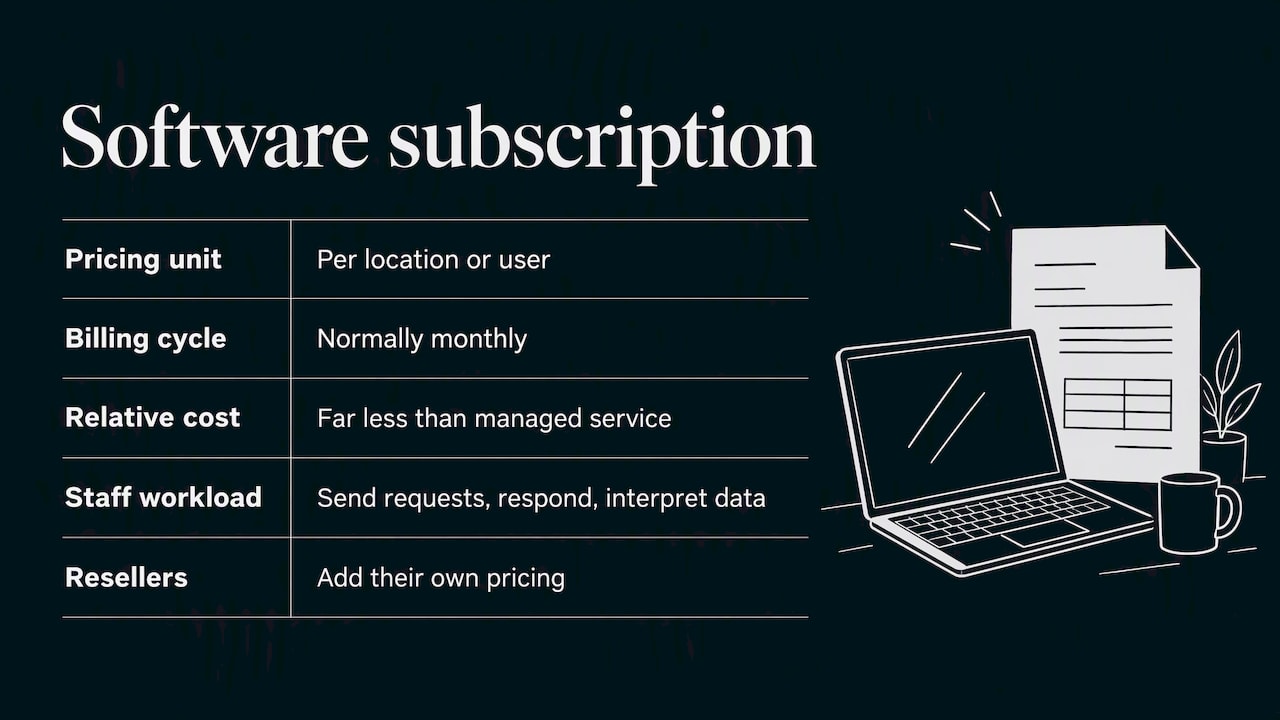
Software that collects reviews, sends requests and consolidates messages is priced per location or per user, normally per month, and costs far less than a managed service. The trade-off is labor: you or a staff member must send requests, respond and interpret the data. Agencies that resell these tools add their own pricing on top, and agency comparison and buyer guides can help you see how providers are positioned and what clients they suit before you ask for quotes.
How to compare quotes without getting burned
Two quotes with the same monthly number can buy very different things. Before you sign, put the proposals side by side and check:
- Deliverables in writing. How many review requests are sent, how many responses are written, how many listings are managed. “Ongoing optimization” is not a deliverable.
- Who owns the accounts. Your Google Business Profile, review platform logins and any new profiles should belong to you from day one.
- Contract term and exit terms. Know the minimum commitment and how to cancel. A three to six month initial term is common for ongoing work, but you should never be locked into a vague auto-renewal.
- Setup fees. Are they one-time, and what do they cover?
- Reporting. You should see review counts, average rating, response time and where leads came from, not just a vanity summary.
- Review sourcing. Reviews must come from real customers. Buying or inventing reviews can get your listings penalized and damages trust far more than a few bad ratings.
- Your time. Ask what you must do each week. Some systems need a short approval step, and that is fine, as long as it is stated up front.
If a proposal cannot answer these in plain language, that tells you something about the provider.
Is it worth the money?
The fair question is whether the spend pays back. For a local business it usually shows up in three places: more calls and bookings from people who compare ratings before choosing, better conversion from your existing traffic, and fewer lost jobs to a competitor with more recent reviews. You can estimate your own break-even. Take the monthly fee, divide by your average job or patient value, and you know how many extra customers a month you need. For an HVAC company with a high ticket value, one extra installation can cover several months of service. For a lower-ticket business, you need a steadier flow.
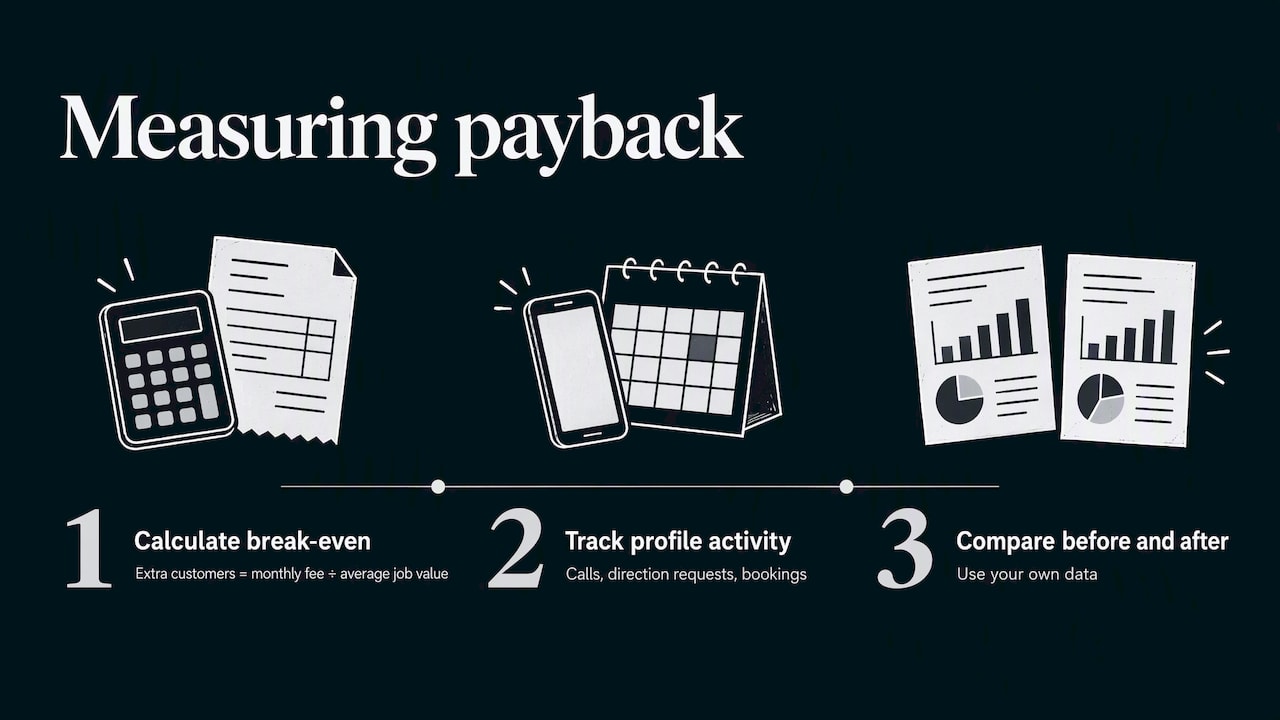
The cheapest way to lose money is to pay for a service and never ask for the numbers. Whatever you choose, track calls, direction requests and bookings from your profile before and after you start, so the decision is based on your own data.
Our perspective
At IBrand Media we work with local and small businesses, such as home service companies, dental practices, med spas and venues, and we see the same pattern again and again: reputation is not a separate project. It sits right next to your Google Business Profile, your local search presence and your website, and it works best when those pieces are managed together.
That is why we build a custom plan for each client and do not push one package at everyone. A banquet hall needs a steady stream of event reviews and fast answers to inquiries. An HVAC company needs reviews tied to completed jobs and a strong profile in the busiest season. A dental practice needs careful, privacy-conscious replies. The same monthly price cannot fit all three, and we think you should know what you are paying for.
Our approach is built around transparent pricing, real-time performance tracking and hands-on support, so you can see what changes each month and judge it against your own bookings. Our aim is to give small businesses a practical, affordable route to a stronger online reputation, without the long, opaque contracts you often see at the high end of the market.
TONY
Pricing by business type
The same service plays out differently by trade, and our guides cover several in detail. If you run a venue, read our affordable venue reputation management strategies. Contractors can start with our overview of HVAC reputation management, and dental practices will find specifics in our guide to online reputation management for dentists.
If you are still working out what to do before spending, our guide on improving online reputation for small businesses lists the free steps worth taking first, and our article on protecting your online business reputation explains how to prepare for the next negative review. When you start comparing providers, our small business guide to choosing a marketing agency gives you a checklist you can reuse for any quote.
Multiple locations and crises
Both cases need a scoped quote. With several locations, ask for a per-location rate and a rollup report, so you can see which sites lag. Start with the weakest location, prove the method works, then expand. With a crisis, ask the provider for a written first-week plan before you commit to a longer contract: what will be monitored, who responds, what you approve and when the first update arrives. Speed matters more than a perfect proposal.
Get a reputation plan scoped to your business
We build reputation management as part of a wider local presence: profile optimization, local SEO, review requests, replies and live performance tracking. Every plan is customized to your trade, your locations and your budget, and we explain what each part costs before you commit. If you want a clear scope and number for your business, talk to us about a custom plan.

If you want search visibility to work alongside your reviews, our guide to SEO for small businesses shows how the two fit together.
FAQ
How much does reputation management cost per month?
For most small and mid-sized US businesses, a managed service lands between $500 and $3,500 per month. Software-only options cost less but require your own time. Crises and multi-location brands are quoted separately.
Is online reputation management cost a monthly or one-time fee?
Both exist. Ongoing review monitoring, requests and replies are billed monthly because the work never stops. Listing cleanups, audits and system setups are often one-time projects. Many providers combine a setup fee with a monthly retainer.
Can I pay less by doing it myself?
Yes, for basic tasks. Claiming your profiles, asking happy customers for reviews and replying within a day cost only time. The paid route makes sense when you lack that time, have several locations or face a problem you cannot fix alone.
How long before I see results?
Review response and profile improvements can show within weeks, while a higher average rating builds over months as new reviews arrive. Search result repair takes longer. Be cautious of any provider that promises a fixed outcome or a guaranteed removal.
What should a good proposal include?
A written list of deliverables, the contract term, setup fees, reporting you will receive, and confirmation that you own all accounts. It should also describe how reviews are collected from real customers.
Sources
- How Ethical Business Practices Impact The Bottom Line (Forbes Business Council, 2025)
- Agency Review Guide: agency profiles and buyer guides
Recent Comments