
TL;DR:
- Mobile devices are now the primary platform where consumers live and shop, with 75% of e-commerce traffic coming from them. To succeed, businesses must prioritize mobile advertising, utilize diverse ad formats, and adopt advanced measurement methods like incrementality testing in a privacy-first world. Effective mobile strategies involve continuous creative iteration, behavioral targeting, and integrating owned channels for maximum ROI.
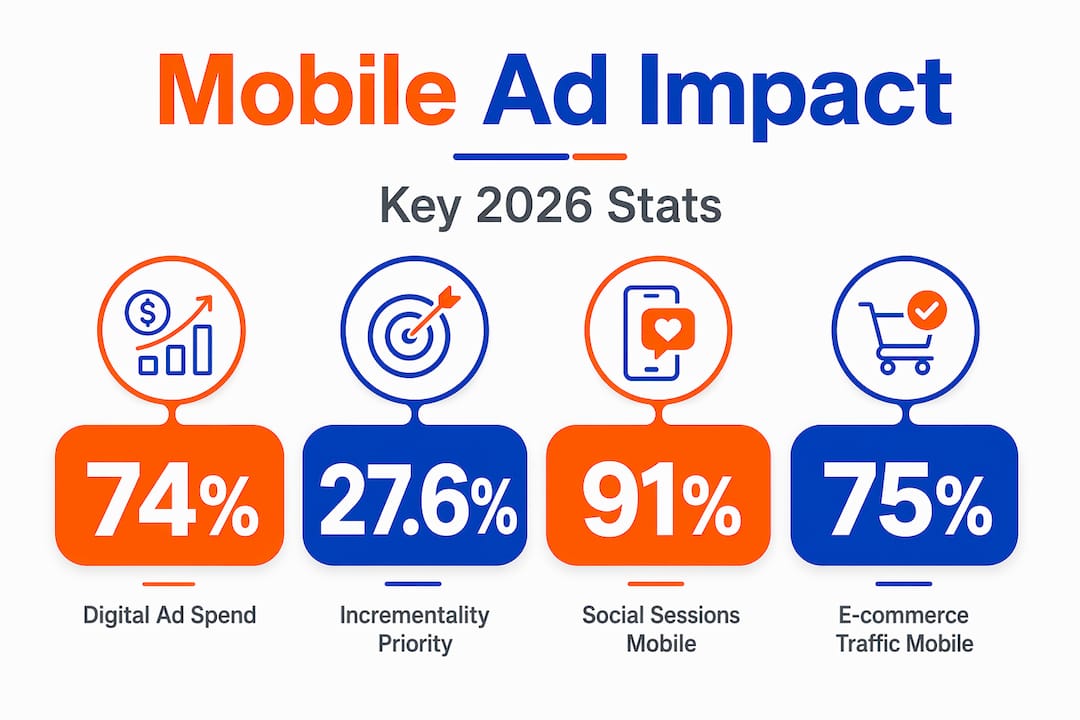
Mobile devices are no longer where your audience goes. They’re where your audience lives. The role of mobile ads has shifted from a secondary channel to the backbone of digital marketing, and the numbers confirm it. Mobile devices generate 75% of e-commerce traffic and account for roughly 74% of all digital ad impressions globally in 2026. If you’re still treating mobile as an add-on to your desktop campaigns, you’re not just behind. You’re invisible to the majority of your customers.
Table of Contents
- Key takeaways
- The role of mobile ads in the 2026 marketing ecosystem
- Mobile ad formats and creative best practices
- Measuring mobile ad effectiveness in a privacy-first world
- Practical strategies for business growth through mobile ads
- My honest take on mobile ads after watching businesses run them
- Take your mobile strategy further with Ibrand
- FAQ
Key takeaways
| Point | Details |
|---|---|
| Mobile is the primary ad channel | Mobile absorbs 74% of digital ad spend in 2026, making it the default channel for reaching consumers. |
| Creative variety drives performance | Uploading multiple text, image, and video assets per campaign significantly improves ad relevance and results. |
| Incrementality beats attribution | Proving true ad lift requires controlled incrementality tests, not just ROAS or last-touch attribution. |
| Privacy changes measurement | iOS privacy frameworks introduce data delays and aggregated reporting that require adjusted optimization strategies. |
| Owned channels deliver top ROI | SMS and push notifications convert at rates that paid media rarely matches, making them worth serious investment. |
The role of mobile ads in the 2026 marketing ecosystem
Mobile advertising is no longer a budget line you test and scale back. It’s the primary surface where consumer attention lives, and your marketing dollars need to follow.

Consider this: global mobile ad spend is projected to exceed $430 billion in 2026, representing nearly three-quarters of all digital advertising investment. That figure isn’t just large. It reflects a permanent behavioral shift. Consumers check their phones an average of 150 times a day, and 91% of social media sessions happen on mobile devices. Your audience is scrolling, swiping, and buying on their phone before they ever open a laptop.
Here’s what that means strategically for your business:
- Mobile is where purchase decisions happen. Mobile commerce sales hit $2.51 trillion in 2025, with 63% of global retail e-commerce coming from mobile devices. The product research, the comparison, and the checkout all happen on one screen.
- Mobile ads complement your full funnel. They work at every stage, from awareness through video and display, to conversion through in-app and search ads. No other single channel covers that range.
- The why prioritize mobile ads question answers itself. When your customer is on their phone 3.5 hours a day inside apps, advertising there is simply meeting them where they are.
Understanding the digital advertising landscape for SMBs also helps contextualize why mobile commands such a large portion of modern budgets. It’s not hype. It’s behavior.
Mobile ad formats and creative best practices
Not all mobile ads work the same way, and the format you choose shapes how your audience experiences your brand. Getting this right is where most businesses leave performance on the table.
Common mobile ad formats worth knowing
The four formats that dominate in 2026 are in-app display ads, short-form video, banner ads, and rich media interactives. Each serves a distinct purpose.
In-app ads remain the highest-engagement format because they appear inside experiences people actively chose to open. Mobile users spend an average of 3.5 hours per day inside apps, and in-app advertising revenue is projected to reach $390 billion in 2025. You’re not interrupting their browsing. You’re appearing inside their favorite game, news app, or social platform.
Short-form video captures attention in the first two seconds or loses it entirely. The creative has to front-load the hook, include captions for silent viewing, and match the native feel of the platform it appears on.
Rich media and HTML5 ads drive higher interaction rates than static banners because they invite a response. They work especially well for product launches where showing beats telling.
How to build creative assets that actually scale
This is where many businesses get the structure wrong. They create one version of an ad and run it until performance fades.
Google’s own recommendation is to upload up to 20 images and 20 videos per app campaign, along with 4 text variations. That variety allows the platform’s algorithm to test combinations and find what resonates with different audience segments. A single image with a single headline gives the system almost nothing to work with.
| Asset type | Recommended quantity | Primary purpose |
|---|---|---|
| Text headlines | 4 variations | Test messaging angles |
| Images | Up to 20 | Cover audience segments and contexts |
| Videos | Up to 20 | Drive engagement and conversion |
| HTML5 assets | As available | Boost interactivity and recall |
Brands should budget for continual creative production rather than treating asset creation as a one-time setup task. Creative fatigue is real, and ad performance degrades faster on mobile than on desktop because users see more ads in shorter timeframes.
Pro Tip: When planning your creative calendar, build a quarterly refresh cadence. Swap at least 30% of your video and image assets every 90 days to prevent engagement decay and keep the platform’s algorithm actively learning.
You can also work with paid media specialists who understand in-app placements and can guide asset production at scale.
Measuring mobile ad effectiveness in a privacy-first world
The impact of mobile advertising is real, but proving it has gotten harder. Privacy changes have reshaped how data flows from click to conversion, and marketers who haven’t adapted their measurement approach are often making budget decisions based on incomplete information.
Why incrementality testing matters more than ever
Attribution models tell you which ad got the last touch before a conversion. Incrementality testing tells you something more useful: would the conversion have happened anyway without that ad?
27.6% of US brand and agency marketers cite incrementality testing as a top measurement priority in 2026. That adoption rate is growing because ROAS alone can be deeply misleading. A customer who was already planning to buy your product might click your retargeting ad right before checkout, making that ad look like the hero when it did almost nothing.
Incrementality testing fixes that by randomly holding back a portion of your audience from seeing an ad, then measuring the conversion gap between the exposed and unexposed groups. The difference is your true lift.
The iOS measurement reality
Apple’s SKAdNetwork introduced privacy-preserving, aggregate-level attribution for iOS app install campaigns. The tradeoff is significant: SKAdNetwork uses postback windows of 0 to 35 days, meaning conversion data arrives late, in batches, and with deliberate noise added to protect user privacy.
Here’s what that means practically:
- Expect delayed reporting. Your iOS campaign data from day one may not finalize for five weeks. Optimize off early signals, not final numbers.
- Avoid daily bid adjustments. The data is aggregated across users. Reacting to single-day swings creates noise-driven decisions, not smart ones.
- Run platform comparisons carefully. iOS and Android attribution data come from fundamentally different systems. Blending them without adjustment distorts your read on performance.
- Use mixed measurement models. Combine platform-reported data with geo-based lift tests and modeled attribution to get the clearest picture available.
“Measurement on iOS requires realigning expectations around aggregated, delayed data. The optimization cadence that worked pre-privacy era no longer fits the data cycle SKAdNetwork creates.”
Mobile ad engagement metrics like click-through rate and session depth still matter. But connecting those engagement signals to actual business outcomes now requires layering multiple measurement approaches, not relying on a single attribution tool.
Practical strategies for business growth through mobile ads
Knowing that mobile ads work is table stakes. The question is how to make them work for your specific business with the budget and resources you actually have.
Targeting that goes beyond demographics
Mobile devices generate behavioral data that desktop simply cannot match. App usage patterns, location history, time-of-day engagement, and purchase frequency all inform who sees your ads and when. A home services company, for example, can target users who have recently searched for plumbers or opened home improvement apps, rather than just targeting “homeowners aged 25 to 54.”
This behavioral precision is part of why AI-driven personalization lifts conversion rates by double digits for brands deploying it on mobile. The personalization isn’t cosmetic. It changes the ad a user sees based on context signals that make the offer genuinely relevant to that moment.
Where to concentrate your mobile budget
- Prioritize in-app over mobile web. In-app ads deliver higher engagement, better viewability, and stronger click-through rates. Mobile web inventory is cheaper for a reason.
- Invest in video for upper-funnel awareness. Short-form video on social platforms builds brand recognition faster than any static format, especially among audiences under 40.
- Don’t neglect owned channels. Push notifications generate 15% of e-commerce revenue from just 3% of total message volume. SMS and push notifications convert at rates up to 40%, making them the highest-ROI direct channel available to businesses with an existing customer base.
Pro Tip: Before scaling paid mobile ad spend, activate your owned channels. A push notification to existing app users costs almost nothing and converts far better than acquiring new users through paid ads. Build the owned audience first, then amplify with paid.
Connecting your mobile advertising to a broader local marketing strategy also multiplies results. Reaching local customers through multiple mobile touchpoints simultaneously creates the repetition that drives recognition and, eventually, action.
My honest take on mobile ads after watching businesses run them
I’ve watched businesses approach mobile ads the same way they approached print ads in the 1990s. Set it up, let it run, check it quarterly. That mindset accounts for more wasted ad spend than any algorithm or privacy change ever could.
The mistake I see most often is treating mobile as a distribution channel when it’s actually a creative performance channel. The same ad that works on a desktop display unit will almost certainly underperform on mobile. The screen is smaller, the scroll is faster, the attention window is measured in milliseconds. You’re not adjusting the same content. You’re rebuilding it for a fundamentally different context.
What I’ve found actually works is thinking about mobile creative the way a product manager thinks about software releases. You ship, you measure, you iterate. You don’t ship once and declare victory. The platforms themselves reward this behavior. The more creative variation you feed them, the more efficiently they find the right audience match.
On the measurement side, I think most businesses are more confused than they need to be about the iOS privacy changes. The shift isn’t a crisis. It’s a forcing function. It pushes you toward measurement methods that were always more rigorous: incrementality tests, geo lift studies, and modeled attribution. The businesses that adapt to that framework end up with a cleaner read on true ROI than they had with the old last-touch attribution models anyway.
The role of mobile marketing is not to replace what you’re doing across other channels. It’s to serve as the connective tissue between your brand and your customer in the moments that matter most.
— TONY
Take your mobile strategy further with Ibrand
Understanding mobile advertising is the first step. Executing it in a way that generates real visibility and measurable growth for your business is where most small and mid-sized businesses need a structured partner.
Ibrand works specifically with small to medium-sized businesses to build digital marketing programs that combine paid mobile advertising, SEO, and local targeting into a single, performance-tracked system. If your mobile ad spend isn’t connecting to your broader search presence, you’re leaving revenue on the table. Ibrand’s SEO for small businesses program is built to solve exactly that gap, turning mobile traffic into lasting organic visibility. You can also explore how digital ads for home service businesses translate mobile engagement into booked appointments and local growth.
FAQ
What is the role of mobile ads in digital marketing?
Mobile ads serve as the primary touchpoint between brands and consumers, accounting for 74% of global digital ad impressions in 2026. They operate across the full marketing funnel from awareness to purchase.
Why should businesses prioritize mobile advertising over desktop?
Mobile devices generate 75% of e-commerce traffic and 91% of social media sessions, meaning most consumer decisions already happen on mobile. Advertising where your audience spends time simply produces better returns.
How do you measure mobile ad effectiveness accurately?
Combine platform attribution with incrementality testing, which compares conversion rates between exposed and unexposed audiences to isolate true ad lift rather than coincidental conversions.
What mobile ad format drives the highest engagement?
In-app ads consistently outperform mobile web formats because they appear inside experiences users actively chose to open. Users spend an average of 3.5 hours per day inside apps, making that inventory highly valuable.
How do iOS privacy changes affect mobile ad measurement?
Apple’s SKAdNetwork delivers aggregated, delayed attribution data with postback windows stretching to 35 days. Marketers need to adjust optimization cadence and layer in geo-based lift tests to compensate for the reduced data granularity.
Recent Comments