
TL;DR:
- Most small businesses operate multiple marketing channels independently, leading to disconnected customer experiences. Cross-channel promotion coordinates and shares data across channels, creating a consistent and effective marketing strategy that improves ROI. Implementing simple data integration and automation first can significantly enhance customer engagement and business growth.
Most small business owners are running three or four marketing channels at once and treating every single one like it exists in its own universe. Email goes out Thursday. A social post goes up Friday. A paid ad runs on Saturday. None of them know about each other. That disconnected approach is exactly what cross-channel promotion is designed to fix, and understanding it could be the difference between marketing that frustrates your audience and marketing that actually builds revenue.
Table of Contents
- Understanding cross-channel promotion and how it works
- Cross-channel vs multichannel vs omnichannel: key differences for SMBs
- The business benefits and ROI impact of cross-channel promotion for SMBs
- Implementing cross-channel promotion: practical steps for SMBs
- Measuring success and optimizing your cross-channel promotion efforts
- Our take: the biggest mistake isn’t choosing the wrong channels
- Ready to put cross-channel promotion to work for your business?
- Frequently asked questions
Understanding cross-channel promotion and how it works
To fully grasp why cross-channel promotion matters, let’s start by defining what it is and how it operates.
Cross-channel promotion is coordinated marketing across multiple customer touchpoints, where each channel’s activity informs what happens in the others. According to Amazon Ads, cross-channel promotion delivers continuous marketing messages across email, social media, SMS, and paid ads to create a consistent customer experience. The key word here is coordinated. It’s not just showing up in multiple places. It’s making sure those appearances feel connected.
Think of it this way. A customer clicks on your Facebook ad for a summer sale. They don’t buy. The next morning, they get an email referencing that same sale with a slightly stronger incentive. Two days later, they see a retargeted display ad reminding them. That sequence is deliberate, and it works because each channel is aware of what the others have done.
When you’re deciding which marketing channels to include in a cross-channel setup, the most commonly used ones for SMBs are:
- Email marketing for personalized follow-up and nurture sequences
- Social media (organic and paid) for awareness and engagement
- SMS for time-sensitive offers and high-open-rate messages
- Paid search and display ads for capturing intent and retargeting
- Your website or app as the central hub where all channels drive traffic
What makes this different from just “using multiple channels” is the data-sharing layer underneath. When a customer opens your email but doesn’t click, that behavior should suppress a redundant SMS and trigger a different type of follow-up instead. That’s coordination in action.
Cross-channel vs multichannel vs omnichannel: key differences for SMBs

Knowing what cross-channel promotion is, it’s helpful to see how it compares with related marketing approaches.
These three terms get used interchangeably, and they shouldn’t be. Each one describes a different level of channel integration, and the differences have real implications for your budget, technology stack, and results. As SPX Commerce explains, cross-channel marketing coordinates selected channels sharing customer data, while multichannel uses channels independently, and omnichannel integrates all touchpoints with real-time adaptation.
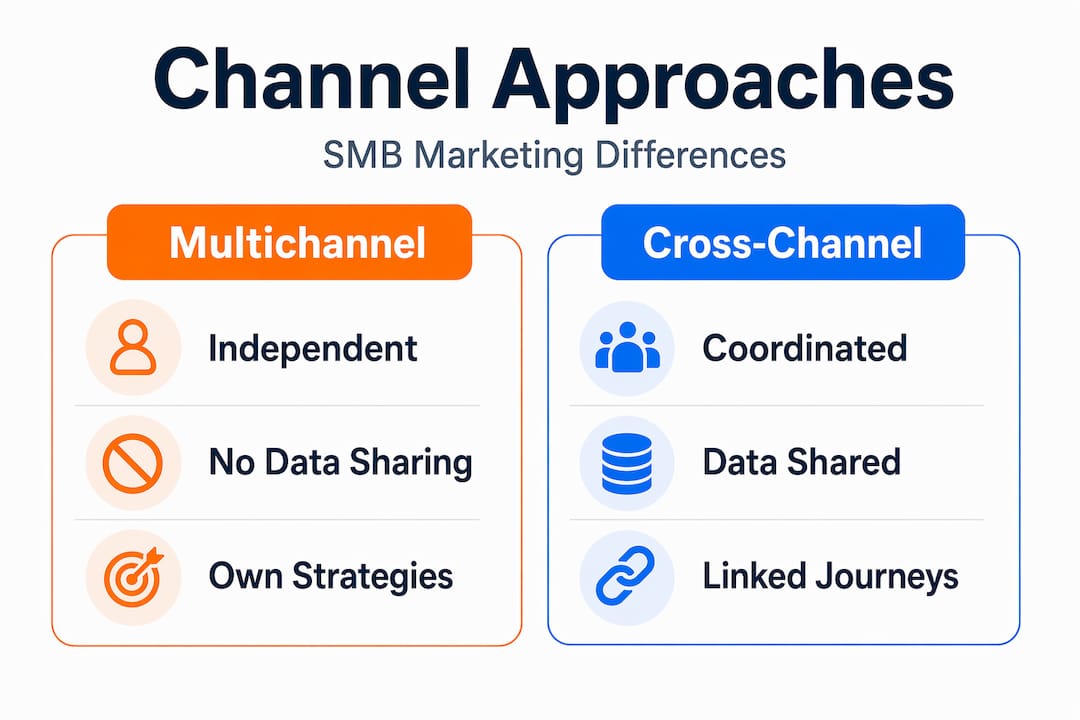
| Approach | How channels relate | Data sharing | Best for |
|---|---|---|---|
| Multichannel | Operate independently | None | Getting started with multiple platforms |
| Cross-channel | Coordinate and share data | Between selected channels | SMBs ready to align key channels |
| Omnichannel | Fully integrated with real-time updates | Across all touchpoints | Enterprise-level, high-tech infrastructure |
For most SMBs, omnichannel is aspirational but not practical right now. It requires a sophisticated tech stack, dedicated data teams, and significant investment. Cross-channel promotion, on the other hand, is achievable with the tools most small businesses already use or can access affordably.
The most important benefits cross-channel brings over plain multichannel for an SMB include:
- Customers receive consistent messaging rather than contradictory or repeated content
- You stop wasting ad spend on people who already converted through another channel
- Campaign performance becomes measurable across the customer journey, not just per channel
- You build a clearer picture of what your customers actually respond to
Pro Tip: Start with just two coordinated channels before building out further. Email and paid social is often the highest-impact pairing for SMBs because data flows naturally between them. Most email platforms let you sync your subscriber list directly to a social ad platform to create custom audiences and suppression lists.
The business benefits and ROI impact of cross-channel promotion for SMBs
With the differences clear, let’s explore what makes cross-channel promotion especially valuable for your business.
The numbers here are hard to argue with. Brands that integrated email, SMS, and chat saw a 22% year-over-year increase in customer lifetime value, while businesses relying on single-channel tactics experienced a 14% decline in marketing ROI over the same period. That’s not a marginal difference. That’s the gap between a marketing program that compounds in value and one that slowly drains your budget.
Here’s what drives that result in practice:
- Higher conversion rates. Customers who encounter your brand across multiple coordinated touchpoints convert at a higher rate because each exposure builds on the last rather than starting from scratch.
- Reduced wasted spend. Suppression logic (blocking ads to people who already bought or already received a message) stops you from paying to reach people who are already in your pipeline.
- Better customer retention. Cross-channel promotion doesn’t stop at the sale. Post-purchase email sequences, loyalty SMS campaigns, and retargeting for repeat buyers all extend the customer relationship and drive lifetime value.
- Stronger brand recognition. Consistent messaging across channels makes your brand more memorable, which shortens the decision cycle for future purchases.
For tracking what’s actually working, having solid marketing ROI measurement in place from the start is non-negotiable. You can’t optimize what you can’t see.
The ROI case for cross-channel also goes beyond revenue. When your channels are coordinated, your marketing team (or you, if you’re wearing all the hats) spends less time creating disconnected one-off campaigns and more time building systems that run efficiently.
Implementing cross-channel promotion: practical steps for SMBs
Now that you understand the benefits, let’s look at how you can successfully implement cross-channel promotion in your business.
Successful implementation involves defining goals, analyzing your audience, aligning your tools, and continuously optimizing with cross-channel analytics. Here’s how that looks in practice as a step-by-step process:
-
Set a specific campaign goal. Vague goals produce vague results. Instead of “get more customers,” aim for “increase first-time purchases by 20% over 60 days.” A clear goal shapes every channel decision that follows.
-
Define your audience segments. Who is this campaign for? New visitors, past buyers, cart abandoners? Each segment needs different messaging and channel treatment. A first-time site visitor and a loyal customer who hasn’t bought in six months need completely different conversations.
-
Choose your two or three highest-impact channels. Based on your audience and goal, select the channels where your customers actually spend time. Don’t add channels because they exist. Add them because your data says your customers are there.
-
Map the customer journey across those channels. Sketch out what a customer experiences from first touch to conversion. What does channel A trigger in channel B? What happens if they don’t respond? Build the logic before you build the campaign.
-
Set up marketing automation and data sharing. Use your marketing automation tools to pass behavioral signals between channels. If someone opens email X, they should automatically move to a different ad audience or trigger a follow-up SMS. Your campaign planning process should account for this from day one.
-
Apply suppression and frequency rules. This is the step most beginners skip, and it causes serious damage to customer experience. Set rules that prevent someone from receiving the same message twice, or seeing ads for something they already purchased.
-
Monitor, test, and adjust. Run at least two weeks before drawing conclusions. Then look at cross-channel metrics, not just individual platform stats.
Pro Tip: Many email platforms now offer native integrations with Facebook, Google, and SMS tools. You don’t need enterprise software to build a functional cross-channel system. Tools like Klaviyo, Mailchimp, or ActiveCampaign can get you most of the way there at a fraction of the cost.
Measuring success and optimizing your cross-channel promotion efforts
Implementing campaigns is just the start; measuring their true impact ensures ongoing success.
Here’s where most SMBs get misled. They look at each channel’s individual dashboard and assume that tells the full story. It doesn’t. Standard last-click attribution misses how one channel influences conversions in another, and cross-channel evaluation must examine full journey interactions and combined impact.
A concrete example: a customer clicks a Google ad, then leaves without buying. Two days later, they open your email and still don’t buy. Three days after that, they see an organic Instagram post and finally convert. Last-click attribution gives Instagram all the credit. In reality, Google and email did the heavy lifting of building trust and familiarity.
| Measurement method | What it captures | Best used for |
|---|---|---|
| Last-click attribution | Final touchpoint before purchase | Quick, channel-level reporting |
| Linear attribution | Equal credit across all touchpoints | Understanding general journey shape |
| Media mix modeling | Statistical impact of each channel on revenue | Budget allocation decisions |
| Incrementality testing | True lift from each channel | Validating ROI of individual channels |
For tracking digital marketing ROI across channels, start with linear or time-decay attribution models before investing in media mix modeling. They’re more accessible and still dramatically more useful than last-click alone.
For campaign performance tracking, look at cross-channel metrics like total customer acquisition cost across the full journey, repeat purchase rate, and email-to-ad conversion lift rather than treating each platform’s number as the truth.
Our take: the biggest mistake isn’t choosing the wrong channels
Most conversations about cross-channel promotion focus on channel selection, messaging frameworks, and attribution models. Those are real considerations, but they’re not where most SMBs actually fail.
The biggest mistake is skipping the data foundation entirely and jumping straight to execution. Businesses launch coordinated campaigns without ever connecting their tools, cleaning their contact lists, or building suppression logic. The result looks coordinated on the surface but functions like multichannel with extra steps underneath.
We’ve seen this pattern repeatedly: a business sets up email sequences, runs paid social simultaneously, and adds SMS for good measure. But their email platform doesn’t talk to their ad platform. Their SMS provider has a completely separate contact database. And nobody is removing buyers from the “convince them to purchase” sequence after they’ve already bought. The customer experience becomes repetitive and tone-deaf, which is somehow worse than no coordination at all.
The fix isn’t expensive technology. It’s sequencing. Before you run any cross-channel campaign, spend two hours connecting your platforms, mapping your suppression logic, and making sure your customer data is in one place. Everything else you build sits on that foundation. Rush it, and you’ll spend far more time untangling broken sequences than you would have spent building it right the first time.
Cross-channel promotion done right isn’t about complexity. It’s about respect for the customer’s experience at every step.
Ready to put cross-channel promotion to work for your business?
If reading this made you realize your marketing channels are operating in silos, you’re not alone. Most SMBs we work with start exactly there. The good news is that a coordinated cross-channel strategy doesn’t require an enterprise budget or a full marketing team to execute.
At ibrand.media, we help small and medium-sized businesses build and run cross-channel marketing programs that actually connect, from social media and email to paid ads and SEO, all tracked in real time. We’ll build you a custom plan based on your audience, goals, and budget so your channels start working together instead of against each other. Start your campaign today and see what coordinated marketing can do for your revenue.
Frequently asked questions
What is the difference between cross-channel and multichannel marketing?
Multichannel uses multiple platforms separately without sharing data between them, while cross-channel coordinates selected channels sharing customer data to create a connected and consistent experience across every touchpoint.
How can small businesses start implementing cross-channel promotion?
The most practical starting point is coordinating email and paid social, sharing your subscriber list as a custom and suppression audience. From there, SMBs can build toward SMS and additional channels as their data foundation matures.
Why is cross-channel measurement important?
Because last-click attribution misses the influence each channel has on the others, leading you to underfund the channels doing the most work and overinvest in the one that just happens to be last in line.
What are common mistakes to avoid in cross-channel promotion?
The most damaging mistakes are skipping the data integration step before launch, failing to set suppression rules that prevent message fatigue, and relying on siloed metrics from individual platforms instead of measuring the full customer journey.
Recent Comments