
TL;DR:
- Effective multichannel advertising doesn’t require large budgets or complex systems; small and medium-sized businesses can succeed by focusing on channels where their customers already spend time.
- Layered with simple planning, testing, and tracking, multichannel campaigns provide a practical, flexible approach that is faster to launch and easier to manage than omnichannel strategies, especially for SMBs.
Forget the idea that effective advertising belongs only to companies with six-figure budgets and dedicated tech teams. Many small and medium-sized business owners assume that running ads across multiple platforms requires sophisticated software, integrated data warehouses, and a full marketing department. That assumption is wrong, and it’s holding back a lot of talented entrepreneurs. Multichannel advertising is, at its core, about showing up where your customers already spend time. You don’t need a unified platform to start. You need a clear plan, a modest budget, and the willingness to test and learn channel by channel.
Table of Contents
- Defining multichannel advertising for small businesses
- Multichannel vs. omnichannel: What’s the real difference?
- How to launch effective multichannel campaigns on a budget
- Measuring success: Attribution and benchmarks for SMB multichannel ads
- Why multichannel advertising works for SMBs, if you embrace its strengths
- Take the next step with Ibrandmedia’s SMB digital marketing resources
- Frequently asked questions
Key Takeaways
| Point | Details |
|---|---|
| Multichannel is accessible | Small businesses can use multiple advertising channels without costly integration. |
| Track results everywhere | Using UTMs and conversion tracking helps avoid wasted spend across channels. |
| Start with channel-level wins | Optimize each channel individually before aiming for seamless cross-channel experiences. |
| Benchmarks guide smart spending | Knowing typical CTR and conversion rates helps prioritize ad budgets for the best results. |
| Measurement beats complexity | Practical tracking and attribution are more valuable for SMBs than chasing integration too early. |
Defining multichannel advertising for small businesses
Building on the idea that you don’t need massive infrastructure, let’s clarify what multichannel advertising actually means, especially for SMBs.
Multichannel advertising is the practice of reaching customers across multiple platforms, such as Google Search, Facebook, Instagram, email, and display networks, while allowing each channel to operate somewhat independently. You don’t need every channel talking to every other channel. Each campaign can have its own messaging, budget, and goal.
Here’s what the definition actually implies in practice:
- You can run a Google Search campaign focused on purchase intent while separately running a Facebook awareness campaign targeting cold audiences.
- You can tailor the tone and creative assets for each platform without needing them to be synchronized at the data level.
- Each channel can be optimized on its own terms, using the native analytics tools that come built into the platform.
- You don’t need to invest in a customer data platform (CDP) or enterprise marketing software to get started.
The key difference from a fully integrated system is that the channels don’t automatically share data. That sounds like a limitation, but for most SMBs, it’s actually a feature. It keeps things simple.
“Multichannel advertising is reaching customers across multiple channels, each potentially operating independently.” This independence is what makes multichannel accessible to businesses that don’t have unified data infrastructure.
The practical upside is huge. Instead of spending weeks configuring a complex integration, you can launch a Google ad campaign on Monday, set up a Facebook retargeting campaign on Wednesday, and start learning what works by the end of the week. For SMBs choosing marketing channels wisely, this speed and flexibility is a genuine competitive advantage.
When you understand that choosing marketing channels is really about finding where your specific customers already hang out, multichannel becomes much less intimidating. It’s not about being everywhere. It’s about being in the right places.

Multichannel vs. omnichannel: What’s the real difference?
Understanding what multichannel means leads naturally to the common confusion about how it differs from omnichannel. Let’s demystify this.
Both approaches use multiple platforms, but they differ in how those platforms relate to each other. Multichannel campaigns operate independently with channel-specific messaging and less data sharing between platforms. Omnichannel, by contrast, integrates channels for a seamless and unified customer journey where behavior on one channel influences what the customer sees on another.
Here’s a side-by-side comparison to make this concrete:
| Feature | Multichannel | Omnichannel |
|---|---|---|
| Channel coordination | Independent | Fully integrated |
| Data sharing | Minimal | Real-time, unified |
| Customer experience | Consistent brand, varied touch | Seamless, personalized journey |
| Tech requirements | Low to moderate | High |
| Best for | SMBs, early-stage campaigns | Enterprise, mature brands |
| Budget required | Low to moderate | High |
| Time to launch | Fast | Slow |
The omnichannel marketing guide does a great job explaining the integrated experience in detail, but for most small businesses, omnichannel is an aspiration rather than a starting point.
Multichannel is a lower infrastructure approach and a more accessible starting point for SMBs. You’re not sacrificing effectiveness by starting with multichannel. You’re making a practical, budget-smart choice that still gives you broad reach, platform-specific optimization, and measurable results.
Key advantages of choosing multichannel over omnichannel as an SMB:
- Faster to launch. You can start individual campaigns without waiting for a technology stack to be built.
- Easier to manage. Each channel can be handled by a single person or a small team.
- More forgiving. If one channel underperforms, it doesn’t break your entire strategy.
- Budget-friendly. You allocate spend where you see results, not where the integration requires it.
The right marketing channel selection approach for most SMBs is to start with two or three channels, learn what works, and then expand or eventually integrate over time.
How to launch effective multichannel campaigns on a budget
Once you know which model fits your business, here’s how you can launch multichannel campaigns efficiently.
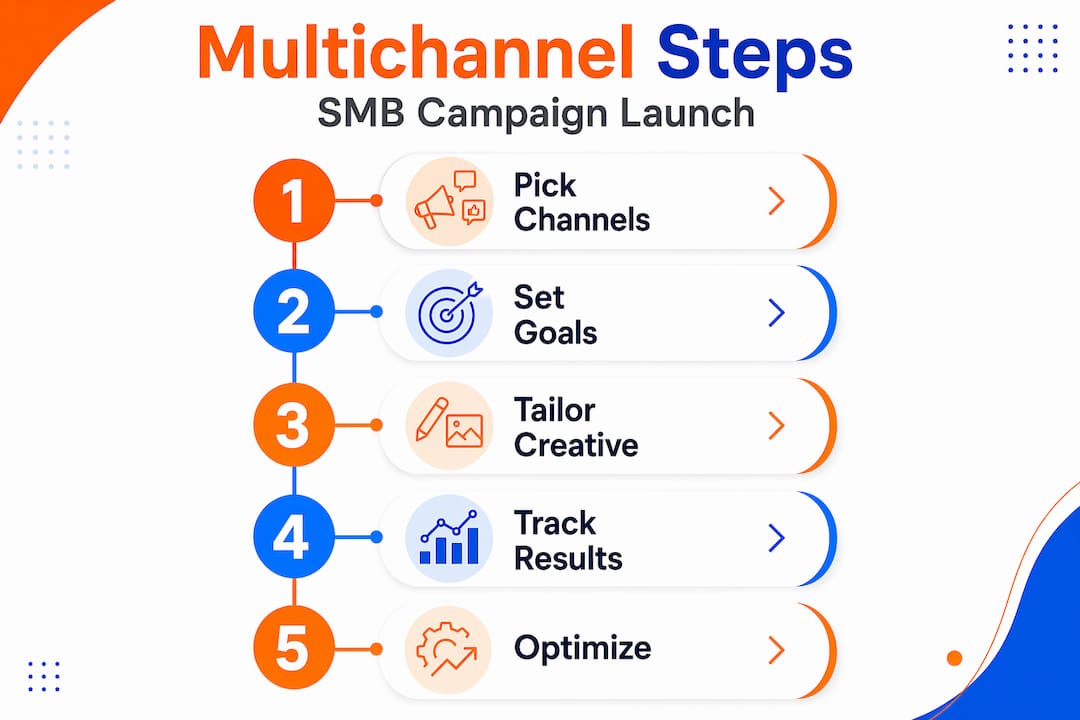
The good news is that the framework is straightforward. Choose your channel mix, adapt messaging per platform, and implement tracking to measure what works. Let’s break that down step by step.
Step 1: Select two or three channels based on your audience.
Don’t spread yourself across every platform. If your customers are searching for your product or service actively, start with Google Search. If you’re building awareness for a visual product or service, Instagram or Facebook may be your best first channel. For B2B businesses, LinkedIn ads often produce better-quality leads despite a higher cost per click.
Step 2: Set a clear goal for each channel.
Search ads are great for capturing demand that already exists. Social ads are better for creating demand and building awareness. Email is best for nurturing and re-engaging existing contacts. Define the specific role each channel plays so you can evaluate it fairly.
Step 3: Tailor your creative and messaging to each platform.
A Google Search ad is five to ten words. A Facebook ad is a scroll-stopping image or video with a punchy headline. A display ad needs to work visually in a fraction of a second. Using the same generic copy across all channels is one of the most common budget-wasting mistakes SMBs make.
Step 4: Set up tracking before you spend a dollar.
Install Google Tag Manager, set up UTM parameters for every campaign URL, and configure conversion tracking inside each platform. This step costs nothing and saves a lot of money later. Check affordable advertising tips for a practical breakdown of how to do this without a developer.
Step 5: Set a realistic budget per channel.
For most SMBs, starting with $300 to $500 per channel per month gives you enough data to make meaningful decisions within four to six weeks. Understand your marketing budget planning before you set live campaigns so you’re not guessing.
Step 6: Review and optimize weekly.
Look at cost per click, click-through rate, and conversion rate for each channel. Kill what doesn’t work. Double down on what does. This is the real skill in multichannel advertising.
Staying current with digital ad trends for SMEs in 2026 is also worth the time. AI-powered bidding, short-form video, and local search formats are all seeing strong performance for smaller budgets right now.
Pro Tip: Automate your reporting using free tools like Google Looker Studio to pull all your channel data into one dashboard. This saves hours every week and helps you spot cross-channel patterns without needing an enterprise analytics tool. Avoid using last-click attribution as your only measurement model. It routinely gives zero credit to the awareness or consideration channels that first introduced a customer to your brand.
Review the best advertising channels available for SMBs to shortlist options that fit your audience and budget before you launch.
Measuring success: Attribution and benchmarks for SMB multichannel ads
Launching campaigns is only the first step. To really drive growth, you’ll need to measure your results correctly.
Multi-channel attribution assigns conversion credit across channels, not just the last touchpoint. This matters enormously for budget decisions. If you only look at last-click data, you’ll likely cut the social awareness campaigns that were actually driving the customers who eventually converted through search.
There are several attribution models to understand:
- Last-click: All credit goes to the final channel before purchase. Simple but misleading.
- First-click: All credit goes to the first touchpoint. Good for awareness measurement, but incomplete.
- Linear: Credit is split equally across all touchpoints. A decent starting model for SMBs.
- Data-driven: Uses algorithmic weighting based on real conversion paths. Requires volume to work well.
For most small businesses, starting with linear attribution or time-decay attribution (which gives more credit to touchpoints closer to conversion) gives a fairer picture than last-click.
Here are 2026 performance benchmarks for the most common SMB digital advertising channels, based on SMB marketing benchmarks 2026:
| Channel | Median CTR | Avg. Conversion Rate |
|---|---|---|
| Google Search | 3.8% | 4.2% |
| Google Display | 0.35% | 0.9% |
| Google Shopping | 0.86% | 1.9% |
| Meta (Facebook/Instagram) | 1.2% | 2.4% |
| Email (owned list) | 22.0% | 3.8% |
These numbers help you set realistic expectations and catch problems early. If your Google Search CTR is sitting at 0.8%, something is wrong with your ad copy or targeting. If your Meta conversion rate is well below 1%, your landing page likely needs work.
A solid measurement plan with UTMs, conversion tracking and attribution is essential to avoid undervaluing the channels that build awareness but don’t directly close the sale.
“Most small businesses undervalue their ‘assist’ channels because they only look at the last touchpoint before conversion. The channel that introduced the customer to your brand deserves recognition in your data, even if it didn’t close the deal.”
Keeping a close eye on tracking campaign performance is what separates growing SMBs from those that keep guessing. Your digital branding fundamentals also play a role here because consistent brand recognition across channels lifts conversion rates on every platform.
Smart measurement also accounts for how social media platform differences affect both audience behavior and ad performance, since what works on Instagram often doesn’t translate directly to LinkedIn or X.
For a deeper look at how to interpret all this data, the analytics for advertising ROI guide is worth bookmarking.
Why multichannel advertising works for SMBs, if you embrace its strengths
Having explored the mechanics and metrics, let’s step back and share what experience has taught about multichannel for SMBs.
Here’s the honest truth: a lot of small business owners spend way too much time feeling bad that they’re not doing omnichannel. They read enterprise case studies, see the integrated customer journey maps, and conclude that their own multichannel setup is somehow incomplete or inferior. That thinking costs them real momentum.
For budget-conscious SMBs, multichannel is both a practical starting point and less prone to complexity, but the tradeoff is you don’t get unified experiences like omnichannel. That tradeoff is completely acceptable at the SMB level. In fact, it’s often the right choice even for businesses that could afford omnichannel.
The most common mistake we see isn’t under-investing in channels. It’s trying to integrate too soon. Business owners get excited about retargeting audiences from their Facebook ads with Google Display, or syncing their CRM with their ad platforms, before they’ve even figured out which individual channels generate profitable customers. That sequencing error wastes both money and time.
The smarter path is to chase channel-level wins first. Find the one channel where your cost per acquisition is genuinely profitable. Get very good at that channel. Then, and only then, start building bridges between channels. Data silos aren’t fatal if you’re tracking key outcomes like cost per lead, cost per acquisition, and return on ad spend for each channel independently.
We’ve also seen that the businesses that grow fastest with multichannel are the ones that resist the urge to be everywhere. Two well-managed channels consistently outperform five poorly managed ones. Focus is a genuine competitive advantage when you’re working with a limited team and budget.
The marketing channel selection decision is ultimately a strategic one, not a tactical one. Choose channels based on where your best customers already spend time, not based on what’s trendy or what a competitor appears to be doing.
Take the next step with Ibrandmedia’s SMB digital marketing resources
If this guide has given you a clearer picture of multichannel advertising, the next move is putting these strategies into practice with the right resources behind you.
ibrand.media offers a full suite of tools and expert guidance built specifically for small and medium-sized businesses. Whether you’re just starting to figure out your marketing channel selection guide, looking to cut ad waste with smarter tactics from our affordable advertising guide, or ready to build a proper measurement system using our performance tracking guide, we’ve got practical, affordable resources designed for real business owners working with real budgets. No enterprise jargon, no inflated retainers. Just clear, actionable support that helps you grow.
Frequently asked questions
How does multichannel advertising help small businesses compete?
Multichannel advertising lets SMBs reach more customers across different platforms and tailor campaigns to each channel, amplifying visibility without requiring huge budgets. It’s a lower infrastructure, accessible starting point that levels the playing field for smaller brands.
Can I launch multichannel campaigns without unified data systems?
Yes, SMBs can run separate campaigns for each channel and still succeed, provided they use basic tracking methods and adapt messages to each platform. Multichannel channels operate independently with tracking and adapted messaging as the foundation.
How do I know which advertising channels perform best?
Check channel benchmarks and track conversions. Median CTR and conversion rates differ by channel, with Google Search and Meta platforms typically outperforming display or shopping ads for most SMBs.
What’s the biggest mistake SMBs make with multichannel advertising?
Neglecting to track results across channels leads to wasted spend and missed optimization opportunities. A solid measurement plan and attribution model prevents you from undervaluing the channels that build awareness and assist conversions.
Does multichannel advertising require omnichannel integration?
No, multichannel advertising works well for small businesses without full omnichannel integration. Omnichannel integrates channels for a consistent journey while multichannel operates independently, making it the practical choice for most SMBs starting out.
Recent Comments