
TL;DR:
- Email marketing provides small businesses with a controllable, high-return channel that owns a direct line to customers beyond social media and paid ads.
- Focusing on click-through and conversion rates, rather than open rates, yields more accurate insights for optimizing campaigns and increasing revenue.
Social media gets the headlines, paid ads get the budget debates, and yet email marketing quietly delivers some of the highest returns of any channel available to small businesses. The role of email marketing is not simply to send promotional blasts — it is to own a direct, measurable line to your customers that no algorithm can take away from you. In this article, you will learn how email marketing works across sales, retention, and automation, why the old metrics no longer tell the full story, and how to integrate it with your broader digital strategy to drive real, sustainable growth.
Table of Contents
- What is the role of email marketing in small business growth?
- Measuring success: key email marketing metrics and their impact
- How automation transforms email marketing performance
- Compliance and deliverability: operating email marketing legally and effectively
- Integrating email marketing with your broader digital marketing strategy
- Rethinking email marketing’s role: beyond volume to thoughtful relevance
- Boost your email marketing with expert support from iBrand Media
- Frequently asked questions
Key Takeaways
| Point | Details |
|---|---|
| Owned communication channel | Email marketing provides a direct line to subscribers you control, unlike rented social platforms. |
| Measure what matters | Prioritize click-through and conversion rates over open rates for accurate engagement insights. |
| Automation boosts revenue | Automated email flows generate significantly more sales than manual campaigns at lower effort. |
| Stay compliant | Follow CAN-SPAM rules to avoid legal risk and maintain strong deliverability. |
| Integrate strategically | Combine email marketing with SEO, social media, and paid ads for maximum business growth. |
What is the role of email marketing in small business growth?
Email marketing involves sending several types of messages to a subscribed audience: promotional offers, transactional confirmations, newsletters, and behavior-triggered automated sequences. Each type serves a different purpose, but together they form a communication engine that keeps your brand top of mind long after the first purchase.
Understanding email marketing fundamentals is the starting point for any business that wants to move beyond guesswork. Unlike social media posts or paid ads, email is an owned channel. That means you control the list, the message, and the timing. No platform can reduce your reach overnight because it changed its algorithm.
As one practical guide puts it, email marketing’s core role is to send commercial or relational messages to opted-in subscribers to build relationships, improve retention, and drive revenue. That definition matters because it separates email from spam: subscribers have chosen to hear from you, which is a built-in competitive advantage.
Here is what email marketing does for small businesses specifically:
- Builds relationships over time through consistent, relevant communication
- Boosts customer retention by keeping buyers engaged after their first purchase
- Drives revenue through targeted offers, upsells, and re-engagement campaigns
- Complements social media and SEO rather than competing with them
- Provides measurable data you own and can act on immediately
Measuring success: key email marketing metrics and their impact
Numbers only matter if you are reading the right ones. The most commonly watched metric in email marketing is the open rate. But here is the problem: open rates are now inflated because Apple Mail Privacy Protection automatically prefetches email content, registering an “open” even when a person never actually reads the message. Chasing open rates in 2026 can lead you to optimize for data that does not reflect reality.

The metrics that actually tell you something useful are click-through rates (CTR) and conversion rates. CTR measures how many recipients clicked a link inside your email. Conversion rate measures how many of those clicks resulted in a purchase, sign-up, or other defined goal. These actions require a human to make a deliberate choice, which makes them far more reliable signals of genuine engagement.
Tracking clicks, conversions, and unsubscribes allows you to optimize campaigns based on real performance rather than relying on platform algorithms or vanity numbers. This is one of the most important distinctions between email and social media: you get granular, behavior-level data that is yours to analyze and act on.
Key metrics to track in every campaign:
- Click-through rate (CTR): measures active engagement with your content
- Conversion rate: connects email activity directly to business outcomes
- Unsubscribe rate: flags when content is missing the mark for your audience
- Revenue per email: the most direct measure of campaign value
- Bounce rate: identifies list health problems before they hurt deliverability
Pro Tip: Set up a dashboard that tracks CTR and revenue per email side by side. If CTR is high but conversions are low, the problem is likely on your landing page, not in the email itself. That distinction saves you from rewriting perfectly good emails unnecessarily.
Applying email marketing best practices around segmentation and personalization is the fastest way to lift both CTR and conversion rates without increasing your send volume.
How automation transforms email marketing performance
Manual campaigns, where you write an email and send it to your list on a schedule, are useful. But automated lifecycle flows are where the real performance gains live.
An automated email flow is a sequence of messages triggered by a specific subscriber behavior. A new visitor signs up for your list and immediately receives a welcome series. A shopper adds items to a cart and leaves without buying, triggering an abandoned cart reminder within an hour. A customer completes a purchase and receives a follow-up sequence asking for a review and suggesting related products. You set these up once, and they run on their own indefinitely.
Stat worth noting: Automated email flows generate 41% of email revenue from just 5.3% of sends, with nearly triple the click rate of standard campaign sends.
That ratio is not a small advantage. It means a well-built automation setup earns disproportionate returns relative to the effort involved. Automation runs offline once set up, improving engagement and conversion efficiency compared to sending campaigns manually every time.
Here is the order in which to build your automated flows for maximum impact:
- Welcome series: introduce your brand, set expectations, and make an early offer to new subscribers
- Abandoned cart sequence: recover lost sales with a reminder email at one hour, then a follow-up with social proof at 24 hours
- Browse abandonment: re-engage visitors who viewed a product but did not add it to cart
- Post-purchase flow: thank the customer, ask for a review, and recommend complementary products
- Win-back campaign: reach out to subscribers who have not engaged in 90 or more days with a compelling reason to return
Reviewing best practices for email automation before you build these flows ensures your sequences are structured for long-term performance, not just quick wins.
Compliance and deliverability: operating email marketing legally and effectively
You can write the best email in the world and it still will not matter if it lands in the spam folder or, worse, triggers a legal complaint. Two factors determine whether your emails reach inboxes: compliance and technical deliverability.
On the legal side, the CAN-SPAM Act requires every commercial email to include accurate header information, identify itself as an advertisement when applicable, provide your physical postal address, offer a clear opt-out mechanism, and honor any unsubscribe request within 10 business days. This is not optional. Violations carry penalties up to $51,744 per email.
On the technical side, deliverability depends on list quality, authentication protocols, and complaint rates. The three authentication standards you need to have in place are SPF, DKIM, and DMARC. These tell receiving mail servers that your emails are genuinely coming from your domain, not a spammer impersonating you.
Critical deliverability practices for small businesses:
- Clean your list regularly: remove addresses that consistently bounce or show zero engagement
- Never buy email lists: purchased lists are full of unverified addresses and guaranteed spam complaints
- Honor unsubscribes immediately: delayed processing damages your reputation and risks legal exposure
- Set up SPF, DKIM, and DMARC: your email service provider can guide you through the setup
- Monitor your complaint rate: keep it below 0.1% to maintain healthy inbox placement
Pro Tip: Most email platforms show your spam complaint rate in the dashboard. If it climbs above 0.08%, pause and audit your most recent sends before sending anything else. Acting early prevents the kind of sender reputation damage that takes months to rebuild.
Understanding email marketing fundamentals around deliverability and compliance is not just about staying legal. It is about protecting the business asset you have built in your subscriber list.
Integrating email marketing with your broader digital marketing strategy
Email does not work in isolation. Its real power comes from what it does alongside the other channels in your marketing mix.
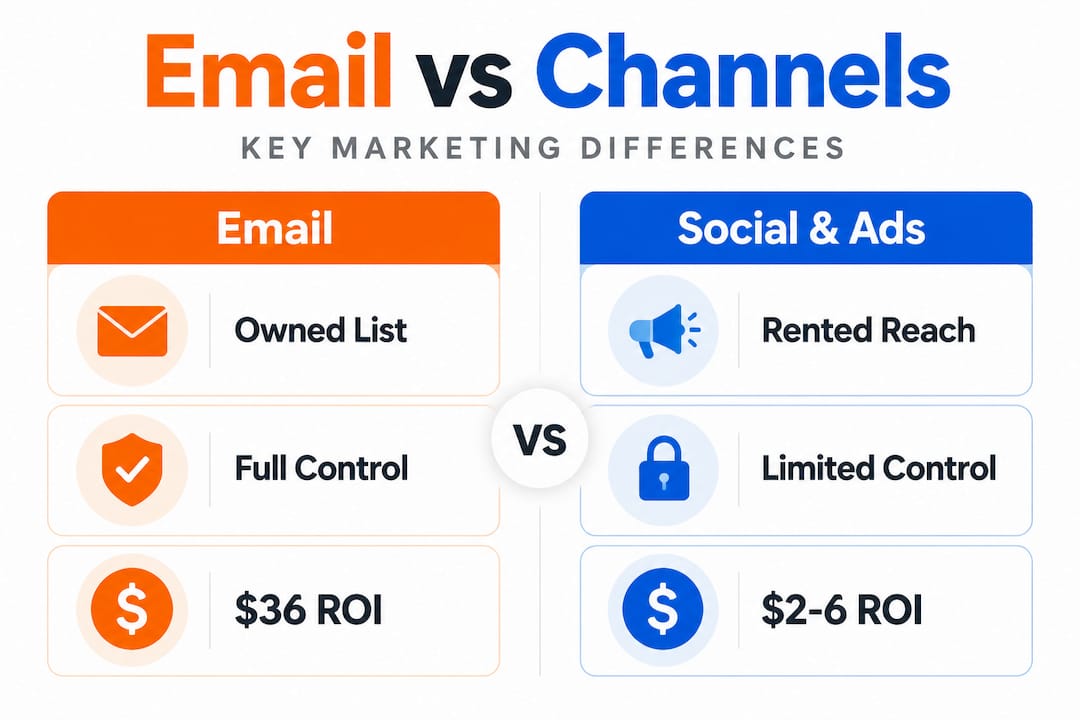
Social media is excellent for building awareness and reaching new audiences, but it is rented space. Your follower count can drop overnight if a platform changes its rules. Email provides the owned, direct communication layer that sits underneath and supports everything else. As one multichannel analysis confirms, email is an owned, direct channel that balances rented platforms like social and paid ads, delivering consistent, permission-based messaging that those platforms cannot replicate.
When you combine email with SEO, the traffic and engagement signals from email-driven site visits can indirectly strengthen your search presence. When you run paid ads, email retargeting sequences can follow up on ad-driven traffic at a fraction of the cost per conversion. And when integrated with social media, SEO, and PPC, email amplifies brand messaging, drives sales, and nurtures leads for long-term growth.
Here is how email stacks up against the other major channels:
| Channel | Reach | Cost | Control | Avg. ROI |
|---|---|---|---|---|
| Email marketing | Owned list | Low | Full | $36 per $1 spent |
| Social media | Algorithm-dependent | Low to medium | Limited | Variable |
| SEO | Organic search | Medium (time) | Indirect | High, but slow |
| Paid ads | Broad | High | High | Variable, spend-dependent |
| SMS | Owned list | Medium | Full | High, but limited use cases |
The pattern is clear: email gives you full control at low cost with consistently strong returns. Staying up to date on small business marketing trends helps you position email correctly within this mix as channels evolve.
Rethinking email marketing’s role: beyond volume to thoughtful relevance
Here is the uncomfortable truth most email marketing guides will not tell you: sending more emails is almost never the answer.
The instinct when results plateau is to increase frequency. Send a fifth email in a week instead of four. Add another promotional blast to the calendar. But this approach works against you in 2026 because subscribers are less tolerant than ever, and inbox providers are more sophisticated at identifying patterns that look like low-value mass sending.
Top-performing teams focus on relevant, behavior-driven emails sent sparingly to engaged lists rather than chasing volume or open rates. That means your highest-value emails are the ones triggered by what a subscriber actually did, not the ones you sent because it was Tuesday and you had something to promote.
The open rate obsession is also worth dropping entirely. Practitioners now treat open rates as directional signals post-privacy changes and prioritize revenue per recipient and CTR to avoid optimizing for misleading data. If you are A/B testing subject lines based on open rates alone, you may be optimizing for a metric that Apple’s privacy settings, not your actual subscribers, are inflating.
What actually moves results is disciplined list hygiene combined with well-built automation journeys. A list of 2,000 engaged subscribers consistently outperforms a list of 20,000 mixed-quality contacts. The effectiveness of email marketing is not about how many people are on your list — it is about how many of them genuinely want to hear from you.
The role of newsletters in marketing follows the same logic. A monthly newsletter that consistently delivers useful, specific content builds a readership. A weekly newsletter stuffed with promotions trains subscribers to ignore you. Review your email marketing best practices regularly and ask a harder question: does each email you send serve the subscriber, or just your sales targets?
Boost your email marketing with expert support from iBrand Media
Building a high-performing email program takes more than a platform subscription and a few ideas. Most small businesses stall because they lack the time to set up proper automation flows, the expertise to segment their lists effectively, or the bandwidth to create content that actually converts.
At iBrand Media, we help small and medium-sized businesses implement email marketing strategies that are tailored to their specific customers and goals. From building automated welcome and cart recovery flows to crafting segmented campaigns that drive real revenue, our team manages the technical and creative work so you can focus on running your business. We also integrate email with SEO for small businesses and social media management to create a digital marketing approach that works as a unified system. If you are ready to stop guessing and start seeing measurable results from your email list, get in touch with our team today.
Frequently asked questions
What is the primary role of email marketing for small businesses?
Its main role is to build and maintain customer relationships through targeted, permission-based messages that improve engagement and drive sales. Email marketing sends commercial or relational messages to opted-in subscribers specifically to strengthen relationships and increase revenue over time.
Which email marketing metrics should I focus on for real engagement?
Focus on click-through rates and conversion rates rather than open rates, especially given the privacy changes that affect open tracking accuracy. Open rates are less reliable now because of privacy protections, making clicks and conversions the better indicators of genuine subscriber interest.
How does email automation improve marketing results?
Automation sends timely, behavior-triggered emails that efficiently nurture leads and recover sales, generating a disproportionate share of revenue compared to manual campaigns. Automated email flows generate 41% of revenue from only 5.3% of total sends, which makes building these flows a top priority for any small business.
What legal rules must I follow when sending marketing emails?
You must comply with the CAN-SPAM Act by providing accurate header information, identifying your message as an advertisement when applicable, including a postal address, offering a clear opt-out option, and honoring unsubscribes within 10 business days. CAN-SPAM requires transparency and unsubscribe compliance to keep your sending legal and your deliverability intact.
How does email marketing fit with social media and SEO efforts?
Email marketing complements these channels by providing owned, direct communication that nurtures leads, drives website traffic, and reinforces brand messaging across every stage of the customer journey. Email integrates with social media, SEO, and PPC to boost engagement and support long-term business growth in ways that rented channels cannot replicate on their own.
Recent Comments