
TL;DR:
- Organic traffic is unpaid, sustainable, and builds over time through search engine relevance.
- It outperforms paid ads in trust, longevity, and cost-efficiency for long-term growth.
- Strategies like SEO, content quality, and regular analysis boost organic website visits effectively.
Most business owners assume more website visitors automatically means more sales. But here’s what changes the game: where those visitors come from matters just as much as how many show up. A site flooded with random clicks from paid ads might barely break even on ad spend, while a smaller stream of the right visitors from search engines can drive consistent, compounding revenue. Organic traffic is that stream. It’s the kind of growth that works while you sleep, builds over time, and doesn’t vanish the moment your budget runs dry. This article breaks down exactly what organic traffic is, why it outperforms other sources for long-term business growth, and how you can start getting more of it.
Table of Contents
- What is organic traffic and why does it matter?
- How is organic traffic different from paid traffic?
- Best strategies to increase your site’s organic traffic
- Tracking and measuring your organic traffic
- Why organic traffic is still your business’s best long game
- Get expert help to boost your organic traffic
- Frequently asked questions
Key Takeaways
| Point | Details |
|---|---|
| Organic traffic is earned | Website visitors from unpaid search results are more likely to trust your brand. |
| It beats paid campaigns long-term | Unlike ads, organic traffic keeps coming even after you stop investing in campaigns. |
| Growth requires strategy | A strong SEO and content plan drives sustainable increases in organic visitors. |
| Track for smarter results | Monitoring your organic traffic helps identify wins and uncover new growth opportunities. |
What is organic traffic and why does it matter?
Let’s start simple. Organic traffic refers to) visitors who arrive at your site through unpaid search results. When someone types a question into Google or Bing, clicks on a result that isn’t an ad, and lands on your website, that’s organic traffic at work. No ad spend. No cost per click. Just your site showing up because search engines decided it’s relevant and trustworthy.
Organic visitors reach your site through several paths:
- Google Search (the dominant source for most businesses)
- Bing and other alternative search engines
- Google Discover (content recommendations on mobile devices)
- Image and video search results
Here’s a quick comparison of the main traffic types so you can see how organic stacks up:
| Traffic source | Cost | Longevity | Trust level | Typical use case |
|---|---|---|---|---|
| Organic | No ad spend | Long-term | High | Evergreen content, local SEO |
| Paid | Cost per click | Stops with budget | Medium | Promotions, product launches |
| Direct | None | Ongoing | High | Existing customers |
| Social | Varies | Short to medium | Medium | Brand awareness, engagement |
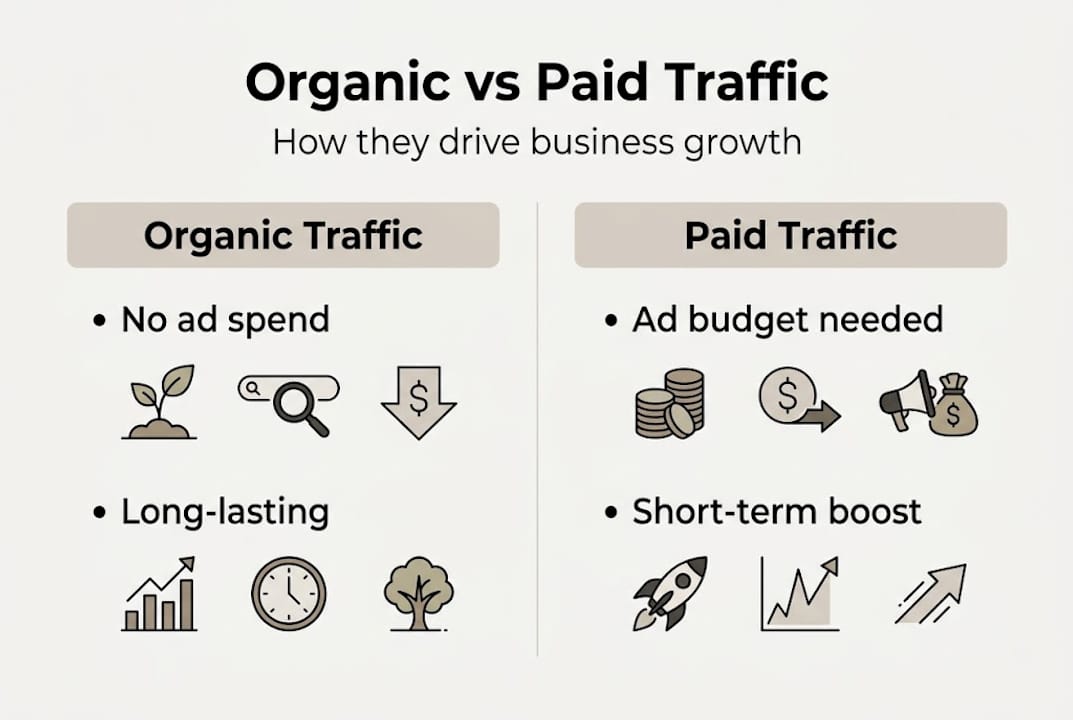
What makes organic traffic genuinely different is its staying power. A blog post you publish today can continue attracting visitors for years, not days. Unlike a paid campaign that switches off the moment you stop funding it, a well-optimized page keeps working indefinitely. That’s why smart website traffic strategies always prioritize organic as the foundation.
The economic logic here is powerful. Your investment in SEO and content is essentially front-loaded. You put in the work upfront, and the returns stretch out over months and years. Compare that to paid traffic, where you’re paying every single time someone clicks.
Pro Tip: Think of organic SEO like planting a tree. Paid ads are like renting shade. The tree takes longer to grow, but eventually it gives you shade for free, forever.
How is organic traffic different from paid traffic?
While organic traffic sounds appealing, it’s easy to confuse it with paid campaigns. Here’s how they truly differ.
The core distinction is simple: paid traffic comes from advertising spend, while organic traffic is earned through relevance and authority. When you pay for Google Ads, your listing appears at the top of the page with a small “Sponsored” label. When you earn organic rankings, you appear below those ads, but without the label and without paying per click.
Here’s a side-by-side breakdown:
| Factor | Organic traffic | Paid traffic |
|---|---|---|
| Cost per visit | $0 | Paid per click |
| Speed to results | Weeks to months | Immediate |
| Longevity | Continues after work done | Stops when budget stops |
| User trust | Higher | Lower |
| Scalability | Compounds over time | Scales with budget |
So when does each type shine? Paid traffic is ideal when you need fast results, like a product launch, a seasonal sale, or a new market you’re testing. Organic traffic is the right play when you’re building something sustainable, a long-term customer base that keeps finding you without ongoing ad spend.
Here’s how a user encounters each type in a typical search:
- They type a query into Google
- The top 2-4 results show “Sponsored” labels (paid ads)
- Below those, unpaid listings appear based on relevance (organic results)
- Users who click sponsored results are often in buying mode
- Users who click organic results often trust those listings more deeply
“Users consistently show higher trust in organic results compared to paid listings, particularly for research-driven queries where credibility matters most.”
Understanding the organic vs paid traffic difference helps you allocate your marketing budget more intelligently. For businesses that can’t sustain large ad budgets, doubling down on SEO vs paid advertising almost always wins in the long run.

Best strategies to increase your site’s organic traffic
Understanding the importance of organic traffic is one thing. Putting strategies into action is what truly drives results.
The foundation of any organic traffic strategy is search engine optimization. SEO and content quality directly impact the likelihood of ranking for organic searches. This means you need your website to be technically sound, your content to be genuinely useful, and your pages to match what people are actually looking for.
Here are the core strategies that move the needle:
- Keyword research: Identify the exact phrases your customers type into search engines. Tools like Google Keyword Planner, Ubersuggest, and Ahrefs make this straightforward even for beginners.
- On-page optimization: Make sure each page has a clear title tag, meta description, header structure, and naturally placed keywords that match user intent.
- High-quality content: Write blog posts, guides, and FAQs that answer real questions your audience has. Depth and accuracy matter more than volume.
- Content refreshing: Updating old pages with new data, better examples, and current information can dramatically boost rankings without starting from scratch.
- Internal linking: Connect your pages to each other so search engines can crawl your site efficiently and readers stay engaged longer.
One of the highest-leverage moves for small businesses is consistent blogging. A business blog for growth creates new entry points for search traffic every time you publish. Each post is a new chance to rank for a new keyword. Over time, that compounds significantly.
Useful tools to support your organic growth:
- Google Search Console (free, tracks rankings and search queries)
- Google Analytics (free, shows traffic behavior and conversion)
- Moz or Semrush (paid, deep keyword and competitor analysis)
- Yoast SEO (WordPress plugin for on-page optimization guidance)
Solid site optimization techniques combined with a real understanding of search intent SEO will separate your business from competitors who are just guessing.
Pro Tip: Stop writing about what you sell and start writing about what your customers are searching for. A plumber who blogs about “why water pressure drops in older homes” will outrank one who only posts about their services.
Tracking and measuring your organic traffic
Once you’ve started implementing strategies, it’s time to measure your results and keep improving your approach.
Tracking organic traffic isn’t optional. Without data, you’re flying blind, and you’ll repeat what doesn’t work while ignoring what does. Google Analytics enables website owners to track organic traffic by source and landing page, giving you a clear picture of which content drives real visits.
Key metrics to watch:
- Sessions from organic: The raw count of visits arriving via search engines
- Bounce rate: The percentage of visitors who leave without taking any action (lower is generally better)
- Conversion rate: How many organic visitors complete a desired action, like filling out a contact form or making a purchase
- Top landing pages: Which pages attract the most organic visitors and why
- Average session duration: How long organic visitors stay, a signal of content quality
Here’s an example of what organic vs. paid traffic might look like in a typical small business’s monthly data:
| Traffic source | Sessions | Bounce rate | Conversions | Cost |
|---|---|---|---|---|
| Organic search | 4,200 | 42% | 126 | $0 |
| Paid search | 1,800 | 61% | 54 | $900 |
| Social media | 950 | 58% | 19 | $300 |
| Direct | 600 | 35% | 30 | $0 |
Notice the pattern: organic delivers more sessions, a better bounce rate, and more conversions, all without a single dollar in ad spend.
To set up basic tracking for your business:
- Create a free Google Analytics 4 account and connect it to your website
- Set up Google Search Console and verify your site
- Link both platforms so data flows between them
- Define your conversion goals inside Analytics (form submissions, purchases, phone calls)
- Review your organic traffic report weekly to spot trends and opportunities
The right website analytics tools will show you not just how much traffic you’re getting, but which pages are converting and which need improvement. That’s where real optimization decisions get made.
Why organic traffic is still your business’s best long game
Here’s the uncomfortable truth most marketing agencies won’t tell you: most businesses quit SEO three months before it would have started working. They see slow early results, pivot to paid ads for a quick win, and never build the compounding foundation that actually creates sustainable growth.
Paid campaigns are a treadmill. The moment you stop running (spending), everything stops. Organic is fundamentally different. Every piece of optimized content, every earned backlink, every well-structured page adds to an asset that grows in value over time. It’s cumulative in a way paid advertising simply isn’t.
There’s also a trust dimension that numbers often miss. Customers who find you through organic search have often done their research. They weren’t interrupted by an ad. They searched, found you, and chose to click. That intent and trust translates into higher-quality leads and better conversion rates over time.
The businesses that win long-term are the ones that commit to long-term business traffic growth with patience and strategy. Start now, measure consistently, and resist the urge to abandon ship before the tree grows tall enough to provide shade.
Get expert help to boost your organic traffic
Ready to apply what you’ve learned and accelerate your growth? Taking those first steps with organic traffic can feel overwhelming, especially when you’re running a business at the same time.
At ibrand.media, we work with small and medium-sized businesses to build the kind of organic presence that drives real, lasting results. Whether you’re starting from zero or looking to scale what’s already working, we can help you optimize your website for maximum search visibility. Explore SEO optimization basics to get grounded in the fundamentals, or dive into our proven SEO strategies for small businesses built for businesses just like yours. You don’t have to figure this out alone.
Frequently asked questions
What is the difference between organic traffic and direct traffic?
Organic traffic comes from unpaid search engine results, while direct traffic happens when someone types your URL directly into their browser. Both are tracked separately by analytics platforms like Google Analytics.
How long does it take to see results from organic traffic strategies?
Most websites start seeing measurable organic growth within 3 to 6 months of consistent SEO and content efforts. SEO typically takes several months before noticeable organic traffic growth appears.
Is organic traffic really free?
Organic traffic doesn’t require ad spend, but it does take an investment of time and effort in content and optimization. As Neil Patel’s research confirms, organic traffic means no cost per click, but quality content and SEO still need real effort.
What are the most important tools to track organic traffic?
Google Analytics and Google Search Console are the top tools for monitoring organic search performance. Both are free, and Google Analytics tracks organic traffic by source and landing page for clear, actionable insights.
Recommended
- Organic vs paid traffic: which grows your business faster? – Ibrandmedia
- Drive website traffic: affordable digital marketing for 2026 | Ibrandmedia
- Why use SEO for small business: affordable growth in 2026 | Ibrandmedia
- SEO for Small Businesses: Boost Local Sales Fast | Ibrandmedia
- Increase for free the organic reach of your publications on Facebook. – Done
Recent Comments