
Nearly 96.55% of web pages earn zero organic traffic, and intent mismatch is one of the biggest reasons why. If your website pages aren’t answering what searchers actually want, Google simply won’t show them, no matter how many keywords you’ve stuffed in. For small and medium-sized business owners, this is a costly blind spot. The good news is that understanding search intent, which means knowing what a user truly wants when they type a query, gives you a clear, repeatable path to better rankings, more relevant visitors, and real sales growth. This guide walks you through exactly how to do that.
Table of Contents
- What is search intent (and why does it matter)?
- The four (or six) types of search intent explained
- How to identify and classify search intent: Practical SMB workflow
- Why search intent changes (and how to stay ahead)
- Aligning content with search intent: Key strategies for SMBs
- Ready to turn search intent into real business growth?
- Frequently asked questions
Key Takeaways
| Point | Details |
|---|---|
| Search intent is critical | Matching user intent is now the top factor for SEO success, even above backlinks or technical fixes. |
| Know your intent types | Focusing on commercial and transactional queries is the fastest path to sales for SMBs. |
| Classification is practical | Identify intent by analyzing Google results and keyword modifiers before creating content. |
| Intent shifts over time | Intent for keywords can change after major updates, so review and adapt content regularly. |
| Align content for results | Structured content audits and alignment with the 3 Cs maximizes your ranking and conversion gains. |
What is search intent (and why does it matter)?
Search intent is the underlying goal behind any search query. When someone types “best running shoes under $100,” they aren’t just looking for a definition of running shoes. They want to compare options before buying. That distinction matters enormously for your SEO strategy.
Google’s entire ranking system is built around satisfying intent. Semrush’s 2024 Ranking Factors Study identifies text relevance and intent satisfaction as Google’s top ranking factor, ranking above backlinks and technical SEO. That means writing content that matches what searchers want is now more important than getting links from other websites.
“If your content doesn’t match the intent behind a search, it won’t rank, regardless of how well-optimized it is technically.”
For SMBs, this is actually good news. You don’t need a massive budget to compete. You need to understand your customers’ needs better than your competitors do. When you align your pages with the right intent, you attract visitors who are already primed to act, which means higher conversion rates and less wasted ad spend.
Before you write a single word of content, always check what’s already ranking for your target keyword. The format, tone, and structure of those top results tell you exactly what Google believes searchers want. This is the fastest free research method available.
Pro Tip: Before creating any page, search your target keyword and study the top five results. If they’re all listicles, write a listicle. If they’re product pages, build a product page. Match the format, not just the topic.
For a deeper look at how intent connects to improving Google ranking, the relationship between relevance and authority is worth exploring further.
The four (or six) types of search intent explained
Not all searches are created equal. Search intent falls into four primary types: Informational, Navigational, Commercial Investigation, and Transactional. Some frameworks expand this to six by adding Local intent and Generative AI intent, both of which are increasingly relevant for SMBs.
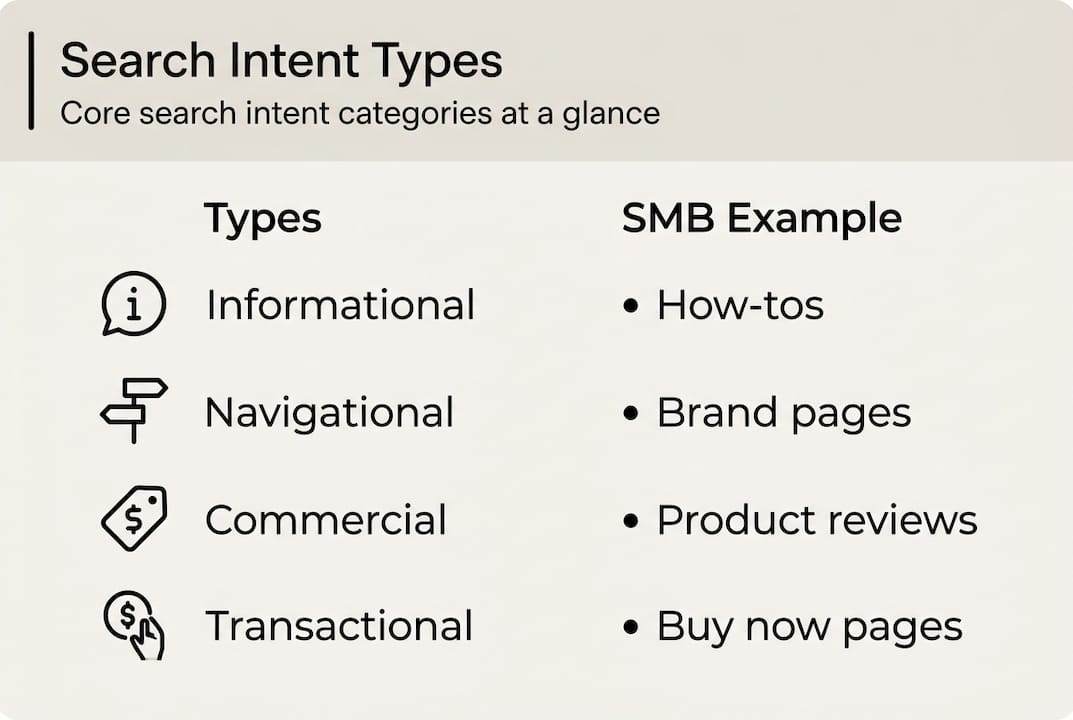
Here’s how each type breaks down in practice:
| Intent type | Example query | User goal | Best SMB content format |
|---|---|---|---|
| Informational | “how does SEO work” | Learn something | Blog post, guide, FAQ |
| Navigational | “ibrand.media login” | Find a specific site | Homepage, branded page |
| Commercial investigation | “best SEO tools for small business” | Compare before buying | Comparison page, review |
| Transactional | “buy SEO audit service” | Complete a purchase | Product/service page |
| Local | “SEO agency near me” | Find local provider | Google Business Profile, local landing page |
| Generative AI | “explain keyword research” | Get a direct AI answer | Structured, concise content |
For SMBs focused on revenue, commercial investigation and transactional intent are your highest-priority targets. Commercial intent keywords drive 58.1% of organic visits to major retail sites like bestbuy.com, and 57.3% to sites like kay.com. That’s the majority of buying traffic coming from just two intent categories.
Key takeaways for your content strategy:
- Informational content builds trust and attracts early-stage researchers
- Commercial investigation pages capture shoppers who are almost ready to buy
- Transactional pages close the deal with clear calls to action
- Local intent is critical if you serve a specific geographic area
For practical guidance on targeting the right queries, keyword research for SMBs is a strong starting point. If you serve a local market, improving local search rankings should be a parallel priority. You can also review a real-world search intent case study to see how these categories play out in actual traffic data.
How to identify and classify search intent: Practical SMB workflow
Knowing the intent types is one thing. Building a repeatable process to classify your keywords is what actually moves the needle. Here’s a simple workflow any SMB can follow, with or without paid tools.
- Collect your target keywords. Start with 10 to 20 keywords most relevant to your products or services.
- Search each keyword on Google. Look at the top five organic results, not the ads.
- Identify the dominant content format. Are results mostly blog posts, product pages, videos, or local listings?
- Look for SERP features. Featured snippets suggest informational intent. Shopping results signal transactional intent. Map packs indicate local intent.
- Check query modifiers. Words like “buy,” “order,” and “price” signal transactional intent. “Best,” “vs,” and “review” indicate commercial investigation. “How to” and “what is” point to informational intent. “Near me” and city names flag local intent.
- Classify and document. Record each keyword’s intent type and the content format Google favors.
Here’s a sample workflow table to organize your findings:
| Keyword | Intent type | Top result format | Recommended content |
|---|---|---|---|
| “SEO services for small business” | Commercial investigation | Listicle/comparison | Comparison landing page |
| “hire SEO agency” | Transactional | Service pages | Service page with CTA |
| “what is local SEO” | Informational | Blog post/guide | Educational blog post |
| “SEO agency in Chicago” | Local | Map pack + local pages | Local landing page |
Ahrefs keyword tools and Semrush both offer intent classification features that automate much of this process. But the manual SERP check is free and often more revealing because you see exactly what Google is currently rewarding.
Pro Tip: Run your top 20 keywords through this workflow every quarter. Intent classifications shift, and a page that ranked well six months ago may now be misaligned with what Google expects.
For a broader look at tools that support this process, the SEO platform comparison at ibrand.media covers the leading options for SMBs. Pairing intent analysis with strong backlink strategies amplifies your results significantly.
Why search intent changes (and how to stay ahead)
Here’s something most SEO guides skip: search intent isn’t static. The intent behind a keyword today may not be the same six months from now. Ignoring this is one of the fastest ways to lose rankings you’ve worked hard to earn.
In a study of 37,000 keywords, search intent shifted approximately 12% over a single year. After Google’s BERT update alone, 10.5% of keywords changed intent classification, with a cumulative shift of 15.7% over the study period. That’s a significant portion of your keyword portfolio potentially becoming misaligned without any action on your part.
“Intent drift is silent. Your rankings drop, your traffic falls, and the page looks fine on the surface. The real problem is that Google’s understanding of the query has evolved and your content hasn’t.”
Why does intent shift? Several forces drive it:
- Algorithm updates like BERT, MUM, and Google’s AI-powered systems continuously refine how queries are interpreted
- Seasonal behavior changes what users want from the same keyword at different times of year
- Competitive content raises the bar for what Google considers the best answer
- User behavior trends shift as new products, events, or cultural moments change how people search
Warning signs that intent has shifted for one of your pages:
- A sudden drop in organic traffic with no technical issues
- New types of results appearing in the SERP (videos replacing articles, for example)
- Your page’s click-through rate falling despite stable rankings
- Competitors with different content formats overtaking your position
Schedule quarterly SERP reviews for your top 20 keywords. Use tracking marketing ROI methods to connect traffic changes to intent shifts, so you can act fast when something moves. Tools like Ahrefs and Semrush offer rank tracking with SERP feature monitoring, which makes spotting intent shifts much faster.
Aligning content with search intent: Key strategies for SMBs
Understanding intent is only half the job. The other half is building content that actually satisfies it. Google’s AI systems, including Gemini and MUM, now evaluate content at a semantic and entity level, meaning they assess whether your page genuinely answers the full scope of what a searcher wants, not just whether your keyword appears on the page.

The most practical framework for alignment is the 3 Cs: Content type, Content format, and Content context. Intent mismatch is the biggest alignment mistake, and the 3 Cs give you a structured way to avoid it.
Here’s how to apply the 3 Cs in practice:
- Audit your existing pages. For each key page, identify the target keyword and check whether the current content type matches what Google ranks for that query.
- Fix the format first. If Google ranks listicles and you have a wall of prose, restructure before rewriting.
- Align the context. Make sure your page covers the subtopics and questions that appear in related searches and “People also ask” boxes.
- Update regularly. Set a calendar reminder to revisit high-value pages every three to six months.
- Track the results. Monitor rankings and traffic after each update to confirm alignment is working.
Common alignment failures to avoid:
- Publishing a blog post when the query demands a product page
- Writing shallow content that answers the surface question but misses the deeper need
- Targeting a keyword with a page that’s off-topic or only tangentially related
- Ignoring SERP features like featured snippets that signal a specific answer format
Pro Tip: Run a content audit twice a year. Compare your top pages’ intent classifications against current SERP results. Even small format adjustments, like adding a comparison table or a step-by-step list, can recover lost rankings quickly.
For SMBs ready to build this into a full strategy, SEO for SMBs covers the broader picture, and the website optimization guide addresses the technical side of making your pages search-ready. Avoiding search intent mistakes from the start saves you months of rework.
Ready to turn search intent into real business growth?
Mastering search intent is one of the highest-leverage moves an SMB can make in 2026. But knowing the theory and executing a full strategy are two different things. Most business owners don’t have hours to spend auditing keywords, rewriting pages, and monitoring SERP shifts every quarter.
At ibrand.media, we handle the entire process for you. From intent-driven keyword research and content alignment to local SEO and real-time performance tracking, our team builds strategies tailored to your specific market and goals. We work with small and medium-sized businesses that need results without the overhead of a full in-house marketing team. If your website isn’t pulling in the traffic and leads it should, we’d love to show you what a properly aligned SEO strategy looks like in practice. Reach out to ibrand.media to get your personalized plan started today.
Frequently asked questions
How do I check a keyword’s search intent without paid tools?
Search your keyword on Google and study the top five organic results. The page formats and features you see reveal exactly what intent Google expects for that query.
What’s the biggest search intent mistake small businesses make?
The most common error is publishing content that doesn’t match what searchers actually want, such as a blog post where Google expects a product or service page.
How often should I review search intent for my main keywords?
Check at least quarterly or after any major Google update, since intent can shift 12% or more over a single year.
Which search intent types matter most for boosting sales?
Focus on commercial investigation and transactional intent. Commercial keywords drive 58.1% of organic visits to major retail sites, making them the highest-value targets for revenue-focused SMBs.
Recommended
- How to improve Google ranking: SEO for small business 2026 | Ibrandmedia
- Optimizing Websites for Search: A Guide for Small Businesses 2025 | Ibrandmedia
- SEO for Small Businesses: Boost Local Sales Fast | Ibrandmedia
- How SEO Works: Complete Guide for Small Businesses | Ibrandmedia
- Local SEO Guide for Ecommerce: Boost Local Sales Fast
Recent Comments