
Finding loyal customers online can feel overwhelming for many small business owners. Choosing the right keywords often decides whether your website appears before local shoppers or stays hidden in search results. With the right keyword research approach, you can reveal exactly how people describe their needs and position your business where they will find you. This guide breaks down the essentials of keyword selection and targets practical strategies you can put to work today.
Table of Contents
- Definition And Role Of Keyword Research
- Types Of Keywords And Search Intent
- Choosing Effective Keyword Research Tools
- Analyzing Keyword Competition And Volume
- Common Mistakes And Pitfalls To Avoid
Key Takeaways
| Point | Details |
|---|---|
| Importance of Keyword Research | Keyword research is essential for small businesses to enhance online visibility and understand customer search behavior. It helps identify relevant search terms and inform content strategies. |
| Types of Keywords and Intent | Understanding different keyword types (Informational, Navigational, Commercial, Transactional) enables businesses to tailor content to user intent and needs. |
| Tools for Keyword Research | Utilizing effective keyword research tools can streamline the process, offering insights into search volume, competition, and long-tail opportunities. |
| Common Mistakes in Keyword Research | Avoid targeting only high-volume keywords and ensure to consider user intent and specific business relevance to enhance conversion potential. |
Definition and Role of Keyword Research
Keyword research represents a foundational strategy for small business owners seeking to improve their online visibility and connect with potential customers. At its core, keyword research involves identifying and analyzing specific search terms that potential customers use when looking for products, services, or information related to a business.
In academic and digital marketing contexts, keywords serve as critical communication bridges. Connecting research to audiences requires strategic term selection that accurately represents core content and enhances discoverability. For small businesses, this translates into understanding precisely how potential customers search and describe their needs online.
The primary objectives of keyword research include:
- Identifying exact search phrases potential customers use
- Understanding search volume and competition for specific terms
- Revealing customer intent and search behavior
- Developing targeted content strategies
- Improving website visibility in search engine results
Keyword selection is not just about finding popular terms, but discovering the right balance between search frequency, relevance, and competition. Strategic keyword choices help connect publications to dynamic environments by revealing precise customer needs and interests.
Pro tip: Start your keyword research by brainstorming terms your customers would actually type into search engines, focusing on their language and specific problems they’re trying to solve.
Types of Keywords and Search Intent
Small business owners must understand the nuanced landscape of keyword types to effectively target potential customers online. Search intent categorizes keywords into four primary classifications that reveal a user’s underlying motivation when searching.
Keyword types represent distinct user objectives, each requiring a tailored content approach:
- Informational Keywords: Users seeking knowledge or answers
- Navigational Keywords: Users attempting to locate a specific website
- Commercial Investigation Keywords: Users researching potential purchases
- Transactional Keywords: Users ready to complete a purchase or action
Search intent subdivides keywords into strategic categories that help businesses understand customer behavior. Informational keywords typically include terms like “how to,” “what is,” or “guide to,” indicating users want educational content. Navigational keywords involve brand or website names, suggesting users know exactly where they want to go.
Here’s a breakdown of common keyword types and sample search phrases for each:
| Keyword Type | Example Search Phrases | Typical User Goal |
|---|---|---|
| Informational | ‘how to start a business’ | Learn or research |
| Navigational | ‘Facebook login’ | Find a specific website |
| Commercial Investigation | ‘best laptops 2024’ | Compare products/services |
| Transactional | ‘buy running shoes online’ | Complete a purchase or action |
Commercial investigation keywords demonstrate a deeper purchasing consideration, often including comparative terms like “best,” “top,” or “reviews.” Transactional keywords signal immediate purchase intent, frequently incorporating phrases such as “buy,” “pricing,” or “discount.” Understanding these distinctions allows small businesses to craft precisely targeted content that meets potential customers exactly where they are in their buying journey.
Pro tip: Map your content strategy to specific search intent types, creating targeted resources that directly address each stage of customer research and purchasing decisions.
Choosing Effective Keyword Research Tools
Small business owners navigating the complex world of digital marketing need powerful keyword research tools that provide actionable insights without overwhelming complexity. Academic keyword analytics tools demonstrate the critical importance of selecting the right technology to enhance online visibility.
When evaluating keyword research tools, consider these essential features:
- Search volume tracking capabilities
- Competitive keyword difficulty analysis
- Long-tail keyword suggestions
- Geographic and local search insights
- Cost-per-click (CPC) information
- Real-time trend monitoring
Specialized keyword tools can significantly reduce the time and effort required for comprehensive keyword research. Popular options like Google Keyword Planner, SEMrush, and Ahrefs offer different strengths, ranging from free basic analytics to advanced competitive intelligence.
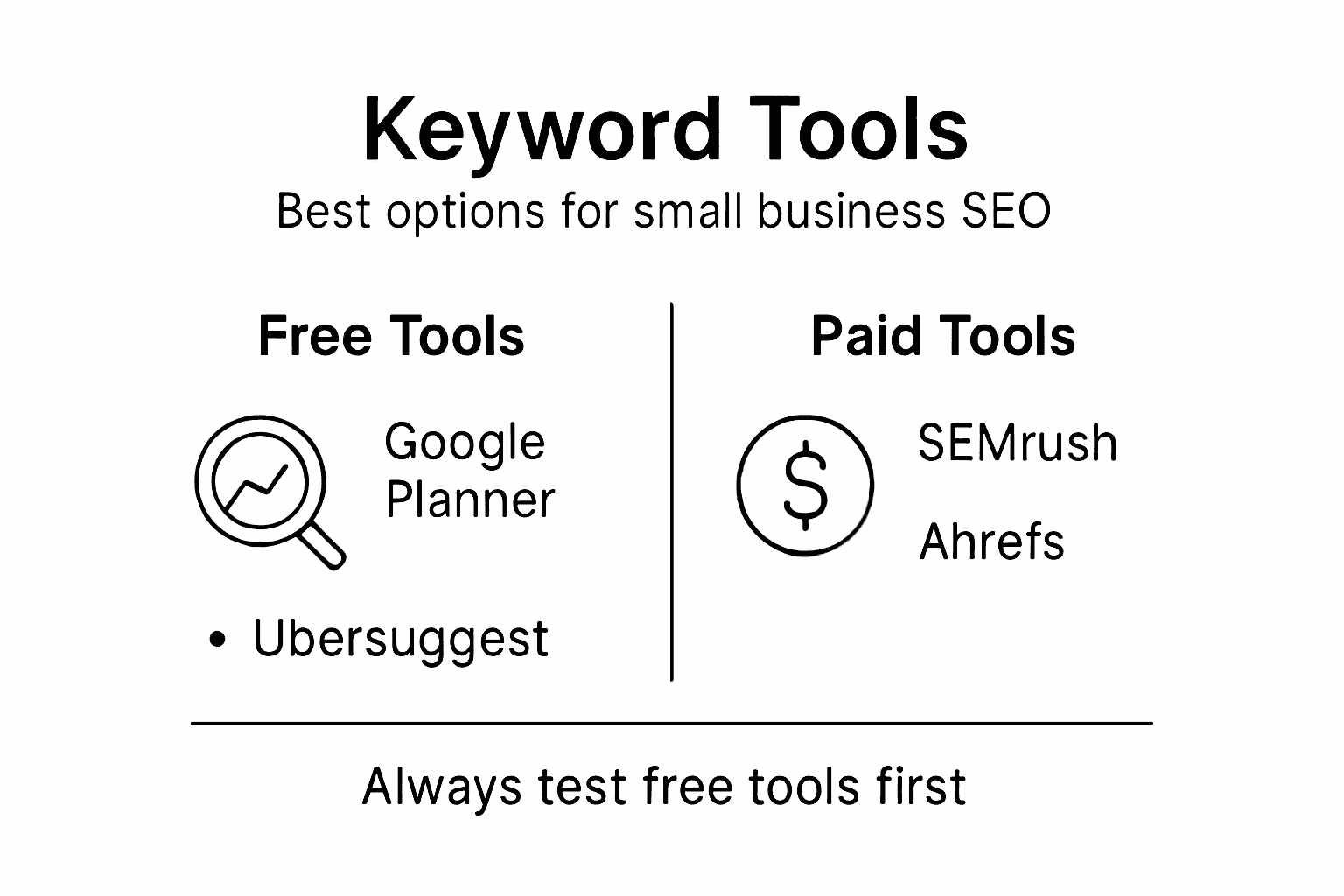
The most effective keyword research tools provide more than just raw data. They help small businesses understand user intent, identify emerging search trends, and uncover niche opportunities that larger competitors might overlook. Look for platforms that offer intuitive interfaces, regular database updates, and clear visualization of keyword performance metrics.
To help you choose a keyword research tool, here’s a comparison of popular options:
| Tool Name | Pricing Model | Main Strength |
|---|---|---|
| Google Keyword Planner | Free | Reliable search volume data |
| SEMrush | Subscription | Advanced competitor analysis |
| Ahrefs | Subscription | Comprehensive keyword metrics |
| Moz Keyword Explorer | Freemium | User-friendly long-tail insights |
Pro tip: Start with free tools like Google Keyword Planner to establish a baseline, then gradually invest in more advanced platforms as your business’s digital marketing needs become more sophisticated.
Analyzing Keyword Competition and Volume
Successful keyword strategy requires more than just identifying popular search terms. Small business owners must understand the nuanced dynamics of keyword metrics that determine online visibility. Keyword competition analysis provides critical insights into the potential success of digital marketing efforts.
Key metrics to evaluate when analyzing keywords include:
- Search Volume: Monthly search frequency
- Keyword Difficulty: Ranking challenges
- Competition Level: Number of websites targeting the term
- Cost-Per-Click (CPC): Advertising value
- User Intent: Alignment with business goals
- Trend Trajectory: Seasonal or long-term search patterns
Understanding these metrics helps small businesses make strategic decisions. High search volume doesn’t always translate to opportunity. A keyword with 5,000 monthly searches might be extremely competitive, while a more specific term with 500 searches could represent a more achievable target with higher conversion potential.

Small business owners should focus on long-tail keywords that balance reasonable search volume with lower competition. These more specific phrases often indicate stronger user intent and can be easier to rank for compared to broader, more generic terms. By carefully analyzing these metrics, businesses can develop a targeted approach that maximizes their digital marketing resources.
Pro tip: Aim for keywords with a sweet spot of 100-1,000 monthly searches and low to medium competition to maximize your chances of ranking effectively.
Common Mistakes and Pitfalls to Avoid
Keyword research is a nuanced process where small business owners can easily fall into costly traps that undermine their digital marketing efforts. Keyword research mistakes often stem from misunderstanding fundamental strategic principles, leading to ineffective content and wasted resources.
Common keyword research pitfalls include:
- Targeting only high-volume keywords
- Ignoring long-tail keyword opportunities
- Neglecting user search intent
- Failing to analyze competitor keyword strategies
- Using generic, overly broad search terms
- Overlooking local and regional search variations
- Disregarding keyword relevance to specific business offerings
Most small businesses mistakenly believe that keywords with the highest search volume guarantee success. In reality, these terms are typically extremely competitive and may not align with specific business goals. A keyword with 10,000 monthly searches might seem attractive, but if it doesn’t match user intent or conversion potential, it becomes essentially worthless.
Successful keyword strategies require deep understanding of your specific audience, their search behaviors, and the subtle nuances of intent behind their queries. Small business owners must look beyond raw numbers and focus on keywords that demonstrate genuine alignment with their products, services, and target customer needs.
Pro tip: Prioritize keywords that demonstrate clear commercial intent and have moderate search volume, rather than chasing high-traffic terms with low conversion potential.
Unlock Your Small Business Potential with Expert Keyword Strategies
Struggling to pinpoint the right keywords that truly connect with your customers and boost your online visibility The article highlights common challenges such as overlooking user intent and chasing overly competitive terms These obstacles can stall your growth but you don’t have to face them alone At Uncategorized | Ibrandmedia we specialize in transforming keyword insights into effective digital marketing action that delivers real results
Take control of your search engine presence today with tailored SEO optimization and data-driven strategies from https://ibrand.media Our team guides you through selecting targeted long-tail keywords that match your ideal customer’s intent and optimize your content for maximum impact Don’t let your competitors outshine you Start crafting your personalized keyword plan now and watch your business thrive
Frequently Asked Questions
What is keyword research and why is it important for small businesses?
Keyword research involves identifying and analyzing specific search terms potential customers use when searching for related products or services. It’s important for small businesses as it helps improve online visibility, understand customer needs, and create targeted content strategies.
What types of keywords should small businesses focus on?
Small businesses should focus on four main types of keywords: informational, navigational, commercial investigation, and transactional. Each type indicates a different user intent, guiding businesses on how to tailor their content effectively.
How can I choose the right keyword research tool for my business?
Consider using tools that offer features like search volume tracking, competitive keyword analysis, long-tail suggestions, and geographic insights. Popular options include Google Keyword Planner, SEMrush, and Ahrefs, each with unique strengths suitable for different needs.
What common mistakes should I avoid in my keyword research process?
Avoid targeting only high-volume keywords, neglecting long-tail opportunities, and not considering user search intent. Focus on keywords with clear commercial intent that align with your business offerings for better conversion potential.
Recommended
- Understanding Why Your Business Needs SEO for Growth | Ibrandmedia
- Improving Local Search Rankings for Small Businesses Easily | Ibrandmedia
- How to Get Found Online: Boost Your Local Business Fast | Ibrandmedia
- Improve Google Visibility: Step-By-Step Guide for Small Businesses | Ibrandmedia
- Small Business Marketing Ideas to Grow Your Business
- How to Design Homepage for Small Business Success | Dreamhaus
- 7 Top Print Marketing Strategies for Business Success
Recent Comments