
Most American small business owners are shocked when they realize just how much missed customer traffic comes from minor errors in their online presence. Even a single outdated phone number or inconsistent business listing can keep your HVAC or plumbing company hidden from local clients searching on Google. Improving your visibility does not demand a big budget, but it does require careful attention to detail and a step-by-step strategy to connect with real customers in your own community.
Table of Contents
- Step 1: Audit Your Current Online Presence
- Step 2: Optimize Your Google Business Profile
- Step 3: Enhance On-Page SEO Elements
- Step 4: Build Quality Local Backlinks
- Step 5: Track Results and Adjust Strategies
Quick Summary
| Key Message | Explanation |
|---|---|
| 1. Audit Your Online Presence | Evaluate your digital footprint to understand strengths and weaknesses in your online visibility. |
| 2. Optimize Your Google Profile | Ensure your Google Business Profile is filled with accurate details and engaging content to attract customers. |
| 3. Enhance On-Page SEO Elements | Focus on optimizing title tags, meta descriptions, and website speed to improve search rankings. |
| 4. Build Quality Local Backlinks | Acquire authoritative local backlinks through partnerships and relevant content to enhance visibility. |
| 5. Track Results and Refine Strategies | Monitor performance metrics regularly to refine your marketing strategies based on data-driven insights. |
Step 1: Audit Your Current Online Presence
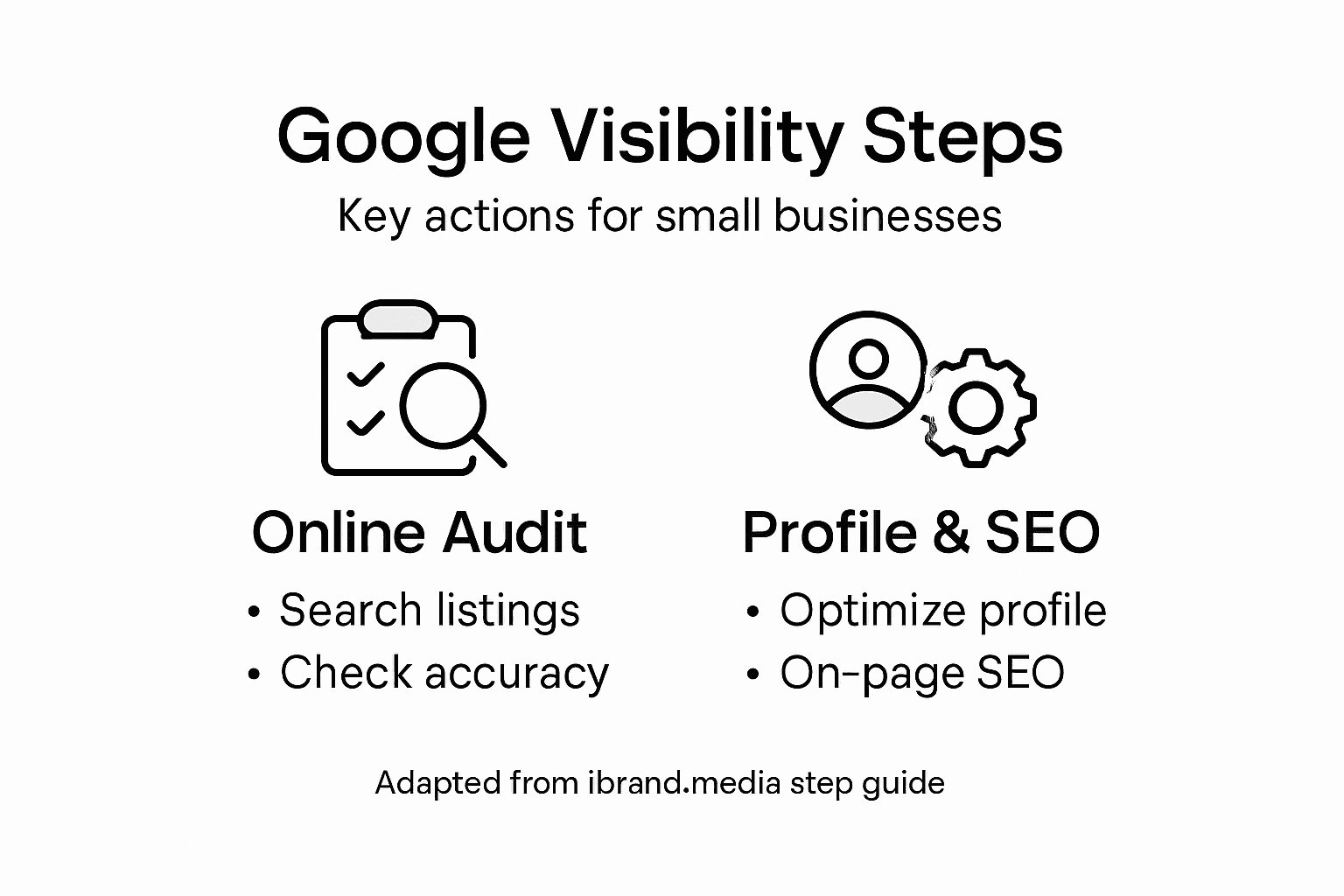
Understanding your current online visibility is the foundation for improving your Google search rankings. Small businesses must systematically evaluate their digital footprint to identify strengths, weaknesses, and opportunities for growth. Start by conducting a comprehensive online presence assessment that provides a clear snapshot of how potential customers might discover and perceive your business online.
Begin your audit by performing a thorough Google search of your business name, key team members, and primary service offerings. Note how you appear in search results and across different platforms. Check your Google Business Profile, social media accounts, review sites like Yelp, and industry specific directories. Look for consistency in your business name, contact information, website link, and overall brand messaging. Pay special attention to any outdated or incorrect information that could confuse potential customers or harm your online reputation.
Document your findings systematically by creating a spreadsheet tracking your online listings, their accuracy, and any discrepancies you discover. Include columns for platform name, current listing details, needed corrections, and priority level for updates. This methodical approach will help you create a strategic roadmap for improving your online visibility and ensuring accurate representation across digital channels.
Pro Tip: Use free online tools like Google Alerts to monitor mentions of your business and track changes in your online presence automatically.
Here’s a quick reference comparing popular online presence assessment tools:
| Tool Name | Main Function | Reporting Features | Ideal For |
|---|---|---|---|
| Google Alerts | Monitors web mentions | Email notifications, keyword tracking | Brand reputation monitoring |
| Moz Local | Audits business listings | Location accuracy, duplicate alerts | Local SEO improvement |
| SEMrush Site Audit | Checks website health | Crawl errors, SEO reports | Technical site issues |
| Yext | Synchronizes business info | Listings updates, local analytics | Multi-location management |
Step 2: Optimize Your Google Business Profile
Maximizing your Google Business Profile is crucial for improving local search visibility and attracting potential customers. Small businesses can significantly enhance their online presence by strategically configuring their business profile to highlight their unique value proposition and make it easy for customers to find and engage with them.

Start by claiming or creating your Google Business Profile with complete and accurate information. Ensure every detail is precise including your business name, address, phone number, website, and operating hours. Upload high quality professional photos that showcase your business interior, exterior, products, and team. Write a compelling business description that includes relevant keywords naturally and explains what makes your business unique. Regularly update your profile with current information about services, special offers, and seasonal changes to keep potential customers informed.
Encourage satisfied customers to leave reviews and respond promptly and professionally to all feedback. Google values businesses that actively engage with their customer base. Utilize features like posts, messaging, and Q&A sections to provide additional information and demonstrate your commitment to customer service. Monitor your profile analytics to understand how customers are finding and interacting with your business online.
Pro Tip: Update your Google Business Profile at least once a month to maintain accuracy and improve your local search rankings.
Step 3: Enhance On-Page SEO Elements
Improving your website’s on-page SEO is essential for increasing Google visibility and attracting more potential customers. Small businesses can significantly boost their search rankings by strategically optimizing key website elements that help search engines understand and rank their content effectively.
Start by focusing on critical on-page SEO components. Craft compelling title tags that include your primary keywords and accurately describe each page’s content within 50 to 60 characters. Write unique meta descriptions that entice users to click while naturally incorporating relevant keywords. Structure your content using header tags H1, H2, and H3 to create a clear hierarchy and help search engines understand your content’s organization. Integrate keywords naturally throughout your text, ensuring they flow seamlessly and provide value to readers. Optimize image alt tags by describing images precisely and including relevant keywords when appropriate.
Pay close attention to your website’s technical elements. Improve page loading speed by compressing images, minimizing code, and leveraging browser caching. Ensure your website is mobile responsive, as Google prioritizes mobile friendly sites in search rankings. Create internal links between related content to help search engines understand your website’s structure and help visitors navigate more effectively. Regularly update your content to demonstrate ongoing relevance and authority in your industry.
Pro Tip: Use free SEO browser extensions to quickly analyze and identify on page optimization opportunities for your website.
Step 4: Build Quality Local Backlinks
Building quality local backlinks is a critical strategy for improving your small business’s Google visibility and establishing regional online authority. By strategically developing authoritative link networks, you can significantly enhance your search rankings and attract more local customers.
Start by identifying local opportunities for backlink acquisition. Connect with nearby business associations, chambers of commerce, and industry specific professional organizations to secure relevant links. Engage with local media outlets and community websites by offering expert insights, guest articles, or commentary related to your industry. Consider sponsoring local events, charities, or sports teams that can provide natural backlink opportunities. Collaborate with complementary local businesses to create cross promotional content that generates mutual linking benefits. Participate in local business directories and ensure your listings include a link back to your website while maintaining consistent business information across all platforms.
Focus on creating high quality, locally relevant content that naturally attracts backlinks. Develop comprehensive guides, local industry research, or informative blog posts that provide genuine value to your community. Reach out to local bloggers, journalists, and industry influencers who might be interested in referencing your content. Monitor your backlink profile regularly to ensure link quality and remove any potentially harmful or irrelevant links that could negatively impact your search rankings.
Pro Tip: Use free backlink analysis tools to track your link building progress and identify new local linking opportunities.
Review these typical local backlink sources and their business benefits:
| Source Type | Example | Benefit for Local SEO |
|---|---|---|
| Local Directories | Chamber websites | Increased regional visibility |
| Community Media | Local news sites | Enhanced authority, trust |
| Business Associations | Trade groups | Valuable niche referrals |
| Sponsorships | Event partnerships | Broader community engagement |
Step 5: Track Results and Adjust Strategies
Successfully improving your Google visibility requires ongoing measurement and strategic refinement. By implementing robust performance tracking, you can make data driven decisions that continuously enhance your online marketing effectiveness.
Establish clear key performance indicators that directly align with your business goals. Use Google Analytics to monitor organic search traffic, track keyword rankings, measure website engagement metrics like bounce rate and time on page, and analyze conversion rates. Set up conversion tracking for specific actions such as form submissions, phone calls, or online bookings. Review your Google Search Console regularly to understand how Google crawls and indexes your website and identify potential technical SEO issues that might impact your visibility.
Schedule monthly or quarterly strategy review sessions to assess your progress and make informed adjustments. Compare your current performance against baseline metrics and industry benchmarks. Look for patterns in your data that reveal successful strategies and areas needing improvement. Be prepared to pivot your approach based on emerging trends, algorithm updates, or changes in your local market dynamics. Document your insights and create actionable plans to address any performance gaps or capitalize on successful tactics.
Pro Tip: Create a simple dashboard that consolidates your most important SEO performance metrics to simplify monthly performance tracking.
Unlock Your Small Business’s Full Google Potential with Expert Help
Facing challenges like low local search rankings, inconsistent online listings, and under-optimized websites can feel overwhelming. This guide highlights key pain points such as improving your Google Business Profile, building quality local backlinks, and tracking real results. At iBrand Media, we understand these hurdles and offer tailored digital marketing solutions designed to help small businesses boost their online visibility quickly and affordably.
Discover how our comprehensive services including SEO optimization, local marketing, and mobile-friendly web design can transform your online presence. Explore success stories and see why partnering with us means personalized plans and transparent pricing to fit your goals. Don’t wait to maximize your Google visibility and attract more customers by visiting Uncategorized | Ibrandmedia.
Ready to rise above the competition? Take the next step now by visiting https://ibrand.media to start your custom campaign. Unlock immediate growth opportunities and get expert support focused on helping your small business thrive in Google search.
Frequently Asked Questions
How can I audit my current online presence to improve Google visibility?
To audit your current online presence, start by searching your business name and key offerings on Google. List the platforms where your business appears and check for accuracy in name, contact information, and messaging. Create a tracking spreadsheet to document any discrepancies and outline necessary corrections.
What should I include in my Google Business Profile to enhance visibility?
Your Google Business Profile should contain complete and accurate information, including your business name, address, phone number, website, and operating hours. Upload high-quality images and write a compelling business description that naturally includes relevant keywords to help attract potential customers.
What are effective ways to improve my website’s on-page SEO?
To enhance your website’s on-page SEO, focus on creating compelling title tags and unique meta descriptions that include primary keywords. Organize your content using header tags and optimize images with descriptive alt tags. Regularly update your website with fresh content to maintain relevance and authority.
How can I build local backlinks for my small business?
Start by networking with local business associations and industry groups to secure backlinks. Participate in community events or sponsor local organizations to gain visibility and link opportunities. Creating valuable, locally relevant content can also attract organic backlinks from local bloggers and media.
What metrics should I track to measure my Google visibility improvement?
Track key performance indicators such as organic search traffic, keyword rankings, and website engagement metrics like bounce rate. Utilize conversion tracking for actions such as form submissions or phone calls, and regularly review data to identify trends and adjust your strategies accordingly.
How often should I update my Google Business Profile?
You should update your Google Business Profile at least once a month to ensure all information remains accurate and relevant. Regular updates about services, hours, and special offers can significantly improve your local search rankings and attract more customers.
Recommended
- Google Maps Optimization Tips for Small Business Growth | Ibrandmedia
- Google Business Profile Guide 2025: Boost Local Visibility | Ibrandmedia
- How to Optimize Google My Business for Maximum Visibility | Ibrandmedia
- Google Business Profile Tips for Maximum Local Visibility | Ibrandmedia
- blog | siift | Startup vs Small Business: What’s Right for You?
- Publicité Google – Augmentez votre Trafic et vos Ventes en Ligne
Recent Comments