
TL;DR:
- Organic traffic is unpaid, sustainable, and builds long-term credibility through SEO efforts.
- Paid traffic offers immediate results but requires ongoing investment and control over targeting.
- Combining both strategies can optimize growth, with paid testing informing organic content and vice versa.
More than half of small business owners treat website traffic like a single category, pouring money into ads or grinding out blog posts without knowing which approach actually moves the needle. Organic traffic is earned through unpaid search results via SEO, while paid traffic is purchased through ads where you bid on keywords and pay per click. Both drive visitors to your site, but they work in completely different ways, on different timelines, and with very different cost structures. Understanding which strategy fits your current business stage could be the single biggest lever you pull this year.
Table of Contents
- What is organic traffic and how does it work?
- What is paid traffic and how does it work?
- Key differences between organic and paid traffic
- How to integrate organic and paid traffic for maximum impact
- A smarter approach to traffic: what most businesses get wrong
- Accelerate your business growth with expert traffic strategies
- Frequently asked questions
Key Takeaways
| Point | Details |
|---|---|
| Organic vs paid definition | Organic traffic is earned through SEO and content, while paid traffic is purchased through ads. |
| Cost and sustainability | Organic takes longer to deliver but builds lasting value, paid works instantly but stalls when budgets end. |
| Best strategy for SMBs | Blending both strategies unlocks faster growth and better long-term results than relying on one channel. |
| ROI differences | Organic delivers compounding ROI over time, while paid excels at immediate impact and testing. |
What is organic traffic and how does it work?
Organic traffic is every visitor who finds your website through an unpaid search result. When someone types a question into Google and clicks your listing, that counts as organic. You didn’t pay for that click directly. Instead, you earned it by building a website that search engines trust and users find relevant.
For small and medium-sized businesses, acquiring organic traffic comes down to three core activities: search engine optimization (SEO), content strategy, and technical site health. SEO for small businesses involves optimizing your pages for keywords your customers actually search, earning backlinks from reputable sites, and making sure your website loads fast and works well on mobile devices.
The advantages of organic traffic are hard to ignore:
- Cost-effectiveness: Once a page ranks well, it keeps attracting visitors without ongoing ad spend.
- Credibility: Users trust organic results more than ads. Appearing at the top of search results signals authority.
- Compounding returns: A well-optimized blog post written today can drive traffic for years. The value builds over time rather than disappearing the moment you stop paying.
- Audience quality: Organic visitors are actively searching for what you offer, so they tend to convert better than cold ad audiences.
The honest challenge with organic traffic is time. Most businesses won’t see significant organic growth for three to six months after starting an SEO effort. It requires consistent publishing, regular technical audits, and patience. That’s a tough sell when you need customers next week.
Pro Tip: Focus your early SEO efforts on long-tail keywords (specific, lower-competition phrases like “affordable plumber in Austin” rather than just “plumber”). These rank faster and attract buyers who are closer to making a decision.
For businesses serious about affordable growth with SEO, the compounding nature of organic traffic is what makes it so powerful. A single strong piece of content can outperform a paid campaign that cost thousands of dollars, given enough time.
What is paid traffic and how does it work?
Paid traffic is exactly what it sounds like. Advertisers bid on keywords and pay per click through platforms like Google Ads, Meta Ads, or display networks. Every time someone clicks your ad, money leaves your account. Stop the budget, and the traffic stops immediately.
Here’s how a basic paid campaign works for a small business:
- Choose your platform. Google Ads targets people actively searching. Meta Ads (Facebook and Instagram) targets people based on demographics and interests.
- Set your budget and bids. You decide how much you’re willing to pay per click and set a daily or monthly spending cap.
- Create your ad. Write compelling copy, choose images or videos, and link to a landing page designed to convert.
- Define your audience. Paid platforms let you narrow by location, age, device, behavior, and even past website visits.
- Launch and monitor. Campaigns go live within hours. You track clicks, conversions, and cost per acquisition in real time.
The biggest benefit of paid traffic is speed. You can have visitors on your site within 24 hours of launching a campaign. For new product launches, seasonal promotions, or testing a new offer, that immediacy is invaluable. Understanding the benefits of online advertising for small businesses goes beyond just speed. Paid ads also give you precise data on what messaging works, which audiences convert, and what your cost per customer actually is.

The tradeoff is cost and dependency. Paid traffic requires a continuous budget, and results can be unpredictable when competition for keywords is high. For a deeper look at how these two channels stack up, the SEO vs paid advertising comparison breaks down the real numbers.
Pro Tip: Use paid ads to test headlines and offers before committing to long-form content. If an ad headline gets strong clicks, turn it into your next blog post or landing page title. Paid data can directly inform your organic strategy.
Key differences between organic and paid traffic
Now that you understand how each channel works, here’s a direct side-by-side comparison across the dimensions that matter most to small business owners.
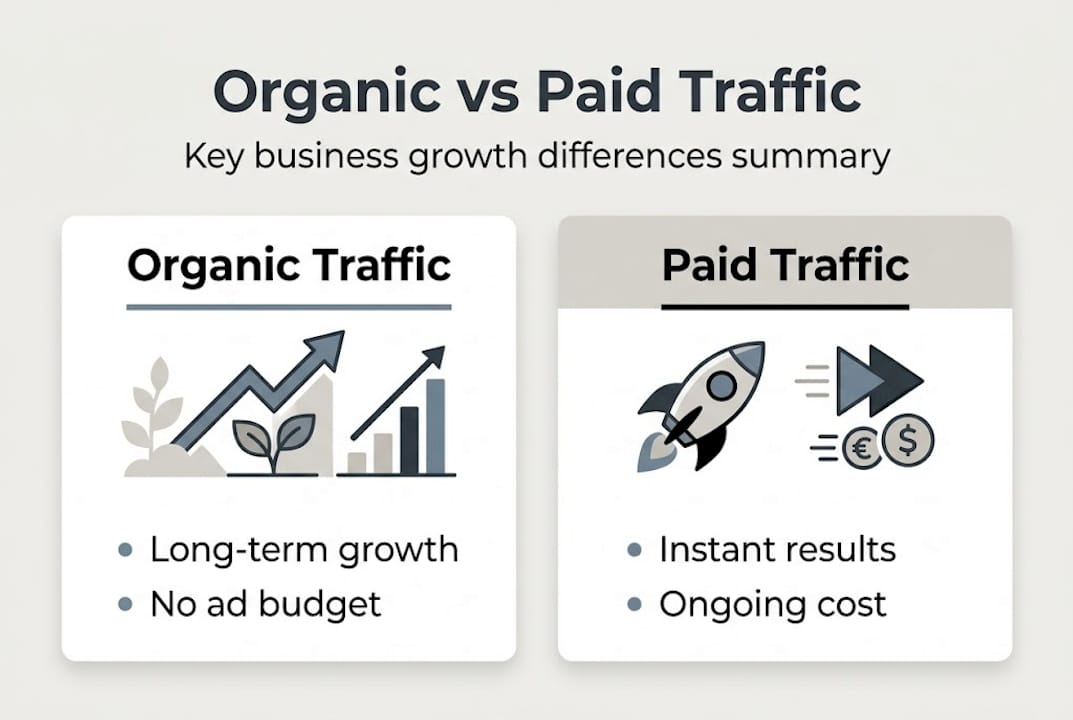
| Factor | Organic traffic | Paid traffic |
|---|---|---|
| Cost | No direct ad spend; requires time and SEO investment | Direct cost per click; scales with budget |
| Speed | Slow (months to build) | Fast (live within hours) |
| Trust | High (users trust organic results) | Lower (users know it’s an ad) |
| Sustainability | Long-term; keeps working after effort stops | Stops when budget runs out |
| Control | Limited; search algorithms decide rankings | High; you control targeting and spend |
| ROI timeline | Long-term compounding returns | Immediate but requires ongoing investment |
The trust factor deserves special attention. Studies consistently show that users click organic results more often than paid ads for most search queries. Organic results feel earned, not bought, which builds a different kind of relationship with potential customers.
That said, paid traffic offers control that organic simply can’t match. You can target someone who visited your site last week, lives within five miles of your store, and has shown interest in your product category. That precision is a genuine competitive advantage.
“Integrating organic and paid can help avoid cannibalization and leverage synergies, making both channels more effective than either would be alone.”
A few other key differences worth noting:
- Competitive advantage: Strong organic rankings are hard to copy quickly. A competitor can outbid you on ads overnight, but they can’t steal your domain authority.
- Data ownership: Organic traffic data lives in your analytics forever. Paid campaign data disappears when you close an account.
- Testing speed: Paid lets you test offers and audiences in days. Organic testing takes months.
For a deeper look at building your foundation, the SEO optimization guide walks through the technical and content steps that drive sustainable rankings. If you’re evaluating tools to manage your SEO, the SEO platform comparison covers the leading options for small businesses.
How to integrate organic and paid traffic for maximum impact
Comparison is useful, but the real growth opportunity comes from running both channels together strategically. Most businesses treat organic and paid as separate budgets managed by separate people. That’s a missed opportunity.
Here’s how to build a hybrid strategy that actually works:
- Use paid to find your best keywords, then build organic content around them. If a Google Ads keyword converts well, create a detailed blog post or landing page targeting that same term organically.
- Retarget organic visitors with paid ads. Someone who found your site through search but didn’t buy is a warm lead. A retargeting ad keeps you top of mind without paying for a cold audience.
- Run paid ads during your organic ramp-up period. While your SEO investment is building momentum (typically three to six months), paid ads keep leads coming in so your business doesn’t stall.
- Avoid bidding on keywords where you already rank organically. This is called cannibalization, and it wastes budget. If you’re already on page one for a term, spending money to also show an ad for it rarely adds proportional value.
Here’s a practical guide for when to prioritize each channel based on your business situation:
| Business situation | Recommended priority |
|---|---|
| New business, no website authority | Paid first, build organic in parallel |
| Established site with good content | Organic primary, paid for promotions |
| Seasonal product or limited-time offer | Paid for speed and targeting |
| Long-term brand building | Organic as the foundation |
| Testing a new product or market | Paid for fast feedback |
For SMBs, prioritize organic for long-term visibility and cost-effective sales growth, then use paid for quick wins and testing. Integrating both avoids cannibalization and lets paid data directly inform your SEO priorities.
One common mistake is treating paid traffic as a permanent solution. Businesses that rely entirely on ads become dependent on platforms that can change their pricing or policies overnight. Building organic traffic in parallel gives you a safety net and lowers your overall customer acquisition cost over time. Learning how to improve your Google ranking is one of the highest-leverage moves any small business can make in 2026.
A smarter approach to traffic: what most businesses get wrong
Here’s the uncomfortable truth most marketing advice won’t tell you: the organic vs. paid debate is the wrong question. The right question is, “What does my business need right now, and what will it need in six months?”
Most small businesses we work with treat organic and paid as rivals competing for the same budget. They pick one, commit to it, and wonder why growth plateaus. The businesses that grow consistently use paid traffic as a testing lab and organic as the engine. They run ads to find what converts, then build SEO content around those proven winners.
The sequencing matters more than the budget split. A business that spends $1,000 on ads to discover its best-converting offer, then builds organic content around that offer, will outperform a business that spends $5,000 on ads with no organic strategy.
We’ve also seen that businesses relying entirely on local sales with SEO often achieve lower customer acquisition costs within 12 to 18 months compared to those running ads alone. The compounding nature of organic traffic is real, but it rewards patience and consistency. The businesses that win are the ones that start both channels early and let each one inform the other.
Accelerate your business growth with expert traffic strategies
Understanding the difference between organic and paid traffic is the first step. Putting it into practice is where most small business owners get stuck, especially when they’re already running a business full time.
At ibrand.media, we help small and medium-sized businesses build traffic strategies that match their goals, budget, and timeline. Whether you’re starting from scratch or trying to reduce your dependence on paid ads, our website optimization guide gives you a clear starting point. For those newer to search marketing, our SEO strategies for beginners walks through every step in plain language. Let’s build a traffic strategy that keeps working even when you’re not.
Frequently asked questions
Is organic traffic really free?
Organic traffic doesn’t require ad spend, but it does require real investment in SEO and content development, along with consistent time and effort to see results.
When should I use paid traffic instead of organic?
Paid traffic is the right call for new product launches, time-sensitive promotions, or when you need immediate visibility while your organic strategy is still building momentum.
Can organic and paid traffic work together?
Absolutely. Using both channels together lets you avoid cannibalization, maximize reach, and use paid data to sharpen your organic content strategy for faster results.
Which is better for long-term growth: organic or paid?
Organic traffic delivers compounding returns over time and greater long-term ROI, while paid traffic is better suited for rapid short-term gains and testing new offers.
Recommended
- Paid Advertising Explained: Simple Guide for Small Businesses 2025 | Ibrandmedia
- Effective Online Advertising Tips for Small Businesses 2025 | Ibrandmedia
- PPC Advertising Explained: Boosting Online Visibility Fast | Ibrandmedia
- Why use SEO for small business: affordable growth in 2026 | Ibrandmedia
- Unlocking the Power of PPC Advertising.Idea Stream Marketing
Recent Comments