
Most small business owners believe digital branding is just about having a nice logo and a social media page. The reality is far more powerful. Strong digital branding drives 23% higher revenue, slashes customer acquisition costs by 60%, and builds the kind of recognition that turns casual browsers into loyal buyers. This guide breaks down the core fundamentals of digital branding specifically for North American SMBs, showing you exactly how to build an online presence that doesn’t just look good but delivers measurable business growth.
Table of Contents
- Key takeaways
- What is digital branding and why it matters for SMBs
- Core elements of an effective digital branding strategy
- The measurable business impact of digital branding for SMBs
- Practical digital branding strategies for North American SMBs
- How iBrand Media can help small businesses master digital branding
- FAQ
Key Takeaways
| Point | Details |
|---|---|
| Revenue impact | Strong digital branding drives 23 percent higher revenue and slashes customer acquisition costs by 60 percent. |
| Brand recognition and trust | Consistent messaging and identity across channels build familiarity that turns casual browsers into loyal buyers. |
| Branding versus advertising | Branding builds long term trust while advertising drives immediate actions, and combining both makes ads more effective. |
| Core branding elements | Successful digital branding rests on four interconnected elements: brand orientation, identity, marketing, and performance. |
What is digital branding and why it matters for SMBs
Digital brand management involves creating a recognizable brand identity across every platform where customers find you online. This includes your website, social media profiles, Google Business listing, review sites, email campaigns, and paid advertising. Unlike traditional branding that relied on billboards and print ads, digital branding puts your business in front of customers exactly when and where they’re searching for solutions.
The strategic value for SMBs is enormous. When you maintain consistent messaging, visual identity, and customer experience across digital channels, you create recognition that cuts through the noise. Customers who see your brand multiple times in different contexts begin to trust you before they ever make contact. This familiarity reduces the friction in the buying process and makes them far more likely to choose you over competitors.
Digital branding also slashes acquisition costs because recognized brands require less convincing. When someone already knows who you are and what you stand for, you spend less on ads trying to explain your value. Instead, your marketing budget goes further because you’re building on existing awareness. For resource-constrained SMBs, this efficiency makes the difference between profitable growth and burning through cash on campaigns that don’t stick.
The key distinction to understand is that branding and advertising serve different functions. Advertising drives immediate actions like clicks, calls, and purchases. Branding builds the foundation that makes all your advertising more effective over time. Think of it this way:
- Advertising asks customers to buy now
- Branding gives them reasons to trust you forever
- Advertising targets transactions
- Branding creates community and loyalty
Smart SMBs invest in both, but they recognize that strong branding amplifies every dollar spent on advertising. When you’ve built recognition and trust, your ads convert better, your organic reach expands, and your customer lifetime value climbs. That’s why building online brand presence should be a strategic priority, not an afterthought.
“Digital branding isn’t about being everywhere. It’s about being consistent, memorable, and valuable wherever your customers are looking.”
Core elements of an effective digital branding strategy
Successful digital branding rests on four interconnected elements that work together to create market impact. These core components include brand orientation, identity, marketing, and performance, and understanding how they interact helps SMBs allocate resources strategically.
-
Brand orientation defines how important branding is to your overall business strategy. For SMBs, this means deciding whether you’ll compete primarily on price, convenience, or differentiated value. Companies with strong brand orientation view every customer interaction as a branding opportunity and make decisions that reinforce their positioning even when cheaper alternatives exist.
-
Brand identity encompasses everything customers see and feel when they encounter your business. This includes your logo, color palette, typography, tone of voice, imagery style, and the emotions you evoke. Digital channels demand consistency across dozens of touchpoints, so documenting your brand guidelines ensures everyone from your social media manager to your web designer maintains the same look and feel.
-
Brand marketing focuses on how you communicate your identity to target audiences. This involves content strategy, social media engagement, email campaigns, SEO, and paid advertising. The goal is to tell your brand story in ways that resonate with customer needs and values, not just list product features.
-
Brand performance measures whether your branding efforts actually move business metrics. Track awareness, recognition, customer acquisition cost, lifetime value, and revenue attribution to understand ROI. Digital tools make this measurement far more precise than traditional branding ever allowed.
| Traditional Branding Focus | Digital Branding Focus |
|---|---|
| Print ads, billboards, TV spots | Social media, search engines, review sites |
| One-way messaging | Two-way conversations and engagement |
| Difficult to measure impact | Real-time analytics and attribution |
| High production costs | Lower barriers to entry |
| Slow iteration cycles | Rapid testing and optimization |
Digital tools enhance all four elements by providing data, automation, and reach that were impossible before. You can test different brand messages with small audiences before committing budgets. You can monitor brand mentions and sentiment in real time. You can personalize experiences based on customer behavior while maintaining overall consistency.
For practical implementation, small business branding tips emphasize starting with clear positioning and visual identity before expanding to multiple channels. Many SMBs make the mistake of jumping straight to social media without defining what makes them different or how they want to be perceived.

Pro Tip: Balance brand consistency with flexibility for platform-specific content. Your core identity should never change, but how you express it on LinkedIn versus Instagram can adapt to each platform’s culture and audience expectations. Rigid adherence to identical posts across channels feels robotic and misses opportunities to connect authentically.
The DIY digital marketing approach works well for SMBs when you understand these fundamentals. You don’t need a massive agency budget to build effective digital branding. You need strategic clarity about who you are, what you offer, and why customers should care, then you need disciplined execution across the channels where your audience spends time.
The measurable business impact of digital branding for SMBs
The financial case for investing in digital branding is compelling when you examine the data. Strong digital branding boosts revenue by 23%, increases customer recognition by up to 80%, reduces acquisition costs by 60%, and raises lifetime value by over 30%. These aren’t marginal improvements. They represent fundamental shifts in how efficiently your business converts prospects into customers and keeps them coming back.
Consider a local service business spending $3,000 monthly on Google Ads with a 2% conversion rate. Without strong branding, every click costs money and requires convincing skeptical strangers. With recognized branding, that same ad spend converts at 3.2% because people already trust the name they’re clicking. The 60% reduction in acquisition cost doesn’t mean spending less. It means getting 60% more customers for the same investment.
Customer lifetime value increases because branded businesses command loyalty that transcends individual transactions. When customers identify with your brand, they return for repeat purchases, refer friends, and forgive occasional service hiccups. Unbranded businesses compete primarily on price and convenience, which means customers switch the moment a competitor offers a better deal.
Revenue Impact: Companies with strong digital branding see 23% higher revenue compared to competitors with weak or inconsistent branding.
The optimal investment strategy integrates branding and advertising rather than treating them as separate budgets. Research suggests a 70/30 split favoring long-term brand building over short-term conversion campaigns delivers the best overall ROI. This means:
- 70% of marketing budget builds brand awareness, content, and engagement
- 30% focuses on direct response ads and promotional campaigns
- Both work together, with branding making advertising more effective
Key benefits that drive these metrics include:
- Increased trust: Customers perceive consistent, professional branding as more reliable and established
- Lower marketing costs: Recognition reduces the persuasion required for each sale
- Higher customer loyalty: Emotional connections keep customers returning despite competitive offers
- Premium pricing power: Strong brands can charge 10% to 20% more than generic alternatives
- Referral multiplication: Branded businesses earn more word-of-mouth recommendations
| Metric | Without Strong Branding | With Strong Branding | Improvement |
|---|---|---|---|
| Customer acquisition cost | $150 | $60 | 60% reduction |
| Conversion rate | 2.0% | 3.2% | 60% increase |
| Customer lifetime value | $500 | $675 | 35% increase |
| Revenue per customer | $200 | $246 | 23% increase |
| Brand recognition | 20% | 80% | 300% increase |
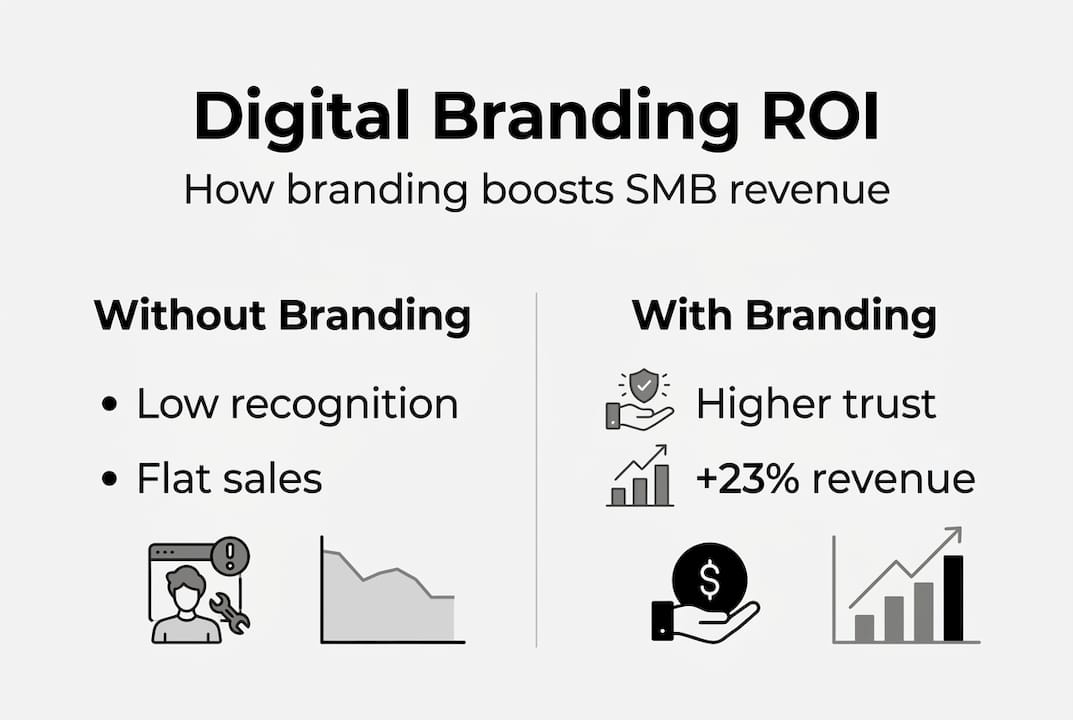
These numbers reflect real-world outcomes from SMBs that committed to strategic digital branding. The timeline to see results varies, but most businesses notice measurable improvements within 90 to 180 days of consistent implementation. Early wins often show up in recognition metrics and organic search traffic before converting to revenue increases.
Understanding digital branding’s role in sales growth helps SMB owners justify the upfront investment required to build strong positioning. Unlike paid advertising that stops working the moment you stop paying, branding creates compounding returns. Each month of consistent execution builds on previous months, creating momentum that becomes increasingly difficult for competitors to overcome.
Practical digital branding strategies for North American SMBs
Theory matters less than execution, so let’s focus on specific tactics that work for resource-constrained SMBs operating in competitive North American markets. Hyperlocal strategies, consistent NAP data, and practical approaches deliver the highest return for businesses serving local or regional customers.
Your Google Business Profile is the single most important digital branding asset for local SMBs. Claim it, complete every section, add high-quality photos, and update it monthly with posts about offers, events, or news. This free platform appears in local search results and Google Maps, putting your brand directly in front of customers searching for your services. Consistent posting signals active business operation and improves ranking.
NAP consistency (Name, Address, Phone) across every online listing is non-negotiable. Search engines use this data to verify your business legitimacy and determine local search rankings. Even small discrepancies like “St” versus “Street” or different phone formats create confusion that hurts visibility. Audit every directory, social profile, and citation to ensure perfect consistency.
Geo-targeted advertising allows SMBs to compete effectively against larger competitors by focusing budgets on specific ZIP codes or radius targeting around your location. A $500 monthly ad budget spread across an entire metro area gets lost. That same $500 concentrated on neighborhoods within 5 miles of your business generates meaningful visibility and traffic.
Top 5 digital branding tactics for North American SMBs:
- Claim and optimize your Google Business Profile with complete information, regular posts, and customer review responses
- Maintain NAP consistency across all directories, social media, and your website to boost local SEO
- Create location-specific content that addresses neighborhood needs and includes local keywords
- Engage authentically on social media by responding to comments, sharing customer stories, and participating in local conversations
- Build a review generation system that makes it easy for happy customers to leave feedback on Google, Yelp, and Facebook
The key is focusing resources on channels where your customers actually spend time. A B2B service company might prioritize LinkedIn and email while a consumer retail shop focuses on Instagram and Facebook. Don’t spread yourself thin trying to maintain presence everywhere. Master two or three platforms that matter most to your audience.
Pro Tip: Integrate customer feedback directly into your branding strategy by monitoring reviews and social mentions for recurring themes. If customers consistently praise your speed, make that a core brand message. If they mention friendly service, highlight your team in your branding. Let real customer language shape how you talk about yourself.
Practical implementation means creating simple systems that don’t require constant attention. Schedule social media posts in batches. Set up Google Alerts for brand mentions. Use templates for responding to reviews. Build checklists for maintaining consistency. The SMBs that succeed with digital branding treat it as an operational discipline, not a creative project that happens when inspiration strikes.
For businesses targeting local audiences effectively, the combination of strong branding and hyperlocal tactics creates competitive moats that are difficult to breach. When you own mindshare in your immediate market, larger competitors struggle to displace you even with bigger budgets. Your marketing to local customers becomes more efficient as recognition grows and word-of-mouth referrals multiply.
How iBrand Media can help small businesses master digital branding
Building effective digital branding requires both strategic clarity and consistent execution across multiple channels. That’s where specialized guidance makes the difference between scattered efforts and cohesive growth. iBrand Media helps SMBs translate branding fundamentals into practical systems that drive measurable results.
Our approach starts with optimizing websites for search to ensure your digital foundation supports both branding and conversion goals. We help you implement SEO strategies for 2026 that boost local visibility while maintaining brand consistency across every page and touchpoint.
Social media management becomes manageable when you understand the fundamentals. Our social media management basics guide shows you how to maintain authentic engagement without overwhelming your schedule. We focus on sustainable systems that integrate branding into your daily operations rather than treating it as a separate project that competes for attention.
FAQ
What is the difference between digital branding and digital marketing?
Digital branding builds long-term recognition, trust, and emotional connections with your audience across online platforms. Digital marketing encompasses the tactical campaigns and activities that drive immediate actions like clicks, leads, and sales. Both are essential, but branding creates the foundation that makes all your marketing more effective. Strong branding amplifies marketing ROI by reducing the persuasion required for each conversion.
How can SMBs measure the success of their digital branding efforts?
Track metrics like brand awareness (search volume for your business name), customer recognition rates, cost per acquisition, customer lifetime value, and revenue attribution to branded channels. Use Google Analytics to monitor direct and organic traffic growth, which indicates increasing brand awareness. Survey customers about how they heard about you to quantify word-of-mouth impact. Digital marketing tracking tools provide the data you need to calculate branding ROI and adjust strategy based on what’s working.
What are the most effective digital branding tactics for small local businesses?
Hyperlocal marketing delivers the highest ROI for local SMBs. Optimize your Google Business Profile completely, maintain consistent NAP data across all directories, create location-specific content, and run geo-targeted ad campaigns focused on your immediate service area. Engage actively with customer reviews and local social media conversations. Targeting local audiences effectively requires focusing resources on the channels and tactics that reach customers in your specific market. Build systems for marketing to local customers online that emphasize consistency and authentic community engagement over trying to compete nationally.
How long does it take to see results from digital branding investments?
Most SMBs notice measurable improvements in recognition and organic traffic within 90 to 180 days of consistent branding execution. Revenue impact typically follows 30 to 60 days after awareness metrics improve. The key is maintaining consistency across all channels rather than expecting immediate returns. Digital branding creates compounding value, meaning results accelerate over time as recognition builds and word-of-mouth referrals multiply.
Recommended
- Digital branding drives 23% sales growth for SMBs in 2026 | Ibrandmedia
- Role of Branding in Digital Marketing: 23% Revenue Boost | Ibrandmedia
- Why choose digital ads in 2026: A smart guide for SMBs | Ibrandmedia
- Performance Marketing Team | Multi‑Channel Paid Ads
Recent Comments