
TL;DR:
- Many marketers confuse social listening with monitoring, but true listening analyzes patterns and sentiment to inform decisions.
- A proactive, structured approach involves clear objectives, targeted sources, disciplined queries, and ongoing monitoring to gain a genuine competitive edge.
Most marketers think they’re doing social listening when they check their brand mentions each morning. They’re not. What is social listening, really? It’s the practice of tracking online conversations, then analyzing them to extract patterns, sentiment, and strategic intelligence that inform real business decisions. 62% of marketers rank it as their second-highest social media priority, yet most teams use it at a fraction of its potential. This guide cuts through the confusion and shows you how to turn conversation data into a genuine competitive edge.
Table of Contents
- Key Takeaways
- What social listening actually means
- Core benefits of social listening
- How to build a social listening strategy
- Choosing and using social listening tools
- Real-world use cases worth knowing
- My honest take on social listening’s real value
- How Ibrand helps you listen smarter
- FAQ
Key Takeaways
| Point | Details |
|---|---|
| Listening beats monitoring | Social listening uncovers the “why” behind conversations, while monitoring only tracks mentions. |
| Crisis signals arrive early | Reputational threats often emerge in niche communities before going mainstream, requiring dedicated detection. |
| Strategy before tools | Clear objectives and team accountability matter more than picking the most expensive platform. |
| Layered tools work best | Combining a capture tool with a dedicated analysis platform improves insight quality significantly. |
| Proactive listening builds loyalty | Brands that move beyond reactive responses create stronger customer relationships and long-term trust. |
What social listening actually means
People conflate social listening with social media monitoring, and the confusion costs them. Monitoring is reactive. You track mentions, flag negative comments, and respond. It answers: who said what, where, and when. Useful, but limited.
Social listening goes further. It analyzes data to uncover patterns, sentiment, and trends that monitoring alone never surfaces. The goal is to understand the “why” behind the conversation, not just log that it happened. Why are customers frustrated? Why is a competitor suddenly gaining traction? Why did a campaign land differently in one region versus another?
The scope also expands beyond your social media feeds. Real social listening pulls from:
- Twitter/X, Instagram, LinkedIn, Facebook, and TikTok
- Reddit threads and niche online forums
- Review platforms like Google Reviews and Yelp
- Blogs, news sites, and podcasts
- YouTube comments and industry communities
This wider net is what separates shallow brand tracking from genuine market intelligence. When you analyze social conversations across all these surfaces, you stop reacting to the loudest voices and start responding to the full picture.
Core benefits of social listening
The importance of social listening becomes obvious the moment you see how it changes decision-making across a business. Here’s where teams feel it most:
- Customer engagement and loyalty. When you understand what your audience actually cares about, not what you assume they care about, your messaging resonates. Brands that shift from monitoring to proactive listening improve customer loyalty measurably because they respond to real needs, not perceived ones.
- Crisis detection before it explodes. Reputational crises escalate within 24 hours of the first social signals in 68% of cases. Proactive listening catches those early whispers before they become screams.
- Competitor intelligence. You learn what customers love and hate about competitors directly from the source. No surveys, no guesswork.
- Product and content development. Customer language reveals unmet needs. The exact phrases people use when complaining become your next product feature brief or content brief.
- Trend identification. Social conversations surface emerging trends weeks before they appear in industry reports.
Pro Tip: Set up a dedicated listening stream for your three closest competitors. You’ll often spot market gaps and dissatisfied customers before their own marketing teams do.
The impact of social listening compounds over time. Each insight feeds the next, and teams that build this feedback loop into their workflow consistently outperform those that treat it as a quarterly check-in.

How to build a social listening strategy
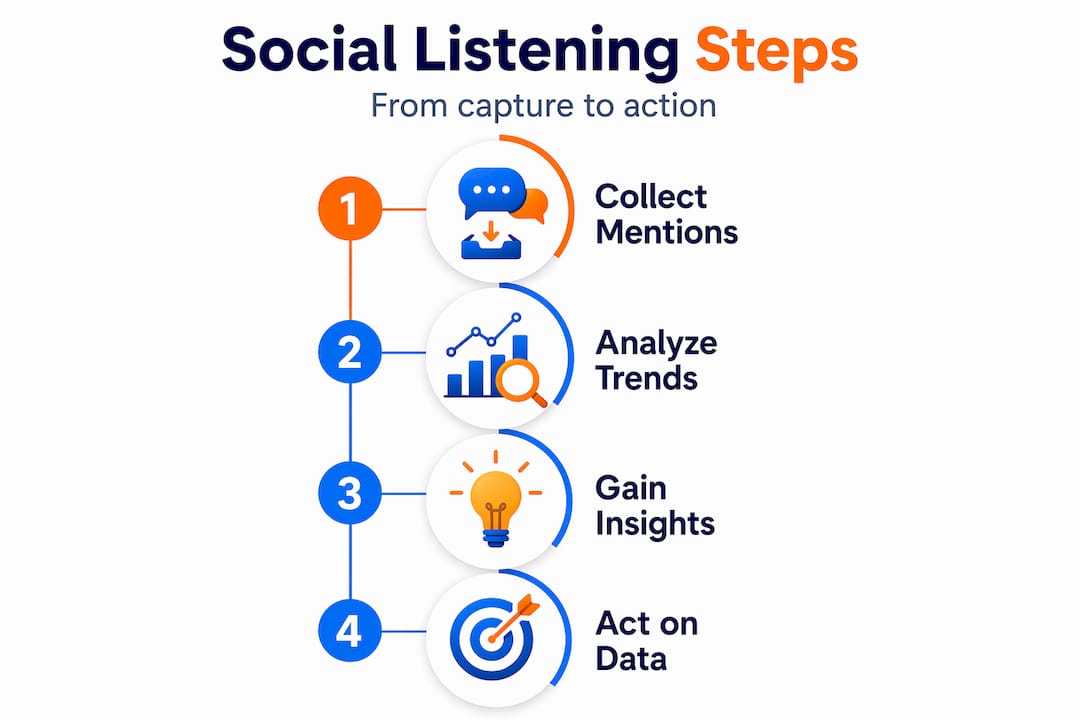
Knowing what social listening is matters far less than knowing how to do social listening effectively. Missing any key component of a structured program leads to either missed signals or complete data overload. Here is a practical six-step approach:
-
Define clear objectives. Tie your listening goals directly to business outcomes. Are you tracking brand health? Monitoring a product launch? Watching for competitive threats? Vague goals produce vague insights.
-
Select your sources. Not every platform is relevant to every brand. A B2B software company needs LinkedIn and Reddit. A restaurant needs Yelp, Google Reviews, and Instagram. Choose sources based on where your actual customers and prospects spend time.
-
Build disciplined search queries. Include your brand name, product names, key executives, and relevant industry terms. Critically, add exclusions to filter out noise. A brand called “Pulse” needs to exclude “pulse rate” and “pulse oximeter” from general searches or the data becomes useless.
-
Set alert thresholds. Not every mention needs human review. Configure alerts to escalate high-priority signals: sudden spikes in negative sentiment, mentions from high-reach accounts, or specific keywords tied to crisis scenarios.
-
Assign team accountability. Without team accountability, social listening programs drown in noise and miss key signals. Designate who owns monitoring, who owns analysis, and who owns response decisions.
-
Commit to continuous monitoring. Checking your dashboard once a week is not social listening. It’s archaeology. Real listening requires ongoing, near-real-time visibility, especially for brands in fast-moving or regulated industries.
Pro Tip: Review and refine your search queries monthly. Consumer language shifts constantly, and queries that captured everything six months ago may miss significant conversations today.
Choosing and using social listening tools
The tool landscape for social listening tools breaks into two distinct layers, and understanding this distinction prevents a common and expensive mistake.
Effective social listening uses lightweight capture tools for data collection combined with specialized analysis platforms for context and meaning. Trying to do both with a single tool often means doing neither particularly well.
| Tool type | Primary function | Best for | Limitation |
|---|---|---|---|
| Capture tools | Scraping mentions across platforms | Real-time brand tracking | Minimal analysis capability |
| Analysis platforms | Sentiment, trend, and pattern analysis | Strategic insight generation | Require clean data input |
| All-in-one suites | Both capture and analysis | Small to mid-size teams | Can lack depth in analysis |
| Native platform tools | In-platform listening (e.g., Meta insights) | Channel-specific monitoring | Limited cross-platform view |
Popular options across these categories include Brandwatch, Sprout Social, Mention, and Talkwalker for capture and analysis, while tools like Google Alerts serve basic capture needs at zero cost for budget-conscious small businesses.
The real question is not which tool is best in the abstract. It is which combination fits your team’s workflow. A solo marketing manager needs a different setup than a PR team at a 500-person company. Start with your objectives from step one, then match the tooling to those goals. Do not let a vendor’s feature list drive your strategy.
Real-world use cases worth knowing
The gap between basic social listening and advanced social listening is clearest in how leading brands actually apply it. A few scenarios illustrate where real value gets created.
Crisis detection through niche monitoring
Early crisis signals often appear in niche communities with low volume but high velocity. A single Reddit thread with 50 comments, all expressing the same product frustration, can predict a wave of mainstream criticism within 72 hours. Brands that set up separate crisis detection streams for these low-volume, high-velocity signals catch problems while they are still manageable.
| Use case | Signal type | Response window |
|---|---|---|
| Product defect detection | Niche forum complaint spikes | 24 to 48 hours |
| PR crisis early warning | Journalist and blogger mentions | 12 to 24 hours |
| Competitor vulnerability | Customer complaint surge | 48 to 72 hours |
| Campaign sentiment tracking | Real-time ad reaction | Hours |
Multi-team intelligence sharing
The proactive intelligence model treats social listening as shared infrastructure across marketing, PR, product, and customer experience teams. Marketing uses it for campaign feedback. Product uses it to prioritize features. PR uses it to monitor reputation risk. CX uses it to identify recurring service pain points. Each team gets filtered, relevant data rather than a single overwhelming feed everyone ignores.
Response time as brand reputation
Customers now expect responses within an hour, many within minutes, even on weekends and holidays. Social listening tools with alert systems let your team meet those expectations without 24/7 manual monitoring. Speed of response has become a brand signal in itself.
My honest take on social listening’s real value
I’ve watched dozens of marketing teams invest in social listening tools and then under-use them because they treat the dashboard as a destination. They log in, scroll through mentions, feel informed, and close the tab. That is not listening. That is a very expensive notification system.
What I’ve learned is that the teams getting genuine value from social listening have made it an operational habit, not a reporting task. They act on what they hear. They share signals across departments. They use customer language directly in ads and content. When I’ve seen brands do this well, the results show up in two places: sharper, faster messaging and a noticeably stronger ability to spot and contain reputational issues early.
The mindset shift is the hard part. Tools are not the problem. Most platforms are capable enough. The real obstacle is moving from “we monitor our brand” to “we run a continuous listening program that informs decisions.” That requires leadership buy-in, clear ownership, and a willingness to act on uncomfortable truths that occasionally surface in the data.
If you are just starting out, do not buy the most expensive tool. Define what you want to learn, set up three to five focused queries, assign one person to review and synthesize weekly, and build from there. Protecting your reputation through consistent, disciplined listening is a compounding advantage. Build the habit first.
— TONY
How Ibrand helps you listen smarter
Social listening insights only create value when your broader digital strategy is built to act on them. At Ibrand, we work with small and mid-size businesses to turn what customers say online into campaigns, content, and search strategies that actually perform. Whether you need help managing social media or want to translate listening data into better search rankings, our team builds plans around your specific goals. We also put together a practical guide to optimizing your website using the exact signals that social listening surfaces. Start with what your audience is already telling you.
FAQ
What is social listening in marketing?
Social listening is the practice of tracking online conversations about your brand, competitors, and industry, then analyzing that data to extract strategic insights. It goes beyond monitoring mentions by focusing on sentiment, patterns, and trends that inform marketing decisions.
How is social listening different from social media monitoring?
Social media monitoring tracks specific mentions and alerts you to activity in real time. Social listening analyzes the broader meaning behind those conversations to guide strategy, making it proactive rather than reactive.
What are the main benefits of social listening?
The core benefits include early crisis detection, deeper customer engagement, competitor intelligence, and improved product development. Brands that practice it consistently build stronger customer loyalty than those relying on reactive monitoring alone.
How do I get started with social listening?
Start by defining a specific business objective, select the platforms where your customers are active, build focused search queries with relevant exclusions, and assign someone to review and act on the data weekly. Tools matter less than discipline and clear goals.
What tools are used for social listening?
Popular social listening tools include Brandwatch, Sprout Social, Mention, and Talkwalker. For small businesses, combining a free capture tool like Google Alerts with a lightweight analysis platform often provides sufficient coverage at manageable cost.
Recent Comments